
Furnace Maintenance Checklist: Homeowner DIY Guide
Key Takeaways
- Do the homeowner tasks before the first hard cold snap, not on a fixed calendar date.
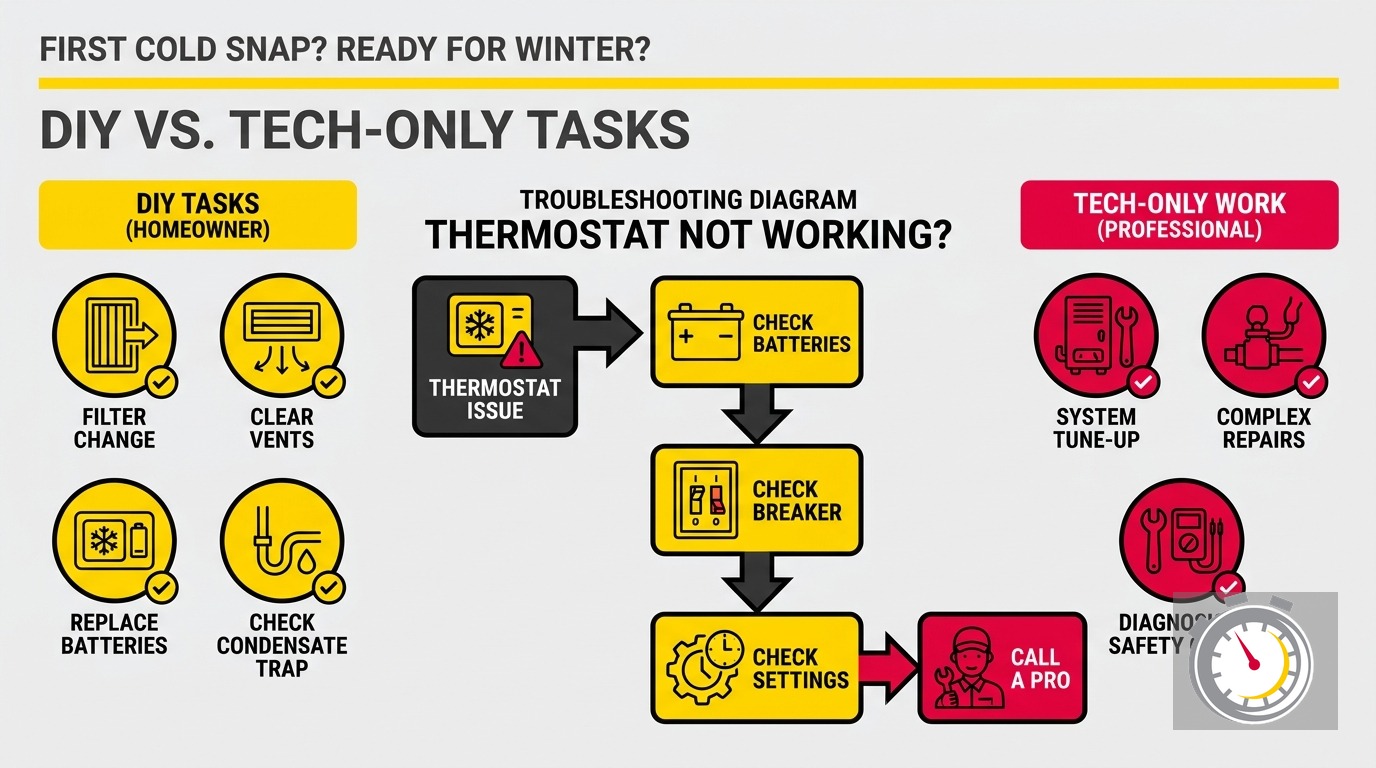
- Homeowner jobs: filter, registers and vents, clearance, thermostat batteries, a look at the condensate trap, outdoor vent check, and CO alarm test.
- Technician jobs: burners, flame sensor, heat exchanger, gas pressure, wiring, and combustion testing.
- Look, don’t dismantle. If you find rust, water, soot, or a strange flame, stop and call.
- ENERGY STAR recommends a yearly tune-up for your heating and cooling system.
- Minnesota law requires a CO alarm within ten feet of each sleeping room.
How do you maintain a furnace before the first cold snap?
You maintain a furnace in two layers. First, you handle simple homeowner tasks: the filter, vents, clearance, thermostat batteries, the condensate trap, and your CO alarms. Second, you book a licensed technician for the gas, electrical, and combustion work that is unsafe to attempt yourself.
That split is the whole checklist. Most furnace trouble in the Twin Cities starts with a first-layer task nobody did. Most serious danger lives in the second layer.
We are Northern One Hour, a locally owned and operated heating and air conditioning company in Ramsey. We see the same pattern every year. A furnace sits idle all summer. Then the first cold snap arrives, and it runs hard for the first time in months.
Why the first cold snap is your deadline
Most checklists say “do this in the fall.” That is vague. In the Twin Cities, fall can feel mild one week and bitter the next.
A better trigger is the first night your furnace has to run for hours. That is when weak spots show up. A dirty filter starves the system of air. A clogged drain trips a safety switch. A dead thermostat battery means no call for heat.
Here is the plan we suggest:
- Before the cold snap: Do the homeowner checklist below. It takes about an hour.
- On the first cold snap: Watch and listen. Note any new smell, noise, or short run time.
- Within a few weeks: Book a professional tune-up if you have not had one this year.
You cannot predict the weather, so do the DIY list early. Treat the first sub-freezing forecast as your last call.
If you smell something odd when the furnace first kicks on, that is often burned-off dust. We cover that in our guide to a burning smell on first furnace use in fall. A smell that does not fade is different. Call us.
Can I clean my HVAC myself?
You can clean some parts yourself. Safe jobs include replacing the filter, vacuuming registers, clearing the area around the furnace, and wiping dust from accessible surfaces. Do not open sealed panels, clean burners, or touch gas or electrical parts. Those jobs need training and tools.
The tasks below are fair game. Each one is a look-and-wipe job, not a repair.
1. Check and replace the furnace filter
This is the most important homeowner task. ENERGY STAR advises checking your filter every month, especially in heavy use months like winter and summer. It says to replace the filter if it looks dirty after a month. It also sets a minimum: change it at least every 3 months, even if it looks clean.
Here is how to do it:
- Turn the thermostat to “off.” You can also flip the furnace switch.
- Slide out the old filter. Note the size printed on the frame.
- Check the airflow arrow on the new filter. It should point toward the furnace.
- Slide the new filter in. Close the door fully.
- Write the date on the frame with a marker.
The U.S. Department of Energy gives similar advice. Its home heating and cooling guide says to clean or replace furnace filters monthly or as recommended. It also says to check the owner’s manual for upkeep details.
A few related guides can help:
- How often to change your HVAC filter in Minnesota
- Which way the filter arrow should point
- How to pick a MERV rating for a Minnesota home
Skip the thickest, densest filter on the shelf. A filter that is too restrictive can choke airflow. If your furnace cycles oddly after a filter change, see our post on high-MERV filters and airflow.
2. Open and clear your registers and vents
Walk through the house. Check every supply register and return grille. Move any furniture, rugs, and curtains that block them.
Then vacuum each opening with a brush attachment. Dust and pet hair collect here all summer. A blocked return can starve the furnace of air just like a dirty filter.
Keep these points in mind:
- Leave registers open. Closing vents in unused rooms does not save energy. It can raise pressure in the ductwork. We explain why in our post on the myth of closing vents.
- Check bedroom doors. A shut door can cut off return air. See closed bedroom doors and airflow.
- Do not pull off duct sections or reach deep into the trunk lines.
3. Clear the space around the furnace
Many Twin Cities furnaces live in basements and utility rooms. Those rooms turn into storage. Boxes, paint cans, and holiday decorations creep toward the furnace.
Keep about three feet of open space around the unit. That gives the furnace room to breathe and gives a technician room to work. Never store anything flammable nearby. That includes paint, gasoline, aerosol cans, and cleaning chemicals.
Also check that the furnace room has air. A tightly closed closet can starve a furnace of combustion air. Our guide on furnace clearance and storage in utility rooms covers this in detail.
4. Replace thermostat batteries and test the schedule
A dead thermostat is a common reason for a “no heat” call. Many models run on AA or AAA batteries. Swap them at the start of heating season even if the display still works.
Then test the system:
- Set the thermostat to “heat.”
- Raise the setpoint five degrees above room temperature.
- Listen for the furnace to start within a few minutes.
- Confirm warm air comes from the registers.
While you are there, check that the day and time are right. If the screen is blank after new batteries, see our thermostat troubleshooting guide. Some smart models need a C-wire for power. Our post on C-wire compatibility explains that.
Wiring work is not a homeowner job. If the thermostat still will not talk to the furnace, call a pro.
5. Look at the condensate trap and drain (look, don’t dismantle)
Most checklists skip this step. It matters in the Twin Cities because many homes have high-efficiency condensing furnaces. They pull so much heat from the exhaust that the exhaust turns to water. That water leaves through a small drain line.
Many of these furnaces have a trap or a drain hose, and some have a small pump. If that path clogs or freezes, a safety switch can shut the furnace down. We offer this as general practice, not as a cited statistic.
Here is what a homeowner can safely do:
- Look at the drain line. Check that it is not kinked, crushed, or sagging.
- Look at the floor drain or pump discharge. Water should flow away freely.
- Look for a puddle under the furnace.
- Check that any unheated section of the drain line is not exposed to freezing air.
- Listen for gurgling when the furnace runs. That can signal a partial blockage.
Here is what to leave alone:
- Do not disconnect the trap or pull apart PVC fittings.
- Do not pour chemicals down the line.
- Do not remove the pressure switch tubing.
Cutting into the system can cause leaks or leave a furnace unsafe. If you see standing water, slime, or a frozen line, call us. Our guides on a frozen condensate drain, water around the furnace, and condensate pump failure show what to expect.
If your furnace has a neutralizer cartridge, ask your technician to check it at tune-up. We cover this in our post on condensate neutralizers.
6. Check the outdoor vent and intake pipes
High-efficiency furnaces vent through plastic pipes that exit through a wall or the roof. Walk outside and look at them.
Check for these problems:
- Snow drifts or leaves piled against the pipe ends
- Bird nests or other debris in the openings
- Ice or frost building up around the terminations
- Loose, sagging, or cracked pipe sections
Clear snow and debris gently with your hand or a broom. Do not poke tools into the pipe. Do not cap or cover the openings. A blocked vent can shut the furnace down for safety.
Cold air can freeze moisture around a vent. We saw this in many homes during sub-zero stretches. Our posts on frost buildup at sidewall vents and vents blocked by snow or ice explain what is normal and what is not.
7. Test your carbon monoxide alarms
Your furnace burns fuel, so CO alarms belong on your furnace checklist.
Minnesota law sets a baseline. Under Minnesota Statute 299F.51, a CO alarm must be installed within ten feet of each room lawfully used for sleeping. This applies to every single-family dwelling and every dwelling unit in a multifamily building. In multifamily units, occupants must maintain the alarms.
Here is our suggestion, not a legal requirement: test your alarms every time you change the filter. It takes ten seconds. Press the test button and listen for the horn.
The Minnesota Department of Health also advises that alarms near bedrooms and furnaces be checked yearly. Look for the date on the back of the unit. Replace any alarm that is past its labeled life or chirps for a fault.
For placement ideas, see our guide to CO detector placement near furnaces and boilers. Also read our furnace season CO safety post.
What should you do when you find a problem?
If you find a problem during your checks, stop the task and call a technician. Do not try to fix gas, flame, wiring, or heat exchanger issues. Turn off the furnace if you see water, smell gas, or suspect CO. A quick call costs far less than a safety incident.
The table below draws a hard line between “look” and “touch.” It tells you what to do when you see something.
| What you see | What it may mean | What you do |
|---|---|---|
| Dirty, clogged filter | Restricted airflow | Replace the filter |
| Puddle under furnace | Clogged drain or leak | Turn off furnace, call us |
| Frozen or sagging drain line | Condensate blockage | Call us |
| Rust stains or flaking on flue pipe | Moisture or corrosion | Call us |
| Soot or black marks near the furnace | Incomplete combustion | Turn off furnace, call us |
| Yellow or flickering flame | Combustion problem | Call us |
| CO alarm sounds | Possible CO leak | Leave the home, call 911 |
| Rotten egg or gas smell | Gas leak | Leave, call from outside |
| Tripped breaker that trips again | Electrical fault | Do not reset again, call us |
| Furnace blinks a code | Lockout or fault | Note the code, call us |
Some of these deserve more detail. If you smell gas, leave right away and read our guide on what to do after a gas smell. If a CO alarm sounds, our post on CO alarms going off explains the next steps. For rust on the vent, see flue pipe rust and corrosion signs.
Flame color is a common question. A healthy furnace flame is steady and blue. A lazy yellow flame can signal a problem. Our guide to yellow versus blue furnace flames shows the difference. Never open the burner area to check. If you can see the flame through a small viewing window, look only. Then call if it looks off.
Who performs preventive furnace maintenance?
A licensed HVAC technician does it. That person cleans and tests the parts you cannot reach, measures combustion, and checks safety controls. You handle the simple upkeep, like filters and vents. A pro handles gas, electrical, and heat exchanger work once a year.
This matches public guidance. The Minnesota Department of Health advises that a qualified heating contractor check your furnace once a year. ENERGY STAR also recommends a yearly tune-up, which it says can improve efficiency and comfort. It does not give a percentage for savings, so we will not either.
A good tune-up is more than a quick glance. Ask your contractor what the visit includes. Our posts on what a furnace tune-up costs and covers and our furnace tune-up service page spell it out.
Not sure whether a plan is worth it? Read our take on whether an HVAC maintenance plan is worth it.
Here is how we handle your visit:
- We schedule inside a time window you choose.
- We arrive within that window.
- We explain what we find in plain language.
- We show you any problem before we recommend work.
We stand behind that with our promise: “Always On Time… Or You Don’t Pay a Dime!(R)” In plain terms, we arrive within the window you select. If the technician does not show up on time, you do not pay for the service.
What work is tech-only?
Technician-only work includes anything that involves gas, high voltage, sealed components, or combustion testing. That covers burner cleaning, flame sensor service, heat exchanger inspection, gas pressure checks, blower and motor service, control board work, and combustion analysis. These tasks need training, tools, and safety knowledge.
Here is why each one stays off your list.
Burner cleaning and inspection
Burners sit in a sealed compartment. Dust or rust there can disturb the flame. Cleaning them means removing panels and handling gas components. That is a professional task.
Flame sensor service
The flame sensor tells the furnace the burner is lit. When it gets dirty, the furnace may start and shut off after a few seconds. Technicians clean it with care. See our guide to a dirty flame sensor and what it costs.
Heat exchanger inspection
The heat exchanger keeps combustion gases separate from your home’s air. A crack can let those gases mix with household air. That is why a trained eye matters.
The U.S. Department of Energy’s combustion safety brief makes a related point. It says that if the unit is more than 10 years old, replace the entire unit instead of just the cracked heat exchanger. Learn the warning signs in our post on cracked heat exchanger signs. Our cost comparison of heat exchanger replacement versus a new furnace can help you decide.
Gas pressure and combustion analysis
A technician uses a gauge and an analyzer to confirm the furnace burns fuel safely. You cannot do this by eye. Read what the test measures in gas furnace combustion analysis.
Electrical and control work
Igniters, capacitors, inducer motors, control boards, and limit switches all carry voltage. Leave them alone. If your furnace hums but will not start, see our humming furnace guide. Then call us.
A simple rule applies. If the task needs a screwdriver, a meter, or a gas line, it is not on your list.
Can neglecting furnace maintenance lead to health hazards?
Yes. A neglected furnace can raise health risks in two ways. First, a cracked heat exchanger or blocked vent can let carbon monoxide into your home. Second, dirty filters and ducts can circulate dust and allergens. Regular checks, working CO alarms, and a yearly professional tune-up reduce these risks.
Carbon monoxide is the serious one. It has no smell or color. Symptoms can feel like the flu: headache, dizziness, nausea, and tiredness. If several people in the house feel sick at once, or feel better when they leave, act fast. Get everyone outside and call 911.
Other risks build more slowly:
- Dust and allergens. A clogged filter lets particles pass into your air and onto the blower.
- Moisture and mold. Drain problems can leave standing water near the furnace. That can cause a musty smell. See why furnaces smell musty.
- Backdrafting. Exhaust fans, fireplaces, and tight homes can pull exhaust back into living space. Read about exhaust fans and furnace backdraft.
- Attached garages. Fumes can travel into the house. Our post on attached garage CO risk covers this.
Neglect also costs money. A furnace starved of air works harder and wears out parts sooner. We walk through the long-term effects in what happens when you skip HVAC maintenance for years.
How does a Minnesota winter change the checklist?
Minnesota winters add cold-weather checks that national guides skip. Sub-zero nights stress condensate drains, outdoor vent pipes, and gas supply. Homes also close up tight, which affects air quality and combustion air. Plan for these local factors when you check your furnace each year.
A few Twin Cities realities to keep in mind:
- Freeze risk. Water in a condensate line can freeze where the line passes through a cold space. We treat this as a field observation, not a sourced figure. Check any drain line that runs through an unheated area.
- Vent terminations. Frost and snow can build up fast. Clear them after storms.
- Tight homes. Sealed houses can have less fresh air. Our post on stale winter air and ventilation explains this.
- Dry air. Winter air dries out skin and wood. See whole-home humidifiers for winter dry air.
- Power outages. A storm can knock out electric to your furnace, even a gas one. Read what to do in a power outage.
Know where your gas shutoff is, too. Our guide shows how to find and use the furnace gas shutoff.
For a deeper seasonal plan, use our fall HVAC shutdown and startup checklist. It covers both heating and cooling equipment. Our guide to preventing winter breakdowns goes further.
What if the furnace still fails during the first cold snap?
Run through a quick triage first. Many no-heat calls come from simple causes.
- Confirm the thermostat is set to “heat” and the setpoint is above room temperature.
- Check the thermostat batteries.
- Check that the furnace switch is on. It often looks like a light switch.
- Check your breaker panel for a tripped breaker. Reset it once only.
- Check the filter. A clogged one can trip a limit switch.
- Look at the condensate drain and the outdoor vents.
If the furnace still will not run, stop there. Do not bypass switches. Do not relight pilot assemblies unless your owner’s manual clearly shows you how, and never force it.
Our guides on a furnace that will not turn on and what to do when the furnace is out tonight walk through the next steps. If the furnace is flashing a code, see our blinking light and error code guide.
Cold mornings add their own trouble. Read about furnaces that will not ignite on a cold morning. For ongoing heating problems, our furnace repair service page shows how we help.
When is maintenance not enough?
Maintenance extends a furnace’s life, but it cannot fix an old, failing unit. If your furnace is past its prime, repairs can pile up. A technician may find a cracked heat exchanger or a failing control board. At that point, replacement may make more sense.
Signs your furnace may be near the end:
- Repairs happen every season.
- Heating bills creep up without a rate change.
- Some rooms stay cold while others overheat.
- The furnace is loud, short cycles, or runs nonstop.
- A technician flagged a safety problem like a cracked heat exchanger.
Our guide on how long furnaces last in Minnesota gives a general timeline. To learn your furnace’s age, see how to find your HVAC system’s manufacture date. When you are ready to compare options, read is it time for a new furnace.
If you replace, look at efficiency, sizing, and incentives. Our post on federal tax credits for high-efficiency equipment explains what many homeowners missed. If a failure forces your hand, see whether homeowners insurance covers furnace replacement. Our furnace replacement service page outlines how we handle installs.
Utility rebates can change over time. Check the current offer with your gas or electric provider before you buy. Our Xcel and CenterPoint rebate guide is a good place to start. We do not quote rebate amounts here because they change.
A new furnace is a big purchase. We offer financing options, and we can walk you through them. No pressure. We will tell you honestly whether repair or replacement fits your home.
Your first cold snap checklist at a glance
Print this list or save it on your phone. Use it each year.
Homeowner tasks (about one hour):
- Replace or inspect the filter. Write the date on it.
- Vacuum registers and return grilles. Open every vent.
- Clear three feet around the furnace. Remove anything flammable.
- Replace thermostat batteries. Test the heat call.
- Look at the condensate drain, trap area, and any pump. Do not dismantle.
- Walk outside. Clear snow and debris from vent and intake pipes.
- Test every CO alarm. Replace expired units.
Technician tasks (once a year):
- Clean and inspect burners.
- Test and clean the flame sensor.
- Inspect the heat exchanger.
- Check gas pressure and run combustion analysis.
- Test safety switches and controls.
- Check electrical connections and the blower.
- Inspect the condensate system and vent.
Stop and call if you see:
- Water, rust, or soot around the furnace
- A yellow or flickering flame
- A repeated breaker trip
- A smell of gas, or a CO alarm
Book your furnace tune-up before the cold arrives
You can handle the first half of this checklist today. The second half belongs to a trained technician.
We are locally owned and operated, and we serve homeowners across the Twin Cities. That includes Minneapolis, St. Paul, Ramsey, Blaine, Maple Grove, Plymouth, Brooklyn Park, Woodbury, and Bloomington. When you book, you pick a time window. We arrive inside it, or you do not pay for the service.
Ready to schedule? Call us at (763) 260-6662 or book online. Pick a time that works for you. We will take it from there.
For more on keeping your system healthy all year, see our heating maintenance services and furnace repair options. If the checklist uncovers a problem, we are one call away.
Frequently Asked Questions
How often should I change my furnace filter in Minnesota? +
Is it safe to open my furnace panel and look inside? +
What should I do if my furnace shuts off during the first cold snap? +
Need a technician now?