
How Often to Change Air Filter: Minnesota's Real Answer
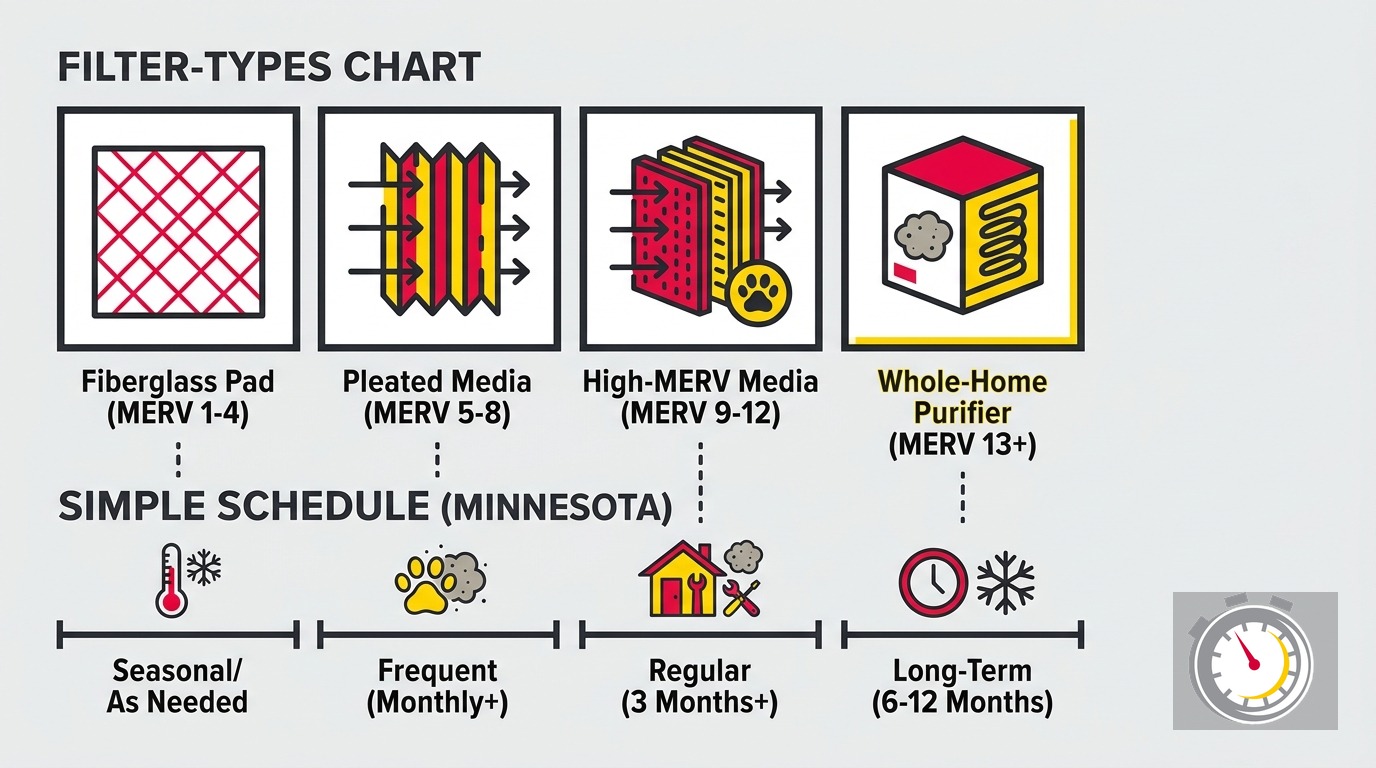
Key Takeaways
- Minnesota furnaces run 6 to 7 months per year - roughly twice as long as furnaces in most of the country. The national “90-day rule” is built for a different climate.
- Change a 1-inch MERV 8 filter every 4-6 weeks during the heating season (October through April).
- A 1-inch MERV 13 filter: every 6-8 weeks during the heating season.
- Four-inch media filters last 6-12 months even in Minnesota winters. Check them at the season start and again in January.
- One or more pets means checking your filter every 30 days, not 60-90.
- Renovation work (drywall sanding, demo, subfloor cutting) can clog a 1-inch filter in days. Replace it the day the project wraps.
- The EPA recommends MERV 13 as the floor for most homes. Most modern furnaces handle it without problems.
- Xcel Energy lists filter changes as a direct energy-saving measure for Minnesota customers. A clean filter lowers your bill.
- Questions about your system? Call Northern One Hour at (763) 260-6662 or book online. We are locally owned and operated in Ramsey, MN.
How Often Should You Change Your Air Filter in Minnesota?
Short answer: Change a standard 1-inch filter every 4-6 weeks during the heating season, which runs roughly October through April in the Twin Cities. That is more often than the 60-90 day national recommendation. Minnesota’s long winters and sealed-house conditions load filters faster than the averages that guideline is built on.
The right interval is not one number. It shifts based on your filter’s MERV rating, whether you have pets, and whether any construction or renovation work is happening in your home. A calendar-based schedule is the floor, not the ceiling. A quick monthly visual check tells you whether the filter has loaded faster than expected. Pull it out and hold it up to a light. If it looks gray and you cannot see light through it easily, replace it regardless of what the calendar says. That check takes two minutes and requires no tools.
Why Doesn’t the “90-Day Rule” Work Here?
Short answer: The 90-day rule is calculated for an average U.S. climate where furnaces run 2-3 months per year. Minneapolis runs its furnace for 6-7 months. More run-hours means more air passes through the filter and more particles load into it each week. The math simply does not transfer to our climate.
The Twin Cities sit in IECC Climate Zone 6A, one of the coldest residential climate zones in the country. Minneapolis logs roughly 7,000 to 8,500 heating degree days per year. The 99% heating design temperature is around -16°F. That combination means your furnace is not running occasionally through the cold months. It runs nearly every day from late October through mid-April.
Compare that to a home in a warmer state. Their furnace might run October through December and then idle through winter and spring. That filter accumulates 90 days of relatively light use. Your filter accumulates 90 days of heavy, near-continuous use in about six to seven weeks.
A second factor makes the calendar problem worse: the sealed-house effect. From October through April, Minnesota homes run with windows completely shut. Every particle in your home - pet dander, cooking smoke, skin cells, dust mites, and renovation debris - recirculates through the same filter with no fresh outdoor air to dilute the load. A home in a milder climate that can open windows for several months gets natural particle dilution. Your home does not get that break for six months straight.
Put those two conditions together and a Twin Cities homeowner’s filter does twice the work in the same calendar period as a filter in a typical U.S. home. Cutting the national change interval in half is not overcautious. It is the appropriate correction for the climate you actually live in.
What Is a MERV Rating, and Does It Change How Often You Replace the Filter?
Short answer: MERV (Minimum Efficiency Reporting Value) is an ASHRAE standard that measures how effectively a filter traps airborne particles. Higher numbers mean smaller particles get caught. A MERV 13 filter traps more per pass than a MERV 8, but it also restricts airflow faster as it loads, so it needs to be replaced on a tighter schedule.
MERV is the industry-standard rating. FPR (Filter Performance Rating) is a proprietary scale used by Home Depot. MPR (Microparticle Performance Rating) is 3M’s system. The three do not convert to each other neatly, so always look for the MERV number when comparing filters.
The EPA recommends at least MERV 13 for most homes, or as high as your system fan and filter slot can accommodate. Many homes are installed with MERV 8 filters from the builder. That rating captures larger particles - dust, pollen, mold spores - but lets smaller particles like pet dander and fine smoke particles pass through into the air you breathe.
A MERV 13 filter is rated to demonstrate at least 50% removal efficiency for the smallest particles in its test range, including PM2.5-range contaminants. The EPA notes that most furnaces and HVAC systems can handle a MERV 13 without equipment problems, provided the filter is replaced frequently. That phrase - “provided it is replaced frequently” - matters. A MERV 13 filter left too long becomes a partial blockage. The finer media loads faster because it is doing more work per cubic foot of air that passes through it.
If you want to go deeper on how air filtration compares to whole-home air purification, our guide to air purifiers versus filters and MERV ratings covers the tradeoffs in detail.
Your Minnesota Filter Change Schedule
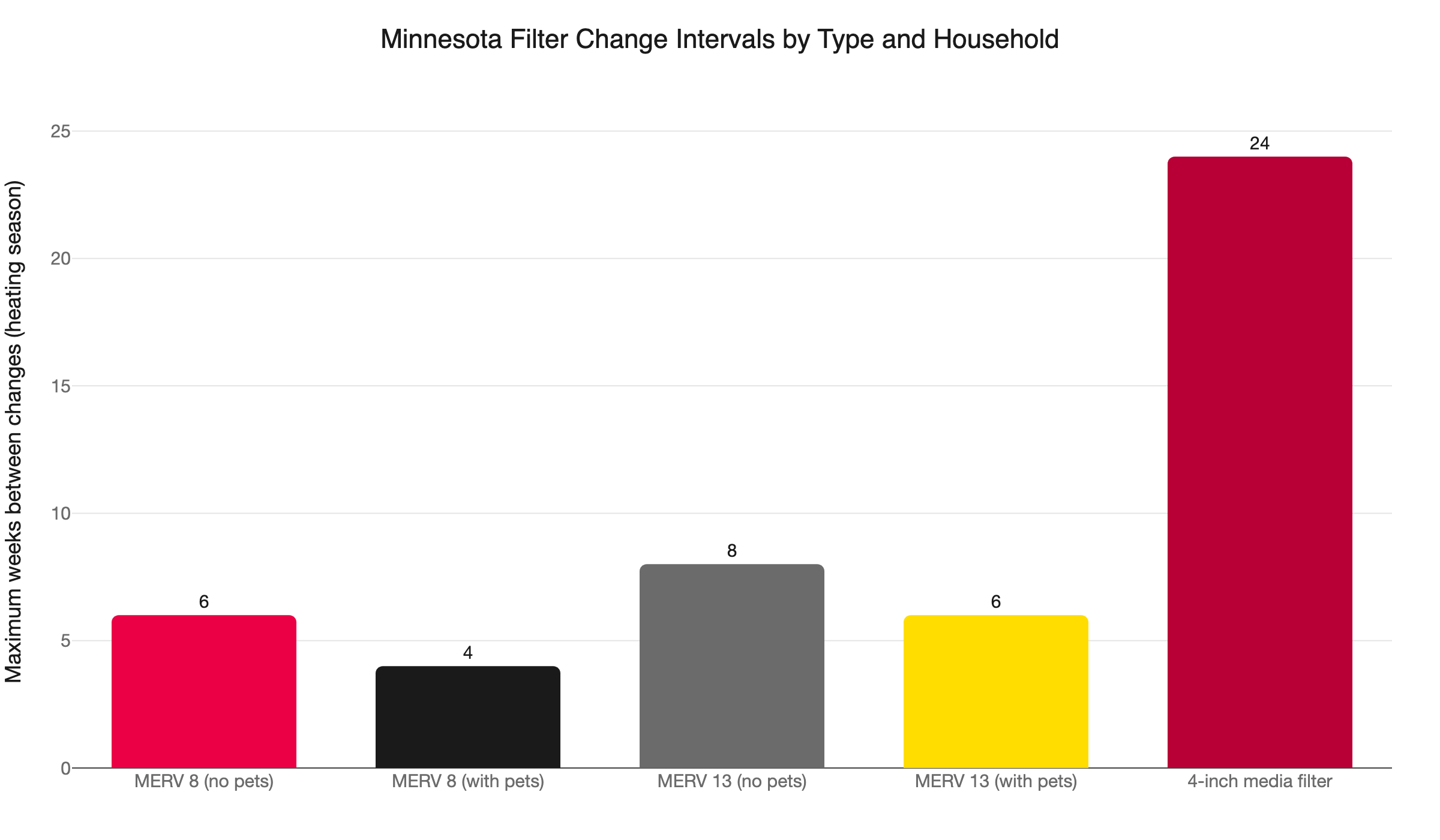
Here is the schedule we recommend for Twin Cities homeowners. These intervals apply during the heating season (approximately October through April). Outside that window, stretching toward the longer end of each range is generally fine, but a monthly visual check is still good practice during the cooling season.
1-inch pleated filters:
| Household situation | Recommended interval |
|---|---|
| MERV 8, no pets, no active renovation | Every 4-6 weeks |
| MERV 8, one or more pets | Every 3-4 weeks |
| MERV 13, no pets, no active renovation | Every 6-8 weeks |
| MERV 13, one or more pets | Every 4-6 weeks |
| Any rating, active renovation work | Check weekly; replace when gray |
4-inch media filters:
Four-inch media filters are physically much thicker than 1-inch filters. They have far more surface area to collect particles before airflow is meaningfully affected. Replace them every 6-12 months. Even in a pet household, most 4-inch media filters hold up for at least 6 months. Check at the start of heating season and again in January.
How to read the table:
The intervals above are guidelines for a typical household. If you have two large dogs, a woodworking shop in the basement, or a family member with asthma or severe allergies, use the shorter end of each range. If your home is one adult with no pets in a tightly sealed modern build, the longer end likely applies.
Industry guidance recommends a monthly visual check during peak heating season regardless of where you fall on this table. The check takes two minutes. If the filter looks gray rather than white, replace it now.
Does Having Pets Change How Often to Change Air Filter?
Short answer: Yes, significantly. Pet hair and dander are among the heaviest contributors to filter loading in a residential home. One pet means checking the filter every 30 days. Two or more pets means checking every two to three weeks during the heating season.
Pet dander is particularly problematic because the particles are small. A MERV 8 filter captures larger pet hair but allows finer dander particles to pass through into your living space. A MERV 13 filter catches more of the smaller particles, which is one reason the EPA recommends it as the floor for most homes.
The trade-off in a pet household is faster loading. A MERV 13 is doing more work per cubic foot of air, so it fills sooner. Plan on the shorter end of the MERV 13 range: 4-6 weeks rather than 6-8 weeks.
One practical habit helps regardless of filter type: vacuum the area around your return air vent regularly. Pet hair accumulates at the grille and gets pulled into the filter in clumps. Keeping that vent area clean can extend each filter’s useful life by one to two weeks. It takes thirty seconds with a vacuum attachment.
Multiple pets compound the load quickly. Two large dogs in a sealed Minnesota home through a full heating season is a reasonable case for upgrading to MERV 13 and checking every two to three weeks. If that feels like a lot of filter changes, 4-inch media filters are worth considering for the longer service interval.
What Does Renovation Work Do to Your Filter?
Short answer: Renovation work - drywall sanding, demolition, subfloor cutting, plaster removal - can clog a 1-inch filter in a day or two. The rule is simple: replace the filter the day the project finishes, not a month later.
Twin Cities homeowners tend to schedule renovation projects in spring and fall. Those seasons overlap with the heating season or the transition out of it, when homes are still sealed or just beginning to open up. All the fine particles from cutting lumber, sanding joints, or removing old insulation go straight into the return air path and onto your filter.
A single weekend of drywall finishing work can deposit enough particles on a 1-inch filter to cut airflow noticeably. When airflow drops, your air handler works harder to move the same volume of air. Energy use goes up and equipment wear accelerates.
If a bigger project is coming, here is a practical approach:
- Buy extra filters before work starts. Having three or four on hand prevents a run to the hardware store mid-project.
- Check the filter at the end of each day of heavy work, including sanding, demo, and spray painting.
- Replace the filter immediately when it looks gray, regardless of how recently you installed it.
- Put in a fresh filter the day the project wraps completely.
- Check again two weeks after the project ends. Fine particles continue to settle for several days after visible construction dust has cleared.
Skipping this step is one of the most common filter mistakes we see. A homeowner does a renovation in September, forgets the filter, and heads into November with a partially blocked system and a furnace running hard against the first cold snap. That is a setup for short cycling and a service call at exactly the wrong time of year.
What Signs Tell You the Filter Is Done?
Short answer: The fastest check is visual. A filter ready to be replaced looks gray rather than white, and light does not pass through it easily when you hold it up. Other signals include weaker airflow from your vents, higher energy bills with no other explanation, and a dusty or stale smell when the furnace kicks on.
You do not need any tools or training to check a filter. Here is what to look for:
- Color: A new pleated filter is white or light tan. A loaded filter turns gray. One left far too long turns dark gray or brown. If yours looks dark, it should have been replaced weeks ago.
- Light test: Pull the filter out and hold it up to a window or light source. If you cannot see light through it at all, replace it immediately.
- Airflow at the vents: Stand near a supply register while the furnace is running. If airflow feels weaker than normal, the filter may be restricting the system enough to affect comfort and efficiency.
- Smell: A dusty or stale odor when the heat first kicks on can mean a loaded filter is releasing particles back into the airstream rather than trapping them.
- Energy bills: If your heating costs are noticeably higher and nothing else has changed, check the filter. A clogged filter forces the blower to run longer and harder.
- Short cycling: If the furnace kicks on, runs briefly, and shuts off before the thermostat reaches the set temperature, a blocked filter may be causing the heat exchanger to overheat and trip the limit switch.
Any of these signs means replacing the filter now, regardless of where you are on the schedule.
How Does a Clogged Filter Drive Up Your Heating Bills?
Short answer: A clogged filter restricts airflow through your system. Your blower motor runs longer and harder to compensate. You spend more energy moving the same heat through the house. In a serious case, the heat exchanger overheats and triggers a safety shutoff, leaving you without heat and facing a repair call.
Xcel Energy specifically lists air filter changes as a direct energy-saving measure for Minnesota customers. That is worth noting because it is coming from the utility company, not from an HVAC contractor. They track energy consumption and they know that restricted airflow shows up on your monthly statement.
The mechanical sequence is straightforward. A filter that is 70-80% loaded slows the air moving across the heat exchanger. The heat exchanger gets hotter than designed because the same amount of combustion heat is concentrated in less airflow. Modern furnaces include a high-limit switch that shuts the system down when the exchanger temperature exceeds a safe threshold. The furnace cools, restarts, overheats again, and shuts down again. That cycle is short cycling, and each cycle adds wear to the inducer motor, the igniter, and the blower.
Repeated overheating also accelerates damage to the heat exchanger itself. A cracked heat exchanger is a serious problem. It can allow combustion gases, including carbon monoxide, to enter your living space. Our post on signs of a cracked heat exchanger in Minnesota covers what to watch for before it reaches that point.
The cost comparison is not subtle. A 1-inch pleated MERV 8 filter costs $5-15. A MERV 13 filter costs $15-30. Replacing filters on schedule through a full heating season costs roughly $30-60 total. A heat exchanger repair or early furnace replacement starts in the hundreds and can reach several thousand dollars. Staying on schedule is one of the highest-return maintenance habits a homeowner can build.
When Should You Call a Pro?
Short answer: Call us if your furnace is short cycling, if you pull out a filter that is solid and not just gray, if ice is forming on your equipment, or if you are not sure what filter your system takes. Those are signs the problem has moved past a simple filter swap.
Filter replacement is a straightforward homeowner task. But the problems that can build up from a neglected filter sometimes need professional attention to fully resolve.
If you pull out a completely blocked filter, it is worth having a technician check the system before running it hard through the rest of the heating season. Prolonged airflow restriction leaves residue on the blower wheel and the evaporator coil. Replacing the filter clears the bottleneck, but that residue stays put and reduces efficiency. A furnace tune-up includes a blower inspection, coil check, and a look at all the components that airflow problems stress. It also gives you a clean baseline to start the next heating season.
If you are not sure what filter your system takes, that is also a quick reason to call. Furnaces are designed for specific filter sizes and MERV ranges. A filter that is too thick for the slot, or one with a MERV rating that restricts airflow beyond what your blower can handle, creates its own problems and can void manufacturer warranties.
Northern One Hour is locally owned and operated in Ramsey, Minnesota, and we serve the full Twin Cities metro. Every service call comes with our on-time promise: “Always On Time… Or You Don’t Pay a Dime!(R)”.
Call (763) 260-6662 or book online to schedule a tune-up or diagnostic visit. If you want to go beyond the filter and look at the broader indoor air quality picture for your home, our indoor air quality services page covers whole-home air purifiers, duct cleaning, and humidification options that work alongside a good filter to keep your air clean through every season.
Frequently Asked Questions
How often should I change my air filter in Minnesota? +
What MERV rating should I use for my Minnesota furnace? +
Can a dirty air filter damage my furnace? +
Need a technician now?