
Signs of a Cracked Heat Exchanger: Why It Can't Be Fixed
Key Takeaways
- The heat exchanger is the sealed metal barrier between combustion gases and your home’s breathing air.
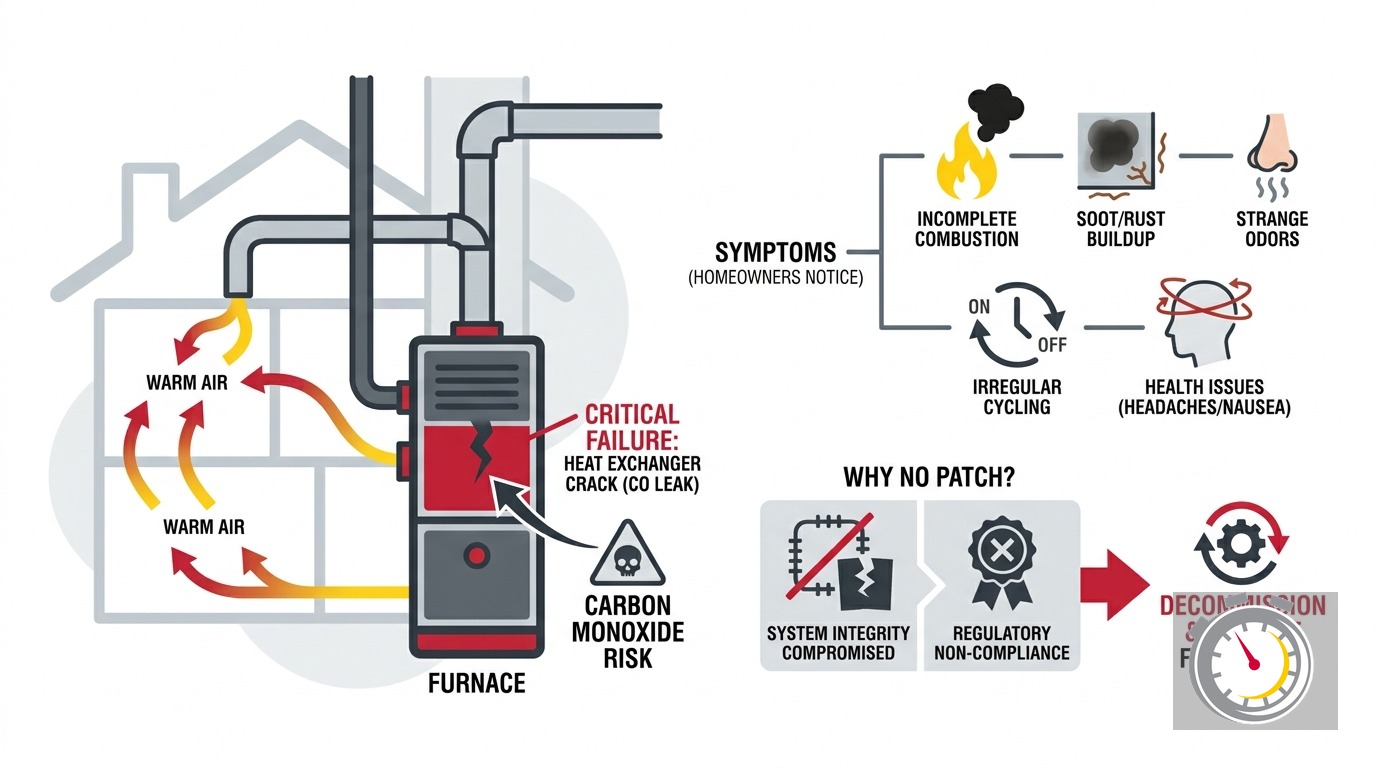
- Hard signals: a CO reading above 30 ppm, a yellow or flickering burner flame, a furnace fault lockout, visible cracks or soot on the exchanger, or a CO alarm activation.
- Soft signals: headaches that clear when you leave home, an unusual smell during heating cycles, or heavier-than-usual dust near supply registers.
- A cracked heat exchanger cannot be patched. The visible crack is a symptom of metal fatigue spread across the whole stressed region.
- CenterPoint Energy red-tags and shuts off any furnace it finds with a cracked exchanger.
- Minnesota law requires approved CO alarms within 10 feet of every sleeping room.
- Utility rebates from CenterPoint and Xcel Energy can reduce the cost of a high-efficiency replacement.
- Call (763) 260-6662 or book online to schedule an inspection before Minnesota’s heating season peaks.
What Is a Heat Exchanger, and What Does It Do?
The heat exchanger is the sealed metal chamber at the center of your gas furnace. Combustion gases from the burner flow through it while your home’s air flows around the outside. The metal wall between those two streams keeps combustion byproducts, including carbon monoxide, out of your breathing air.
That wall does critical work. A gas furnace burning natural gas produces carbon dioxide and water vapor. If combustion is incomplete, it also produces carbon monoxide. None of those belong in the air your family breathes. The heat exchanger transfers warmth from the combustion side to the air side and contains everything else inside.
Most heat exchangers are made from thin-gauge aluminized steel or stainless steel. They are built for a finite number of thermal cycles. In Minnesota, the heating season runs roughly October through April with sustained sub-zero stretches. Furnaces here rack up far more cycles per year than national design assumptions predict. That accelerated pace is why exchangers crack sooner in cold-climate homes than average-life estimates suggest.
The failure is rarely sudden. A crack develops gradually over years of thermal stress. By the time you notice signs of a cracked heat exchanger, the damage is usually already significant.
What Are the Signs of a Cracked Heat Exchanger?
Signs divide into two tiers. Hard signals (CO readings above 30 ppm, a yellow burner flame, furnace fault lockouts) demand same-day action. Soft signals (headaches that clear when you leave, unusual odors, extra dust near registers) call for a professional inspection soon. Knowing which is which helps you decide how fast to act.
Hard signals: act today
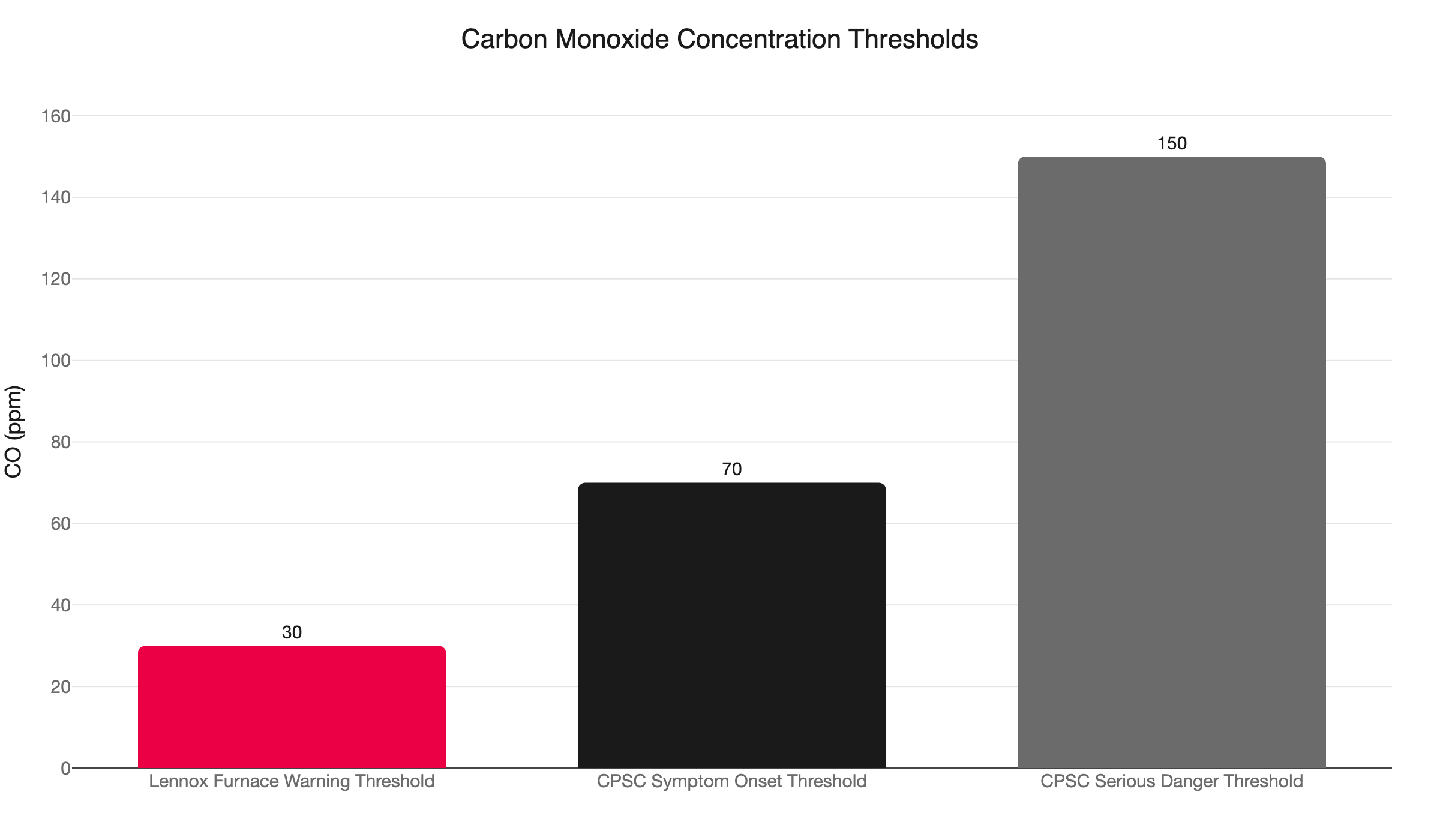
CO detector reading above 30 ppm. One major furnace manufacturer flags a reading above 30 ppm as a potential cracked heat exchanger indicator. The CPSC puts the symptom-onset threshold at around 70 ppm. The gap between those two numbers is your warning margin. Do not wait for symptoms.
Yellow or flickering burner flame. A healthy burner burns steady blue. Yellow or lazy, rolling flames indicate incomplete combustion. This often accompanies heat exchanger damage, because a crack can disrupt pressure inside the combustion chamber.
Furnace fault lockout mid-cycle. If the furnace shuts down with a rollout or pressure fault code, a safety control has detected abnormal combustion behavior. That is a hard signal requiring a professional diagnosis.
Visible crack or soot on the exchanger face. A licensed technician using a mirror, light source, or combustion analyzer can confirm this directly. Soot staining on the exchanger surface confirms combustion gas has been escaping into the air handler side.
CO alarm activation. Leave the house immediately, call 911, and do not re-enter until emergency responders clear the building. A CO alarm activation is not a situation to investigate on your own.
Soft signals: schedule an inspection
Headaches, dizziness, or flu-like fatigue without fever. CO is odorless and colorless. You cannot detect it without a monitor. Mild to moderate exposure produces headaches, fatigue, nausea, and shortness of breath - symptoms that look identical to the flu. If those symptoms clear when you leave the house and return when you come back, that pattern is reason enough for a diagnostic call.
An unusual smell when the furnace runs. A working furnace has no noticeable odor during a heating cycle. An aldehyde-like smell when the heat kicks on can mean combustion byproducts are entering your air stream. This is a soft signal on its own and more meaningful when paired with other indicators.
Soot or heavier-than-usual dust near supply registers. When combustion gases bleed into the air handler side, they can carry fine particulates through the ductwork to your registers. If your home seems dustier since heating season started, mention it to a technician.
How Dangerous Is Carbon Monoxide From a Cracked Exchanger?
Dangerous enough to take seriously, and subtle enough to miss until the situation is serious.
The CPSC reports that at 1 to 70 ppm, most healthy people experience no symptoms. Some people with heart disease may feel chest pain at the low end. Above 70 ppm, symptoms become noticeable for most people. Sustained exposure above 150 to 200 ppm can produce disorientation, unconsciousness, and death.
The EPA notes that CO “can kill you before you are aware it is in your home.” Mild cases are routinely misdiagnosed as the flu. Symptoms overlap with so many common illnesses that CO poisoning often goes unrecognized until exposure is severe. Children, elderly adults, and those with cardiovascular conditions are most vulnerable at lower concentrations. Other family members may feel nothing.
That is why a CO detector reading above 30 ppm matters even when you feel fine. The monitor catches what your body has not yet registered. Do not dismiss a low reading as an error.
Why Can’t a Cracked Heat Exchanger Be Patched?
Because the visible crack is not the problem. It is a symptom of metal fatigue that has already spread through the surrounding material. Fixing the one you can see leaves the compromised metal around it untouched.
The metallurgy.
Each heating cycle heats the exchanger, which expands. The furnace shuts off and the metal contracts. After thousands of these cycles, the thin-gauge steel work-hardens in the zones under the most strain. Minnesota’s long heating seasons accelerate that process beyond what national design assumptions account for. By the time one crack is visible, the surrounding metal is already compromised. A second crack is forming nearby. Patching the first crack does nothing for the metal next to it.
The listing barrier.
A heat exchanger is a UL-listed combustion pressure boundary. That listing means it was certified as a sealed unit from the factory. Field-welding or sealing it is not an approved repair under any recognized code. It voids the manufacturer warranty and will not pass a mechanical inspection. In Minnesota, furnace replacement requires a mechanical permit and compliance with the 2020 Minnesota Mechanical Code. A licensed HVAC contractor must perform the work.
The economics.
The heat exchanger is the single most expensive component in the furnace. Labor to remove and replace just the exchanger in an aging furnace approaches the cost of a full unit replacement. The rest of an aging furnace is typically near end-of-life when the exchanger fails: blower motor, control board, and capacitor all wear on the same timeline. Patching is false economy on two fronts. It fails technically. And even if it held, it preserves an aging system at near-replacement cost.
Is a Cracked Heat Exchanger a Contractor Upsell?
Sometimes the claim is legitimate. Sometimes it gets oversold. The technical answer does not change regardless of severity: no approved field repair exists for a cracked heat exchanger. A trustworthy contractor shows you the evidence, gives you a combustion analyzer reading, and lets the data make the case.
A Twin Cities home inspector who has examined thousands of furnaces puts it directly: a cracked heat exchanger “probably isn’t as dangerous as many folks make it out to be, but the furnace (or heat exchanger) still needs replacement.” Calling for replacement is not a scam. Fabricating a crack that is not there would be.
The actual CO risk depends on crack size, system airflow, and how much CO incomplete combustion is producing. A hairline crack in a well-balanced draft system may produce minimal bleed. A larger fracture with an aggressive blower can push measurable CO into your living space. Either way, the conclusion is the same: there is no code-approved patch. Replace the furnace.
A professional diagnosis should include a combustion analyzer reading, a description of what the technician found, and a clear explanation of the evidence. If a contractor cannot provide those three things, ask for them before agreeing to anything.
What Happens When CenterPoint Energy Finds a Crack?
CenterPoint Energy shuts the furnace off at the electrical switch and the gas valve and tags the appliance. The furnace stays off until a licensed contractor completes the replacement and it passes inspection. There is no bypass or workaround.
They take this step because a cracked exchanger “can potentially be a carbon monoxide issue.” That is their policy, not a suggestion.
In January, a red-tag means no heat today. That is the strongest argument for a fall inspection. Finding a failing exchanger in October is a scheduled replacement on your terms. Finding one in January is a same-day crisis in sub-zero weather. Our team is locally owned and operated in Ramsey, MN, and we serve the Twin Cities year-round - but we would rather find the problem before it finds you.
What Does Minnesota Law Require for CO Alarms?
Every single-family home and every multifamily unit in Minnesota must have an approved, operational CO alarm within 10 feet of each room used for sleeping. That is state law under Minnesota Statutes section 299F.51.
An “approved” alarm under that statute means one certified to UL 2034. It must be hardwired, directly plugged into an outlet without an on-off switch, or battery-powered and wall-mounted.
Most CO alarms carry a manufacturer-rated service life of 5 to 7 years. Check the manufacture date stamped on the back of yours. If you cannot find a date, replace the unit. Alarms past their rated life may not activate reliably.
For a deeper look at alarm placement, testing intervals, and what to do when one sounds, see our carbon monoxide safety and furnace season guide.
What Should You Expect From a Professional Inspection?
A licensed HVAC technician checks the heat exchanger using one or more methods. One approach uses a mirror and light source to look for visible cracks or soot. Another uses a combustion analyzer to read CO and oxygen levels in the flue gas. A third is a chemical detection test. Some inspections also include a pressure test. The most thorough approach combines visual inspection and combustion analysis.
The technician also checks the burner flame color, the venting system for backdrafting or blockages, and CO levels at your supply registers with the furnace running. A register reading significantly above ambient CO levels confirms combustion gas is entering the air stream. These are measurable findings, not guesswork.
If a crack is confirmed, you receive a written diagnosis with the technician’s findings. The conversation then turns to replacement options, efficiency tiers, and available rebates. We do not patch heat exchangers. No reputable HVAC contractor does. We will not call for replacement unless the evidence supports it.
Our emergency furnace repair warning signs guide covers other fault conditions that commonly surface during these inspections.
How Much Does Furnace Replacement Cost, and Can Rebates Help?
A cracked heat exchanger almost always means furnace replacement rather than a component swap. The cost varies by unit size, efficiency tier, and installation complexity. Utility rebates can meaningfully reduce your out-of-pocket number, and they are worth checking before you budget.
Our furnace replacement cost guide for Twin Cities homeowners covers the full range of variables in detail.
CenterPoint Energy (gas) and Xcel Energy (electric) both run Minnesota residential efficiency programs for high-efficiency furnace replacement. Dollar amounts and AFUE tier cutoffs rotate with each program year. Check live figures at CenterPoint’s efficiency programs page and Xcel’s home rebates page before finalizing your budget.
The federal energy-efficiency tax credit (IRC Section 25C) may also apply for qualifying high-efficiency furnaces. Verify current eligibility at irs.gov and through the MN Commerce Department’s rebate portal. Amounts and phase-in rules change with each program update, so confirm directly rather than relying on what you read last season.
If upfront cost is a concern, ask about financing options when you call us. We offer financing on larger jobs and will walk you through it clearly.
When Should You Schedule a Furnace Inspection?
Before the problem schedules itself. A September or October tune-up gets a trained technician in front of your heat exchanger, burner, and venting system before Minnesota’s winter peaks. Our fall heating tune-up guide for Twin Cities homeowners covers what a thorough inspection includes and why each item matters.
The CPSC recommends annual professional inspection of all fuel-burning appliances, including furnaces. An annual tune-up satisfies that standard and puts a licensed set of eyes on the exchanger every season.
If your furnace is 15 years old or older, schedule a standalone inspection. The same applies if you are buying or selling a home. Exchangers most commonly fail on older units. The older the furnace, the more the economics favor replacement over repair.
If you notice soft signals between scheduled appointments, call us rather than waiting for your next tune-up. Soft signals are not emergencies. They are a request for an inspection before they become one.
Call Northern One Hour Before Winter Makes the Decision for You
If you recognized any hard signals in this post today, do not wait for a maintenance window.
Call (763) 260-6662 or book online. We are locally owned and operated in Ramsey, MN, and we serve Minneapolis, St. Paul, Blaine, Maple Grove, Plymouth, Brooklyn Park, Woodbury, and communities throughout the Twin Cities.
We will give you a straight diagnosis: what we found, what it means, and what your options are. No guesswork, no pressure. Our promise stands on every call: “Always On Time… Or You Don’t Pay a Dime!(R)”
A fall inspection is a minor investment. An emergency replacement in a frozen house is not. Let us find the problem before the temperature does.
Frequently Asked Questions
Can a cracked heat exchanger be repaired or patched? +
What are the most reliable signs of a cracked heat exchanger? +
How dangerous is a cracked heat exchanger? +
What does CenterPoint Energy do when it finds a cracked heat exchanger? +
Does Minnesota require CO alarms near bedrooms? +
Need a technician now?