
Carbon Monoxide Furnace Safety: Minnesota Homeowner Guide
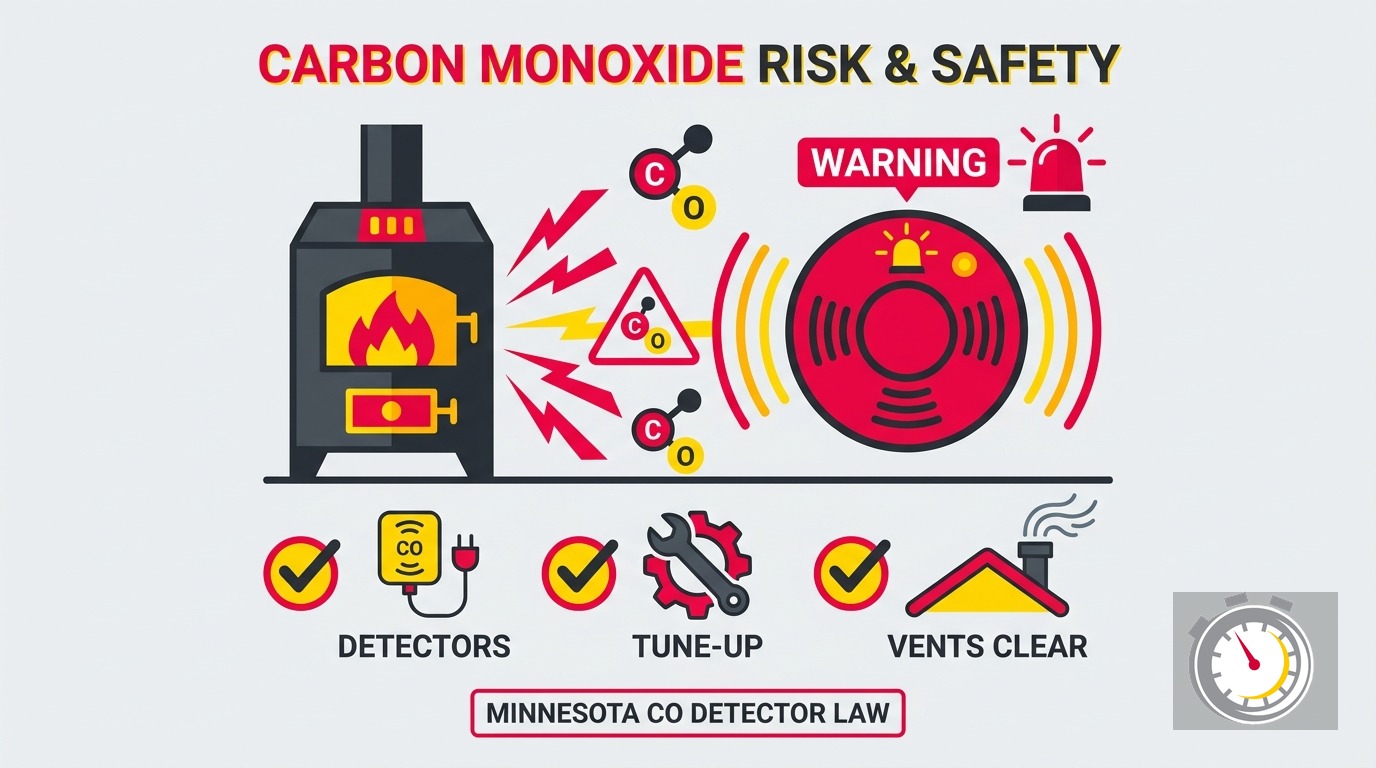
Key Takeaways
- Carbon monoxide (CO) is colorless and odorless. Any fuel-burning appliance, including your furnace, can produce it.
- A cracked heat exchanger is the most common furnace-related CO hazard in Minnesota homes.
- Minnesota Statute 299F.51 requires a CO alarm within ten feet of every sleeping room in every single-family home.
- Standard residential CO alarms trigger at 70 ppm of sustained exposure. They do not protect against chronic low-level exposure.
- Twin Cities furnaces run roughly 5-6 months per year. That sustained load accelerates heat exchanger fatigue faster than southern-market furnaces experience.
- High-efficiency furnaces with PVC sidewall vents can be blocked by a single heavy snowfall. Most national guides never mention this.
- Annual furnace tune-ups are the most reliable way to catch CO risks before heating season arrives.
- CO detectors have a service life of 5-7 years. Replace any unit older than five years, even if the test button still works.
Carbon monoxide furnace safety is a year-round responsibility for Twin Cities homeowners. The risk peaks every time your heating system runs. Here is what to know before the season starts.
How Does a Furnace Produce Carbon Monoxide?
Carbon monoxide forms when combustion is incomplete. A properly tuned gas furnace burns fuel with enough oxygen to produce carbon dioxide and water vapor. When oxygen supply is insufficient, each carbon atom bonds to only one oxygen atom instead of two. That reaction produces CO instead of CO2.
Any fuel-burning appliance can produce CO. Furnaces carry the highest risk in most Minnesota homes because of how hard they run and for how long.
A properly burning furnace exhausts mostly CO2 and water vapor through the flue. Problems arise when any of these conditions occur:
- Dirty or misaligned burners restrict airflow to the flame
- A blocked combustion air intake starves the burner of oxygen
- The heat exchanger that separates combustion gases from circulated air develops a crack
- A partially blocked flue causes exhaust to back-draft into the system
In a well-maintained furnace, none of these failure points produce CO that reaches your living space. In a neglected furnace, any of them can.
Carbon Monoxide Furnace Safety: The Heat Exchanger Is Your Only Firewall
Your furnace burns fuel to generate heat. The heat exchanger transfers that heat to the air circulating through your home. It also performs a second, equally critical function: it keeps combustion gases completely separate from the air your family breathes.
Think of the heat exchanger as a sealed wall between two chambers. Heat passes through the wall. The combustion gases, including any CO, stay on the burner side. They travel through the exchanger and exit through the flue. As long as the exchanger is intact, your family breathes only conditioned air.
When the exchanger cracks, that wall fails.
Every heating season, the heat exchanger expands and contracts thousands of times as the furnace cycles on and off. That thermal cycling causes metal fatigue over years of use. Even a hairline crack allows CO to migrate from the combustion side into the air supply. The migration is invisible, odorless, and silent.
One visible sign to watch for: a yellow or orange flame instead of a steady blue one. Yellow or orange indicates incomplete combustion and may signal that CO is present in the exhaust. Confirming actual CO levels requires professional combustion analysis equipment.
Furnaces older than 10 years face a higher heat exchanger crack risk. Beyond 15 years, repair cost often approaches replacement cost. If your system is in that range, our guide on when to replace rather than repair your furnace walks through the math.
Does Minnesota Law Require CO Detectors in Every Home?
Yes. Minnesota Statute 299F.51 requires every single-family home and every multifamily dwelling unit to have an approved, operational CO alarm installed within ten feet of each room used for sleeping. There are no exceptions for newer homes or homes without gas appliances.
Many Twin Cities homeowners know smoke detectors are required by law. Fewer realize the CO alarm requirement is just as specific, including the ten-foot placement rule.
What Does “Within Ten Feet” Mean in Practice?
Ten feet is a measured distance, not a general guideline. It means the detector must be close enough to a sleeping room door that occupants can hear it and respond before CO exposure incapacitates them.
A single CO alarm in the kitchen or utility room does not satisfy the statute if bedrooms are farther away. A typical two-story home needs detectors on both floors. A home with a finished basement and sleeping space there needs a detector on that level as well.
Minnesota Rules Section R315 adds a layered requirement: CO alarms must be present on each level of the home, not just near bedrooms. A summary published by Mankato Building Inspection confirms this level-by-level approach mirrors what statewide code requires.
What Happens If You Don’t Comply?
Under Minn. Stat. 299F.51, a first violation results in a safety warning. A second or subsequent violation is a petty misdemeanor.
The legal consequence matters less than the safety one. A home without properly placed CO detection is a home where a slow leak can injure or kill occupants before anyone wakes up.
Landlords carry additional responsibility under the statute. Multifamily property owners must install and replace CO alarms between tenancies.
What Should You Know About the 2026 Minnesota CO Code Changes?
More buildings are about to be required to have CO detection. Minnesota is aligning with the 2024 International Fire Code. The expansion requires CO alarms in nearly all commercial buildings. This applies to enclosed spaces served by fuel-burning systems. It covers existing buildings, not just new construction.
As of July 2026, the commercial expansion has not been officially adopted. The direction is clear: regulators continue to raise the floor on CO protection across Minnesota.
For homeowners, the practical takeaway is this: the bar on CO safety is moving up, not down. Proper detector placement and annual furnace inspections put you well ahead of minimum compliance regardless of where the code lands.
MTG’s overview of the 2026 changes covers what commercial property owners are preparing for. It gives useful context on the scope of the upcoming requirements.
A Twin Cities Risk That National Guides Miss
Here is a scenario most national HVAC content never mentions. A high-efficiency furnace runs at full capacity while its sidewall exhaust vent is buried in snow.
High-efficiency condensing furnaces (90%+ AFUE) are common in newer Minnesota construction. They vent through PVC pipes at ground level rather than through metal chimney stacks. That design improves efficiency. It also places the exhaust termination where a single heavy snowfall can cover it entirely.
When the exhaust pipe is buried, combustion gases cannot exit the building. The furnace may continue running. Exhaust recycles back through the combustion cycle. CO concentrations build. Gases that should vent outdoors have nowhere to go.
This failure mode does not exist in southern markets. It is a Minnesota-specific hazard. It compounds the structural risk that comes with the Twin Cities’ longer heating season.
Twin Cities furnaces run roughly late October through mid-April. That is 5-6 months of sustained heating, compared to 2-3 months in most southern markets. The heat exchanger cycles through thousands of expand-contract events per season. Over 10 years, that adds up to roughly 2-3 times the thermal fatigue of a furnace in a warmer climate.
What to do:
- Before the first snowfall, locate both the exhaust pipe and combustion air intake pipe. They typically terminate on an exterior wall within two feet of the ground, close together.
- Mark each pipe with a painted stake or flag before winter arrives. You need to find them after a storm.
- After any significant snowfall, check both pipes and clear any snow or ice buildup.
- If the vents were buried while the furnace was running, call our team before assuming everything is fine. A combustion analysis after a blockage confirms whether the system ran cleanly.
Our guide to preventing winter heating breakdowns covers additional cold-weather habits that reduce heating-season risk across the board.
How Do You Know If Your CO Detector Is Still Working?
Check the manufacture date, not just the test button. A CO alarm’s test button verifies the electronics and alarm circuitry. It does not verify that the CO sensor inside is still capable of detecting the gas.
CO detector sensors degrade over time. A typical residential CO detector has a reliable service life of 5 to 7 years. A unit older than five years may not alarm even at CO concentrations that cause serious harm.
Find the manufacture date printed on the back of each unit. Replace any detector that is more than five years old. Do this even if the test button sounds perfectly.
What CO Levels Should Trigger an Alarm?
UL-listed residential CO alarms are designed to trigger at sustained exposures around 70 ppm. The exact timing depends on concentration. Higher concentrations trigger the alarm faster. Lower concentrations require longer sustained exposure before the threshold is reached.
That threshold protects against acute, high-concentration poisoning. It does not protect against chronic low-level exposure. Repeated exposure at sub-alarm concentrations, over days or weeks, can cause persistent headaches, fatigue, and difficulty concentrating. Many people attribute those symptoms to something else entirely.
By the time a residential CO alarm sounds, low-level exposure may have been happening for some time. That is another reason annual furnace tune-ups matter: a technician measures combustion efficiency directly, before any household exposure occurs.
What Does a Furnace Tune-Up Catch That You Can’t See?
A professional tune-up gives a technician direct access to the heat exchanger, burners, and flue. These are the three components most likely to produce a CO problem. A visual inspection and combustion analysis can identify cracks, sooting, and combustion inefficiency that homeowners cannot detect on their own.
During a furnace tune-up, a technician typically:
- Inspects the heat exchanger for cracks or signs of corrosion
- Measures CO and CO2 levels in the exhaust flue with a calibrated analyzer
- Checks the burner flame pattern (steady blue indicates complete combustion; yellow or orange signals a problem)
- Confirms the flue is clear and drafting correctly
- Tests limit switches and safety shutoffs designed to stop the furnace when a hazardous condition develops
- Verifies the combustion air supply is adequate for the system’s burner load
National code allows up to 400 ppm CO in furnace exhaust flue gases. A properly tuned furnace should measure below 100 ppm in the flue. Readings above 100 ppm indicate incomplete combustion and require further diagnosis.
Those measurements require professional equipment. A homeowner looking at a running furnace cannot assess combustion quality from the outside. The annual tune-up is the checkpoint between your family and a silent, invisible problem.
Our team at Northern One Hour is locally owned and operated. We serve Minneapolis, St. Paul, Ramsey, Blaine, Maple Grove, Plymouth, Brooklyn Park, Woodbury, Bloomington, and the surrounding Twin Cities. When you schedule service with us, you get a technician who shows up when we say.
When Is It Time to Replace Instead of Repair?
Age is the clearest signal. Furnaces older than 15 years face elevated heat exchanger failure risk. The cost of repairing a cracked exchanger often approaches the cost of a new furnace. At that point, repair buys a few more years on an aging system. Replacement gives you a new one.
Here is a rough decision framework:
- Under 10 years old: Repair is almost always the right call. A tune-up and targeted repair extends the system’s useful life significantly.
- 10-15 years old: Evaluate based on repair cost versus replacement cost. A repair that exceeds 50% of the new furnace cost often tips the math toward replacement.
- Over 15 years old: A heat exchanger crack or major repair is typically the last straw. Replacement is usually the better financial and safety decision.
If your furnace is approaching that range and you are weighing the options, see our guide on whether it is time to replace rather than repair your system. Financing is available on new furnace installations. Ask when you call.
What to Do If Your CO Alarm Goes Off
Leave immediately. Do not look for the source. Do not open windows. Do not go back for belongings. Get every person and pet out, close the door, and call 911 from outside.
CO acts faster than most people expect. The impulse to investigate first is a dangerous one.
After emergency services clear the building, call a furnace repair technician before re-entering. A technician can identify the CO source and make the necessary repairs. They will confirm the system is safe before the home is occupied again.
If the alarm sounded once and then cleared, that is still a professional call. An intermittent alarm may indicate a failure that will recur.
A Carbon Monoxide Furnace Safety Checklist for Every Heating Season
Carbon monoxide furnace safety comes down to three consistent habits:
1. Schedule an annual tune-up before heating season. This is the professional inspection that catches heat exchanger cracks, combustion problems, and flue blockages before the system runs full-time. Early fall is the right time. Do not wait until November.
2. Check your CO detectors once a year. Test the button, check the manufacture date, and replace any unit older than five years. Place detectors within ten feet of each sleeping room and on every level of your home. That is what Minnesota law requires. That is also what the risk warrants.
3. After every heavy snowfall, check your sidewall vents. If your furnace exhausts through PVC pipes at ground level, confirm those pipes are clear after every major storm. Mark the vent locations before the first snowfall so you can find them after.
None of these steps is complicated. Together, they address the three main failure paths: the heat exchanger, the alarm, and the vent.
Northern One Hour is locally owned and operated, serving the Twin Cities and surrounding communities from Ramsey, MN. Our team shows up when we say we will. “Always On Time… Or You Don’t Pay a Dime!(R)” is not a marketing line. It is how we work.
To schedule your furnace inspection or CO safety check, call us at (763) 260-6662 or book online. Get it done before heating season arrives.
Frequently Asked Questions
Does Minnesota law require carbon monoxide detectors in every home? +
How does a furnace produce carbon monoxide? +
How often should a furnace be inspected for CO risks? +
How long do CO detectors last? +
Need a technician now?