
Where to Place a Carbon Monoxide Detector Near a Furnace
Key Takeaways
- Place a CO detector 5 to 20 feet from your furnace, water heater, or boiler. That window gives early warning without triggering false alarms from normal ignition startup.
- CO is nearly the same density as air and distributes throughout the room. Height is not the critical variable: knee-to-chest level (2-5 feet off the floor) is a practical target, but a ceiling mount also works.
- Avoid dead-air corners, spots next to windows or exterior vents, and areas directly behind large equipment.
- Twin Cities homes with a basement furnace and upstairs bedrooms need at least two detectors: one near the appliance, one outside the sleeping areas on the upper level.
- One detector covers multiple fuel-burning appliances (furnace, water heater, gas dryer) in a shared mechanical room, as long as no wall separates them.
- Minnesota law requires CO alarms in every home with fuel-burning appliances (MN Statutes 299F.50/299F.51). This is a legal requirement, not a suggestion.
- Replace the entire detector unit every 5 to 7 years. The test button checks the alarm circuit, not the sensor’s ability to detect CO.
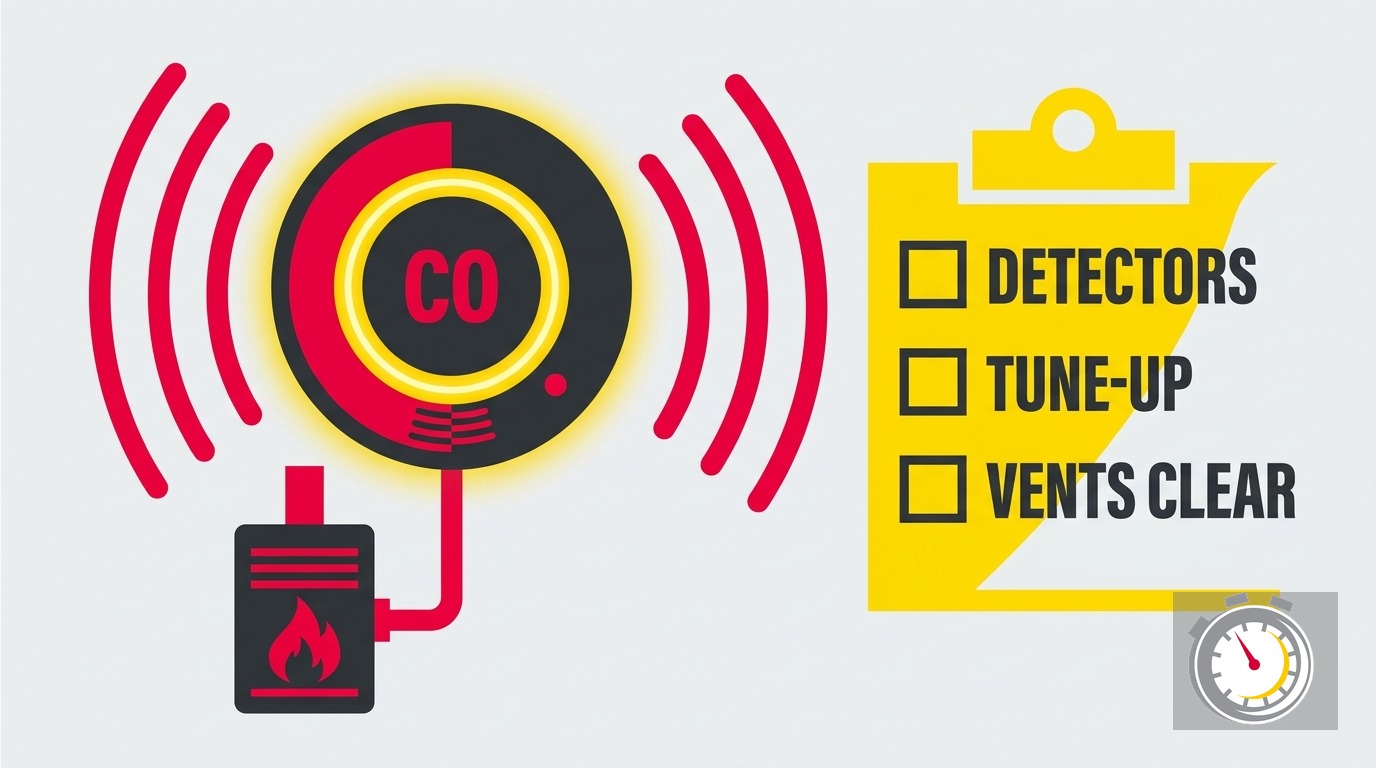
- An annual professional furnace inspection is the front-line defense. A correctly placed detector is the backup.
Carbon Monoxide and the Minnesota Heating Season
Carbon monoxide is colorless and odorless. You cannot see it, smell it, or taste it.
Most homeowners know CO is dangerous. Fewer understand why furnaces are the central risk. According to the CPSC, heating equipment is one of the top contributors to unintentional non-fire CO poisoning deaths each year in the United States. In the CPSC’s 2022 annual estimates, heating systems were linked to an estimated 76 deaths: 28% of the 274 total non-fire CO poisoning deaths associated with consumer products that year.
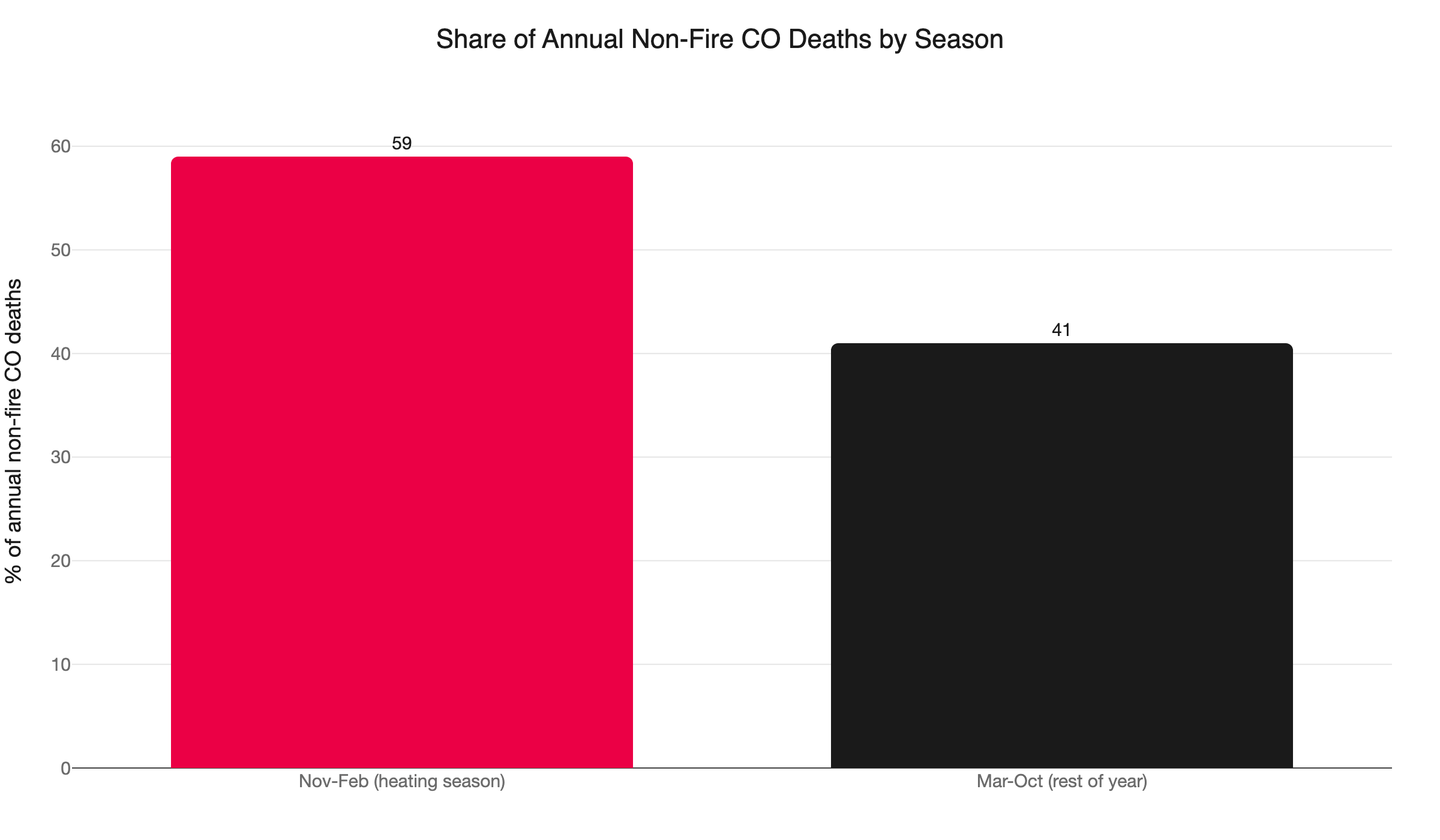
The timing tells the story. 59% of all non-fire CO deaths occur November through February - the coldest months, when furnaces run the hardest. In the Twin Cities, that risk window is even longer. Our heating season runs October through April: six months or more. During a cold snap, a gas furnace cycles nearly continuously. That constant demand stresses heat exchangers, draft inducers, and flue connections - the components most likely to let CO into a living space when something fails.
A correctly placed detector gives you warning time. A detector in the wrong spot nuisance-alarms on a cold January morning, gets its battery pulled, and sits silent when the threat is real.
Where Should You Place a Carbon Monoxide Detector Near a Furnace?
The correct placement window is 5 to 20 feet from the furnace or any other fuel-burning appliance. That range provides early warning of a real CO leak while staying far enough back to avoid false alarms from normal furnace startup behavior.
Here is the mechanism most placement guides leave out.
Every time a gas furnace ignites, combustion produces a brief, small puff of carbon monoxide. Under normal operation, that puff is harmless: it is pulled through the heat exchanger and exhausted through the flue or PVC vent pipe immediately. But if a CO detector sits within a foot or two of the appliance, that ignition puff is enough to trigger the alarm. As Carrier explains, combustion appliances “may emit small, harmless amounts of CO upon start-up that could trigger nuisance alarms” - which is why manufacturers specify a minimum standoff distance from any combustion appliance.
A nuisance alarm is not just annoying. It trains homeowners to silence the alarm or pull the battery. A detector with a dead battery cannot warn you when the CO is genuine.
At 5 feet and beyond, the ignition puff has dispersed enough to read as baseline. At 20 feet and closer, a genuine CO buildup from a failing component - a cracked heat exchanger, a blocked flue, a disconnected vent connection - reaches the sensor quickly enough to matter. Kidde recommends a CO alarm on any level of the home with fuel-burning appliances, with placement in the 5-to-20-foot window near any specific appliance.
Where Exactly in the Room Should the Detector Go?
Mount it on an interior wall with natural air circulation at roughly 2 to 5 feet off the floor. Avoid corners, spots next to windows or exterior vents, and any position blocked by shelving or large equipment.
CO is nearly the same density as air: slightly lighter, but not enough to stratify the way propane does (which sinks to the floor) or the way smoke does (which rises sharply to the ceiling). CO distributes throughout the room. That means height matters less for CO than for either of those other gases. A ceiling-mounted detector is fine. A mid-wall detector is fine. What matters most is air circulation.
Dead-air spaces degrade sensor performance. Kidde specifically flags room corners, areas next to windows or exterior air vents, and spots behind large furniture as locations to avoid. In a basement mechanical room, the worst possible placement is a corner directly behind the water heater where air stagnates against the wall.
The practical guidance for a Twin Cities basement utility room: mount the detector on the interior wall between the furnace and the water heater, at about chest height (3 to 4 feet off the floor), with clear air movement around it. That position puts the sensor within the 5-to-20-foot window from both appliances and away from dead-air corners.
Do You Need More Than One CO Detector?
Yes, almost certainly. Minnesota code requires a detector outside each sleeping area. One unit in the basement does not cover bedrooms on the main or upper floor.
This is the gap that most placement guides skip. They treat a CO detector installation as a single-alarm question. In a typical Twin Cities home - basement furnace, bedrooms one or two floors up - you need at minimum:
- A detector in or just outside the basement mechanical room, 5 to 20 feet from the furnace.
- A detector outside each sleeping area on the upper level, no more than 10 feet from each bedroom door.
The basement detector catches a CO event near the source. The upstairs detector is the one that wakes your family before dangerous concentrations build in the rooms where they sleep. One well-placed detector cannot do the work of two.
If your home has sleeping areas on multiple levels, add a detector on each of those levels. Minnesota Statutes 299F.50 and 299F.51, implemented through MN Residential Code R315, are specific: alarms must be outside each sleeping area, within 10 feet of the bedroom door, and present on every level of the home with sleeping areas.
In new construction, the code also requires hardwired alarms with battery backup, all interconnected. That interconnection is the critical piece: when the basement unit detects CO, every alarm in the house sounds at once. You do not have to be near the source to hear the warning.
What If You Have Multiple Fuel-Burning Appliances in the Same Room?
You do not need a separate detector for each appliance. A single detector in the 5-to-20-foot window from the furnace, roughly centered in the room, covers the furnace, water heater, and gas dryer together, as long as no wall separates them.
Most Twin Cities basements put all three fuel-burning appliances in the same utility room. Every one of them burns gas. Every one of them is a potential CO source. But the placement logic does not require one detector per appliance.
If the mechanical room is unusually large, or if a partition wall separates the furnace from the water heater, add a second unit rather than relying on one detector to cover the full space.
One placement mistake to avoid: do not mount the detector on the exterior wall behind the workbench just because that surface is convenient. That often puts the sensor facing away from all three appliances, in a dead-air corner, with the worst possible position relative to the actual CO sources.
Does the Type of Furnace Change Where to Place the Detector?
The 5-to-20-foot placement window applies to both standard and high-efficiency furnaces. But the failure modes that produce CO differ between the two, and knowing your furnace type helps you understand what a technician is looking for during an inspection.
A standard 80% AFUE furnace uses a metal flue pipe that vents combustion gases up through the roof. The primary CO risk is a cracked heat exchanger or a blocked or disconnected flue. A cracked heat exchanger can let combustion gases - including CO - leak into the circulated air stream before those gases ever reach the exhaust path. Our guide to cracked heat exchanger signs walks through the warning symptoms in detail.
A high-efficiency condensing furnace (90%+ AFUE) uses sealed combustion and exhausts through a PVC pipe that exits low on an exterior wall. The sealed design eliminates several of the flue-related failure modes of an 80% furnace. But it introduces a different risk: a blocked PVC vent - from snow, ice, debris, or a bird nest - can force exhaust gases back into the system and into the home. Our guide on high-efficiency furnace exhaust vent blockages covers that scenario specifically, and it is more common in Minnesota winters than most homeowners expect.
Place the detector in the same 5-to-20-foot window regardless of furnace type. But know which furnace you have so you can have an informed conversation with the technician at your next annual inspection.
Does CO Detector Height Matter?
Less than most people assume. Knee-to-chest height (2 to 5 feet off the floor) is a sensible target, but a ceiling-mounted detector also works. CO does not pool on the floor or stratify near the ceiling the way other gases do.
This is where CO differs from both smoke and propane. Smoke rises sharply, which is why smoke detectors belong high on the wall or on the ceiling. Propane is heavier than air, which is why propane detectors go near the floor. CO’s density is close enough to air that it disperses throughout the room without strong stratification. Carrier confirms that height is not the critical variable for CO placement: the breathing zone (roughly knee-to-chest) is a practical guideline, but the rules around distance from the appliance and air circulation matter more.
What does matter at any height: keep the detector away from direct humidity sources (right above a utility sink), away from supply vents that push conditioned air directly at the sensor and could dilute readings, and away from corners where air stagnates and sensor response slows.
What Does Minnesota Law Require for CO Detectors?
Minnesota requires CO alarms in all residential dwellings with fuel-burning appliances or attached garages. This is state statute, not a building-code recommendation. If your home has a gas furnace, a CO alarm is legally required.
The specific requirements under MN Statutes 299F.50 and 299F.51 (implemented through MN Residential Code R315):
- An alarm located outside each sleeping area, no more than 10 feet from the bedroom door
- An alarm on each level of the home that contains sleeping areas
- In new construction: hardwired alarms with battery backup, all interconnected so every unit sounds when one triggers
If your home predates the interconnection requirement, you are not required to retrofit hardwired wiring. Battery-operated wireless interconnected units are an affordable way to get the interconnection benefit in an older home.
Minnesota is among approximately 27 states that mandate CO alarms by law. This is not a best-practice suggestion for our customers - it is a legal baseline.
How Often Should You Test and Replace a CO Detector?
Test the alarm button monthly. Replace the entire unit every 5 to 7 years, even if the alarm sounds when you press the test button. The electrochemical sensor inside degrades silently over time and may no longer detect actual CO even when the alarm circuit functions correctly.
This is the most overlooked part of CO detector maintenance. The test button verifies the alarm circuit and the battery. It does not verify whether the sensor can still detect carbon monoxide at meaningful concentrations. That degradation happens invisibly and gradually. A seven-year-old detector that beeps on command may have a sensor that no longer responds to a real CO event.
Check the manufacture date printed on the label on the back of the unit. Most detectors include a “replace by” date. If yours is past that date, or if you do not know how old it is, replace it now. The cost of a new unit is minimal.
A few more maintenance rules worth following:
- Do not paint over the detector. Paint seals the sensor vents and blocks the air sample the sensor needs.
- Do not store the unit in an enclosed cabinet between uses.
- Vacuum the exterior once a year to clear dust buildup that restricts airflow to the sensor.
What to Do When a CO Alarm Sounds
Do not silence the alarm and go back to sleep. Do not assume it is a false alarm because you feel fine. CO symptoms - headache, nausea, dizziness - develop slowly, and you may not notice them yet when the alarm first triggers.
When the alarm sounds:
- Get everyone out of the house immediately, including pets.
- Leave the door open as you exit to help vent the space.
- Call 911 from outside.
- Do not re-enter until emergency responders clear the building.
- Contact a qualified HVAC technician before running the furnace, water heater, or any other fuel-burning appliance again.
The CPSC reports that more than 200 people die each year from unintentional non-fire CO poisoning linked to consumer products, with heating equipment among the top contributors. A working detector in the right location and a clear exit plan cut that risk significantly. Neither requires any special skill. Both require follow-through.
The Detector Is the Backup. An Annual Inspection Is the Defense.
A correctly placed CO detector matters. Replacing it on schedule matters. But neither one substitutes for a properly maintained furnace.
An annual furnace tune-up includes a direct inspection of the components most likely to produce CO: the heat exchanger for cracks, the flue or PVC vent for blockages and disconnections, the combustion chamber for proper burner operation, and the draft inducer for correct exhaust pull. The CPSC recommends annual professional inspections of all fuel-burning systems - furnaces, boilers, water heaters, chimneys, flues, and vents. In Minnesota, where furnaces run six months a year and face the thermal cycling of our winters, that annual check is how you catch problems before they become CO events.
Northern One Hour is locally owned and operated in Ramsey, Minnesota. We serve the full Twin Cities metro: Minneapolis, St. Paul, Blaine, Maple Grove, Plymouth, Brooklyn Park, Woodbury, Bloomington, and the surrounding communities. Our technicians cover everything on the CPSC checklist as part of a standard heating maintenance visit.
If your detector is in the wrong spot, we can tell you when we are there.
“Always On Time… Or You Don’t Pay a Dime!(R)”
Call us at (763) 260-6662 or book online to schedule your furnace inspection. We will check your heat exchanger, combustion system, and flue - and you will know your heating system is ready for whatever the Minnesota winter brings next.
Frequently Asked Questions
How far should a carbon monoxide detector be from a furnace? +
Do I need a CO detector if I have a high-efficiency condensing furnace? +
How many CO detectors does a Twin Cities home with a basement furnace need? +
How often should I replace a carbon monoxide detector? +
What does Minnesota law require for CO detectors? +
Need a technician now?