
Gas Fireplace and Furnace Sharing Combustion Air Minnesota
Key Takeaways
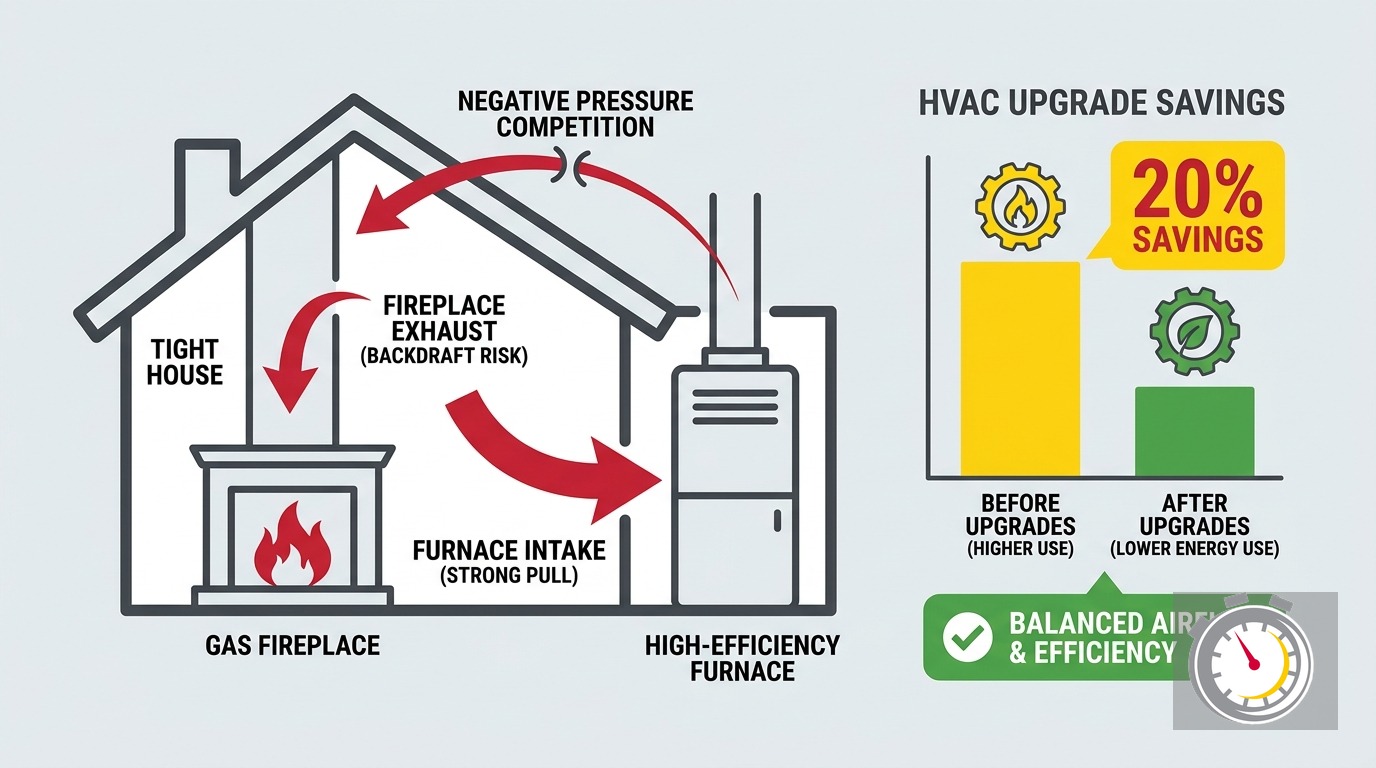
- Replacing an 80% furnace with a 95%+ sealed-combustion unit removes the furnace from the indoor-air equation. Your B-vent gas fireplace becomes the only atmospheric appliance left exposed to house pressure.
- A drop of just 10 Pa of indoor pressure is enough to trigger backdrafting in naturally vented gas appliances. A large range hood can clear that threshold on its own.
- Stack effect increases with temperature difference and building height. At -20°F design temperatures, Minnesota stack effect can depressurize a house before any fan turns on.
- CO above 30 ppm means leave immediately and call an HVAC professional.
- Minnesota deleted the two-permanent-openings method from its mechanical code. Natural-draft appliances need a single direct outdoor opening sized by calculation.
- Fixes range from adding a missing combustion air opening to converting to a direct-vent fireplace to a makeup air unit ($3,000 to $5,000 installed).
The Upgrade That Changes Everything
You replaced your aging furnace last fall. The contractor did solid work. The new 95%+ unit runs clean, heats the house evenly, and the gas bills dropped.
Then a cold January morning arrives. The CO detector trips. The fireplace smells like exhaust. A faint black smudge sits above the firebox.
Nobody connects it to the furnace replacement. They should.
The upgrade most homeowners focus on is efficiency. An 80% AFUE furnace wastes 20 cents of every gas dollar up the flue. A 95%+ unit wastes less than 5 cents. Over a Minnesota winter, that gap shows up clearly on the gas bill.
What the efficiency improvement also does is change the combustion architecture of the house. The furnace is no longer connected to your indoor air supply at all. And that change has a side effect that does not show up on any rebate calculator.
The high-efficiency furnace upgrade is often the trigger. It changes the pressure balance inside your house in a way most contractors do not explain at installation.
What Is the Combustion Air Problem?
Your house is not airtight. Every exhaust fan, clothes dryer, and range hood pushes air out. If replacement air cannot enter fast enough, pressure drops. Naturally vented appliances like a B-vent gas fireplace reverse-flow combustion gases back into the room. That is backdrafting, and it takes very little pressure change to trigger it.
Houses breathe. They exchange air with the outdoors through intentional openings and unintentional gaps. When the rate of outflow exceeds the rate of inflow, the house goes negative. Indoor pressure falls below outdoor pressure.
When that happens to a naturally vented gas appliance, the physics work against you. A B-vent fireplace relies on warm exhaust gas rising through the flue. That column works because warm air is less dense than cool air. When indoor pressure drops, the column weakens or reverses. Outside air pushes down the flue instead of letting exhaust escape.
A drop of just 10 Pa of indoor pressure is enough to cause backdrafting in gas fireplaces and naturally vented water heaters. That threshold is not extreme. A large range hood running on high can approach it alone. Add a bath fan and a running clothes dryer and the pressure drop compounds quickly.
The problem is not new. What changed for millions of Minnesota homes is the removal of one of the appliances that was sharing the pressure load.
Why Does a High-Efficiency Furnace Change the Equation?
Before your furnace upgrade, you had two atmospheric appliances in the house. The old 80% furnace had an open combustion-air grill that acted as a passive pressure inlet. When you replaced it with a sealed 95%+ unit, that inlet disappeared. Your fireplace became the only atmospheric appliance left exposed.
Natural-draft Category I furnaces pull combustion air from the room through an open grill on the combustion chamber. That grill is also a passive pressure opening. It allows a real - if modest - flow of air between the combustion zone and the room. When the house goes slightly negative, the furnace shares the exposure with the fireplace.
A Category IV (90%+ AFUE) furnace should be installed as sealed-combustion and direct-vent: combustion chamber sealed from the room, combustion air drawn from outside via a dedicated PVC pipe. After installation, that furnace is completely pressure-indifferent. It draws air from outside regardless of what is happening inside the house.
The sealed furnace did not create the problem. It removed a buffer. Your B-vent fireplace, which was sharing pressure exposure with the furnace before, now carries the full load alone. Every exhaust fan, every cooking session, every dryer cycle pushes the house toward negative pressure with no furnace combustion-air opening to compensate.
The problem is more acute in a tight modern house. Many Twin Cities homeowners have air-sealed and insulated their homes alongside a furnace upgrade, taking advantage of rebate programs from CenterPoint Energy and Xcel Energy. Tight homes have fewer passive infiltration paths. When mechanical exhaust runs, pressure drops faster and drops further.
Does Minnesota’s Winter Climate Make This Worse?
Yes. Stack effect increases with indoor-outdoor temperature difference. At -20°F design temperatures, Minnesota stack effect can depressurize a house enough to trigger backdrafting before any mechanical exhaust runs. It is one of the most severe combustion-air environments in the country.
The three drivers of house depressurization are wind, stack effect, and mechanical exhaust. Stack effect increases with temperature difference and building height, making Minnesota winters the worst-case scenario for naturally vented appliances.
Stack effect works like this. Warm indoor air is less dense than cold outdoor air. It rises and escapes through gaps at the top of the house. That creates low pressure at the bottom, pulling cold outdoor air inward through lower openings. In a two-story home, the pressure gradient from basement to attic is significant.
At -20°F outdoors with 70°F inside, the indoor-outdoor temperature difference hits 90°F. Stack effect is extreme. The fireplace flue is a vertical channel running through the middle of that pressure gradient. The warm gases trying to rise and exhaust are competing with a strong physical force pushing the opposite direction.
This is why problems surface on the coldest mornings. A homeowner makes breakfast. The range hood runs on high. The dryer is going. The temperature outside is -15°F. Stack effect is already pushing the house toward negative pressure. The range hood tips it past the backdraft threshold. The CO detector trips.
The Minnesota angle matters because it is not a marginal effect. In a Southern climate, stack effect is modest and mechanical exhaust is the primary driver. In Minnesota, stack effect alone can cross the backdraft threshold before a single fan turns on. Add a sealed furnace that no longer provides any pressure relief, and the fireplace flue operates under the most difficult conditions possible.
What Are the Warning Signs of Backdrafting?
Soot staining above the fireplace opening, an exhaust or gas smell near the firebox, CO detector alarms on cold mornings, and a flame that flickers or goes out unexpectedly are all signs of backdrafting. Stop using the appliance and call a technician. Do not wait for a CO alarm to confirm what soot staining already suggests.
Here is the full symptom list to watch for:
- Soot or black staining above the fireplace opening, on the mantel, or on surrounding walls
- Exhaust or gas smell near the firebox when the fireplace is running or has recently shut off
- CO detector alarms, particularly on cold mornings or when range hoods and bath fans run simultaneously
- Pilot or flame that flickers unexpectedly or extinguishes more often than normal
- Condensation or moisture near the flue collar or damper area
- Staining or discoloration on the ceiling above the fireplace
CO levels above 9 ppm over 8 hours are considered unsafe. At 30 ppm or higher, occupants should leave immediately and call an HVAC technician. Do not stay in the house to troubleshoot the source.
Backdrafting and flame rollout are life-threatening. Flame rollout occurs when the space is at such negative pressure that flames are pulled out of the combustion chamber entirely. Soot staining and exhaust odor are reason enough to schedule a service call before any alarm fires - not after.
For more on CO detector placement and the right response protocol when an alarm trips near a gas appliance, see our guide to carbon monoxide safety during furnace season.
Also watch for secondary symptoms. A house under sustained negative pressure faces higher utility bills, poor indoor air quality, and moisture condensing inside wall cavities. If you are seeing unexplained humidity damage alongside fireplace odors, they may share the same root cause.
Can You Test for Depressurization Yourself?
A partial check: yes. Close all windows, run every exhaust fan and the dryer simultaneously, and hold a lit incense stick near the closed fireplace damper. If smoke pulls toward the damper, the house is under negative pressure. A proper diagnostic requires a manometer and a licensed technician, but this test tells you whether to make the call.
The test, step by step:
- Close all windows and exterior doors.
- Turn on all bath fans, the kitchen range hood on its highest setting, and the clothes dryer.
- Let the system run for two to three minutes to reach a steady state.
- Light a stick of incense and hold it near the fireplace damper (with the fireplace off).
- Watch the smoke. If it pulls toward the damper instead of rising, the house is under negative pressure.
You can also hold the incense near the base of the ash door or any unsealed opening to the firebox. Air pulling inward confirms the result.
This is a screening test. It tells you there is a pressure problem. It does not tell you how severe it is, whether the combustion air opening is adequate, or whether the installation is code-compliant. A licensed technician uses a calibrated manometer to measure indoor pressure differentials, identify the sources of depressurization, and determine the right remediation path. That assessment is called a combustion appliance zone (CAZ) test.
While you are inspecting, look for the dedicated combustion air opening. It should be a single permanent opening within 12 inches of the floor, communicating directly with the outdoors or through a dedicated duct. If you cannot locate one, or if it appears blocked by a past remodel, that is a code issue independent of the pressure test result.
What Does Minnesota Code Require?
Minnesota deleted the two-permanent-openings method entirely from its mechanical code. Naturally vented appliances require a single permanent opening within 12 inches of the floor, communicating directly with the outdoors through a dedicated duct. No sharing with the return air plenum, no using the chimney liner annular space.
Minnesota Rules Part 1346.5304 deleted the two-opening method (IFGC 304.6.1) that older installations sometimes relied on. The current requirement is a single permanent opening, properly sized by calculation, directly communicating with the outdoors.
The specific requirements:
- Combustion air ducts must serve a single appliance space. You cannot run a shared duct to multiple appliances.
- The duct cannot terminate in the return air plenum of the forced-air heating system. Combustion air and return air are separate systems.
- The chimney liner annular space cannot supply combustion air. The exception is certain direct-vent appliances listed for solid-fuel fireplaces.
- Sizing uses Worksheet E-1, the Residential Combustion Air Calculation Method in IFGC Appendix E as amended by Minnesota Rules 1346.6012 and 1346.6014.
- A mechanical permit is required for any new gas fireplace installation or wood-to-gas conversion in Minnesota, with required rough-in and final inspections.
Many Twin Cities homes have gas fireplaces installed before these rules took effect, or converted from wood without a permit. The combustion air opening may have been omitted, undersized, or blocked during a subsequent remodel. A CAZ assessment is the tool that surfaces these issues.
One detail worth understanding: if your furnace was replaced after the gas fireplace was already installed, the combustion air calculation should have been redone at that time. Replacing the furnace changes the appliance inventory and the pressure dynamics in the home. That recalculation often does not happen. A homeowner who upgraded to a 95%+ furnace two years ago and has never had a CAZ assessment since is in exactly this situation.
What Are Your Fix Options, and What Do They Cost?
Three options, in order from least to most expensive: add or repair the dedicated combustion air opening, convert the fireplace to a sealed direct-vent unit, or install a makeup air system. The right choice depends on what the CAZ assessment finds and whether you plan to replace the fireplace unit anyway.
Option 1: Add or Repair the Combustion Air Opening
If the CAZ assessment finds no code-compliant outdoor combustion air opening, this is the required first step. A licensed technician cuts a properly sized opening and installs a screened, direct-to-outdoor duct that meets MN Rules 1346.5304 sizing requirements for the appliance BTU load.
Cost varies by construction type, wall material, and access. This is typically the lowest-cost option of the three. It is the right starting point when the pressure problem is moderate, the fireplace unit itself is in good condition, and the missing or undersized opening is the primary gap.
In some homes, adding the opening is sufficient on its own. In homes with very powerful exhaust appliances or unusually tight construction, the opening helps but may not fully resolve the depressurization. The CAZ measurement tells you which scenario you are in.
Option 2: Convert to a Direct-Vent Gas Fireplace
A direct-vent gas fireplace uses sealed combustion. A coaxial pipe runs through the wall or roof. The outer sleeve draws outside air in. The inner pipe exhausts combustion gases out. The combustion chamber is completely sealed from the room.
Direct-vent fireplaces are immune to indoor pressure problems. There is no atmospheric pathway for backdrafting, regardless of how much mechanical exhaust runs. This is the cleanest long-term resolution if the fireplace unit is aging, has already shown backdraft staining or damage, or you want to upgrade the firebox appearance.
Our team is locally owned and operated out of Ramsey, MN, and serves the Twin Cities metro. We can assess whether a direct-vent conversion is a fit for your home and existing framing before you commit to the work.
Option 3: Install a Makeup Air Unit
A makeup air (MUA) system is a powered fresh-air intake, typically sized for the largest exhaust appliance in the house. It delivers preheated outdoor air into the house so mechanical exhaust always has a dedicated supply source. The house stays at neutral pressure regardless of what fans are running.
A makeup air system sized for a 600 to 1,000 cfm range hood runs $3,000 to $5,000 installed. It adds a conditioning load because it brings in outside air that must be heated in winter and cooled in summer. But it solves depressurization for the whole house, not just the fireplace.
This is the right fix when multiple atmospheric appliances are present, when the range hood is a commercial-grade high-cfm unit, or when option 1 alone is not sufficient to reach pressure balance.
If the cost of a direct-vent conversion or makeup air unit is a concern, ask our team about financing options. Northern One Hour offers financing to help you move forward without waiting through another Minnesota winter.
Getting a Professional Assessment
If your CO detector has tripped on a cold morning, if you smell exhaust near the fireplace, or if you replaced your furnace in the last few years without a combustion appliance zone check since, schedule one now.
Northern One Hour is locally owned and operated in Ramsey, MN. We serve Minneapolis, St. Paul, Blaine, Maple Grove, Plymouth, Brooklyn Park, Woodbury, Bloomington, and the broader Twin Cities metro. Our technicians carry combustion analysis equipment and perform CAZ testing as part of a heating system diagnostic. We identify pressure defects, find missing or undersized combustion air openings, and walk you through the options before any work begins.
For a related read on how mechanical exhaust interacts with gas appliance safety, see our post on exhaust fans and furnace backdraft in Minnesota homes. If you are overdue for a seasonal check, our furnace tune-up service includes combustion analysis and a safety inspection.
“Always On Time… Or You Don’t Pay a Dime!(R)”
Call us at (763) 260-6662 or schedule your appointment online.
Frequently Asked Questions
Can my gas fireplace and furnace share the same combustion air opening? +
How do I know if my gas fireplace is backdrafting? +
Does replacing my furnace with a 95%+ model make my gas fireplace unsafe? +
Need a technician now?