
Spray Foam Insulation Combustion Air Problems in Minnesota
Key Takeaways
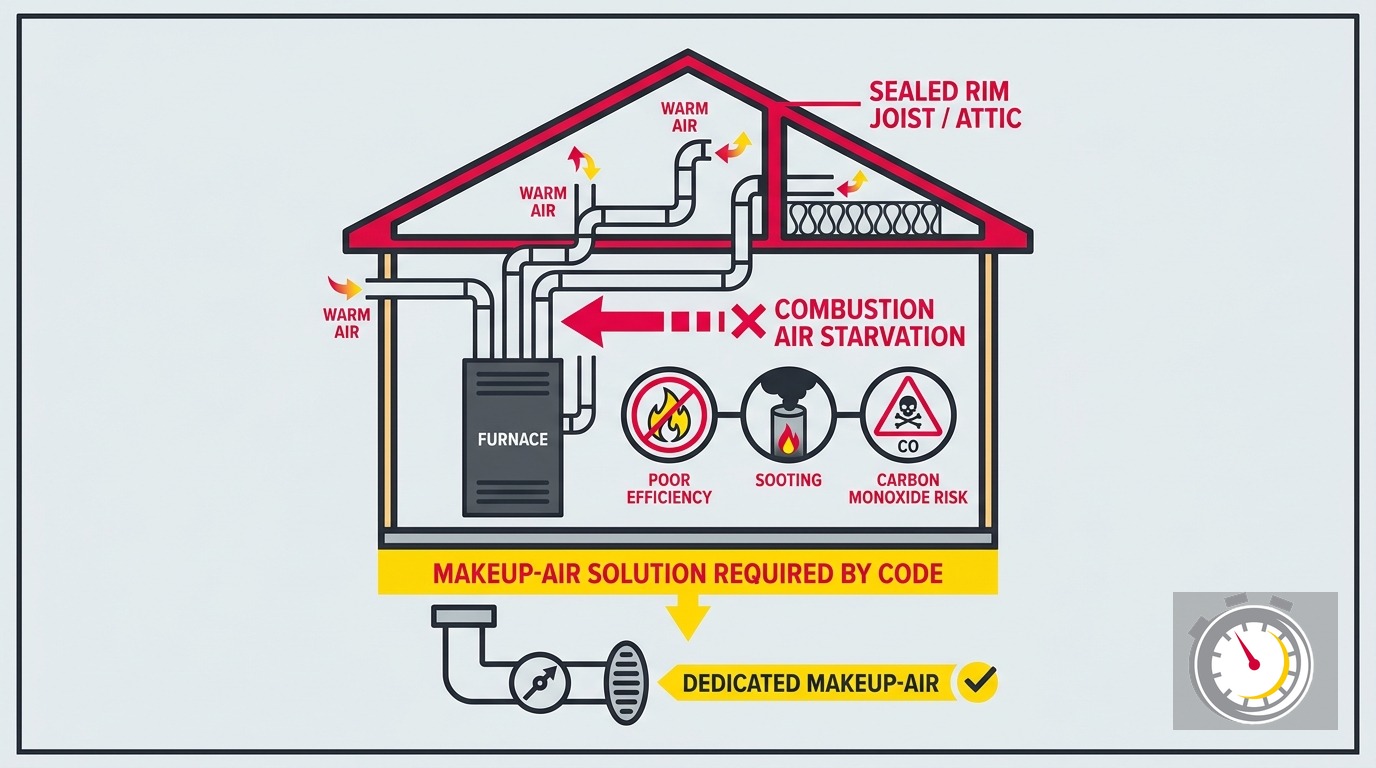
- Atmospheric (natural-draft) furnaces and water heaters pull combustion air from the room they sit in. Spray foam sealing the rim joist removes that air supply.
- The rim joist is the first weatherization target in most Twin Cities homes. The furnace and water heater almost always share the same basement utility room.
- Minnesota code (MN Rules Chapter 1346 / IFGC) requires atmospheric appliances to have adequate combustion air. A tightly sealed space does not comply.
- Warning signs include a pilot light that repeatedly goes out, yellow or orange burner flames, soot near the draft hood or flue collar, and CO detector alarms.
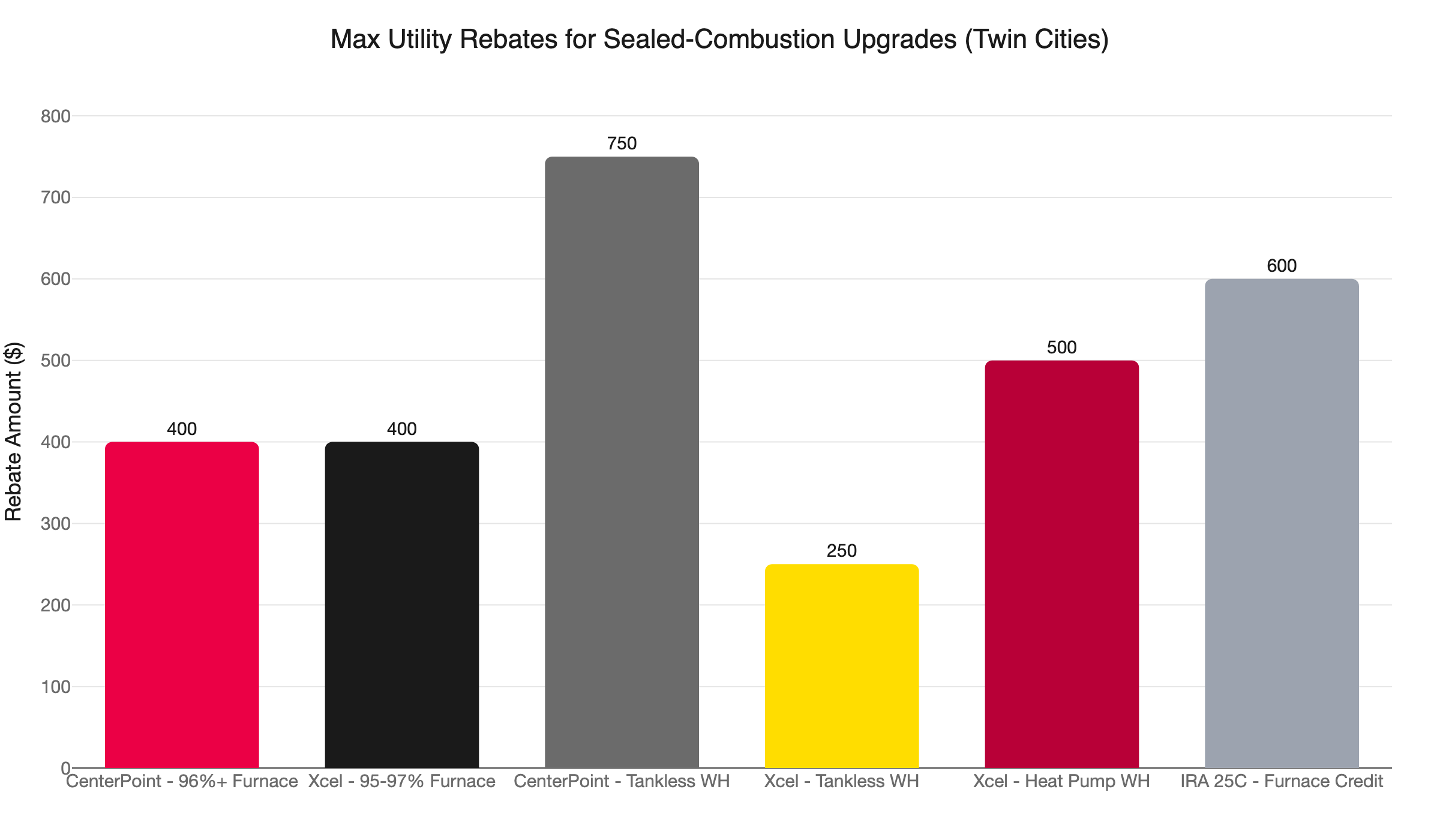
- The permanent, code-compliant fix is sealed-combustion or direct-vent equipment. CenterPoint and Xcel utility rebates plus the IRA 25C tax credit can offset $600 to over $1,750 of upgrade costs.
- Any combustion air modification in Minnesota requires a permit. Work done without one skips the safety review entirely.
A weatherization contractor just finished your basement rim joists. The house is noticeably tighter. Your energy bill should drop this winter. That is good news.
What they may not have told you is that your gas furnace and water heater have been quietly relying on those gaps for decades.
Spray foam insulation combustion air problems are one of the least-discussed risks in the Twin Cities weatherization market. Insulation contractors seal building envelopes. They are not HVAC technicians, and they do not always flag what a tight envelope does to the atmospheric appliances already sitting in your utility room.
This post explains the risk in plain terms: how atmospheric appliances work, what rim joist foam takes away, how to run a quick self-check on your utility room, what warning signs to watch for, and what Minnesota code requires. We will also show you how to turn a forced compliance upgrade into a rebate opportunity.
What Is Combustion Air and Why Does Your Furnace Need It?
The short answer: Combustion air is the oxygen-bearing air your gas furnace or water heater draws in to sustain the burner flame. Without adequate supply, the burner runs oxygen-poor, produces carbon monoxide, and eventually fails to ignite. For an atmospheric appliance, that air comes straight from the room the unit sits in.
An atmospheric appliance, also called a natural-draft appliance, has no dedicated air intake piped from outside. It breathes room air. The draft hood at the top of the unit draws room air in alongside exhaust gases to dilute the flue stream and create the upward pull that moves combustion products out through the chimney.
That design worked reliably for decades in older Minnesota homes. Pre-1990 construction was leaky by default. Air infiltrated through the rim joist, the sill plate, window frames, and every other gap in the envelope. That infiltration replaced the air the furnace and water heater burned. No one planned that partnership. It simply existed.
The natural-draft tank water heater is part of this equation too. Most articles on this topic focus on furnaces. The water heater sitting two feet away has the same air requirement and the same draft mechanism. Both appliances compete for the same pool of room air. When that pool shrinks, both are at risk.
When you spray-foam the rim joist, you end the partnership that kept both appliances running safely.
Why Is the Rim Joist the Hidden Combustion Air Risk in Twin Cities Homes?
The short answer: The rim joist runs the full basement perimeter, directly adjacent to where the furnace and water heater sit. It is the primary infiltration path those appliances were silently borrowing from. Rim joist foam seals it completely, and the appliances are left with only the air already trapped in the utility room.
Most published content on spray foam insulation combustion air problems addresses attic spray foam. That is a real scenario, but it is not the dominant one in the Twin Cities.
Minnesota is basement-heavy. Nearly every metro home has a poured or block foundation with a full or partial basement. The furnace and water heater are almost always in that basement, directly inside the rim joist zone. When a weatherization contractor seals the rim joist, they work within feet of those appliances.
Attic spray foam affects combustion air through a different path. Rim joist spray foam affects the utility room directly. The risk is more immediate because the appliances are in the same space.
There is a permit gap that makes this worse. Spray foam jobs in Minnesota that pull a building permit trigger a review of combustion appliance compatibility. Many rim joist jobs, particularly those done without a general contractor, skip permits entirely. No permit means no inspector and no flag. The homeowner does not know the problem exists until a symptom appears, and by then the risk has been present through multiple heating cycles.
Most Twin Cities homes built before 2000 have an 80% AFUE atmospheric furnace and a natural-draft tank water heater. Both were installed before sealed combustion became standard. Both depend on infiltration air that rim joist spray foam removes.
How Spray Foam Seals Off the Air Supply Your Appliances Depend On
The DOE identifies rim joist and sill plate air sealing as one of the highest-impact weatherization improvements available in a home. Energy auditors in the Twin Cities recommend it first precisely because basement perimeter air leakage is one of the biggest heat loss paths in a Minnesota home.
That is also why it is the most common trigger for combustion air problems here.
Before foam, the rim joist zone runs the full perimeter of the house at the foundation-floor junction. Air moved freely through gaps in that zone. After foam, the utility room is significantly tighter. If the furnace and water heater are both atmospheric units, they are now competing for a shrinking pool of room air.
When the air supply is insufficient, several things happen in sequence. The burner flame pulls harder on available oxygen. The flame burns incompletely, producing more carbon monoxide. Draft reversal risk increases: instead of combustion gases rising and exiting the flue, they can spill back into the room. The draft hood, which is designed to admit dilution air, can also let CO back in when the pressure balance reverses.
A sealed room with two atmospheric appliances running is not a safe operating environment. The building science community is clear on this point. Atmospherically vented appliances have no place in a sealed enclosure. The only compliant long-term solution is sealed or direct-vent equipment.
What Are the Warning Signs of Spray Foam Insulation Combustion Air Problems?
The short answer: A pilot light that keeps going out for no obvious reason, yellow or orange burner flames, soot or black residue near the draft hood or flue collar, CO detector alarms, a furnace that short-cycles or locks out, exhaust smell in the utility room, and new condensation on basement windows after the insulation work.
Watch for all of these after any significant air-sealing project:
- Pilot light repeatedly goes out with no clear mechanical cause, especially in the weeks after the foam installation.
- Yellow or orange burner flame on the furnace or water heater. A properly burning gas flame is blue. Yellow or orange signals incomplete combustion due to insufficient oxygen.
- Soot or black residue around the furnace draft hood or the water heater flue collar. This indicates combustion gas spillage back into the room instead of out through the chimney.
- CO detector alarm during or shortly after a heating cycle. Do not reset it and keep running the appliance. Leave the house and call for service.
- Furnace short-cycles or locks out on ignition fault with no obvious mechanical cause.
- Musty or exhaust smell in the basement utility room when the furnace is running.
- Excessive condensation on basement windows following the insulation work, which can signal a pressure and humidity imbalance in the space.
If any of these appear, do not wait for the next scheduled tune-up. Call us at (763) 260-6662. Our team will check combustion air safety before you run another full heating cycle.
For related safety context, see our post on carbon monoxide safety and your furnace, which covers detector placement, CO sources, and when to evacuate.
Does Your Utility Room Have Enough Combustion Air? The Code Math
Here is a quick homeowner self-check:
- Find the input BTU/hr rating on your furnace nameplate. Common values: 60,000, 80,000, or 100,000 BTU/hr.
- Find your water heater’s input BTU/hr rating. A standard tank heater is typically 36,000-50,000 BTU/hr.
- Add the two together.
- Multiply by 50. That is the cubic footage your utility room must provide.
Example: an 80,000 BTU/hr furnace plus a 40,000 BTU/hr water heater equals 120,000 BTU/hr combined. Multiply by 50: you need 6,000 cubic feet of room volume.
A typical 20 x 15 ft basement utility room at 8 ft ceilings is 2,400 cubic feet. That is 40% of the requirement. Most Twin Cities utility rooms fail this calculation before the spray foam, then fail harder after it.
The duct workarounds that insulation contractors sometimes leave behind do not solve this. A 4-inch combustion air duct provides only about 12.6 square inches of net free area, sufficient for roughly 37,700 BTU/hr at most. That is smaller than most residential furnaces running alone, before adding the water heater load. Small flex duct connections are code violations in most configurations.
When all combustion air must be mechanically supplied, IFGC Section 304.9 requires a minimum of 0.35 CFM per 1,000 BTU/hr of total installed appliance input, delivered from outdoors. Sizing that correctly requires a licensed mechanical contractor with a permit.
Does Minnesota Code Require You to Act?
The short answer: Yes. Minnesota Rules Chapter 1346 governs the state mechanical and fuel gas codes. Gas-fired appliances in tightly sealed homes must be direct-vent, power-vent, or sealed-combustion. Atmospheric draft appliances are not compliant in a tightly sealed space. If your home crosses the tight-construction threshold, the code requires a permitted fix.
The tight-construction trigger under IFGC is 0.40 ACH natural infiltration. Minnesota’s 2020 energy code requires 3 ACH50 or better for new construction. A well-executed rim joist spray foam retrofit on a pre-1990 Twin Cities home can push the whole-house number past that threshold from a single job. Once it does, the KAIR method under IFGC Section 304.5.2 governs, and a mechanical solution is required.
Minnesota also requires combustion air openings and makeup air openings to be separate penetrations. A combined system requires building-official approval. Every combustion air modification requires a permit and must be done by a licensed mechanical contractor. This is not a DIY project and is not something the insulation company should handle without mechanical credentials.
This connects directly to the broader interaction between air sealing and HVAC performance. Our post on air sealing before an HVAC upgrade in Minnesota covers how tightening the envelope affects sizing and equipment selection across a full system replacement.
What Are Your Options for Solving the Problem?
The short answer: Two paths exist. The first is adding code-compliant combustion air ducts sized to your exact BTU load, which keeps your existing equipment. The second is replacing atmospheric appliances with sealed-combustion or direct-vent units, which removes the problem permanently and qualifies for utility rebates.
Path 1: Add Dedicated Combustion Air Ducts
This option keeps your furnace and water heater in place. Two permanent openings are cut to the outside, sized per the code calculation for your combined BTU load. Each must meet the minimum net free area under IFGC. A permit is required, and the work must be inspected.
This makes sense when your appliances are relatively young and you want to preserve existing equipment. But it has a ceiling. You are retrofitting atmospheric appliances that will eventually need replacement. You are still relying on correct draft every heating cycle. And if the utility room is very small, even correctly sized ducts may not satisfy the code volume requirement without additional modifications.
Path 2: Replace with Sealed-Combustion or Direct-Vent Equipment
A sealed-combustion furnace draws air directly from outside through a dedicated PVC intake pipe. It does not breathe room air at all. That eliminates the combustion air problem at the source and makes the appliance fully compatible with a tight building envelope.
High-efficiency furnaces rated 90%+ AFUE are sealed-combustion by design. Power-vent and condensing tankless water heaters are direct-vent by design. Every 96%+ AFUE furnace in production today qualifies for utility rebates.
Installed costs in the Twin Cities: a 96%+ AFUE furnace starts around $6,500 and ranges to $9,100 or more depending on BTU load and model tier. See our furnace replacement cost guide for the Twin Cities for current pricing by tier. Northern One Hour offers financing options for larger jobs. Ask our team when you call.
Can You Stack Rebates When You Upgrade Your Furnace or Water Heater?
The short answer: Yes. A homeowner forced into a compliance upgrade can stack CenterPoint or Xcel utility rebates with the federal IRA 25C tax credit and reduce costs by $600 to over $1,750, depending on the utility provider and equipment selected.
Here is what is currently available in Minnesota:
CenterPoint Energy rebates:
- 94-95.9% AFUE furnace: $300
- 96%+ AFUE furnace: $400
- Power-vent tank water heater (.67 EF+): $250
- Tankless water heater (.87 UEF+): $750
Xcel Energy rebates:
- 95-97% AFUE furnace: $200-$400
- Storage gas water heater (.64+ UEF): $75
- Tankless gas water heater (.87+ UEF): $250
- Heat pump water heater: $400-$500
Federal IRA 25C tax credit: 30% of equipment cost, up to $600, for a qualifying high-efficiency gas furnace. This credit is available through 2032.
Stacking example: a CenterPoint customer upgrading to a 96%+ furnace ($400 rebate) and a tankless water heater ($750 rebate) plus the 25C federal credit (up to $600) captures $1,750 in combined incentives. That turns a forced compliance project into one with a clear payback path.
Sources: Xcel Energy MN Residential Rebate Summary / MN Energy Rebates 2026
For a full breakdown of how these incentives combine, see our HVAC rebate stacking guide for Minnesota homeowners.
What to Do Right Now
If you recently had rim joist spray foam installed in your Twin Cities home, or if you are planning to have it done, here is the action list:
- Identify your appliance types. Look at the top of your furnace and water heater. If you see a metal draft hood with an open gap around the flue pipe, the appliance is atmospheric.
- Run the BTU math. Add the input BTU/hr ratings from the nameplates and multiply by 50. Compare that number to your utility room’s cubic footage. Most rooms fail.
- Check for symptoms. Review the warning sign list above. Any of those signs means you need service before the next heating cycle.
- Do not skip the permit. Whether you add combustion air ducts or replace equipment, the work requires a Minnesota mechanical permit. Licensed contractors handle that as part of the job.
- Call us. Northern One Hour serves Ramsey, Blaine, Maple Grove, Plymouth, Brooklyn Park, Woodbury, Bloomington, Minneapolis, and St. Paul. We are locally owned and operated, and we schedule around your day.
Call us at (763) 260-6662 or book online. “Always On Time… Or You Don’t Pay a Dime!(R)” We back that with a 100% satisfaction guarantee.
Frequently Asked Questions
Is it safe to spray foam a Minnesota basement if I have an atmospheric furnace? +
What does a yellow flame on my water heater mean after spray foam work? +
Do I need a permit to fix a combustion air problem in Minnesota? +
Need a technician now?