
Should I Air Seal Before Replacing My Furnace? Here's Why
Key Takeaways
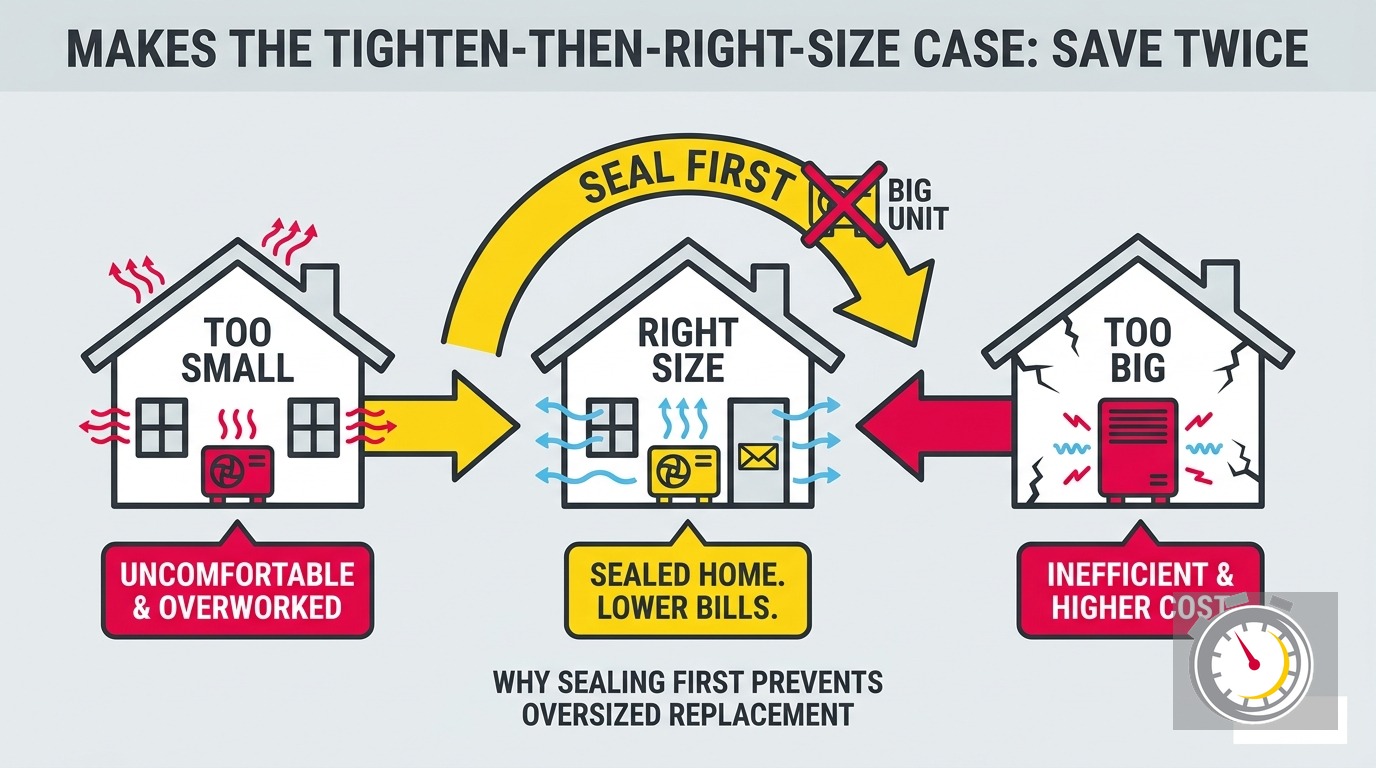
- Air sealing lowers your Manual J heat-load number. A lower load means a smaller, less expensive furnace is the right answer.
- In IECC Climate Zone 6A (Minneapolis, St. Paul, Ramsey, and surrounding suburbs), the load difference between a leaky pre-1990 house and a properly sealed version can be 20-30%. That gap often drops you one full equipment tier.
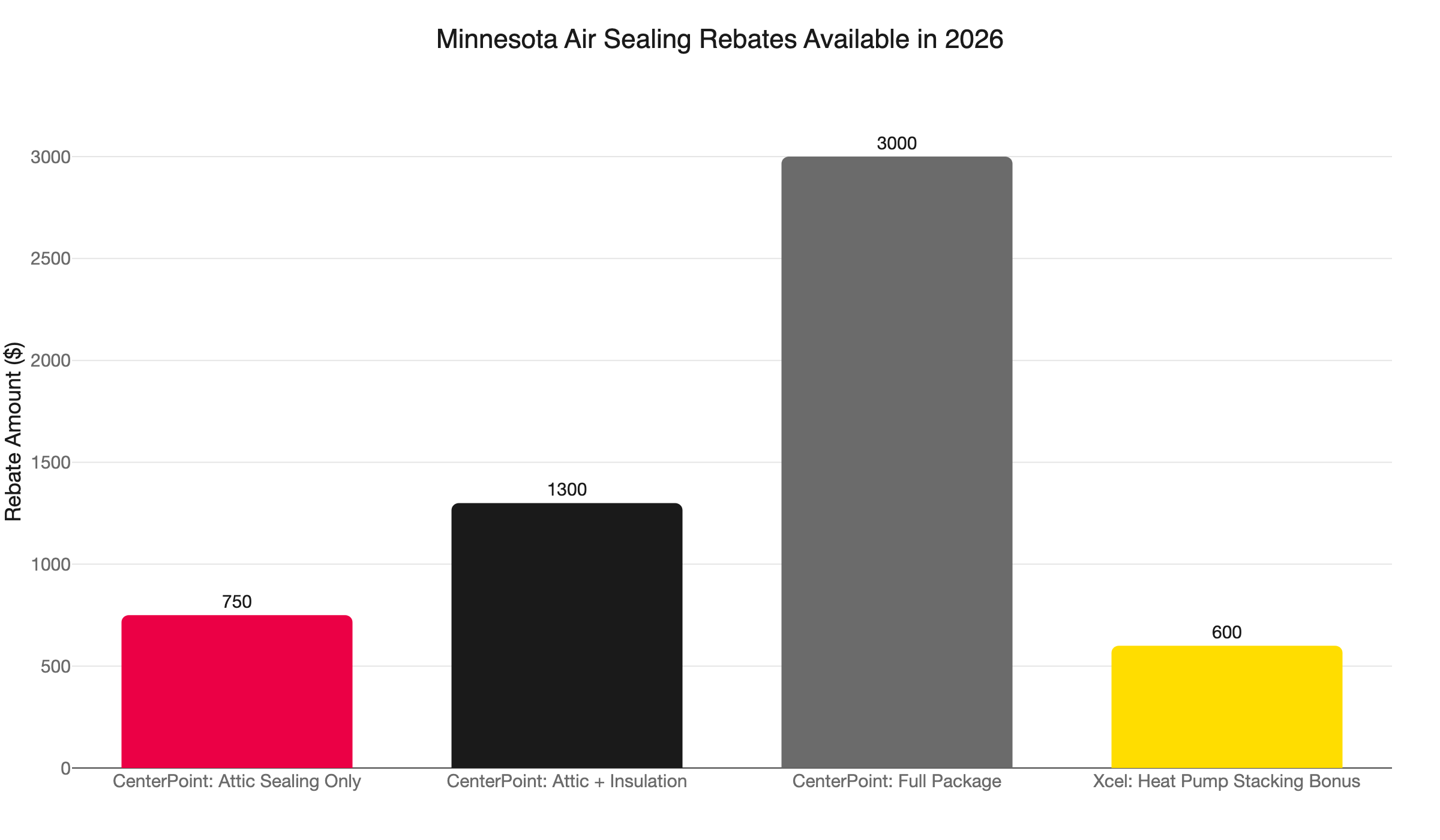
- CenterPoint Energy customers can collect $750 to $3,000 in rebates for air sealing and insulation done before December 31, 2026.
- Xcel Energy customers who add qualifying insulation now can stack a $600 bonus rebate when they install a qualifying heat pump within two years.
- An oversized furnace short-cycles. Repeated short cycles stress the heat exchanger. In a long Minnesota heating season, that stress leads to cracks, and a cracked heat exchanger is a carbon monoxide risk.
- The right sequence: seal first, collect the rebate, run a fresh load calculation, then buy the furnace sized for the house you actually have.
Should I Air Seal Before Replacing My Furnace?
Short answer: Yes. Sealing the building envelope before furnace replacement prevents you from buying a furnace sized for a house you are about to fix. Seal first, then size the equipment to the tighter building. You save on the purchase price and on every heating season that follows.
Most furnace replacement conversations start with a symptom. The unit is old, it runs constantly, or the heating bills keep climbing. The contractor measures the house, quotes a furnace, and the work is done in a day.
What often gets skipped is this: the house itself is part of the sizing equation.
A furnace is sized to meet the heating load of the building it serves. That load is calculated using a method called Manual J. The calculation accounts for insulation levels, window area, and how much air bleeds through the building envelope on a cold day.
According to the U.S. Department of Energy, air leakage accounts for 25-40% of heating and cooling energy use in a typical home. That is not a rounding error. A house losing 30% of its heat through cracks and gaps carries a 30% inflated load calculation. Fix the leaks and the calculated load drops. The furnace you need drops with it.
If you replace the furnace before sealing, you buy equipment sized for the leaky house. You then pay for more capacity than the sealed house will ever demand. That oversize penalty shows up on your gas bill every month for the next 15-20 years.
Why the Order Matters: Manual J and Load Calculations
Minnesota requires Manual J sizing for all residential HVAC work under state building code. The standard uses your home’s infiltration rate as a key input. A leaky house has a high infiltration rate. A sealed house has a lower one. The two rates produce different load outputs and different equipment recommendations.
The Building Performance Association addresses this directly: “Weatherization will significantly reduce a building’s heating and cooling requirements; therefore, it is vital to have an understanding of the calculated load after weatherization.”
If your contractor runs Manual J before you seal, the load number reflects the leaky house. The equipment they recommend is sized for that inflated number. You then seal the house and own a furnace with more capacity than the tighter building will ever need.
Contractors who size by square footage instead of running a proper Manual J commonly end up recommending equipment two to four times larger than the actual calculated load. The overcorrection is worst in houses that have recently been air sealed, because the load drop after sealing is steeper than a square-footage guess can anticipate.
The fix is straightforward. Tell your contractor that air sealing work is planned or already completed. Ask them to run the load calculation after the weatherization, not before. A contractor who pushes back on that request is a contractor worth questioning.
We have a detailed post on how Manual J sizing protects Twin Cities homeowners if you want the full technical picture.
How Much Can Sealing Reduce Your Furnace Size?
Short answer: In a typical pre-1990 Twin Cities home with significant air leakage, sealing can reduce the heating load by 20-30%. At Minneapolis’s -9°F design temperature, a 20-30% load reduction can shift you from one furnace capacity tier to a lower one. Smaller capacity means lower equipment cost upfront and lower operating costs every year after.
The EPA’s ENERGY STAR program documents an average 15% reduction in heating and cooling costs when homeowners air seal and insulate attics, floors over crawl spaces, and basements. The DOE puts the combined range for weatherization paired with an HVAC upgrade at 20-50%.
For a Zone 6A house with a six-month heating season, those percentages represent real savings compounded over years. The total value of proper air sealing goes well beyond the first winter.
The equipment-size implication is the bigger story for day-one cost. If sealing drops your calculated load enough to shift you from a higher capacity tier to a lower one, you spend less on the furnace itself. You also avoid the operational problems that come with an oversized unit, which are covered in the carbon monoxide section below.
Sealing first forces an honest calculation. The furnace that results from that honest calculation is sized to serve the building you are actually heating, not a leaky version of it.
Should I Air Seal Before Replacing My Furnace in Minnesota? The Rebate Case
Short answer: Yes, especially now. Minnesota utility rebates make 2026 the most financially compelling year to seal first. CenterPoint Energy is offering $750 to $3,000 in cash rebates for air sealing and insulation through December 31, 2026. Xcel Energy adds a $600 heat pump stacking bonus for customers who seal this year.
Minnesota’s climate amplifies every argument for sealing. Minneapolis sits in IECC Zone 6A with an ASHRAE 99% winter design temperature of -9°F. That number is the worst-case scenario baked into every load calculation in this market. A house that leaks heat at -9°F loses an enormous amount of energy over a long heating season.
Every BTU that escapes through an attic gap or an uninsulated rim joist inflates the calculated load. More load means more furnace. More furnace means higher equipment cost on day one and more gas burned every winter for the life of the unit.
The utility rebates make the sequence pay for itself before the new furnace even goes in. A homeowner who collects the full CenterPoint air sealing package has already recovered $3,000 of the weatherization cost. The furnace purchase then reflects the sealed load, not the inflated one.
For context on what current furnace installation costs look like at each capacity tier, our furnace replacement cost guide for Twin Cities homeowners breaks down what to expect with equipment and labor included.
What Are the Current Minnesota Rebates for Air Sealing?
Short answer: CenterPoint Energy offers $750 for attic air sealing alone, $1,300 for attic air sealing plus insulation, and up to $3,000 for a full package. Xcel Energy adds a $600 bonus when you pair qualifying insulation with a heat pump installation within two years. Both programs run through the end of 2026.
The CenterPoint program details are on their air sealing and insulation rebates page:
- Attic air sealing alone: $750
- Attic air sealing plus attic insulation: $1,300
- Full package with wall and rim joist sealing: up to $3,000
These rebates are funded through Minnesota’s Conservation Improvement Program, a state-mandated efficiency initiative. Most Twin Cities natural gas customers served by CenterPoint qualify. Rebates are first-come, first-served with a December 31, 2026, postmark deadline.
The Xcel Energy residential rebate program adds a $600 bonus rebate when a qualifying heat pump is installed within two years of completing qualifying insulation or air sealing work. Most Twin Cities homes are served by both CenterPoint for gas and Xcel for electric, so the two programs can be used together.
One note on federal incentives: the Section 25C Energy Efficient Home Improvement Credit for air sealing and insulation was terminated for projects placed in service after December 31, 2025. That credit is not available for 2026 work. The CenterPoint and Xcel programs above are the active incentives this year.
Why an Oversized Furnace Raises Carbon Monoxide Risk
Short answer: An oversized furnace heats the house too quickly, satisfies the thermostat in under five minutes, shuts off, and starts again shortly after. Each rapid on-off cycle thermally stresses the heat exchanger. In a Minnesota heating season, those cycles accumulate fast. A cracked heat exchanger allows combustion gases including carbon monoxide into the living air supply.
Trane’s guidance on furnace short cycling identifies 10-15 minutes as the healthy run cycle for a properly sized furnace. An oversized furnace often runs 3-5 minutes per call for heat. It reaches the thermostat setpoint too fast, shuts off, and the house cools back down. Then the cycle repeats.
Each start-stop cycle involves rapid heating and cooling of the heat exchanger. The exchanger is a thin metal wall separating combustion gases from the supply air stream. Repeated thermal cycling causes metal fatigue. Over time, that fatigue leads to cracks.
In Minnesota, the furnace runs from October through April. An oversized unit accumulates that fatigue every day of a six-month heating season. The failure timeline is shorter than most homeowners expect.
A cracked heat exchanger does not always produce immediate symptoms. Carbon monoxide is odorless. By the time a detector sounds, the damage has been developing for some time.
Sealing the house before sizing the replacement prevents this pattern from starting. A furnace sized for the sealed load runs full cycles, stresses the heat exchanger far less, and lasts longer.
Our post on cracked heat exchanger warning signs in Minnesota walks through what to watch for before a failure becomes a safety event.
Can I Stack the Xcel Heat Pump Bonus With CenterPoint Air Sealing Rebates?
Short answer: Yes, if your home is served by both utilities. CenterPoint handles natural gas for most Twin Cities homes; Xcel handles electric. The two programs run through separate utilities with separate eligibility processes, but they are fully compatible. You collect the CenterPoint rebate now and the Xcel bonus when you install a qualifying heat pump within two years.
The stacking scenario in practice: a homeowner in Ramsey who does the full CenterPoint air sealing and insulation package collects $3,000 upfront. Within two years, they install a qualifying heat pump and collect the Xcel $600 bonus. Total utility rebates: $3,600, before any additional heat pump incentives that may also apply.
That is real money returned on two separate home improvement investments, timed to work together.
The CenterPoint deadline is the time-sensitive piece. The December 31, 2026, postmark cutoff creates urgency. If you are considering a heat pump on any timeline in the next two years, sealing now captures the CenterPoint rebate while starting the full Xcel two-year clock.
What Does Air Sealing Actually Involve?
Short answer: Air sealing addresses gaps that insulation does not cover. A contractor runs a blower door test to measure and locate leakage, then seals those gaps with caulk, spray foam, or rigid foam board. Work focuses on the attic floor, rim joists, and mechanical penetrations. Most jobs on a Twin Cities home take one to two days.
Air sealing and insulation are related but different. Insulation slows conductive heat transfer through walls and ceilings. Air sealing stops convective loss through holes, gaps, and penetrations where conditioned air moves directly into unconditioned space.
The main locations in a typical older Twin Cities home:
- Attic floor penetrations: plumbing and electrical chases, HVAC drops, and the unsealed tops of interior partition walls. These are often the largest single leakage source.
- Rim joists: the band of framing between the foundation wall and the first-floor subfloor. A major air leakage path in pre-1990 homes.
- Recessed lights: older can lights that open directly into the attic are significant leakage points.
- Basement mechanical penetrations: where pipes and ducts exit the conditioned envelope into the rim joist cavity or crawl space.
A qualified weatherization contractor starts with a blower door test. It depressurizes the house and measures total leakage in CFM50 (cubic feet per minute at 50 pascals). That number feeds directly into your Manual J calculation. The contractor then seals the identified gaps before adding insulation over the sealed surfaces.
After the work is complete, ask for a new Manual J before signing anything on a furnace. That calculation is the step that converts your tighter envelope into a specific equipment recommendation. The entire financial case for sealing first depends on running the load calc against the sealed house, not the leaky one.
Ready to Right-Size Your Furnace?
If your furnace is aging and your home was built before 1990, this is the year to get the sequence right. Seal first. Collect the CenterPoint rebate. Run a fresh Manual J against the tighter house. Then buy the furnace the sealed building actually needs.
Northern One Hour is locally owned and operated in Ramsey, MN. We serve homeowners across the Twin Cities, from Minneapolis and St. Paul to Blaine, Maple Grove, Plymouth, and Woodbury. We run accurate Manual J calculations and size equipment to the real load, not a square footage estimate. We back every installation with a 100% satisfaction guarantee and stand by the on-time promise: “Always On Time… Or You Don’t Pay a Dime!(R)”
Financing is available for qualifying equipment. Ask about your options when you call.
Call us at (763) 260-6662 or schedule your furnace assessment online. We will walk through the sequencing with you, help you time the rebates correctly, and make sure the furnace we install is sized for the house you are actually heating.
Frequently Asked Questions
Does air sealing before furnace replacement actually change the equipment size? +
What CenterPoint Energy rebates are available for air sealing in 2026? +
Can an oversized furnace cause carbon monoxide exposure? +
Is the federal tax credit still available for air sealing in 2026? +
Need a technician now?