
AC Drain Line Clogged? A Twin Cities Step-by-Step Guide
Key Takeaways
- A clogged AC drain line is one of the most common reasons an air conditioner stops running in summer.
- The correct order is suction first, then flush. Wet-vac the exterior exit to pull the clog out before you pour vinegar in. Pouring vinegar first can push debris deeper.
- If the AC still won’t run after you clear the line, the float switch is likely still tripped. Water in the pan holds the float elevated. Dry the pan completely before you try to restart the system.
- Twin Cities dew points average around 60°F in June and July, with recorded spikes past 80°F. That humidity load can overwhelm a sluggish drain in hours, not days.
- Most Twin Cities homes have high-efficiency furnaces that produce condensate all winter. Your drain line is active eight or more months a year, not just during cooling season.
- Pouring a cup of distilled vinegar into the access port every one to three months prevents most clogs.
Your AC drain line clogged, and now water is standing in the drip pan under the air handler. Or the system has shut off and won’t restart. Both are fixable problems. This guide walks you through clearing the line correctly. It also covers one thing most guides skip: what to do when the AC still won’t run after the flush.
What Does the AC Condensate Drain Line Do?
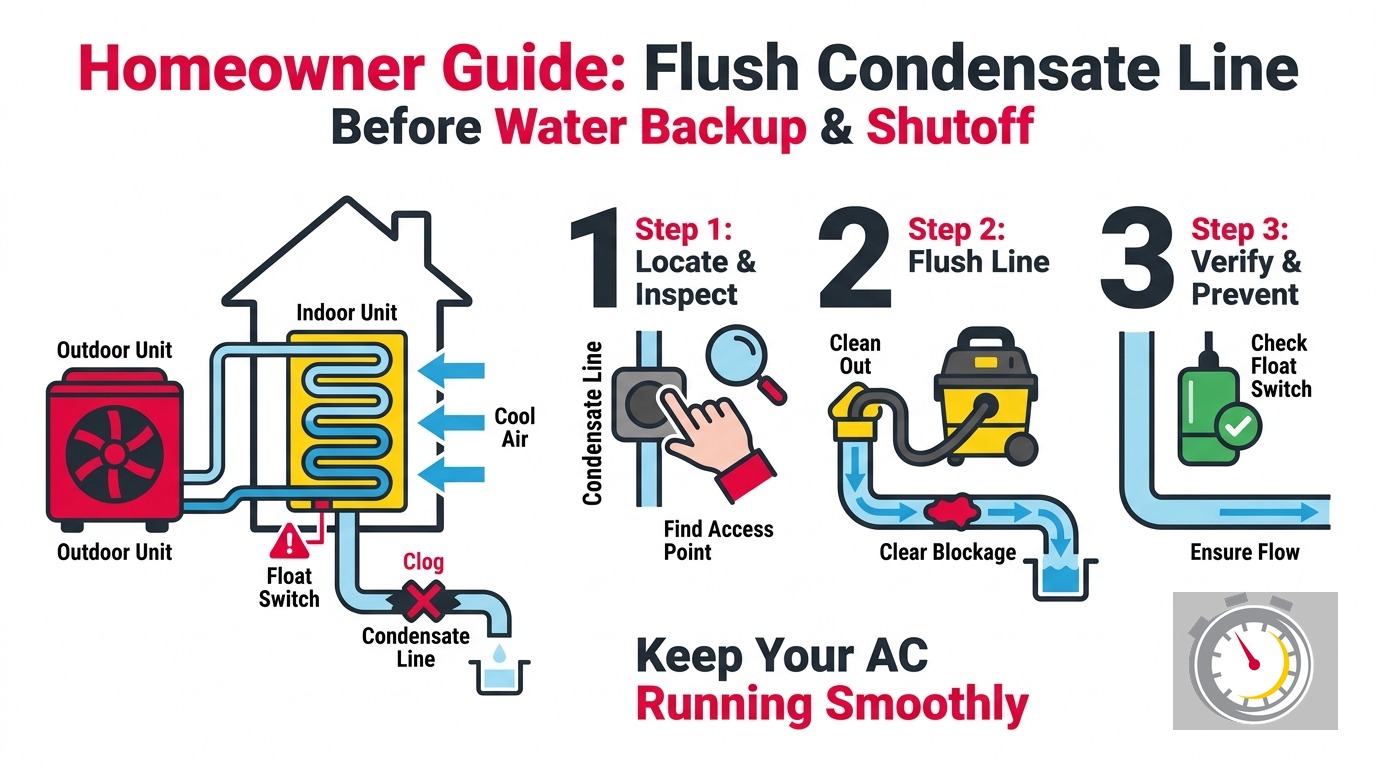
Short answer: Your air conditioner removes moisture from indoor air as it cools. That moisture drips off the evaporator coil into a drain pan. Then it flows out through a PVC pipe called the condensate drain line. A clog in that pipe causes water to back up into the pan and eventually into your home.
Your air conditioner does two jobs at once. It lowers the air temperature, and it removes humidity from the air. That moisture drips off the cold evaporator coil and falls into a shallow pan beneath the air handler. From there, it drains out through a narrow PVC pipe, usually three-quarter-inch diameter. That pipe exits through the foundation wall, into a floor drain, or near the outdoor unit.
The inside of that pipe stays wet and dark year-round. Over time, algae, mold, and mineral deposits build up inside. A partial blockage restricts flow. Water fills the pan faster than it can drain out.
When the pan fills, the float switch trips. The float switch is a small safety device inside or just above the drain pan. When rising water lifts the float, the switch cuts power to the system. The AC turns off completely. It will not restart until the pan dries out and the float drops.
Signs Your AC Drain Line Is Clogged
Watch for these warning signs:
- Water in the drip pan. Even a shallow pool means the drain is not keeping pace.
- Water stains on the ceiling or walls near the air handler. An overflow that goes unnoticed can cause serious structural damage.
- A musty or mildewy smell near the air handler or from the vents.
- Your AC shuts off without warning and won’t come back on. If the thermostat is set correctly and there is no error code, a tripped float switch is a likely cause.
- Gurgling sounds from the air handler cabinet as the system cycles off.
If the AC shuts off unexpectedly and won’t restart, our guide on troubleshooting an AC that is not blowing cold air in the Twin Cities covers more potential causes. And if you are seeing water drip inside the house, our post on AC drainage and water leaks in Twin Cities homes covers how to trace the source.
Why Does Minnesota Get AC Drain Line Clogs Faster?
Short answer: High humidity means high condensate volume. Twin Cities summers regularly push dew points past 70°F, and occasionally past 80°F. A drain line with partial buildup can handle an average day but fail fast on a peak humidity day. Most guides are not written for that load.
Minnesota DNR dew point records show the Twin Cities regularly sees dew points climb above 70°F during summer heat events. In late July 2026, the metro hit a near-record 81°F dew point overnight. At that humidity level, your air conditioner is pulling moisture out of indoor air at a high rate every hour it runs. A drain line at 70 percent capacity may limp through a typical day. On a day like that, the pan can fill in a matter of hours.
This is also why a clog seems to appear from nowhere. The buildup forms gradually over weeks. The first hot, muggy Minnesota stretch is what tips the pan over. If the guide you read was written for a southern climate, it likely does not account for the speed or volume of a Minnesota humidity event.
What You Will Need Before You Start
Gather these before you open the access panel:
- Wet-dry vacuum with a hose
- A rag or duct tape to seal the hose to the drain exit pipe
- Distilled white vinegar (one cup)
- A small funnel or measuring cup
- Old towels for soaking up standing pan water
- Flashlight
- Safety glasses
Set the thermostat to OFF before you start. Then cut power to the air handler at the circuit breaker. Do not work around a live unit when there is water in the pan.
How Do You Unclog an AC Drain Line, Step by Step?
Short answer: Use a wet-vac at the exterior drain exit to pull the clog out first. Then flush from the access port near the air handler with distilled vinegar. The order matters. Pouring liquid in first can push debris deeper if nothing is pulling it through from the other end.
Step 1: Locate the condensate drain exit. This is a PVC pipe that exits your home somewhere. On most Twin Cities homes, it comes through the foundation wall near the outdoor unit, or empties into a floor drain or utility sink. Trace the pipe from the air handler if you are not sure where it ends.
Step 2: Seal the wet-vac hose to the exit pipe and run it for 60 to 90 seconds. Wrap a rag or tape around the joint to create a tight seal. Running suction at the exit pulls the clog toward you rather than pushing it deeper. Suction at the exit before any flushing is the correct clearing sequence for a condensate line.
Step 3: Find the access port on the line near the air handler. This is usually a T-shaped fitting or a capped stub on the PVC pipe. It is typically inside the utility closet, near the bottom of the air handler cabinet. Remove the cap.
Step 4: Pour one cup of distilled vinegar into the access port. Vinegar breaks down algae and mineral deposits. It does not damage PVC. Let it sit for 15 to 30 minutes, then flush with a cup of clean water. A vinegar flush between professional visits is standard preventive maintenance for a condensate drain.
Step 5: Dry the drip pan completely. Use towels to remove all standing water. This step is critical. The float switch will not drop until the pan is dry. If water remains in the pan, the system will not restart even after the drain is clear.
Step 6: Restore power and test. Turn the circuit breaker back on. Set the thermostat to cooling mode. The system should respond within a minute or two. If it does not start, read the next section before calling anyone.
Why Won’t My AC Turn On After I Cleared the Line?
Short answer: The float switch is still tripped. Water in the drain pan holds the float elevated even after the drain is clear. The system will not restart until the pan is completely dry and the float can drop freely. Clearing the drain is not the same as drying the pan.
This is the situation that brings homeowners back to search engines in frustration. The flush worked. The vinegar went through. The exterior exit looks clear. But the AC still won’t run.
Here is what to check:
1. Find the float switch. It is a small device, usually about the size of a matchbook. It mounts inside the drain pan or on the drain pipe just above the pan. It looks like a small white or black cylinder.
2. Confirm the pan is genuinely dry. A quick wipe is not always enough. Use a dry cloth to get the pan as dry as possible. Then tilt the float gently. It should drop freely. If it sticks, try freeing it by hand.
3. Check for a secondary drain pan. Some air handlers have two pans: a primary pan under the evaporator coil and a secondary safety pan under the entire unit. The secondary pan may have its own float switch. Dry both pans before you try to restart.
4. Reset the system. Set the thermostat to OFF. Wait 30 seconds. Set it back to cooling mode. Some float switches also have a small manual reset button on the switch body itself.
5. Wait five minutes. Many systems have a built-in restart delay after a safety shutoff. If the AC still won’t start after five minutes, the problem is likely not the drain line. At that point, call a technician.
The float switch behavior after a drain flush is almost never explained in online guides. Most articles stop at “flush the drain and call a pro if it doesn’t work.” Knowing what the switch does and what resets it can save you an unnecessary service call.
Does My High-Efficiency Furnace Have the Same Clog Risk?
Short answer: Yes. High-efficiency furnaces at 90% AFUE or above produce condensate as a byproduct of combustion. That condensate flows through the same drain line or a connected one. In Minnesota, where most newer homes have high-efficiency furnaces, the drain is active eight or more months a year, not just in cooling season.
Most homeowners think of the condensate drain as an AC-season concern. It is not. High-efficiency furnaces can produce several gallons of condensate per day during heating season. Almost every newer Twin Cities home has a 90%+ or 95%+ AFUE furnace. That means condensate has been moving through the drain pipe all winter. By July, a partial clog may already be developing from months of heating season use.
The practical takeaway is simple. Add a condensate drain flush to your fall furnace checklist, not just your spring AC checklist. If your system has not had a professional tune-up since last season, it is worth scheduling one now. Our air conditioning maintenance service includes a drain inspection as part of every seasonal visit.
How Do You Keep the Drain Line Clear All Season?
Short answer: Flush with one cup of distilled vinegar through the access port every one to three months during cooling season. Change your air filter on schedule. A clean filter means less debris reaching the evaporator coil, and less debris means less material feeding algae growth in the drain line.
ENERGY STAR recommends inspecting the condensate drain during your spring AC tune-up. A plugged drain can cause water damage and raise indoor humidity levels. Flushing the drain every few months and changing filters every three months limits the buildup that leads to clogs.
A dirty evaporator coil makes things worse over time. Sludge from the drain line can coat the coil. A coated coil forces the system to work harder, which drives up energy bills. Keeping the drain clear and the filter fresh is one of the cheapest maintenance steps you can take on an AC system.
For a full checklist of steps that extend the life of your air conditioner, see our post on 5 maintenance tips to extend your AC’s lifespan.
Is Your Condensate Discharge Up to Minnesota Code?
Short answer: Minnesota code requires condensate to exit through an indirect waste connection with an air gap. It cannot discharge directly into a drain system without one, and it cannot drip over a public walkway or sidewalk. If your pipe exits through the foundation and drips onto your front steps, that may not meet current code.
Minnesota Rules 4714.0814 require condensate to discharge to a properly trapped and vented receptor, the tailpiece of an approved plumbing fixture, or an exterior location approved by the Minnesota Pollution Control Agency. Condensate waste cannot drain over a public way.
Most professionally installed systems already meet this requirement. Older homes with original drain setups are worth a second look, especially if the pipe exits through the foundation and drips onto a concrete stoop or shared walkway. Flag it to your technician at the next service call.
No permit is required for homeowner drain maintenance. Vinegar through the access port and wet-vac suction at the exterior exit are standard tasks any homeowner can do. The permit requirement applies when the drain line itself is rerouted or reconnected to the plumbing system.
When Should You Call a Pro?
Short answer: Call if the wet-vac and vinegar flush did not clear the line, if the pan refills within a day or two, or if the float switch is confirmed dry but the system still won’t run. Any water that has reached drywall or flooring needs professional assessment right away.
Call Northern One Hour if:
- The flush did not clear the line and the pan keeps filling back up.
- You see mold growth or water that has reached drywall, flooring, or insulation.
- The float switch is dry and confirmed free, but the system still won’t start.
- Water appears in the secondary drain pan. That usually points to a cracked primary pan or a serious overflow, not just a blocked line.
- Your system has not had a drain inspection in over a year. A professional flush also covers coil condition, refrigerant levels, and electrical connections that vinegar alone won’t replace.
We are locally owned and operated. Our team serves the Twin Cities metro, including Minneapolis, St. Paul, Ramsey, Blaine, Maple Grove, Plymouth, Brooklyn Park, Woodbury, and Bloomington. Every service visit is backed by our “Always On Time… Or You Don’t Pay a Dime!(R)” guarantee. We show up when we say we will, or you don’t pay.
Call (763) 260-6662 or schedule your AC service online. If water is already backing up in the pan, don’t wait. One muggy Minnesota afternoon can turn a partial clog into a water damage problem.
Frequently Asked Questions
How do I know if my AC drain line is clogged? +
Can I unclog my AC drain line myself? +
How often should I flush my AC drain line? +
Why won't my AC turn on after I cleared the drain? +
Need a technician now?