
AC Drain Pan Full of Water: Primary vs. Secondary Pan?
Key Takeaways
- An AC drain pan full of water is not one problem with one answer. Which pan is full is the first question to answer.
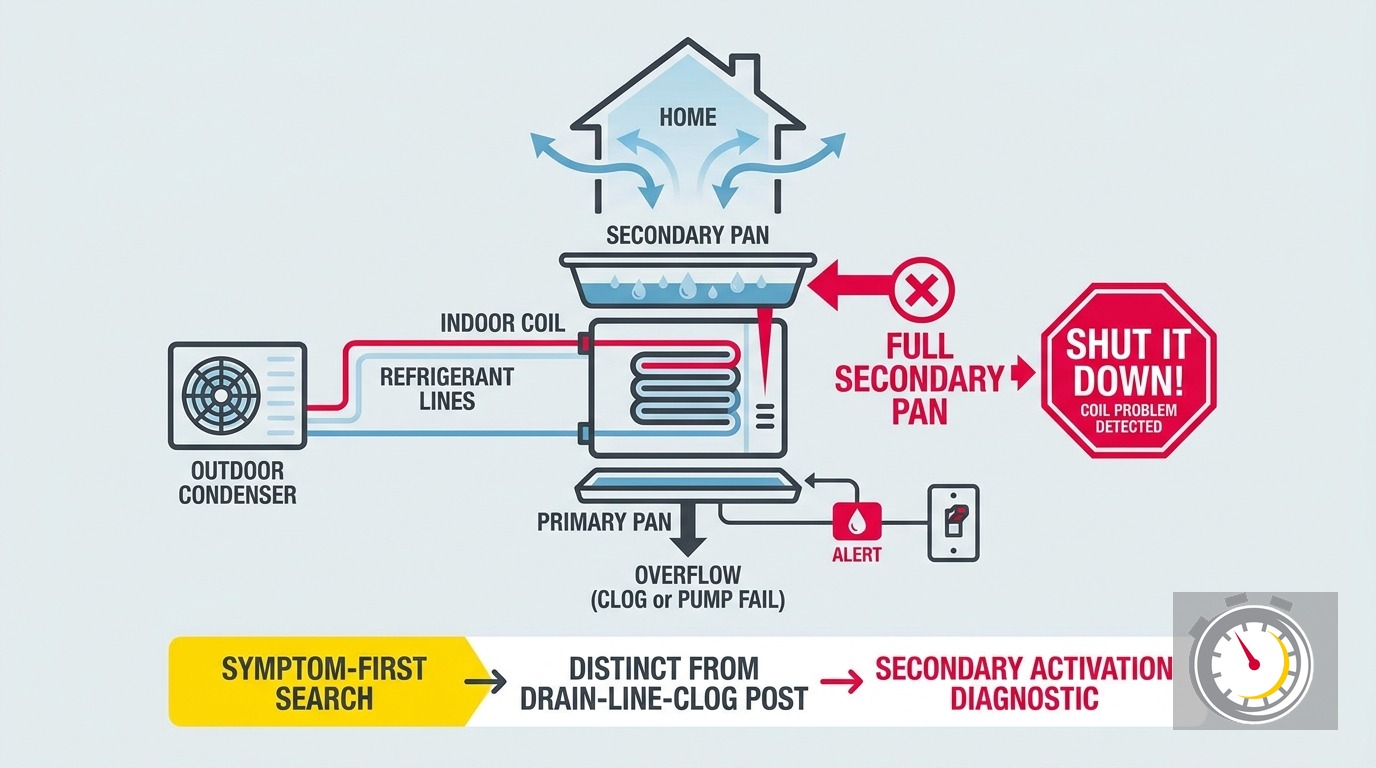
- The primary pan sits directly under the evaporator coil. It handles condensation every cooling cycle. Water there usually means a clog, a failed condensate pump, or a leveling issue.
- The secondary pan sits under the entire air handler and should always be bone dry. Water there means the primary system already failed, or something is happening with the coil itself.
- A frozen evaporator coil can overwhelm both drain pans when it thaws. That is a coil problem, not a drain problem. Clearing the line will not fix it.
- If the large overflow pan has water in it, turn the system off before you do anything else.
- Attic AC installations are a structural risk when the secondary pan activates. Treat them as emergencies.
Which Pan Do You Have?
Two pans, two different jobs. The primary pan sits under the evaporator coil and collects condensation during every cooling cycle. The secondary pan sits under the air handler and should always be dry. Which pan has water determines whether this is a maintenance call or a shut-it-down-now situation.
Most residential forced-air AC systems have both pans. The primary pan is the smaller one. It lives inside the air handler cabinet, directly under the evaporator coil. You usually need to remove an access panel to see it.
The secondary pan is larger. It sits under the entire air handler unit. Some technicians call it the overflow pan or the auxiliary pan. Under a properly working system, it stays completely dry, all season.
Water in the primary pan points to a drainage problem. Water in the secondary pan points to a drainage failure, or something more serious happening upstream at the coil. These two outcomes lead to different repairs, different urgency levels, and sometimes a different technician call entirely.
Getting this right saves time and money. A homeowner who calls for a drain clog and actually has a coil problem gets the drain cleared and watches the same symptom return. The pan location is the sorting question. Everything else flows from it.
What Is the Primary Drain Pan?
The primary drain pan catches condensation that drips off the evaporator coil during normal cooling. It drains continuously through a condensate line to a floor drain or outdoor discharge point. Water in this pan means drainage has slowed or stopped. The cause is almost always a clog, a failed pump, or a pan that has shifted out of level.
The drain line exits the primary pan, runs to a trap, and terminates at a discharge point. Properly installed lines are pitched at least 1/8 inch per foot so water flows away from the pan. A flat or back-pitched line holds water and creates the conditions for algae and mold growth inside the pipe.
Most well-installed systems include a float switch in the primary pan. When water reaches a set level, the float switch cuts power to the unit before the pan overflows. If the float switch is missing, wired incorrectly, or has failed, the primary pan overflows into the secondary pan below.
What Is the Secondary Drain Pan?
The secondary pan is a safety device, not a normal drainage component. It catches overflow only if the primary drain system fails. It should hold zero water during normal operation. Any water in it means the primary system already overflowed, or the coil produced more meltwater than both systems could handle at once.
Minnesota Mechanical Code 307.2.3 requires a secondary pan or overflow switch wherever condensate overflow could damage building components. The pan must be at least 1.5 inches deep. It must also be at least 3 inches larger than the unit in each horizontal direction, made of corrosion-resistant material.
The secondary pan has its own drain line to a separate, conspicuous discharge point. IRC 2024 M1411.3 prohibits the secondary line from sharing the primary drain line. If both pans drain to the same pipe, one clog defeats both protection systems at once.
Why Is My Primary Pan Full of Water?
A clogged drain line, a failed condensate pump, or an out-of-level pan are the three most likely causes. All three are maintenance-category repairs. You generally don’t need to shut the system off while waiting for service, unless the water is close to spilling into the secondary pan.
Clogged drain line. Algae, mold, and airborne dust accumulate inside the condensate line over a cooling season. Even a partial clog slows drainage and backs up the primary pan. Flushing the line with distilled white vinegar every few months helps prevent buildup. An established clog usually requires a technician to clear properly.
Failed condensate pump. Basement installations that can’t drain by gravity use a small electric pump. When the pump fails, water fills the primary pan and eventually overflows.
Out-of-level pan. An air handler that has settled or shifted can tilt the primary pan. Water pools at the low end instead of flowing toward the drain outlet. This looks like a clog but isn’t one.
One less obvious factor is coil fouling. A coil matted with dust and debris restricts airflow and runs colder than it should. A colder coil collects more moisture per hour. Even with a clear drain line, a fouled coil can produce more condensate than the system was designed to handle continuously.
For a step-by-step walkthrough on diagnosing and clearing a blocked line, see our post on fixing a clogged AC condensate drain line.
Why Is My Secondary Pan Full of Water?
A full secondary pan means the primary drainage system already overflowed, or a frozen evaporator coil thawed and flooded both pans at once. These are different problems with different repairs. Either way, the immediate response is the same: turn the system off.
TheUnclog frames the secondary pan correctly: “The large emergency pan beneath the unit should normally be dry. Standing or rising water there means the normal drainage path is slow, blocked, damaged, or unable to keep up.”
That description covers the overflow scenario. But it also describes what happens after a coil freeze. A frozen coil thaws and dumps a large, sudden volume of water. Both drain systems get overwhelmed at once. The secondary pan fills not because the primary line clogged, but because the coil created more water than both drains were designed to handle in a short window.
A slow rise in the secondary pan suggests a gradual primary clog. A sudden large volume suggests a coil thaw. Both require the same immediate response, but the repair call is different.
Why a Full Secondary Pan Can Signal a Coil Problem, Not a Drain Problem
When an evaporator coil freezes, it builds ice over hours or days. When the system cycles off, or when the ice becomes thick enough to restrict airflow, the ice melts. The meltwater is sudden and large in volume.
AceHVAC puts it plainly: “When evaporator coils freeze, they produce excessive condensation when they thaw. This overwhelms both primary and secondary drain systems.”
Clearing the drain line does nothing here. The primary line can be completely clear. The coil created more water than both drains could move in that amount of time. The repair starts at the coil, not the drain.
Three things cause an evaporator coil to freeze:
- Low refrigerant. When refrigerant pressure drops below the design range, the coil surface falls below freezing. Moisture in the air turns to ice on the coil surface. Refrigerant doesn’t run out on its own. A low charge means there is a leak somewhere in the system.
- Restricted airflow. A severely dirty air filter, a blocked return vent, or a dirty blower wheel slows warm air across the coil. The coil stays too cold and ice forms.
- Dirty coil surface. Dust and debris on the coil act as insulation. Airflow through the coil drops, the coil temperature drops, and icing follows.
Running the system with a coil problem doesn’t just produce more water. It delays a refrigerant repair that will only get more expensive. See our post on frozen evaporator coil causes and what to do for the full breakdown.
What If My AC Evaporator Coil Is Frozen?
Turn the system off completely. Set the thermostat to “off” or “fan only.” Do not run cooling cycles while the coil is iced. TheUnclog is direct: “A frozen coil is not fixed by clearing the drain alone. If cooling is weak, airflow is low, or you see ice, turn the system off.”
After the coil thaws - usually two to four hours - check the air filter. A severely restricted filter is sometimes the only fix. Replace it, let the system dry, and restart. If the coil refreezes with a clean filter installed, the cause is almost certainly refrigerant.
North Country Aire lists the key indicators of a refrigerant leak in Minnesota homes: high indoor humidity, noticeably weak cooling output, hissing or bubbling sounds near the indoor unit or line set, and oily residue at refrigerant line fittings. If you notice any of these, call before running the system again.
Our post on AC refrigerant leak signs in Minnesota covers each warning sign in detail.
What Minnesota Homeowners Need to Know About AC Drain Pans
Minnesota’s climate creates condensate risk factors that national troubleshooting guides rarely address.
High humidity in July and August. The Twin Cities regularly see high dew points mid-summer. More humidity means more condensate produced per hour of runtime. A drain system that handled light loads in May can overflow in August with just a partial restriction in the line.
Cottonwood and pollen seasons. Every spring, the Twin Cities get a heavy airborne pollen and cottonwood load. That debris coats evaporator coils faster than in most other climates. A coil that was clean in September can have meaningful fouling by June. Fouled coils restrict airflow, lower coil surface temperatures, and increase the risk of icing and overflow when summer humidity peaks.
Copper line stress from thermal cycling. Minnesota’s temperature swings - subzero winters to humid summers - stress refrigerant lines and coil connections every year. Small leaks develop at brazed fittings over time from repeated expansion and contraction. These leaks are subtle at first. By the time a frozen coil fills both drain pans, the refrigerant charge may already be significantly low.
Basement vs. attic placement. Most Twin Cities homes have the air handler in the basement. A primary pan overflow there is a wet floor and a service call. Inconvenient, not catastrophic. The bigger basement risk is a failed condensate pump, since gravity drainage often isn’t possible. Older homes that added central air to an existing boiler system may have an attic air handler instead, and the consequences of an overflow there are far more serious.
What About Attic AC Systems?
An attic air handler with a full secondary pan is a structural emergency. Condensate overflow in an attic saturates insulation, rots sheathing, and damages the ceiling below. Turn the system off immediately and call. Do not run it while waiting for the technician.
Structure Tech Home Inspections notes that float switches are standard practice in Minnesota attic installations for exactly this reason. A properly installed and wired float switch shuts down both the compressor and the blower when the secondary pan activates.
A common wiring deficiency worth knowing: some float switches are wired to disable only the compressor. The blower keeps running. That means the system keeps pulling humid air across the problem coil while the pan fills. If you’re unsure how your float switch is wired, ask a technician to verify it at your next service call.
What Does Minnesota Code Require for Condensate Drains?
Minnesota follows the International Mechanical Code with state amendments. Equipment installed where overflow could damage the building must have a secondary pan with a separate drain, a shutoff switch, or both. The secondary drain line must be independent of the primary. They cannot share the same pipe.
Minnesota Mechanical Code 307.2.3 gives installers four compliance paths: an auxiliary pan draining to a conspicuous point, an overflow drain on the equipment pan itself, an auxiliary pan with a UL 508-listed water-level shutoff switch, or a standalone UL 508 shutoff device in the primary drain.
The “conspicuous location” requirement is intentional design. When the secondary drain terminates above a window or over a walkway, a drip alerts someone before the pan overflows. That visible drip is the warning sign the system is designed to produce.
Bryan Orr at HVAC School confirms these secondary protection requirements apply to all condensate-producing equipment, including rooftop units and ductless mini-splits, not only standard split systems.
When to Call Northern One Hour
A clogged primary drain line is a scheduled service call. Most are cleared and the system is back running the same visit. A single tune-up visit, which includes condensate system inspection and clearing, runs $95-$250.
But several situations warrant a faster call.
Call now if:
- The secondary overflow pan has any water in it
- You see ice on the indoor unit or refrigerant lines
- Your AC is running but cooling is noticeably weaker than usual
- You hear hissing or bubbling sounds near the indoor unit or line set
- The air handler is in the attic and any pan has water
Schedule a service call soon if:
- The primary pan had standing water but the drain now seems clear
- Your system hasn’t had condensate system service in more than a year
- You replaced the air filter and the coil refroze anyway
Northern One Hour is a locally owned and operated HVAC company in Ramsey, MN, serving homeowners throughout the Twin Cities, including Blaine, Maple Grove, Plymouth, Brooklyn Park, Woodbury, Bloomington, Minneapolis, and St. Paul. Our technicians show up when they’re scheduled - “Always On Time… Or You Don’t Pay a Dime!(R)” - and they’ll tell you exactly what caused the problem and what the repair costs before any work begins.
Call (763) 260-6662 or schedule your visit online.
Frequently Asked Questions
Is it normal for an AC drain pan to have some water in it? +
Can I clear the drain line myself to fix a full AC pan? +
Why is my secondary drain pan full even though my AC seems to be cooling? +
How much does it cost to fix an AC drain pan issue in the Twin Cities? +
Need a technician now?