
AC Condensate Pump Not Working Basement: Causes and Fixes
Key Takeaways
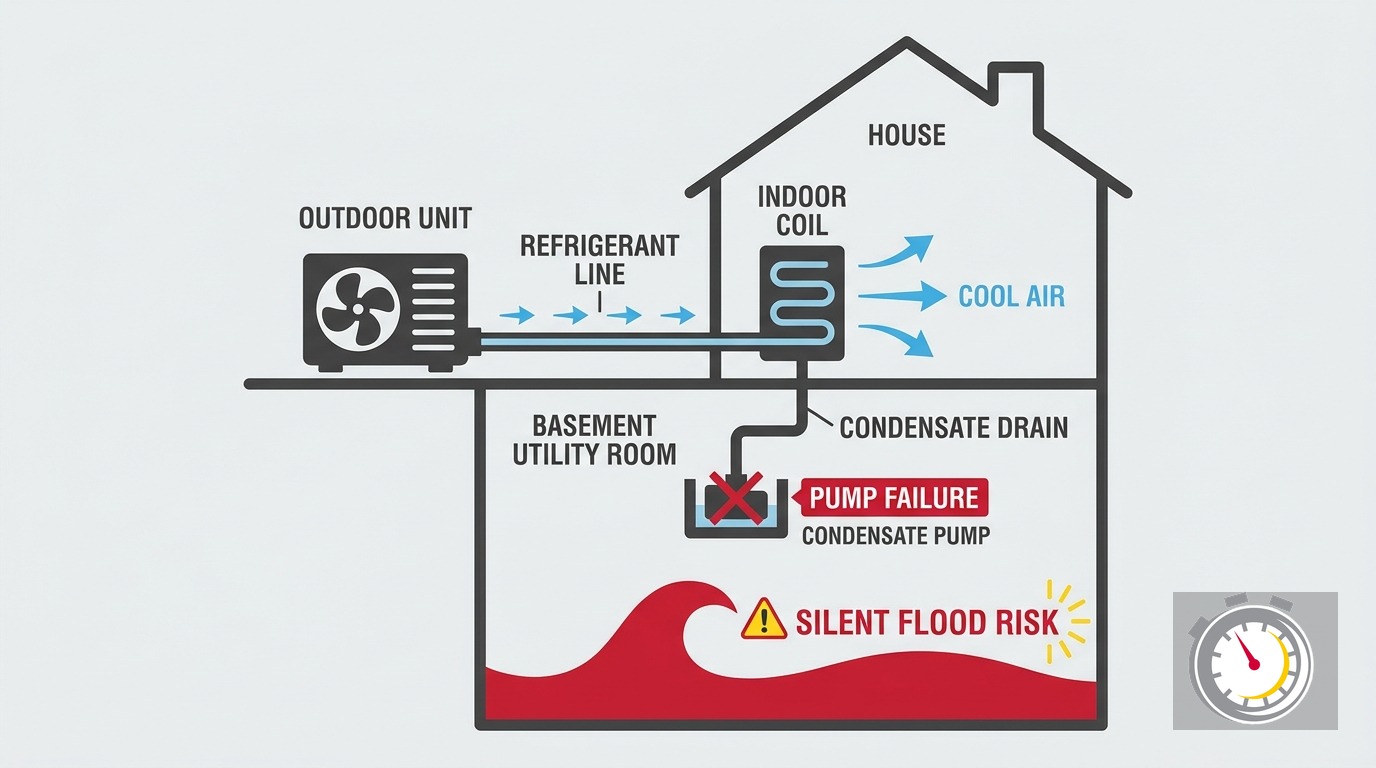
- An AC condensate pump not working in your basement is a silent flood risk. Unlike a first-floor failure that drips onto a ceiling, a basement overflow spreads across a concrete floor and behind walls.
- High-efficiency (90%+ AFUE) furnaces produce 5-10 gallons of condensate per day during heavy heating use. The pump handles water in January just as much as in July.
- The EPA recommends drying water-damaged areas within 24-48 hours to prevent mold. After that window, mold growth should be assumed.
- Minnesota Mechanical Code Section 307.2.3 requires auxiliary overflow protection for every condensate-producing appliance. Many older Twin Cities installations lack a safety cutoff switch.
- The five most common failure causes: clogged reservoir or inlet, stuck float switch, burned-out motor, failed check valve, and a frozen discharge line in winter.
- Call (763) 260-6662 or book online for fast, on-time service. We are locally owned and operated in Ramsey, and every visit is backed by “Always On Time… Or You Don’t Pay a Dime!(R)”.
What Is a Condensate Pump, and Why Does Your Basement Need One?
Short answer: A condensate pump collects water produced by your HVAC equipment and lifts it to a drain when gravity drainage is not possible. In a basement mechanical room, the available drain is often higher than the appliance outlet, so water cannot flow out on its own and a pump is required.
When a high-efficiency furnace or central air conditioner runs, it removes moisture from the air as part of the conditioning process. That moisture collects as water called condensate. On a main-floor air handler, condensate usually drains by gravity through a pipe to a floor drain or utility sink. That works well when the drain is lower than the unit.
In a basement mechanical room, the geometry is often different. The nearest drain or utility sink is higher than the condensate outlet, or too far away to reach with a properly sloped gravity pipe. A condensate pump solves this. It collects water in a small reservoir, senses the rising level with a float switch, and runs a motor to lift the water up and out to a drain.
The pump is roughly the size of a shoebox. It runs briefly, then stops. Most homeowners never think about it until the day it fails. In a basement, the consequences of that failure can spread silently for days before anyone notices.
What Causes an AC Condensate Pump to Stop Working?
Short answer: The five most common causes are a clogged inlet or reservoir, a stuck float switch, a burned-out pump motor, a failed check valve, and in Minnesota winters, a frozen discharge line. Any one of them stops the pump from moving water, and the reservoir overflows onto your basement floor.
Condensate is mildly acidic. Research from ACHR News puts furnace condensate on the acidic end of the pH scale, roughly comparable to black coffee. Over months and years, that acidity contributes to mineral scale buildup inside the reservoir and on the float switch mechanism. Algae and mold grow quickly in a warm, wet reservoir and form a sludge that blocks the inlet or jams the float arm so it cannot rise.
The float switch tells the motor when to run. When it sticks in the down position, the motor never starts. Water rises until the reservoir overflows. When it sticks in the up position, the motor runs continuously and burns out.
The check valve is a one-way valve in the discharge line. It prevents pumped water from flowing back down into the reservoir after each pump cycle. When the check valve fails, water flows backward, refills the reservoir, and triggers the pump again immediately. This rapid short-cycling accelerates motor wear.
Minnesota adds a fifth failure mode that warm-climate guides rarely mention. Discharge lines routed near an exterior wall can freeze solid during cold snaps. The motor runs fine, but the water has nowhere to go. The reservoir overflows with a fully functional pump. Diagnosing it correctly means tracing the discharge line all the way to its exit point.
What Are the Warning Signs Your Condensate Pump Is Failing?
Short answer: Standing water around the base of your furnace or air handler is the clearest sign. Earlier signals include the pump running without stopping, a musty smell in the utility room, your HVAC system shutting off on its own, or visible slime inside the reservoir when you lift the cover.
Look for these specific indicators:
- Water on the floor. Any puddle near the furnace or air handler is reason to investigate before it spreads.
- Pump running without stopping. The motor should run briefly, then stop. Continuous operation usually means the check valve has failed and water is cycling back in from the discharge line.
- HVAC system shutting off unexpectedly. If your furnace or AC shuts off after a few minutes and keeps short-cycling, the safety float switch may have tripped because the reservoir is full. The system is doing what it should - but the pump is not clearing the water.
- Musty or mildew odor. Standing water in the reservoir or on the floor begins to support mold growth within 48 hours. The smell often arrives before visible water does.
- Slime or discoloration in the reservoir. A quick look inside the cover should show clear water. Any greenish or brownish buildup means algae or mold has accumulated and may be partially blocking the inlet.
- Dripping that stops and starts. If the pump sounds like it is working but water is still rising, the discharge line may be partially blocked or the check valve is sealing only intermittently.
Why a Basement Pump Failure Is More Dangerous Than a Floor-Level Leak
This is the core distinction between a basement condensate pump failure and the same failure on an upper-floor air handler. On a main floor, a leaking drain pan or clogged drain line eventually shows up as a water stain on the ceiling below the unit. It interrupts your visual field. You notice it.
In a basement mechanical room, there is no ceiling below to report the problem. Water spreads across a concrete floor, travels to the lowest point in the room, and seeps under drywall, behind water heaters, and into floor framing. A slow overflow can continue for two or three days. You may not notice until you walk into the utility room and step in a puddle.
The EPA recommends drying water-damaged areas and items within 24-48 hours to prevent mold growth. After that window, mold growth should be assumed. Mold produces allergens, irritants, and in some cases mycotoxins that can trigger asthma attacks and cause eye, skin, nose, and throat irritation, with more severe effects for people with compromised immune systems. Mold remediation in a finished basement is not a small project.
For comparison, a clogged AC condensate drain line at floor level is a more forgiving problem. It tends to announce itself before significant damage accumulates. A basement pump failure with no safety cutoff switch is a different category of risk entirely.
Does Your Furnace Use the Same Condensate Pump?
Short answer: Almost certainly yes, if your furnace is 90%+ AFUE. Most Twin Cities homes with a basement mechanical room route both the furnace and the AC condensate line into the same pump. A single pump failure backs up water from both appliances year-round, not just during cooling season.
This surprises most homeowners. They associate condensate pumps with air conditioning - a summer problem. But Minnesota’s heating season runs October through April, and high-efficiency furnaces produce a substantial amount of water every time they run.
A high-efficiency furnace produces a meaningful amount of condensate per hour of operation, which adds up to several gallons per day during heavy heating use. During a January cold snap, a furnace may run six to eight hours a day. That is several gallons moving through your condensate pump every winter day.
If you are unsure whether your furnace produces condensate, look at the flue pipe. An 80% AFUE furnace has a metal flue pipe venting hot gases through the roof or wall. A 90%+ AFUE condensing furnace has white PVC vent pipes and always produces condensate. If you have PVC vent pipes, your pump is a year-round device. A separate but related failure mode - the condensate line itself freezing in winter - is covered in our post on high-efficiency furnace condensate drains frozen in winter.
What Does Minnesota Code Require for Condensate Overflow Protection?
Short answer: Section 307.2.3 of the Minnesota Mechanical Code requires auxiliary overflow protection wherever a failed primary condensate drain could damage building components. In practice, that means every properly installed basement condensate pump system should include a safety float switch that shuts off the HVAC equipment before the reservoir overflows.
Minnesota Mechanical Code Section 307.2.3 states that where damage to building components could result from a primary condensate removal system overflow, an auxiliary protection method is required for each cooling coil or fuel-fired appliance that produces condensate. The same section requires condensate piping to maintain a minimum horizontal slope of 1/8 inch per 12 inches to ensure gravity assists drainage toward the pump.
The Minnesota Plumbing Code, MN Rule 4714.0814, adds that condensate waste pipes must connect to the drainage system indirectly through an air gap or air break. Condensate cannot drain directly over a public walkway or create a nuisance condition.
In practice, a code-compliant basement condensate system has three components:
- A pump sized for the total condensate load of all connected appliances.
- A safety float switch wired to shut off the HVAC system before the reservoir overflows.
- Discharge piping with proper slope, a functioning check valve, and an indirect connection at the drain end.
The challenge in Twin Cities homes is history. Many houses built before roughly 2000 had 80% furnaces with no condensate. When those furnaces were replaced with 90%+ units, a condensate pump was added as part of the job - but the safety cutoff switch was sometimes omitted to reduce cost. If your home received a furnace upgrade at some point and you have never confirmed whether the pump has an overflow switch, a service visit can answer that in minutes.
How to Troubleshoot a Condensate Pump Before Calling for Service
These steps take about 10-15 minutes. They will either resolve the problem or give the technician a much clearer picture when they arrive.
Step 1: Confirm the pump has power. The condensate pump plugs into a standard outlet, usually behind or beside the unit. Confirm it is plugged in. Test the outlet with a phone charger or lamp. A tripped GFCI outlet is a common reason a pump that worked yesterday is dead today.
Step 2: Check the reservoir. Remove the cover and look inside. If the reservoir is dry and the floor is wet, the inlet line from the appliance is blocked. If the reservoir is full of standing water, the motor is not removing it.
Step 3: Test the float switch manually. With water in the reservoir, lift the float arm by hand. You should hear the motor start within a second or two. If the motor runs and the water level drops, the float switch is stuck and needs cleaning or replacement. If the motor does not start at all, the motor has failed.
Step 4: Check for a frozen discharge line. In winter, trace the discharge line from the pump to where it exits into a drain or utility sink. A section running along an exterior wall or through an unheated space can freeze solid. Frost on the outside of the line or a blocked termination point points to this cause.
Step 5: Watch for check valve failure. After the pump clears the reservoir, watch whether water immediately flows back in from the discharge line. If the reservoir refills within a minute of the motor stopping, the check valve is not sealing properly.
Step 6: Assess for water damage. If there is standing water on the floor, estimate how long it may have been there. Press on the base of the surrounding drywall and check for soft spots or discoloration. If materials have been wet for more than 48 hours, contact a remediation professional in addition to scheduling HVAC service.
When Should You Replace vs. Repair a Condensate Pump?
Short answer: Clean and reset a pump under five years old with a single clog or stuck float. Replace one that is older than eight to ten years, has failed twice, or has a burned-out motor. The part cost is low, and the flood risk of a repeat failure is too high to accept.
A condensate pump replacement is one of the more manageable HVAC repairs. The pump itself is not expensive, and the labor to swap one is modest compared to most component replacements. What often makes replacement the right call even for a technically fixable pump is the failure pattern. A pump that clogged once will tend to clog again as the same scale and algae return.
If your existing installation lacks a safety float switch, a pump replacement is the ideal time to add one. A cutoff switch that shuts down your HVAC before overflow costs very little relative to even a minor water damage repair.
If the pump failure has also caused the AC drain pan to fill up and overflow, that is a connected but separate problem. Our post on a full AC drain pan overflow explains how the two systems interact and what a full pan signals about your equipment.
How Do You Size a Condensate Pump Correctly?
Short answer: Size a replacement pump to handle the combined peak condensate load of all connected appliances and choose one rated for at least 20% more vertical lift than your actual rise. A pump running at maximum rated capacity will underperform as it ages. Headroom is essential.
Residential condensate pumps are sized to handle the flow and lift height typical of home installations. The key sizing rule is that the pump’s rated maximum lift must exceed the actual vertical rise in your installation by at least 20% to maintain reliable operation as the motor and check valve age.
In a typical Twin Cities basement, the discharge line travels 8-12 feet of vertical rise to reach a laundry tub or utility sink. A pump rated for exactly that height will work when new. As the motor wears and the check valve loses tension, it will begin to struggle. A pump rated for 15-20 feet provides the headroom to stay reliable over its service life.
When a pump serves both a 90%+ furnace and a central AC, the gallon-per-hour rating must cover the combined output of both appliances at simultaneous peak load. A technician can calculate this during a service visit and confirm whether your current pump was installed at minimum spec or has adequate capacity for the long term.
How to Prevent Future Condensate Pump Failures
Most condensate pump failures are preventable with a consistent annual routine. Add these steps to your HVAC maintenance checklist:
Flush the reservoir twice a year. Before cooling season in spring and before heating season in fall, pour a small amount of diluted bleach - about 1 tablespoon per cup of water - into the reservoir. Let it sit for 15 minutes, then run a pump cycle. This slows algae growth and keeps the float mechanism clean.
Test the float switch every year. Lift the float arm by hand and confirm the motor engages. The test takes 10 seconds. If the motor does not start, clean the float and contacts before trusting the pump with the upcoming season.
Inspect the discharge line before the first hard freeze. Trace the line from the pump to the drain connection. Any section running along an exterior wall or through an unheated space is a freeze risk. Add pipe insulation before temperatures drop below freezing.
Add a safety cutoff switch if you do not have one. This is the single highest-value upgrade for a basement condensate system. A safety float switch that shuts down your HVAC before overflow occurs eliminates the silent flood scenario entirely. If your installer skipped it during the furnace upgrade, add it now.
Include the condensate pump in your annual HVAC tune-up. A technician servicing your furnace or AC each year can check the pump, clean the reservoir, test the float, and flag wear before it causes a failure. That kind of proactive catch is exactly what an annual tune-up - which runs $95-$250 - is built for.
Call Northern One Hour for Fast, On-Time Service
A failed condensate pump in a basement is not a problem to defer. The 48-hour mold window is not theoretical: water sitting behind drywall for three days requires remediation, not just a dry-out. Our locally owned and operated team serves the Twin Cities - Minneapolis, St. Paul, Ramsey, Blaine, Maple Grove, Plymouth, Brooklyn Park, Woodbury, Bloomington, and surrounding communities.
We arrive within the time window you choose. If we do not show up on time, you do not pay for the service. “Always On Time… Or You Don’t Pay a Dime!(R)” is our commitment, backed by a 100% satisfaction guarantee and honest, upfront pricing.
Call (763) 260-6662 or schedule directly through our AC repair and service page. We will diagnose the pump, check whether your system has a safety cutoff switch, and give you a straight answer on repair versus replacement.
Frequently Asked Questions
What causes an AC condensate pump to stop working? +
Can a failed condensate pump cause mold in my basement? +
Does my high-efficiency furnace share the condensate pump with my AC? +
Should I repair or replace my condensate pump? +
Need a technician now?