
Furnace Condensate Pump Not Working: What to Check First
Key Takeaways
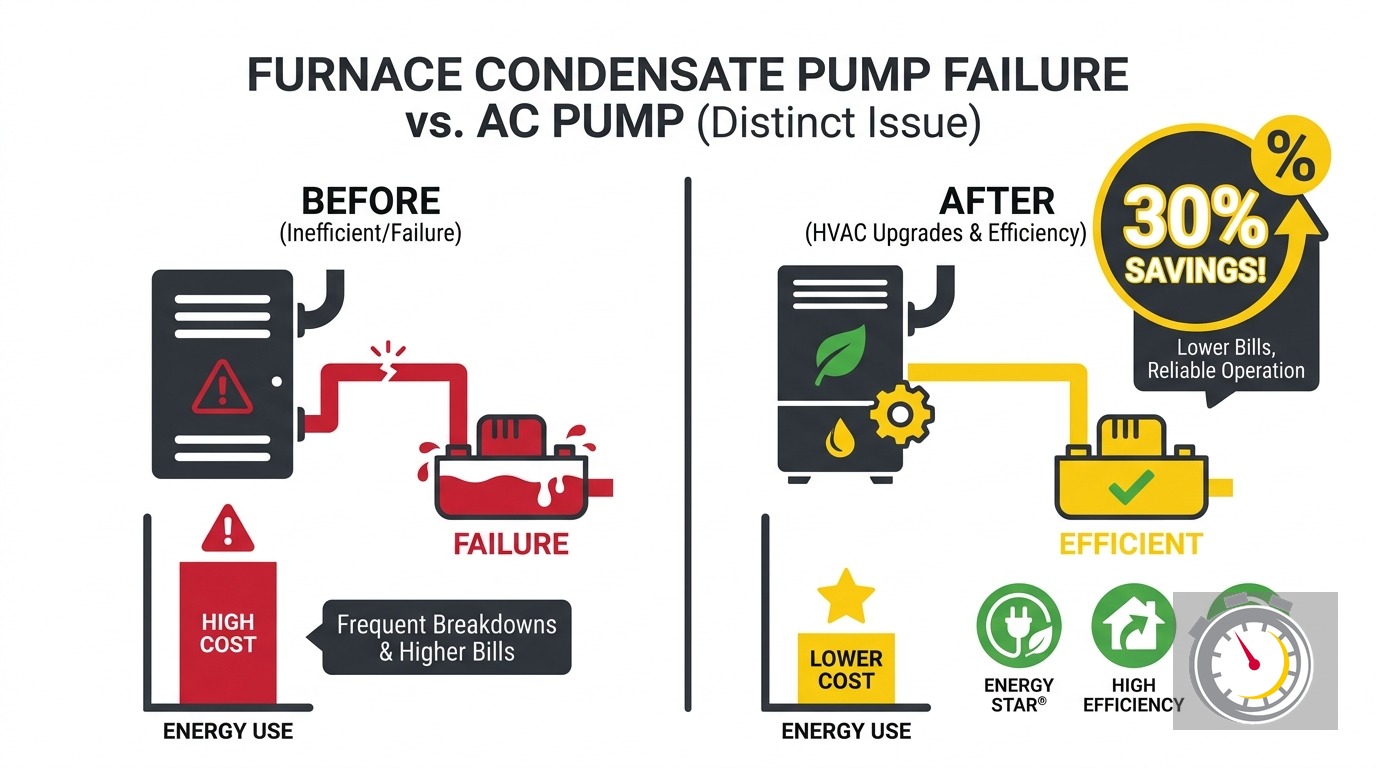
- A furnace condensate pump not working rarely shows up as a puddle on the floor. The usual first sign is your furnace starting, running for 60 to 90 seconds, and shutting off because a backed-up reservoir triggers a safety switch that cuts furnace power.
- Every replacement furnace installed in Minnesota runs at 90% AFUE or higher. Every 90%+ AFUE furnace produces condensate. If your home has a modern gas furnace, it has a condensate drain system that can fail.
- Furnace condensate is acidic (pH 3.0-5.0) because CO2 from combustion dissolves into the water as carbonic acid. AC condensate is near-neutral. That chemistry difference affects pump lifespan, drain material requirements, and code compliance.
- In a Minnesota winter, the most commonly misdiagnosed pump failure is a frozen discharge line. The pump motor runs fine. The water simply has nowhere to go.
- Minnesota Mechanical Code, IMC Section 307.2.3 requires a safety float switch wherever a condensate overflow could damage building components. A basement pump installation without one is below code.
Why Does Your Furnace Shut Off After 60 Seconds?
When the condensate pump reservoir fills up, the float switch rises with the water and cuts power to the furnace before the water overflows. Your control board logs this as a pressure switch fault or drain fault, not a pump fault. The furnace shuts off to protect itself, even though the burner, heat exchanger, and igniter are all fine.
This symptom sends a lot of homeowners in the wrong direction. They pull furnace error codes, see “pressure switch fault,” and start chasing that diagnostic without ever looking at the condensate pump. If your furnace starts and shuts off on a consistent 60 to 90 second pattern, go to the condensate pump before you go anywhere else.
Two quick checks you can do right now:
- Look inside the pump reservoir. If there is standing water at or above the float, the pump is overwhelmed or dead.
- Look at the drain line from the furnace to the pump. If that line is blocked or kinked, water backs up before it ever reaches the pump.
A dry reservoir that still triggers a lockout usually means the float is stuck in the raised position. A damp cloth wiped along the float shaft will often free it. If the float moves freely and the reservoir is dry but the furnace still locks out, the issue is in the float switch wiring or the pressure switch itself, and it is time to call a technician.
What Is the Most Common Cause of Furnace Condensate Pump Failure?
A fouled float or clogged inlet port is the most frequent failure. Furnace condensate carries combustion byproducts that deposit scale and biofilm on the float shaft and inside the pump body. When the float sticks in the raised position, the pump signals “full” even with an empty reservoir. The furnace locks out, and the homeowner suspects a furnace problem rather than a maintenance problem.
Other failure modes, in rough order of frequency:
- Clogged inlet strainer. Fine particles from combustion byproducts settle in the pump body over time and restrict water flow to the impeller.
- Failed impeller motor. The motor hums with normal current draw but produces no water movement. You can hear it running without any flow.
- Cracked or disconnected discharge line. The pump clears the reservoir, but water never reaches the floor drain. It pools behind a wall or under the floor instead.
- Worn check valve. Water drains back into the reservoir between pump cycles. The pump runs nearly continuously trying to keep up, and the motor wears out ahead of schedule.
Distinguishing a cleaning problem from a replacement problem takes about five minutes. Unplug the pump, carry it to a utility sink, pour a cup of water into the reservoir, and plug it in. If the float rises and the pump clears the water with steady flow, the unit is mechanically sound. If the motor hums without moving water, the impeller or motor has failed and the pump needs to be replaced.
Most clog and float failures are preventable. Annual cleaning during your fall furnace tune-up catches them before they trigger a heating lockout at 10 PM in January.
Furnace Condensate vs. AC Condensate: Why the Chemistry Matters
Most guides treat furnace and AC condensate pumps as interchangeable. They are not, and the chemistry explains why.
When a high-efficiency gas furnace runs, it burns natural gas and produces CO2 and water vapor as combustion byproducts. The secondary heat exchanger drops exhaust temperature to 90-120°F, causing the vapor to condense back to liquid inside the appliance. As it condenses, it absorbs CO2 and forms dilute carbonic acid. The result is condensate with a pH of 3.0 to 5.0, roughly as acidic as black coffee or tomato juice.
AC condensate forms differently. Warm interior air passes over the cold evaporator coil, and moisture drops out of the air as condensation. There is no combustion, no CO2 absorption, and no carbonic acid. AC condensate pH is close to neutral water.
The acidity gap matters in three specific ways:
Pump lifespan. Acidic condensate corrodes metal components inside conventional pump housings faster than neutral water does. A condensate pump that lasts eight years in an AC-only application may fail in four to five years on a high-efficiency furnace line. If you are comparing the timeline to our separate post on AC condensate pump failure and basement drainage, the difference is real and not just a matter of installation age.
Drain material and slope. IMC Section 307.1, adopted by Minnesota, requires condensate piping from fuel-burning condensing appliances to use corrosion-resistant material, with a minimum pitch of 1/8 inch per foot toward the drain. PVC is the standard choice for this application. Copper and galvanized steel are not appropriate for long-term exposure to acidic furnace condensate.
Condensate neutralizers. Some municipalities require pH adjustment before condensate discharges to a drain. Even where it is not required, a neutralizer installed inline extends the life of the pump, the drain line, and any metal components downstream. If you are replacing a pump on an aging installation, it is worth asking our team whether a neutralizer belongs in the system.
The Minnesota Freeze Failure Most Guides Miss
This failure mode does not appear in warm-climate HVAC guides. It is the most commonly misdiagnosed cold-weather condensate problem in the Twin Cities, and it mimics pump failure so closely that many homeowners replace a perfectly good pump without fixing anything.
Here is how it plays out. The pump motor runs. You can hear it cycle on normally. Water fills the reservoir, the float rises, the pump triggers, and the water overflows onto the floor. Nothing about the pump itself is wrong. The discharge line, which runs through or along an exterior wall or near a rim joist, has frozen solid. The pump is doing its job. The water has nowhere to go.
Diagnosing this requires following the discharge line from the pump outlet all the way to where it exits the building. A rigid, ice-cold section along a stretch near the foundation or exterior wall is the tell. In a typical basement installation in Ramsey, Blaine, or Maple Grove, the discharge line travels several feet near the sill plate before reaching a floor drain or laundry tub. That section can freeze at -10°F or colder, temperatures Minnesota sees reliably every winter.
Insulation wrapping alone is not sufficient in severe cold. Heat cable, rated for plastic tubing, is the correct fix for any discharge line segment that passes through or near an unheated space. The cable needs to run continuously without overlaps and terminate at a GFCI outlet. This is not a judgment call you want to make while guessing at the installation from memory. If you have had a frozen discharge line once, treat it as a confirmed system deficiency and address it before next November.
The reason this is so often misdiagnosed: testing the pump in the mechanical room, where it is 65°F, confirms the motor works fine. The freeze is fifteen feet away against the rim joist. We cover the full freeze failure picture in our post on frozen condensate drains and high-efficiency furnaces.
Why Is My Condensate Pump Always Running?
A pump that runs almost continuously almost always has a failed check valve or a discharge line that drains back. The check valve’s job is to hold water in the discharge line between pump cycles so the pump does not have to re-prime from zero every time. When the valve fails or loses its seal, water drains back into the reservoir. The float drops, the pump triggers again, and the cycle repeats every few minutes around the clock.
A discharge line with reverse slope creates the same symptom. If the line sags or was installed without sufficient pitch, water pools in the low section and drains back into the reservoir when the pump shuts off. The pump runs, clears the reservoir, water pools back, the float drops, and the pump runs again.
To diagnose: watch and listen after the pump shuts off. If water drains audibly back into the reservoir within 30 to 60 seconds, the check valve has failed. You can also press the check valve with a finger at the top of the pump body. It should open under light pressure and spring firmly back closed. A valve that stays open or feels loose needs to be replaced.
A pump that is always running is heading toward motor failure. It is also creating a fault loop at the furnace: a near-continuous running pump can intermittently signal a high-float condition and trigger a lockout. Address a continuously running pump the same week you notice it, not at the end of the heating season.
Does Minnesota Code Require a Safety Float Switch?
Yes, in most basement pump installations. IMC Section 307.2.3, adopted by Minnesota, requires either an auxiliary drain pan with overflow outlet, or a UL 508 water-level detection device that shuts off the equipment before water overflows, wherever a primary drain failure could damage building components.
A basement condensate pump overflowing into a finished recreation room, home office, or storage area clearly meets that threshold. The safety float switch mounted in the pump reservoir is that UL 508 device. It cuts power to the furnace when water levels rise, preventing an overflow. It is not a premium feature. It is a code requirement for that installation type.
If your current pump installation does not have a safety float switch, it was either installed before enforcement was consistent or the contractor skipped it. Either way, add one when you replace the pump. The switch itself is an inexpensive component. The damage from an unchecked overflow in a finished basement is not.
One note on code scope: Minnesota Rule 1346 deletes IMC Section 307.3 in its entirety. Sections 307.1 and 307.2.3 remain in force. If you are reading a national HVAC guide that references Section 307.3 requirements, those provisions do not apply in Minnesota.
How Do You Clean a Condensate Pump?
Clean the reservoir, float, and check valve once per year, ideally in the fall before the heating season starts. This one maintenance step prevents most clog and float-related failures.
Here is the full sequence:
- Unplug the pump from its outlet. Do not rely on turning the furnace off at the thermostat. Disconnect power at the pump itself.
- Disconnect the inlet tubing from the pump body (the line coming from the furnace drain outlet).
- Remove the pump and carry it to a utility sink.
- Pour out any standing water. Rinse the reservoir with clean tap water.
- Wipe the float and float shaft with a soft cloth dampened in a diluted white vinegar solution (one part vinegar to four parts water). White vinegar dissolves carbonate scale and biofilm without degrading rubber or plastic components.
- Inspect the check valve at the top of the pump housing. Press it with a finger: it should open under light pressure and spring firmly closed. Replace the valve if it stays open, feels loose, or shows visible pitting or corrosion.
- Reassemble the pump, pour a half-cup of water into the reservoir, and plug the pump into an outlet. Confirm the float rises, the motor triggers, and the pump clears the water with steady flow.
- Reconnect the inlet tubing and restore furnace power.
Avoid bleach, drain cleaners, or enzyme cleaners inside the reservoir. They degrade the rubber float seal and check valve components faster than normal condensate does.
If your pump is mounted in a tight or elevated location, or the discharge line routing is complex, include this cleaning in your annual furnace inspection visit. A technician can check the discharge line slope, the float switch wiring, and the full drain path from the secondary heat exchanger to the pump in the same visit.
Should You Repair or Replace a Condensate Pump?
For most Minnesota homeowners, replacement makes sense if the motor is dead or the unit is more than seven years old. The hardware cost is modest. Published market references put the pump unit itself at $60 to $180, with total replacement including labor in the low hundreds of dollars. Call (763) 260-6662 for an accurate quote on your specific installation; price varies with pump type, discharge line configuration, and whether a safety float switch needs to be added.
Repair makes sense when:
- The pump is under five years old
- The failure is a clogged inlet, a fouled float, or a cracked discharge line
- The motor tests good and the check valve is intact
Replace the pump when:
- The motor hums but produces no water flow
- The unit is more than seven to eight years old on an acidic furnace condensate application
- The installation lacks a safety float switch (add it at replacement)
Start a broader conversation when:
- The furnace is aging and you are stacking condensate pump, igniter, and control board repairs in the same season
- A frozen discharge line has failed twice in consecutive winters and a proper heat-cable installation has not been done
On furnace replacement specifically: Minnesota’s minimum efficiency standard requires 90% AFUE or higher for all new or replacement residential gas furnaces in the Northern region. The DOE’s 2023 Final Rule raises that minimum to 95% AFUE, effective 2028-2029. Any furnace you install between now and then will produce condensate, and any furnace after 2028 will produce more of it at the higher efficiency tier. The condensate pump system you specify today needs to be sized for that.
If you heat with a hydronic boiler rather than a forced-air furnace, boiler circulator pump failure follows a different diagnostic path - no condensate involved, but similar symptoms of heat loss and short cycling.
If you are weighing a heat pump alongside a furnace replacement, our Minnesota heat pump guide covers how cold-climate systems perform through a Twin Cities winter and what the payback math looks like.
Our furnace replacement cost guide for the Twin Cities has pricing by efficiency tier if you are at the point of comparing repair costs against replacement.
Utility Rebates if You Are Replacing the Furnace
A failing condensate pump sometimes tips a repair decision into a replacement conversation. If you are buying a new furnace, both major Twin Cities utilities offer rebates on high-efficiency units.
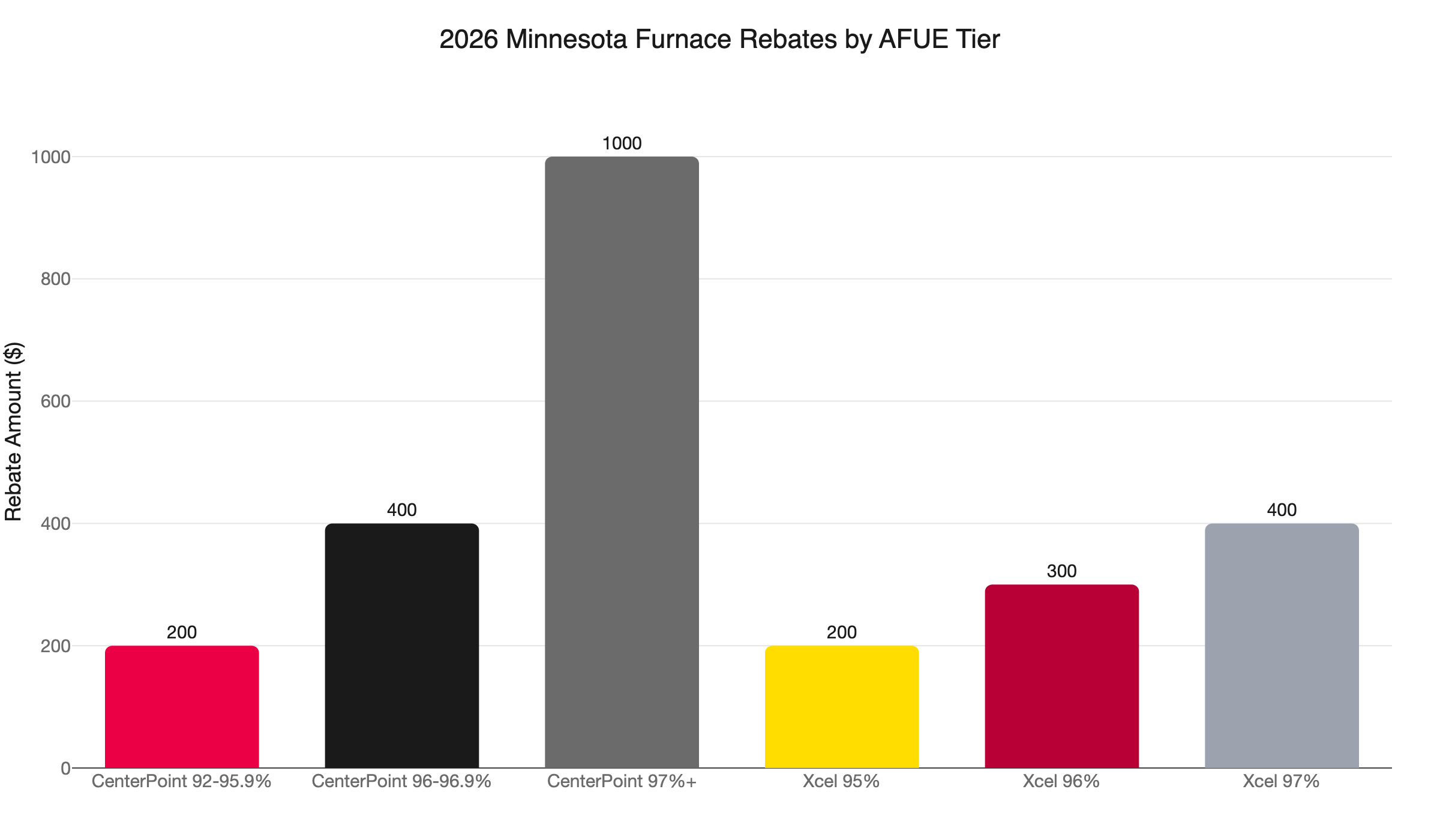
CenterPoint Energy (2026 Minnesota residential, applications due December 31, 2026): $200 for 92-95.9% AFUE, $400 for 96-96.9% AFUE, $1,000 for 97%+ AFUE. Source: CenterPoint Energy
Xcel Energy (2024-2026 Minnesota residential): $200 for 95% AFUE, $300 for 96% AFUE, $400 for 97% AFUE. Self-installs do not qualify; the unit must be listed on ahridirectory.org. Source: Xcel Energy
Ask our team about financing options for furnace replacements if the upfront cost is a consideration. The rebates do not last indefinitely, and the CenterPoint window closes at year-end.
Schedule Service With Northern One Hour
A condensate pump is a modest part. The system around it is not. Discharge line routing, freeze protection, code-required float switch compliance, drain slope, and material compatibility with acidic condensate all require a technician who knows both the Minnesota Mechanical Code and what a severe cold snap does to a poorly routed line.
We are locally owned and operated in Ramsey, MN. Our team serves the full Twin Cities metro, including Minneapolis, St. Paul, Blaine, Maple Grove, Plymouth, Brooklyn Park, Woodbury, and Bloomington. We know the freeze failure patterns, the code requirements under MN Rule 1346, and the installation details that warm-climate guides skip.
When you book with Northern One Hour, you get our on-time promise: “Always On Time… Or You Don’t Pay a Dime!(R)” We show up in the window you select. If we do not, you pay nothing for the service call.
If your furnace is short-cycling and there is a cold front on the way, do not wait. Call (763) 260-6662 or book a furnace service visit online.
Frequently Asked Questions
How do I replace a furnace condensate pump? +
Need a technician now?