
Furnace Inspection in Minnesota: What a Tech Checks
Key Takeaways
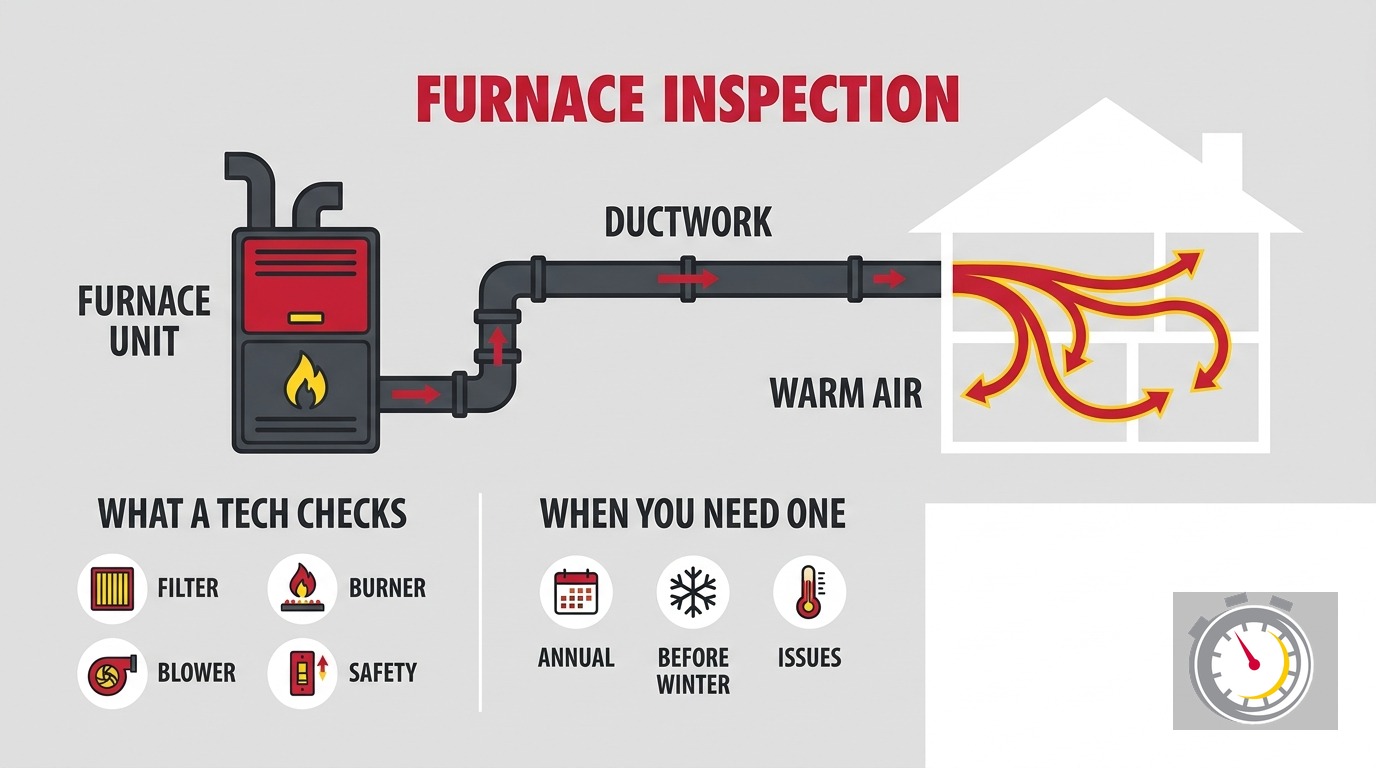
- A furnace inspection in Minnesota is an annual safety priority. Your furnace runs five to seven months per year here, and that runtime accelerates wear on every component.
- About 300 Minnesotans visit emergency rooms for CO poisoning each year, and ER visits more than double between September and November.
- A complete inspection covers the heat exchanger, burners, flame sensor, igniter, blower, draft inducer, venting, and a combustion analysis that produces real measured numbers - not just a visual walkthrough.
- CenterPoint customers can claim a $25 tune-up rebate every other year, making inspection nearly free.
- Beyond annual service, specific triggers include: a new home purchase, a furnace over 15 years old, a CO alarm event, a Minneapolis TISH home sale, or a furnace that ran hard through an extended cold snap.
- Starting in late 2028, all new residential gas furnaces must meet a 95% AFUE minimum under a new DOE rule. If your furnace is aging, evaluate it now.
Why Minnesota Furnaces Demand an Annual Inspection
Most states treat furnace maintenance as a smart precaution. In Minnesota, it is closer to a safety obligation.
A Minnesota furnace runs roughly five to seven months per year. That is potentially 2,000 or more operating hours in a long heating season - more runtime than furnaces in mild climates see in two or three years. Every hour adds wear to the heat exchanger, the burner assembly, the blower motor, and the venting system. Components that hold up for a decade in warmer climates wear out faster here.
The carbon monoxide risk is concrete. According to the Minnesota Department of Health, about 300 Minnesotans visit emergency rooms for CO poisoning every year, and about 14 die from it. ER visits for CO poisoning more than double between September and November - exactly when most households fire up their furnaces after a summer of sitting idle. Peak risk runs November through February.
Minnesota Commerce identifies a cracked heat exchanger as a leading cause of CO buildup in homes, alongside blocked vents, separated flue pipes, and insufficient combustion air. Minnesota law requires at least one working CO alarm within 10 feet of every sleeping area. A detector is the last line of defense. A furnace inspection finds the source before CO ever reaches the alarm.
What Does a Tech Check During a Furnace Inspection?
A complete furnace inspection covers 10 or more components and includes a combustion analysis - not just a visual walkthrough. The tech measures actual CO, CO2, and O2 concentrations in the flue gas and compares those numbers against code-defined limits. That is what separates a real inspection from a filter swap.
Here is what each component check actually involves and why it matters:
Heat exchanger
The heat exchanger is the metal chamber that separates combustion gases from your home’s air supply. A crack here allows CO to enter your duct system directly. Techs inspect it visually, use a combustion analysis camera on accessible sections, and run a pressure-differential test. Minnesota Mechanical Code sets a maximum CO concentration in flue gas at 0.04%. A reading above that threshold indicates a failing exchanger or degraded combustion. Our post on signs of a cracked heat exchanger in Minnesota covers what homeowners notice before a tech confirms it.
Burners
Dirty or misaligned burners produce incomplete combustion. That generates excess CO and wastes fuel. The tech checks that each burner fires cleanly, that the flame pattern is stable across all ports, and that the flame color indicates complete combustion - a steady blue with no lifting or yellow streaks.
Flame sensor
The flame sensor is a metal rod that confirms the burner is lit. A dirty or degraded sensor causes the furnace to shut off on a false no-flame reading. The tech cleans it and checks for corrosion or hairline cracks.
Igniter
Most modern furnaces use a silicon nitride hot-surface igniter that glows orange to light the gas. These crack with age. The tech measures igniter resistance in ohms against the manufacturer’s specification and replaces it if the reading is out of range.
Blower motor and wheel
The blower pushes conditioned air through your ducts. A wheel coated in dust restricts airflow and strains the motor. The tech checks amp draw against the rated value, inspects the wheel for buildup, and listens for bearing noise that signals motor wear.
Draft inducer motor
The draft inducer pulls combustion gases out of the heat exchanger and pushes them into the flue. A failing inducer lets gases back up into the furnace cabinet - and then into the home. The tech checks motor RPM, amp draw, and the pressure switch that confirms proper draft is established before the gas valve opens.
Gas valve and manifold pressure
Gas pressure at the valve must match the furnace’s rated input. The tech uses a manometer to check manifold pressure against the spec on the data plate. A valve that sticks open is a safety hazard. One that sticks closed is a furnace that will not light.
Venting and flue
The tech traces the flue pipe from the furnace to the exterior termination and checks for disconnected joints, corrosion, improper slope, and blocked terminations. A separated flue joint can vent combustion gases into finished living space rather than outdoors.
Combustion analysis
This is the step most generic inspection checklists skip. A combustion analyzer inserted into the flue gives real numbers. Minnesota code guidelines call for CO below 0.04%, CO2 in the 8-13% range, and O2 in the 4-10% range. A reading outside those ranges tells the tech exactly where combustion is degraded - not just that something might be off.
Air filter and controls
The tech checks the filter condition and reads the control board for stored fault codes. A clogged filter restricts airflow enough to trip the high-limit switch and send the furnace into safety lockout. Fault codes on the control board are a log of what has already gone wrong.
When Do You Actually Need a Furnace Inspection?
Once a year, in early fall, is the baseline. Several situations in Minnesota make an inspection urgent regardless of when you last had one: a new home purchase, a furnace over 15 years old, a CO alarm event, a home sale in Minneapolis under the TISH requirement, or a furnace that ran hard through an extended cold snap.
Annual fall service
Schedule before heating season, typically August through October. A failed igniter or a cracked heat exchanger found in September is a scheduled repair at standard rates. The same finding on a January night when temperatures drop below zero is an emergency call - with an emergency premium of $180 to $270 per hour on top of standard labor rates.
New home purchase
You do not know the maintenance history of the home you just bought. The previous owner may have skipped service for years. An inspection before your first winter is how you find out what you bought - not after the furnace quits on the coldest night of the year.
Furnace over 15 years old
Most furnaces last 15 to 20 years. The final stretch is when heat exchangers develop cracks, gas valves stick, and control boards fail. An inspection tells you whether to repair, plan a replacement, or accelerate the timeline. Our furnace replacement cost guide for the Twin Cities covers installed pricing by efficiency tier so you can compare the numbers before you need to make a call under pressure.
CO detector alert
If your CO detector alarmed - even if it reset on its own - treat it as an emergency. A detector that cleared is not proof that nothing happened. CO may have spiked and dissipated when a door opened or the furnace cycled off. Call us before you run the furnace again.
Minneapolis or St. Paul home sale
Minneapolis requires a Truth-in-Sale of Housing (TISH) inspection at the time of any home sale. A furnace in poor condition surfaces in that report. Getting a professional furnace inspection before you list gives you control over the repair decision and timeline, rather than discovering problems under closing-date pressure.
After an extreme cold winter
Minnesota cold snaps push furnaces into continuous-run mode for 48 to 72 hours at a stretch. That sustained load accelerates wear on the heat exchanger, the inducer, and the blower. A fall inspection after a demanding winter catches what the cold revealed before the next heating season begins.
What Happens if the Tech Finds a Problem?
The tech documents the finding, explains it in plain terms, and gives you a repair quote before touching anything. For safety issues - a cracked heat exchanger, a separated flue connection, or CO levels above code limits - the furnace should not run until the repair is done. Non-safety items like a dirty flame sensor or worn igniter can usually be handled the same visit.
For common component repairs, costs in the Twin Cities run from $95 to $325 for flame sensor service or an igniter replacement, $375 to $900 for a draft inducer motor (some brand-specific units run $500 to $1,650), and $1,100 to $2,200 for a blower motor depending on whether your system uses a standard PSC motor or a variable-speed ECM motor.
When a repair approaches or exceeds half the installed cost of a replacement furnace - especially on a system already 15 years or older - most homeowners choose replacement. A repair that costs $2,000 on a furnace worth $4,500 in remaining service life is rarely the right financial call. The furnace replacement cost guide linked above covers installed pricing by efficiency tier.
In Minnesota, furnace replacement requires a mechanical permit in virtually all jurisdictions. Our team pulls the permit as a standard part of every replacement job. A contractor who skips the permit conversation is a red flag - permits protect the homeowner, not just the installer.
How Much Does a Furnace Inspection Cost in the Twin Cities?
A single furnace inspection visit in the Twin Cities runs $95 to $250. An annual maintenance plan that includes inspection, cleaning, and priority scheduling costs $195 to $390 per year.
The inspection cost is the smallest number in the furnace equation. A repair discovered during a $150 September visit is almost always cheaper than the same repair handled as an emergency call. Emergency and after-hours service in the Twin Cities adds $180 to $270 per hour on top of standard labor rates - and the calendar is not on your side in January.
A maintenance plan earns its keep when you want annual coverage without managing the scheduling yourself each fall and when you want priority calendar access in October, when HVAC schedules in the Twin Cities fill within days. Call (763) 260-6662 to ask about plan options, or book a tune-up online to get on the calendar before fall rush.
How Does the CenterPoint Tune-Up Rebate Work?
CenterPoint Energy offers a $25 rebate for a qualifying furnace tune-up, available every other year per heating system. Your contractor submits the rebate paperwork at time of service. On an inspection that runs $95 to $150, that rebate offsets a meaningful portion of the bill before you pay anything out of pocket.
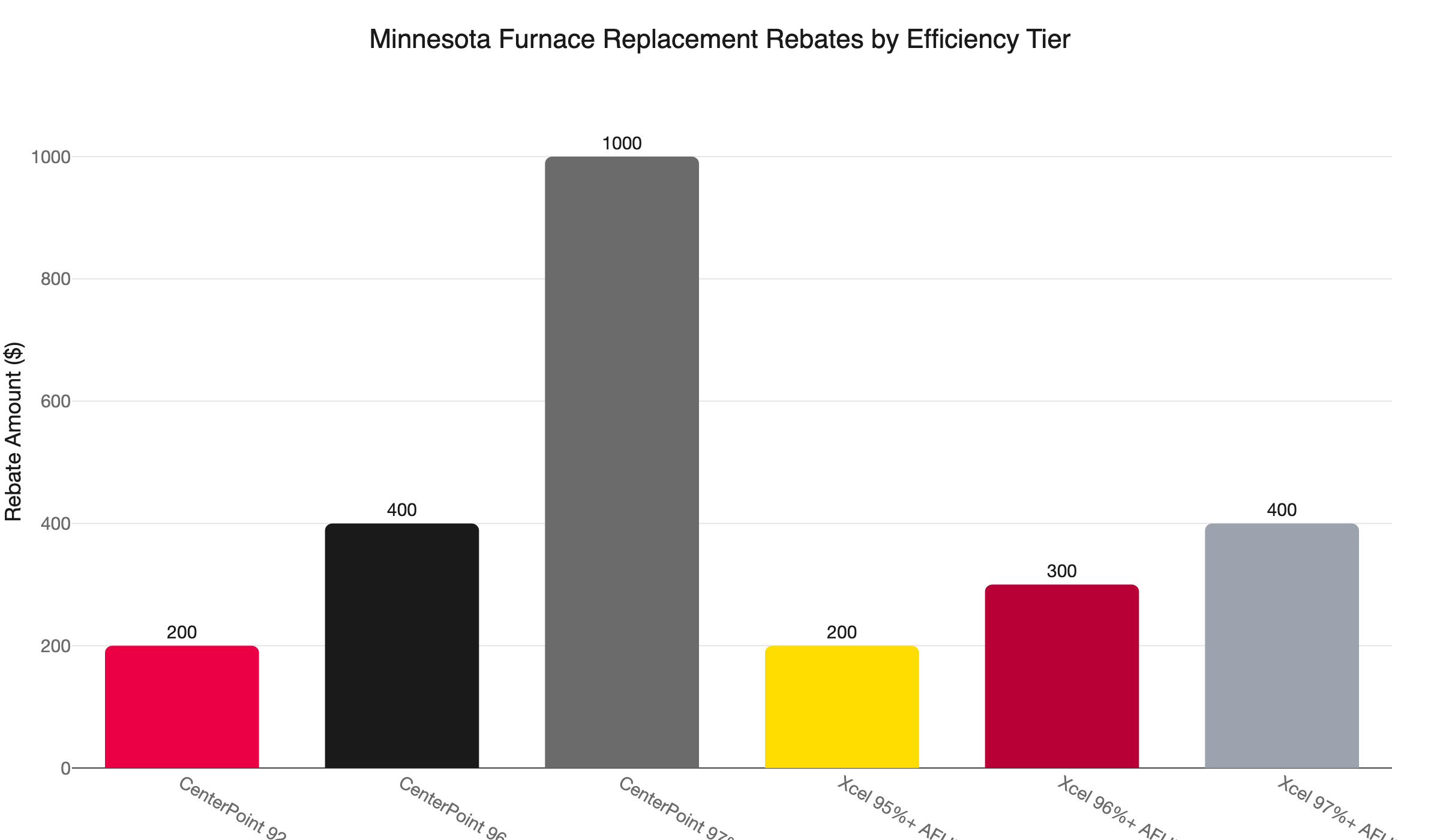
If the inspection reveals a replacement is needed, the numbers get significantly larger. CenterPoint replacement rebates run from $200 for 92-95.9% AFUE equipment, to $400 for 96-96.9% AFUE, and up to $1,000 for 97%+ AFUE furnaces. Xcel Energy customers can access separate utility rebates of $200 for 95%+ AFUE equipment, $300 for 96%+, and $400 for 97%+ AFUE units listed in the AHRI directory.
Utility rebates can be stacked with the federal 25C tax credit for qualifying high-efficiency HVAC upgrades. Our guide on stacking HVAC rebates and tax credits in Minnesota shows how to combine them without leaving money behind.
What Does the 2028 DOE Standard Mean for Your Older Furnace?
Starting in late 2028, all new non-weatherized residential gas furnaces must meet a 95% AFUE minimum, under a DOE rule finalized in 2023. If your furnace is a mid-efficiency 78-82% AFUE unit, that efficiency tier will not be available as a replacement option once the standard takes effect.
This matters directly for your furnace inspection. Minnesota’s energy code already requires 80% AFUE statewide, and many Twin Cities jurisdictions require 90%+ under local amendments. A straight replacement with an 80% unit is not code-legal in much of the metro today. The 2028 standard simply raises that floor nationwide.
Old standing-pilot furnaces ran 60-65% AFUE. Mid-efficiency units run 78-82%. High-efficiency condensing furnaces run 88-97%. Moving from a 78% unit to a 96% unit cuts gas use by roughly 23% for the same heat output. The DOE projects the new standard will save U.S. consumers $1.5 billion per year nationally.
If your furnace is 12 to 15 years old and your inspection surfaces a significant repair, replacing now - before 2028 - gives you access to the full current equipment lineup, current rebate tiers from both utilities, and current installed pricing before the market adjusts to the new minimum. When we are there for the inspection, we will give you a straight assessment of where your system stands and what replacement would cost.
Schedule Your Furnace Inspection with Northern One Hour
We are locally owned and operated in Ramsey, MN, and serve homeowners across Minneapolis, St. Paul, Blaine, Maple Grove, Plymouth, Brooklyn Park, Woodbury, and Bloomington.
Our technicians carry the DLI-required contractor bond, hold the competency cards required by Minneapolis and St. Paul, and pull permits on every replacement job. Every inspection we run includes a full combustion analysis. We do not skip the step that matters most.
We back every visit with “Always On Time… Or You Don’t Pay a Dime!(R)” Schedule a time and we keep it. If a larger repair or replacement comes up, we offer financing options so you can make the right call for your home - not just the one that fits this month’s budget.
Call (763) 260-6662 or book your furnace inspection online. Fall calendar spots in the Twin Cities fill fast. Get on the schedule now so you head into heating season with a clean bill of health, not an open question.
Frequently Asked Questions
How often should I get a furnace inspection in Minnesota? +
What does a furnace inspection include? +
Does a furnace inspection detect carbon monoxide problems? +
Can I get a rebate for a furnace inspection in Minnesota? +
Need a technician now?