
Furnace Combustion Analysis Efficiency Test: What to Know
Key Takeaways
- A combustion analysis inserts a probe into the flue and samples actual gas chemistry. A standard tune-up checks what the technician can see and measure with a multimeter. The two tests answer different questions.
- Healthy natural gas furnace targets: O2 at 3-6% (fan-assisted) or 7-9% (atmospheric), CO2 at 8-9.5%, CO under 50 ppm as-measured.
- A condensing furnace flue should read 100-130°F. A reading above 200°F means the unit is not condensing. Your heating bill reflects it.
- Raw CO numbers can mislead. Air-free correction can turn a 100 ppm reading into 300 ppm or more. Safety standards use the air-free number.
- The shutdown test catches cracked heat exchangers that look fine on a visual inspection. In a tight Twin Cities house, that is a CO risk, not just an efficiency problem.
- Minnesota requires a 92% AFUE minimum for all new and replacement furnace installations. An 80% unit cannot be installed as a replacement here.
- If ambient CO in your home reaches 70 ppm or higher: evacuate immediately and call emergency services. Do not re-enter until cleared.
What Is a Furnace Combustion Analysis?
A combustion analysis is a chemistry test on your furnace’s exhaust. A technician inserts a probe into the flue near the heat exchanger. The analyzer reads oxygen, carbon monoxide, and flue temperature. It calculates combustion efficiency, CO2, and excess air percentage in real time.
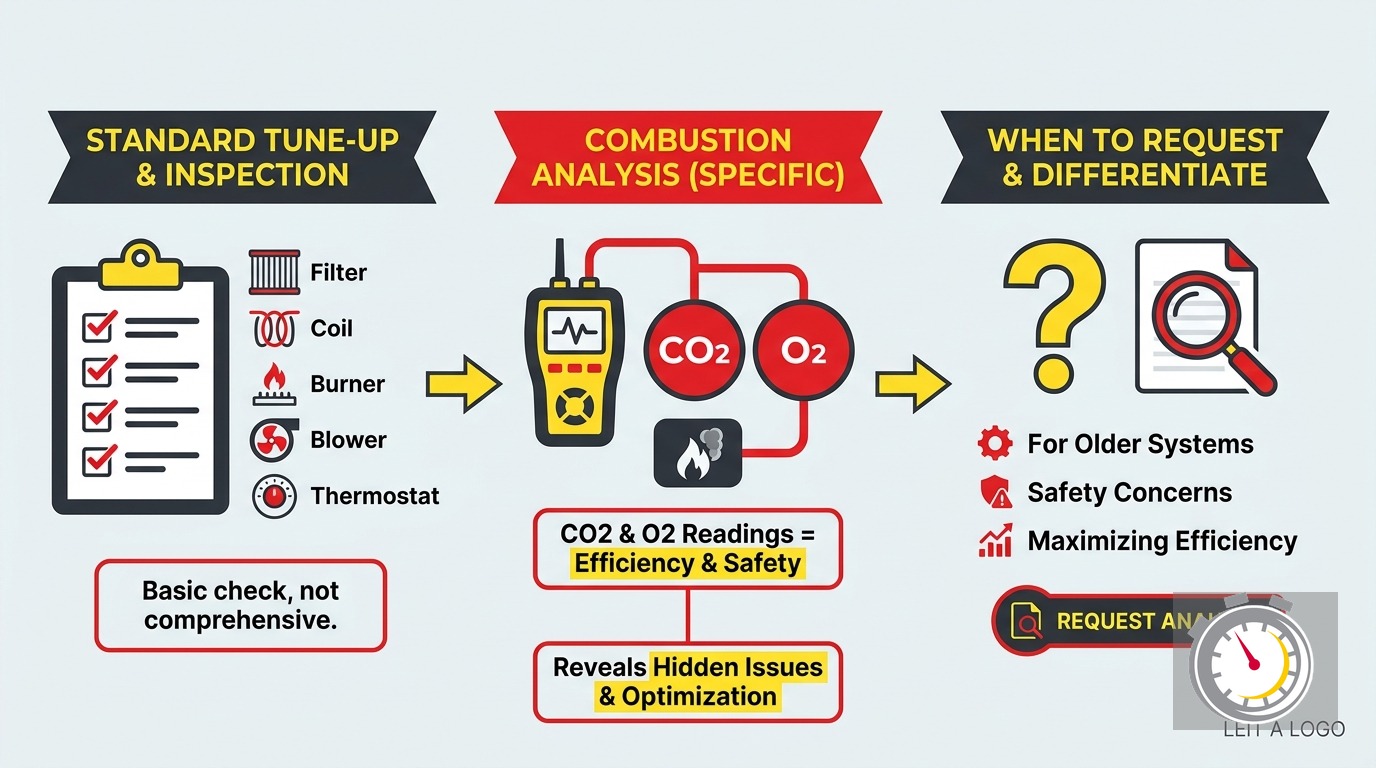
A standard tune-up gives you what the technician can observe: the filter condition, flame appearance, blower amp draw, and igniter resistance. That work has genuine value. But it does not tell you whether the furnace is burning cleanly or how much heat is escaping through the flue.
Most homeowners first hear about a combustion analysis when a technician offers to add it to a tune-up visit. Many have never had one performed. The test is not universally included, and it is worth knowing what you are getting before agreeing - or asking for it when the tech does not mention it.
Think of the difference this way: a tune-up is a visual exam. A combustion analysis is a blood test. Both matter. A clean-looking flame can still produce dangerous CO levels.
How Does a Combustion Analysis Differ from a Standard Tune-Up?
A standard tune-up covers visual and mechanical checks: filter, flame, blower, igniter, and flue appearance. A combustion analysis adds a probe in the flue that measures O2, CO, and stack temperature under live operating conditions. The probe runs during three distinct test moments.
A standard tune-up typically includes a visual inspection, filter check, amp draw, and burner appearance check. It does not involve flue gas chemistry. A combustion analysis adds three test moments: light-off to catch ignition irregularities, steady-state for the efficiency reading, and shutdown to check for heat exchanger cracks.
Some technicians include a basic combustion check as part of a full tune-up. Many do not. It is worth asking before you book. If you want the combustion data, ask specifically for the analyzer report when scheduling a furnace tune-up.
A standard tune-up on a well-maintained furnace typically runs $95-$250. The combustion analysis adds lab-quality data to that visit. If the numbers confirm the furnace is tuned correctly, you have a documented baseline. If numbers are off, the tech can often adjust the air-fuel mixture or clean burners on the same visit.
What Should O2% Be in a Flue Gas Analysis?
For a fan-assisted or power-burner furnace (most modern gas furnaces), the target O2 reading in the flue is 3-6%. For older atmospheric or draft-hood furnaces, the healthy range is 7-9%. Too low means rich combustion and rising CO risk. Too high means excess air is carrying heat out the vent.
Fan-assisted power-burner furnaces target 3-6% O2. Atmospheric units with draft hoods target 7-9%. Minnesota requires a minimum AFUE for all new and replacement furnaces. Most Twin Cities homes today have fan-assisted condensing units. The 3-6% range applies to most reports you will see.
O2 and CO2 move in opposite directions. When O2 falls, CO2 rises. Most field analyzers calculate CO2 from the O2 reading. They do not measure CO2 directly. For natural gas at perfect stoichiometric combustion, the theoretical maximum CO2 is 11.7%. A healthy real-world CO2 range is 8-9.5%. Above 10% means the air-to-fuel ratio is too tight.
If O2 reads below the target range, the tech checks several causes. These include a restricted combustion air supply, a dirty burner, a failed draft component, or a competing appliance drawing on the same air. A gas fireplace or water heater sharing a mechanical room can rob air from the furnace. That drops O2 below the safe target. Our post on gas appliances competing for combustion air explains how that failure mode works.
What Is a Good Reading on a Combustion Analysis?
A good report shows all four measurements in range simultaneously: O2 within the target for your furnace type, CO2 at 8-9.5%, CO below 50 ppm as-measured, and stack temperature consistent with your efficiency rating. No single number tells the complete story.
Here is what each measurement means:
O2: The primary efficiency dial. Too low signals rich combustion and CO production. Too high signals heat bleeding out the vent.
CO2: The efficiency mirror. Natural gas combustion in good tune shows 8-9.5% CO2. The stoichiometric maximum for natural gas is 11.7%. CO2 confirms what the O2 reading shows.
CO (as-measured): The early safety signal. A healthy furnace produces under 50 ppm CO. Above 100 ppm warrants investigation. The raw number is not the final safety judgment. The air-free correction, covered in the next section, is.
Stack temperature: The efficiency signal in plain numbers.
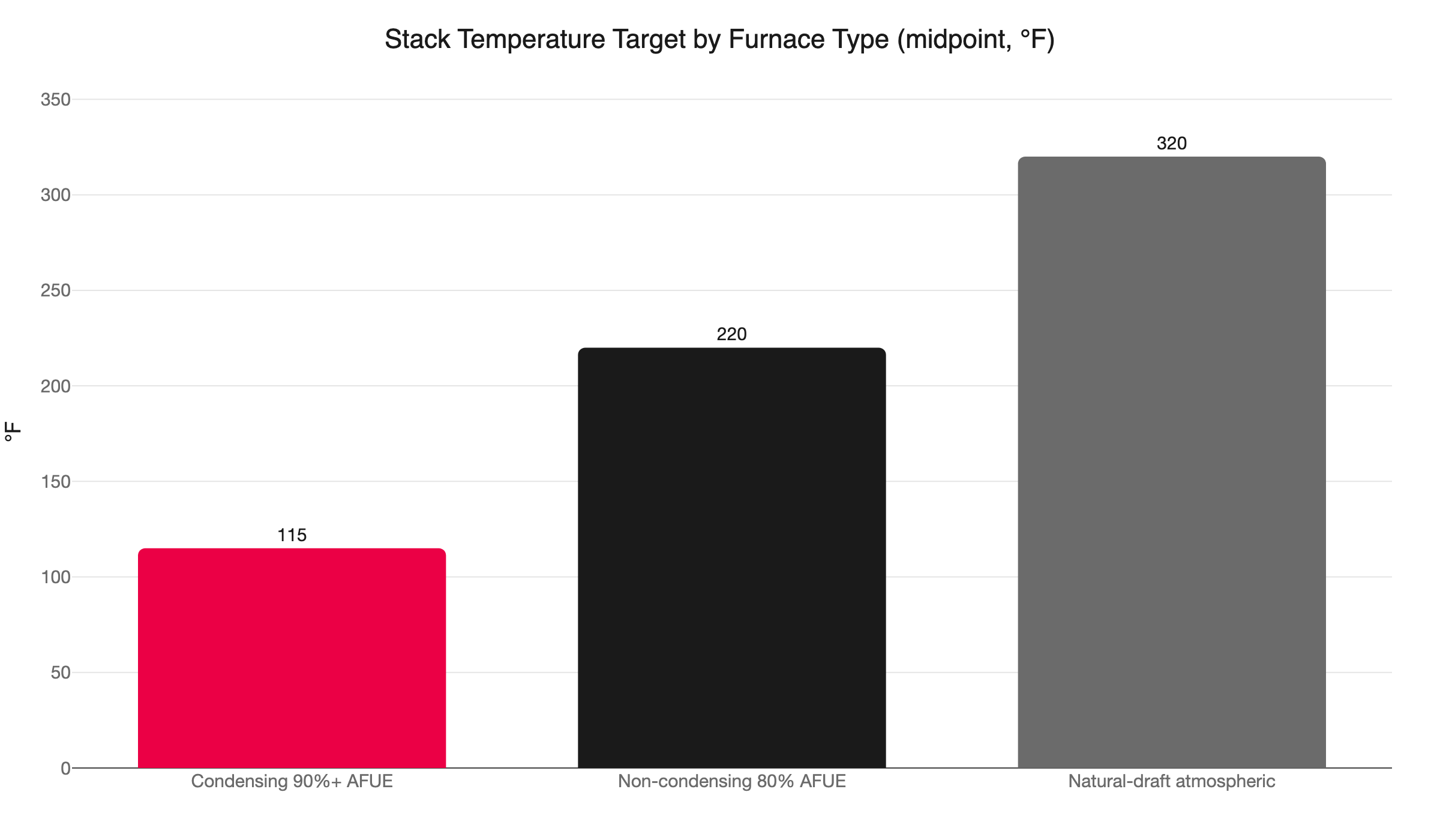
- Condensing (90%+) furnace: flue should read 100-130°F. A reading above 200°F suggests the unit is not condensing and efficiency is well below the rated value.
- Non-condensing induced-draft (80% AFUE): stack temperature should run 170-270°F above the supply air temperature.
- Natural-draft (atmospheric) units: 270-370°F above supply air.
- Non-condensing stack temperature should not fall below 250°F. Below that, condensate can form in a flue not designed for moisture.
Combustion efficiency: The analyzer calculates this from all of the above. Field-installed furnaces run approximately 6.4% below their lab-rated steady-state efficiency. A furnace’s actual operating efficiency in your home will likely be lower than its rated efficiency. The combustion analysis gives you the real-world number, not the rating plate.
One thing that surprises homeowners: a furnace that looks clean, runs quietly, and heats the house normally can still show off-spec combustion readings. The combustion analysis catches what normal operation hides.
Why Does the Raw CO Reading Miss the Real Risk?
The as-measured CO number is diluted by excess air. A lean-running furnace shows lower CO on the probe even when combustion products are dangerous. The air-free correction removes that dilution. Safety standards use the air-free number, not the raw reading.
The correction formula: CO multiplied by 20.9, divided by (20.9 minus O2). A raw reading of 100 ppm at 14% O2 calculates to over 300 ppm air-free. That is more than three times what the raw column shows.
ANSI Z21.47, the certification standard for gas-fired central furnaces, sets a ceiling of 400 ppm air-free CO. Above that threshold, the unit should be shut down before the next heating cycle. A homeowner reading only the as-measured column on a printed report could be looking at a furnace over the shutdown limit. They might not realize it.
This is why a combustion analysis requires a trained technician. The data only makes sense in context. The air-free correction, the furnace type, and the three test moments together form the complete picture.
How Does the Shutdown Test Catch a Cracked Heat Exchanger?
When the burner shuts off, the blower keeps running and pressurizes the heat exchanger. If a crack is present, air pushes through it into the flue stream. An O2 spike in the flue right after blower pressurization is a diagnostic signal for a cracked heat exchanger.
This matters in Minnesota. Furnaces here run five to six months a year. A heat exchanger cycles through thousands of expansion-and-contraction events over a 15-20 year service life. Small cracks form over time with no visible symptom: no error code, no burning smell, no obvious flame disturbance. A small crack in a well-sealed Twin Cities house can push combustion byproducts into the supply air stream.
A visual inspection misses many of these cracks. The shutdown test is not foolproof, but it catches what a flashlight cannot. Our guide to cracked heat exchanger warning signs covers the full range of symptoms beyond what the combustion test reveals.
What Ambient CO Levels Should Make You Act?
Ambient CO is the concentration in the air you breathe. These thresholds apply to your CO detector or an air quality reading, not a flue combustion report. They are lower than most people expect.
At 70 ppm ambient or higher: evacuate immediately, call emergency services, and do not re-enter until the space is cleared. Leave the door open on your way out.
CO alarms use time-weighted averages. They alarm at sustained exposures, not brief spikes. Low-level chronic exposure below the alarm threshold can still cause real symptoms: persistent headaches, fatigue, and difficulty concentrating. If those symptoms improve when you leave the house and return when you come back, treat it as a CO concern. Call for an inspection before the next heating cycle.
What Minnesota’s Efficiency Rules Mean for Your Report
Minnesota sits entirely in climate zones 6 and 7. Minnesota sets a minimum AFUE requirement for all furnace installations in the state. New installs and replacements both must meet it. An 80% AFUE furnace cannot be installed as a replacement unit here.
Every furnace replacement in Minnesota also requires a mechanical permit. Minneapolis adds a city-level contractor license requirement on top of the state requirement. A combustion analysis after an installation confirms the new system was tuned correctly. It is not just a maintenance item.
That standard affects how a combustion report should be read. A condensing furnace has different target stack temperatures and different draft mechanics than an 80% induced-draft unit. An analyst who does not account for furnace type can misread a normal condensing report as a problem. The reverse is also true.
The DOE finalized a 95% AFUE minimum for non-weatherized gas furnaces nationally, effective in late 2028. A large portion of the natural gas furnace market today consists of lower-efficiency units, all being phased out. Minnesota already requires more than the incoming national floor.
Space heating accounts for roughly 40% of residential energy use. At Minnesota’s 2025 residential natural gas rate of $10.98 per Mcf, a furnace running 6-7% below its rated efficiency burns real money. That adds up over a six-month heating season.
If you are weighing repair against replacement, the efficiency and savings math for Minnesota homeowners runs through the real numbers. And if you are exploring whether a heat pump makes sense for your home, our guide on switching from gas to a heat pump in Minnesota walks through the full cost and performance comparison.
When to Request a Combustion Analysis
A combustion analysis is not only for when something seems wrong. The most common time to find a problem is before a symptom appears. Request one in any of these situations:
- You have never had one done. A baseline reading is useful even if the furnace appears to be working normally.
- The furnace is more than 10 years old. Combustion efficiency drifts as burners, heat exchangers, and draft components wear.
- Heating bills have climbed without explanation. An off-spec combustion profile can add hundreds of dollars to a Minnesota heating season.
- A CO alarm went off, even briefly. CO alarms can alert and then clear as the furnace cycles off and the air dilutes. That does not mean the problem resolved. Have the system inspected before the next heating cycle.
- The house has been tightened up recently. New windows, spray foam insulation, or added weatherstripping reduces the combustion air your appliances can draw on.
- Someone in the home has unexplained winter headaches or fatigue. Low-level CO exposure is easy to miss. Rule it out first.
- You are deciding whether to repair or replace. Real combustion efficiency data is a better anchor for that decision than the rating plate.
Schedule a Combustion Analysis with Northern One Hour
Our team is locally owned and operated. We serve Ramsey, Blaine, Maple Grove, Plymouth, Brooklyn Park, Woodbury, Bloomington, and communities across the Twin Cities. We bring a calibrated combustion analyzer on furnace service calls.
When you book with us, you pick the arrival window. If our technician does not arrive within that window, you do not pay for the service. That is what “Always On Time… Or You Don’t Pay a Dime!(R)” means in practice - not a slogan, but a commitment on every call.
Call (763) 260-6662 or schedule your furnace tune-up online and ask for the combustion analysis report.
Frequently Asked Questions
How is a combustion test performed on a furnace? +
What is a good efficiency rating for a furnace in Minnesota? +
Need a technician now?