
Furnace AFUE Rating Minnesota: The Savings Math That Matters
Key Takeaways
- Furnace AFUE rating in Minnesota matters more than in most states. Minneapolis logs roughly 7,981 heating degree days per year - one of the highest in the lower 48.
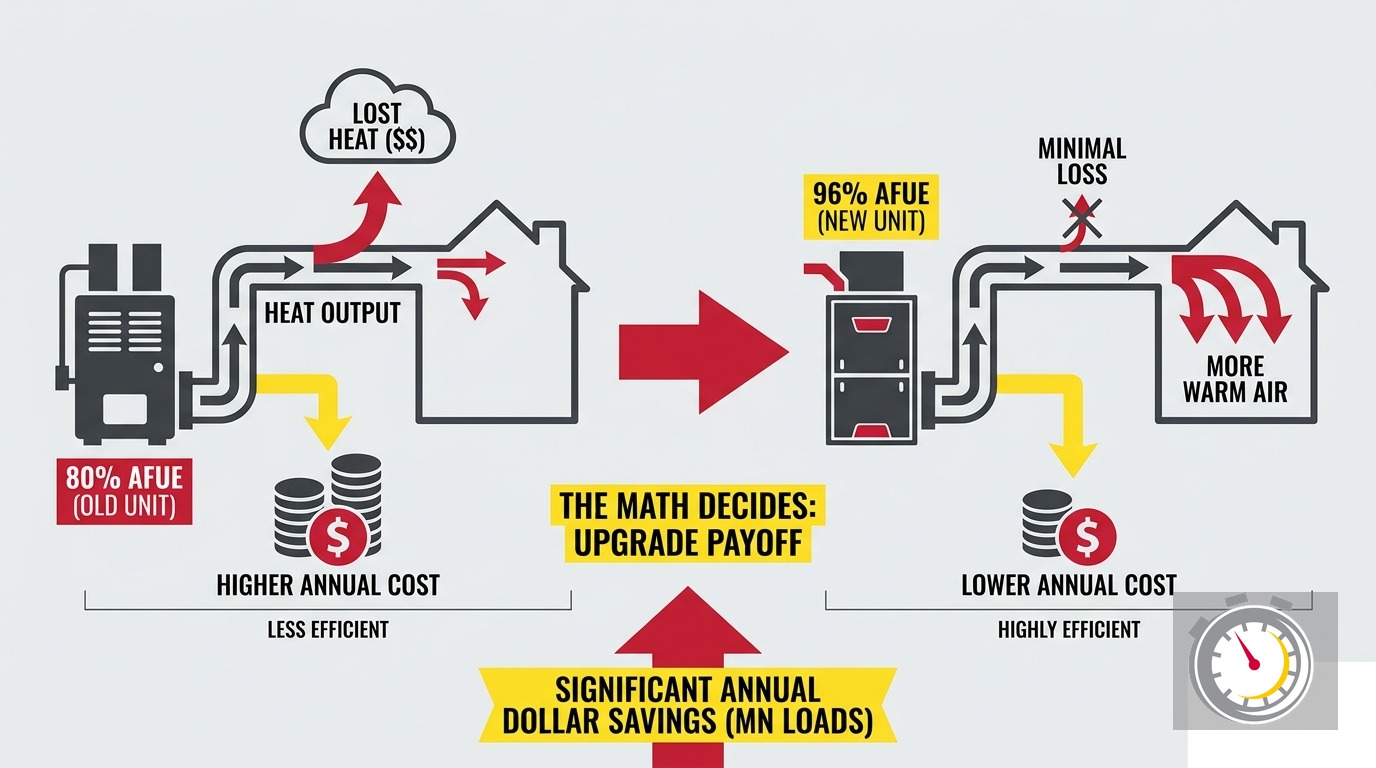
- The savings formula: annual fuel savings = annual heating cost x (1 - old AFUE / new AFUE). On a $1,400 gas bill, upgrading from 80% to 96% AFUE saves about $233 per year.
- The federal Section 25C tax credit expired December 31, 2025. Utility rebates are the only 2026 incentive: Xcel pays up to $400 per unit, CenterPoint up to $400 plus a $100 ECM add-on.
- AFUE measures combustion efficiency only. Leaky ducts lose 20-30% of delivered heat. A 96% AFUE furnace with 25% duct loss effectively delivers only about 72% efficiency to your living space.
- The DOE northern-region minimum rises to 90% AFUE in 2029. An 80% unit installed today will fall below the coming standard and earns no rebate now.
- Combined fuel savings plus rebates can recover $733 or more in year one alone on an 80%-to-96% upgrade.
What Is Furnace AFUE Rating and Why Does Minnesota Make It Count?
AFUE stands for Annual Fuel Utilization Efficiency. It is the percentage of gas your furnace converts to usable heat over a full heating season. A 96% AFUE furnace turns 96 cents of every gas dollar into warmth and vents 4 cents as exhaust. An 80% unit loses 20 cents on every dollar burned.
That gap matters everywhere, but it matters most in cold climates. Minnesota homeowners run their furnaces from October through April and sometimes into May. Every hour of extra runtime multiplies the cost of every percentage point of inefficiency. Ramsey, Maple Grove, Blaine, Plymouth, Woodbury: the math is the same across the metro.
Think of it this way. A family burning $1,400 in gas each heating season with an 80% furnace is effectively throwing $280 up the flue every year. That money is gone before it heats a single room.
Northern One Hour is locally owned and operated in Ramsey, MN. We install and service furnaces across the Twin Cities and see the real-world difference AFUE makes on customer bills every winter. This is not a national-calculator exercise for us. It is the work we do every day.
How Do You Calculate Your Furnace AFUE Savings?
Multiply your annual heating fuel cost by (1 minus old AFUE divided by new AFUE). On a $1,400 gas bill, upgrading from 80% to 96% AFUE saves about $233 per year. The formula is that direct and the inputs are on your billing statements.
Annual savings = Annual heating fuel cost x (1 - Old AFUE / New AFUE)
Walk through a Twin Cities example:
- Annual gas bill (heating season): $1,400
- Current furnace AFUE: 80%
- New furnace AFUE: 96%
- Calculation: $1,400 x (1 - 80/96) = $1,400 x 0.167 = $233 per year
A separate published example uses a $1,080 heating-season bill on the same 80%-to-96% upgrade and arrives at $180 per year in savings. The range ($180-$233) reflects different starting bills. Your number depends on how much gas you actually burn for heat.
One caveat worth noting: these calculations use your total gas bill. If your bill also covers a gas water heater, dryer, or range, your heating-only share is lower, and so are the modeled savings. A therms-based approach, which isolates your heating load from other gas uses, gives a more accurate picture. We will cover that in the next section.
What about pushing past 96% to a top-tier modulating furnace at 98%+? The additional fuel savings above 96% are only $35-50 per year. The equipment premium for that jump is substantial. For most homeowners, 96% is where the returns stop being compelling.
Minnesota’s Heating Load: Why the Savings Are Higher Here
Generic AFUE savings calculators are built around national averages. Most assume 5,000-6,000 heating degree days (HDD) per year. Minneapolis averages approximately 7,981 HDD annually. That is well above any national baseline.
HDD is a direct measure of how hard your heating system works each season. More degree days means more runtime. More runtime means every percentage point of inefficiency costs more real money.
The savings math for Minnesota homeowners is materially better than what national calculators produce. When you factor in 7,981 HDD versus a 5,500 national average, you get roughly 45% more furnace runtime. That same 80%-to-96% upgrade that saves $233 on a $1,400 bill in Minnesota might save only $160 on the same bill in a milder climate. Minnesota’s winters are the multiplier.
The design temperature in Minneapolis is -12°F. That is the engineering baseline for worst-case heating load. It is why a furnace installed in the Twin Cities is sized, specified, and tested to conditions most of the country never faces.
A therms-based approach makes the Minnesota advantage concrete. Natural gas trades at roughly $1.98 per therm nationally (Minnesota rates tend to run slightly below the national average, but the national figure provides a useful reference). A mid-size Twin Cities home typically burns 700-1,100 therms per heating season, depending on home size, insulation, and winter severity.
At 80% AFUE, burning 900 therms costs about $1,782 in gas to deliver 720 therms of usable heat. At 96% AFUE, you burn only 750 therms to deliver the same 720 therms. That drops the gas cost to $1,485. The difference is nearly $300 per year. Minneapolis’s above-average HDD load is the reason that number is as high as it is.
Does AFUE Tell the Whole Story When It Comes to Furnace Efficiency?
No. AFUE measures only combustion efficiency at the furnace itself. It does not account for heat lost in your duct system on the way to your living space. Leaky ducts through an unheated attic or crawl space can lose 20-30% of the heat your furnace produces before it reaches a single room.
The AFUE standard itself flags this limitation. Here is the practical impact: a 96% AFUE furnace with 25% duct loss delivers only about 72% of your fuel energy to your living space. You paid for a high-efficiency system and you are getting near-80%-equivalent results at the register.
This situation is more common than many homeowners realize. Many older split-levels, ramblers, and two-story homes across the Twin Cities metro have ductwork that runs through unconditioned attics, uninsulated garage spaces, or crawl spaces that drop below freezing. The furnace burns efficiently. The ducts bleed the heat before it arrives.
The fix is a duct leakage test, followed by targeted duct sealing and repair. In many older homes, sealing the duct system delivers as much measurable efficiency gain as upgrading the furnace AFUE. Sometimes more. If your home has ducts in unconditioned space and they have never been tested, the honest recommendation is to do both at the same time. A 96% AFUE furnace paired with sealed ducts is a meaningfully different system than a 96% furnace bleeding 25% through leaks.
The 2026 Rebate Landscape: What Changed and What Did Not
A large number of online sources still cite the federal Section 25C Energy Efficient Home Improvement Credit as an active incentive for high-efficiency furnaces. It is not active. The One Big Beautiful Bill Act, signed July 4, 2025, terminated the Section 25C credit for any equipment placed in service after December 31, 2025. There is no grandfather clause, no extension, and no replacement program. A furnace installed in 2026 receives $0 from the federal government.
This matters because multiple national HVAC sites and calculators still reference the credit in their savings estimates. That is a genuine information gap. If a salesperson quotes you a federal tax credit on a 2026 install, that number does not exist. Ask them to remove it from the estimate.
What does exist are Minnesota utility rebates, funded by the Conservation Improvement Program (CIP).
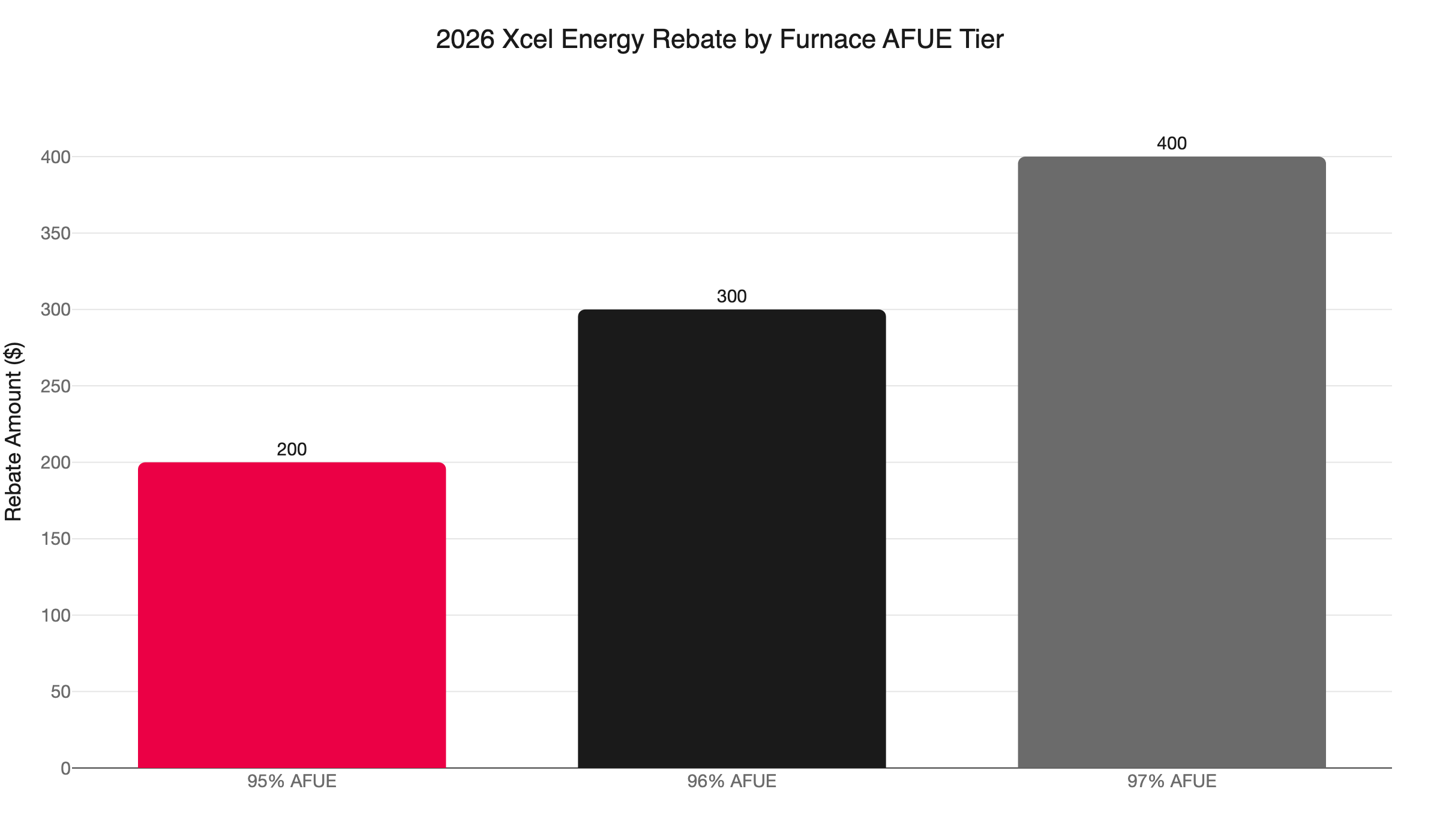
Xcel Energy 2026 rebates (source):
- 95% AFUE furnace: $200
- 96% AFUE furnace: $300
- 97% AFUE furnace: $400
CenterPoint Energy 2026 rebates (source):
- 95-96% AFUE furnace: $200
- 97%+ AFUE furnace: $400
- ECM variable-speed blower motor add-on: $100
- Income-qualified households: up to $1,200
Most Twin Cities homeowners are served by both utilities. Xcel handles electricity; CenterPoint handles gas. When both rebate programs apply to a single install, stacking them is possible. CIP budgets can cap out before year-end. Confirm current availability with your installer or directly with the utility before you commit to a timeline.
CenterPoint also offers $1,100 toward a ducted air-source heat pump paired with a 92%+ AFUE gas furnace in a dual-fuel setup. That is a separate program, but worth knowing if a hybrid system is on your radar.
Does a Furnace AFUE Rating in Minnesota Create a Fast Payback?
Yes, in most cases. Combine roughly $233 per year in fuel savings with a $300 Xcel rebate and a $200 CenterPoint rebate and you recover about $733 in year one alone on an 80%-to-96% upgrade. That frequently covers the entire equipment cost premium before the first winter ends.
Here is the full year-one picture for a typical Twin Cities homeowner served by both utilities:
- Annual fuel savings (80% to 96%): approximately $233
- Xcel Energy rebate (one-time): $300
- CenterPoint Energy rebate (one-time): $200
- Year-one total recovery: approximately $733
The equipment cost premium of a 96% unit over an 80% unit typically runs $375-$750, depending on brand, capacity, and configuration. At $733 recovered in year one, the premium on a 96% unit pays for itself before the second heating season begins. After that, $233 in annual fuel savings continues for the life of the unit, typically 15-20 years.
See our full breakdown of furnace replacement costs in the Twin Cities for what to expect on labor, equipment, and permitting combined.
What AFUE Tier Does Minnesota Code Actually Require?
Minnesota’s state minimum is currently 80% AFUE. However, the DOE northern-region standard rises to 90% AFUE in 2029. No utility rebate program in Minnesota pays for an 80% unit today. Most Twin Cities installers and municipalities already treat 90%+ as the practical floor for replacements.
A few things worth knowing about code and permits:
The 2029 DOE rule changes the calculus. An 80% furnace installed today will fall below the federal northern-region minimum within three years. Installing one now means you start the clock on an equipment that earns no rebate and will be below code before its teenage years.
Energy Star has a northern-region threshold. Energy Star certification for gas furnaces in the northern U.S. requires a minimum of 97% AFUE. Minnesota, as a Climate Zone 6A state, falls in the northern region. The southern-region threshold is 95%. That 2-point difference affects rebate eligibility on some program tiers and matters if Energy Star certification is part of your financing criteria.
Permits are not optional. Every furnace replacement in Minnesota requires a mechanical permit. Unpermitted furnace work can void homeowner’s insurance and complicate a home sale. Our team pulls the permit and coordinates the inspection as part of every installation. This is not a step to skip to save a few hundred dollars.
Do ECM Blower Motors Add Savings Beyond Furnace AFUE?
Yes. AFUE measures gas combustion efficiency only. It says nothing about the electricity your blower motor uses to push heated air through your ducts all winter. An ECM variable-speed motor uses roughly 75% less electricity than a standard PSC motor, saving $100-200 per year independently of your AFUE-driven gas savings.
This is documented specifically in cold-climate furnace efficiency analysis. A Minnesota heating season runs the blower motor hard for five or six months. At standard PSC motor consumption rates, that electricity cost is not trivial. At ECM rates, it is a fraction of the equivalent.
CenterPoint Energy recognizes the ECM advantage with a $100 add-on rebate for ECM-equipped furnaces. When you stack ECM electricity savings on top of AFUE fuel savings, the total efficiency picture improves substantially beyond what the AFUE number alone suggests.
Most 96%+ AFUE furnaces come standard with ECM blower motors. It is worth confirming when comparing quotes. Two furnaces at 96% AFUE can have meaningfully different operating costs if one uses an ECM and the other uses a standard PSC motor.
The Right Upgrade Path for Twin Cities Homeowners
Here is a practical sequence for evaluating a furnace upgrade:
Step 1: Confirm your current AFUE. The yellow EnergyGuide sticker on your furnace shows the rating. Most units installed before 2010 are 80% or below. Units installed before 2000 can be as low as 65%.
Step 2: Run the savings formula. Multiply your annual heating-season gas cost by (1 - 80/96). That is your annual fuel savings from a 96% upgrade. Write down the number.
Step 3: Check your duct system. If your ducts run through an unheated attic, crawl space, or garage and have never been tested, schedule a leakage test before or alongside the furnace install. The duct picture changes the real efficiency calculation.
Step 4: Confirm rebate availability. Xcel and CenterPoint rebate availability is CIP-funded and can cap mid-year. Do not assume the rebate exists until you have confirmed it with your utility or installer before scheduling.
Step 5: Review financing. Financing options are available on new installations. When you combine available rebates with financing, a 96% system is often accessible without waiting for the next budget cycle.
If your furnace is more than 15 years old or running increasingly frequent repair calls, the payback math gets even clearer. A properly installed 96% AFUE furnace with a sealed duct system will outperform an aging 80% unit on every metric: fuel cost, reliability, and comfort on the coldest nights of a Minnesota winter.
“Always On Time… Or You Don’t Pay a Dime!(R)” - that promise backs every appointment we make, including furnace estimates. We are locally owned and operated in Ramsey, and we will run the rebate math with you, confirm your eligibility, and give you a straight answer on whether upgrading now makes sense for your home and your budget.
Call us at (763) 260-6662 or schedule a furnace replacement estimate and we will take it from there.
Frequently Asked Questions
What is a good furnace AFUE rating for Minnesota? +
How much will I save upgrading from 80% to 96% AFUE in Minnesota? +
Is the federal tax credit still available for high-efficiency furnaces in 2026? +
Need a technician now?