
Chimney Liner Required: Furnace Replacement Minnesota Guide
Key Takeaways
- A 95%+ AFUE condensing furnace vents through PVC - not the masonry chimney. The old shared flue goes cold the day the new furnace starts running.
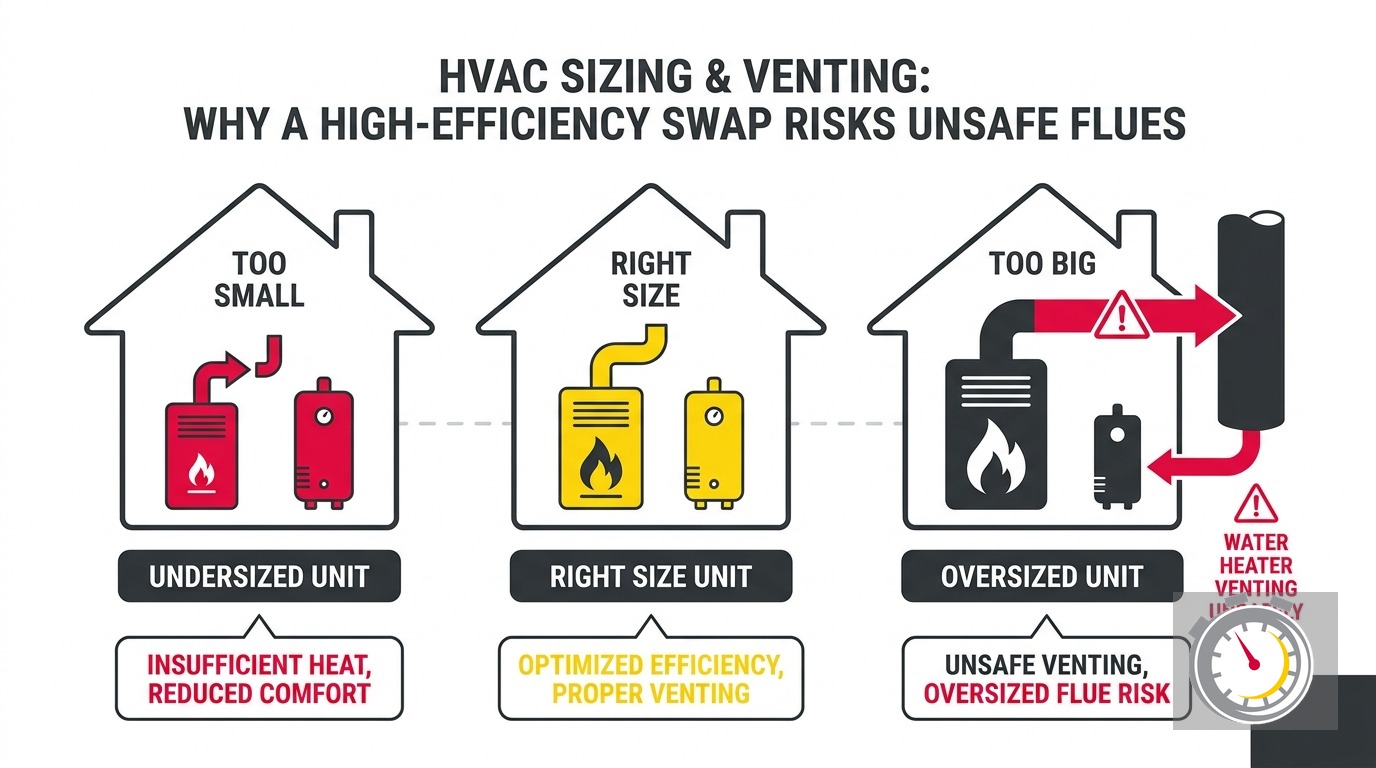
- When the furnace leaves the shared chimney, the water heater is now the only appliance in an oversized flue. That configuration is both unsafe and non-compliant.
- Minnesota Admin Rules 1346.5501 require an approved metallic liner in every masonry chimney venting a gas appliance.
- The NFPA 54 “7x rule” is the specific test inspectors use to flag an oversized flue left with a single atmospheric appliance.
- Minneapolis’s -16°F design temperature makes cold-chimney backdraft conditions worse here than in most of the country.
- Three compliant solutions exist: reline the chimney, replace the water heater with a power-vent or direct-vent unit, or cap the flue entirely.
- CenterPoint Energy and federal 25C tax credits can offset the cost of a water heater upgrade by $250 to $1,100, depending on the unit you choose.
- Your HVAC contractor is accountable for disclosing this at quote time.
Introduction: What Your Furnace Quote May Not Cover
The quote for your new furnace looks good on paper. The old 80% AFUE unit goes out, a new high-efficiency condensing furnace goes in, and you save money on gas every winter. What the quote may not mention: the moment that new furnace begins venting through PVC pipe in the side of your house, your masonry chimney runs cold - and your water heater is still connected to it.
This is the orphaned water heater problem. It is one of the most common compliance failures in Twin Cities furnace replacements. Minnesota Admin Rules 1346.5501 are not ambiguous on this point, and no licensed contractor should leave your home without addressing it. Here is what you need to know.
What Happens to Your Water Heater When You Replace the Furnace?
Short answer: A new condensing furnace vents through PVC and no longer uses the masonry chimney. If your water heater shared that flue, it becomes the only appliance in a chimney sized for two - an “orphaned water heater” that violates code and creates a CO risk.
Most older Twin Cities homes were built with a single masonry chimney serving two gas appliances: the furnace and the water heater. The chimney diameter was sized for the combined exhaust volume of both. That sizing math worked when both units were running.
When a high-efficiency furnace replaces the old unit, combustion exhaust takes an entirely new path - a plastic PVC or CPVC vent pipe that exits through the rim joist or the foundation wall. The masonry chimney is no longer part of the furnace’s venting system.
Your water heater, however, is still connected to the old flue. It is now the only appliance left in a chimney built for two. The water heater cannot generate enough exhaust volume to properly warm a flue sized for twice the load. The result is an oversized, under-loaded flue that struggles to draft - especially in winter.
The problem has a name in the industry: an orphaned water heater. CenterPoint Energy has used that exact term in their own documentation and identified CO spillage as the resulting hazard.
Why Minnesota Winters Make This Especially Dangerous
Minneapolis carries an ASHRAE 99% heating design temperature of -16°F. That figure represents the outdoor temperature that a venting system must handle on the coldest 1% of winter hours. It is the baseline engineers use to evaluate whether combustion exhaust will reliably rise and exit.
An atmospheric draft water heater - the standard tank unit in most homes - relies entirely on buoyancy. Warm combustion gases are lighter than the cold air in the flue, so they rise. The physics only work if the temperature difference between the gas and the flue air is large enough to generate the necessary upward velocity.
Minnesota’s exterior masonry chimneys compound this. Many Twin Cities homes were built with the chimney on the cold exterior wall, not in the center of the house. On a January night at -16°F, that brick mass can reach temperatures far below freezing. A water heater cycling on its own - much less frequently than a furnace - may not generate enough heat to warm the chimney mass before combustion gases cool and stop rising.
When draft fails, those gases do not just sit in the flue. They can spill backward through the draft hood and into the mechanical room or living space. Carbon monoxide has no color and no odor. There is no warning before it reaches dangerous concentrations. This is not a remote edge case in Minnesota. It is a genuine cold-climate risk that no competing article on this topic discusses with the specificity Minnesota homeowners deserve.
What Does Minnesota Code Actually Require?
Short answer: Minnesota Admin Rules 1346.5501 § 501.12 require an approved metallic liner in every masonry chimney used to vent a gas appliance. Leaving an unlined masonry flue in service for the water heater after a furnace swap is a code violation, with one narrow exception that does not apply to residential work.
The rule specifies three approved liner materials:
- Aluminum (1100 or 3003 alloy, minimum 0.032-inch wall thickness)
- Stainless steel (304 or 430 alloy, minimum 26 gauge for sizes up to 8 inches)
- Any listed vent system that meets the standard
The only exception is for appliances exceeding 400,000 Btu/hr input. That is commercial-scale equipment with no relevance to a residential furnace or water heater replacement.
The Minnesota Mechanical Code 2015, Chapter 8 adds a second requirement: the flue liner must be “continuous and free of cracks, gaps, perforations, or other damage.” That standard applies to existing liners too. If your masonry chimney has a clay tile liner, and that liner has deteriorated cracks - common in chimneys older than 20 years - it does not qualify even before the orphan problem is factored in.
Both requirements must be satisfied. A structurally intact liner is not compliant if it is the wrong size. A properly sized liner is not compliant if it is cracked. Your contractor is responsible for confirming both.
The “Orphaned Water Heater” Problem Explained
The term has a precise technical meaning. An atmospheric draft water heater depends entirely on natural convection: warm exhaust rises because it is lighter than the cold column of air in the chimney. The water heater does not have a fan or blower. It contributes no mechanical assistance to the venting process.
For that natural draft to work, the flue must be correctly sized. NFPA 54 defines the rule: the vent area shall not exceed 7 times the draft hood outlet area for a single appliance. This is the NFPA 54 single-appliance sizing rule that mechanical inspectors apply when they evaluate venting after a furnace replacement.
Run the numbers on a typical Minnesota home. The masonry flue was sized for two appliances: a furnace producing 60,000-100,000 Btu/hr and a water heater producing 36,000-50,000 Btu/hr combined. Remove the furnace. The remaining water heater is now venting into a flue that was sized for up to three times its own demand. That commonly exceeds the 7:1 ratio outright - meaning the installation fails the code test on day one.
The second problem compounds it. Before the furnace replacement, the furnace cycled frequently throughout the day and evening, keeping the masonry chimney warm. The flue stayed above draft temperature during active heating hours. Once the furnace vents through PVC and no longer warms the chimney, the masonry reverts to ambient temperature between water heater firings. On cold Minnesota nights, the chimney can cool to near-outdoor temperatures before the next water heater cycle fires.
This is the double failure: oversized flue area and a chronically cold chimney mass. Both working together on a -16°F January night in Ramsey or Blaine or Maple Grove is exactly the scenario that produces CO spillage.
How Do Inspectors Catch a Failed Installation?
Short answer: The inspector applies the NFPA 54 7:1 rule. If the masonry flue area exceeds seven times the water heater draft hood outlet area, the installation fails. An unlined masonry chimney left with a single atmospheric water heater almost always fails this test.
The mechanical inspector reviewing your furnace permit will evaluate the complete venting system - not just the furnace vent pipe. If the water heater is still connected to an unlined or improperly sized masonry chimney, the permit will not close. The contractor must return to address the non-compliant venting before the job is considered complete.
This is the moment where the financial and logistical surprise hits homeowners hardest. The furnace is installed. The house is warm. But the inspector tags the permit as open because the water heater venting was not addressed. Now the homeowner is coordinating a second trade visit, possibly a second permit, and costs that were not in the original quote.
The straightforward solution is to address it upfront - before installation begins - so there are no surprises and the right materials and permits are staged on day one.
What Are Your Three Code-Compliant Options?
Short answer: Reline the masonry chimney to the correct diameter for the water heater alone, replace the water heater with a power-vent or direct-vent unit, or cap the flue entirely if no appliance will use it. Each path has different costs and rebate implications worth reviewing before you choose.
Option 1: Reline the Masonry Chimney
A stainless steel or aluminum liner, properly sized for the water heater alone, brings the masonry chimney into compliance with both the Minnesota liner requirement and the NFPA 54 sizing rule. This is the traditional path and the right call when the chimney is otherwise in sound structural condition.
A liner installation for a single water heater typically runs $500-$2,500, depending on chimney height, access, whether an insulation wrap is required for an exterior chimney, and the liner material chosen. Stainless steel liners are the more durable choice for Minnesota’s freeze-thaw cycles. The liner must be installed with an approved cap and proper termination height to prevent downdraft and animal intrusion.
If your masonry chimney also shows cracks or deterioration in the existing clay tile liner, that must be addressed at the same time. An insulated liner sleeve adds both thermal performance and code compliance in one installation.
Option 2: Replace the Water Heater with a Power-Vent or Direct-Vent Unit
A power-vent water heater uses an internal blower to push exhaust through a PVC pipe that exits through the side of the house - no chimney required. A direct-vent unit draws combustion air from outside through one pipe and exhausts through a second. Either approach eliminates the orphaned flue problem entirely and allows the masonry chimney to be capped and abandoned if no other appliance remains.
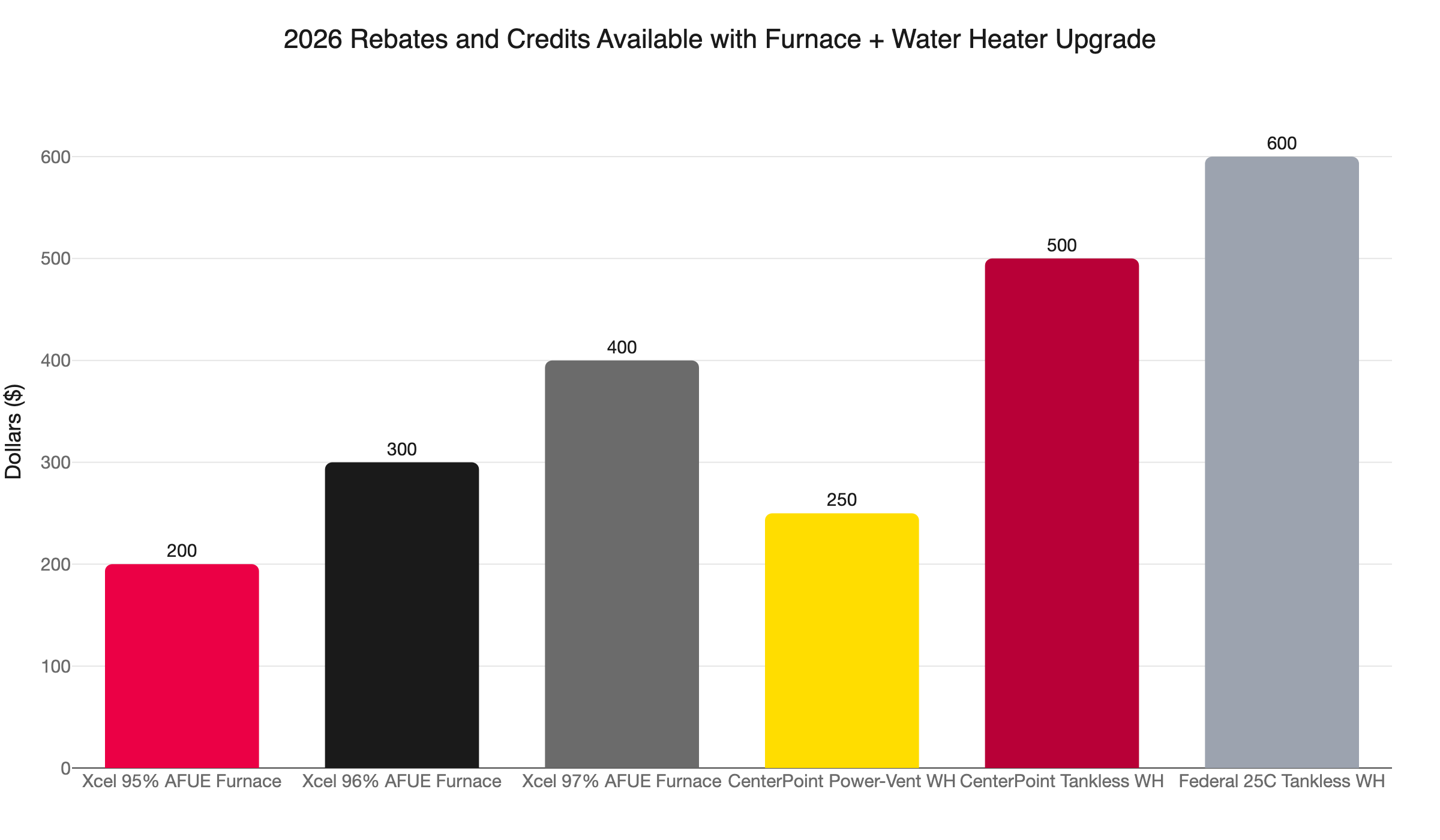
This option has the strongest rebate position in 2026. CenterPoint Energy’s residential rebate program offers $250 cash for a qualifying power-vent tank water heater (UEF 0.64 or higher, 55 gallons or less) and $500 for a qualifying tankless unit (UEF 0.87 or higher). The federal 25C tax credit covers 30% of qualifying gas tankless water heater costs, up to $600. Those two programs can stack.
Doing the water heater replacement at the same time as the furnace also opens the Xcel Energy furnace rebate: $200 for a 95% AFUE unit, $300 for 96%, and $400 for 97%, per Xcel’s 2026 Trade Ally program. Combining a 96% AFUE furnace with a qualifying tankless water heater could return $300 + $500 + up to $600 in federal credit against the total project cost.
A power-vent tank water heater installed in the Twin Cities typically runs $1,100-$2,200 depending on unit size and any venting modifications. A tankless unit runs $2,500-$4,500 installed before rebates. For many households, the net-of-rebates cost of the water heater upgrade is comparable to - or lower than - chimney liner installation, with the added benefit of a newer, more efficient water heater.
Option 3: Cap and Abandon the Flue
If you are removing the gas water heater entirely - upgrading to a heat pump water heater, for example, or converting to all-electric - and no appliance will vent through the masonry chimney, the flue can be properly capped and taken out of service. This eliminates any ongoing compliance obligation for the chimney. The cap must prevent water infiltration and animal access, and the interior termination must be properly sealed.
Does a Chimney Liner Require a Permit in Minneapolis?
Short answer: Yes. Per Minneapolis’s mechanical and venting permit guidance, liner work requires a permit. Whether it is a heating permit or a plumbing permit depends on which appliance the liner serves.
If the liner serves a furnace on a B-vent, a heating (mechanical) permit is required, pulled by a Minneapolis-licensed gas installer. If the liner serves only a water heater, it may be pulled as a plumbing permit by a licensed plumber, gas installer, or an owner-occupant.
That permit split matters in practice. Your HVAC contractor will pull the furnace mechanical permit. The water heater venting - if addressed separately - may require a second permit under a different trade. Make sure you know before work begins which contractor is pulling which permit and who is responsible for seeing each to final inspection.
A furnace installation that passes inspection while leaving an open water heater venting permit is not a complete project. The homeowner carries the code violation on their property until the second permit closes. Our guide to when an HVAC permit is required in Minnesota walks through the broader permit landscape if you are coordinating multiple trades.
What Does This Cost, and Can Rebates Help?
Short answer: Chimney liner installation runs roughly $500-$2,500. Replacing the water heater to eliminate the need for a liner runs $1,100-$4,500 installed, but 2026 rebates from CenterPoint Energy and the federal 25C credit can reduce that by $250-$1,100 depending on the unit you choose.
The rebate math is most favorable when the water heater replacement happens at the same time as the furnace. CenterPoint’s cash rebate deadline is December 31, 2026. Xcel’s furnace rebates are also available through the end of the year through their Trade Ally network.
Do not wait until after the furnace is installed to figure out the water heater path. Coordinating both in a single project visit reduces labor, ensures permits are pulled correctly, and keeps you eligible for the full rebate stack.
For a full breakdown of furnace replacement costs and efficiency tier comparisons, see our furnace replacement cost guide for the Twin Cities. For a comprehensive look at how utility, state, and federal incentive programs combine, see our post on stacking HVAC rebates and tax credits in Minnesota.
What Should Your Contractor Tell You at Quote Time?
Short answer: Any licensed HVAC contractor quoting a furnace replacement in Minnesota should identify shared flue configurations, explain what happens to the water heater venting, and present compliant options before you sign. This is a disclosure obligation at the estimate stage, not an afterthought once the new furnace is already running.
A furnace quote that does not address the water heater venting is an incomplete quote. The full project cost includes resolving the orphaned appliance - whether that means a liner or a water heater replacement. When you receive estimates, ask directly: “What happens to my water heater’s venting when you remove the old furnace?”
The answer should be specific. Which appliances share the chimney now? What is the current flue diameter? Will the water heater be orphaned after the switch? What are the compliant solutions, and which do they recommend given the chimney’s condition and your household’s rebate eligibility?
A contractor who cannot answer those questions clearly is not prepared to close the permit on your project.
We Cover the Whole Job
At Northern One Hour, we are locally owned and operated in Ramsey, MN. Our team serves the Twin Cities: Minneapolis, St. Paul, Blaine, Maple Grove, Plymouth, Brooklyn Park, Woodbury, Bloomington, and the surrounding area. When we quote a furnace replacement, we walk through the complete venting system. We identify shared flue configurations at the estimate stage, not after installation. We present all compliant options, including which rebate programs apply to your specific situation.
Transparent pricing and honest disclosure are not extras. They are part of how we do business. We back every visit with our commitment: “Always On Time… Or You Don’t Pay a Dime!(R)” and a 100% satisfaction guarantee.
If your current quote did not cover the water heater venting question - or if you are just starting the process and want the full picture before you commit - call us at (763) 260-6662 or book online. We will make sure you know exactly what the project involves before any work begins.
Key Takeaways (Recap)
- A high-efficiency furnace swap orphans any atmospheric water heater that shared the masonry flue.
- Minnesota Admin Rules 1346.5501 require an approved metallic liner in every masonry flue still serving a gas appliance.
- The NFPA 54 7:1 sizing rule is how inspectors quantify the failure - and unlined masonry chimneys left with a single water heater commonly fail it on the spot.
- Minneapolis requires a permit for liner work - heating or plumbing, depending on which appliance is served.
- Three compliant solutions exist: reline, replace the water heater, or cap the flue.
- The rebate stack in 2026 makes the power-vent or tankless water heater path financially competitive with liner installation for most households.
- Your contractor must disclose this at quote time. If they did not, ask before you sign.
Frequently Asked Questions
Does every furnace replacement in Minnesota require a chimney liner? +
Who is responsible for telling me about the orphaned water heater problem? +
Can utility rebates offset the cost of fixing an orphaned water heater? +
What happens if I ignore the orphaned water heater issue? +
Need a technician now?