
Do I Need a Permit to Replace HVAC in Minnesota?
Key Takeaways
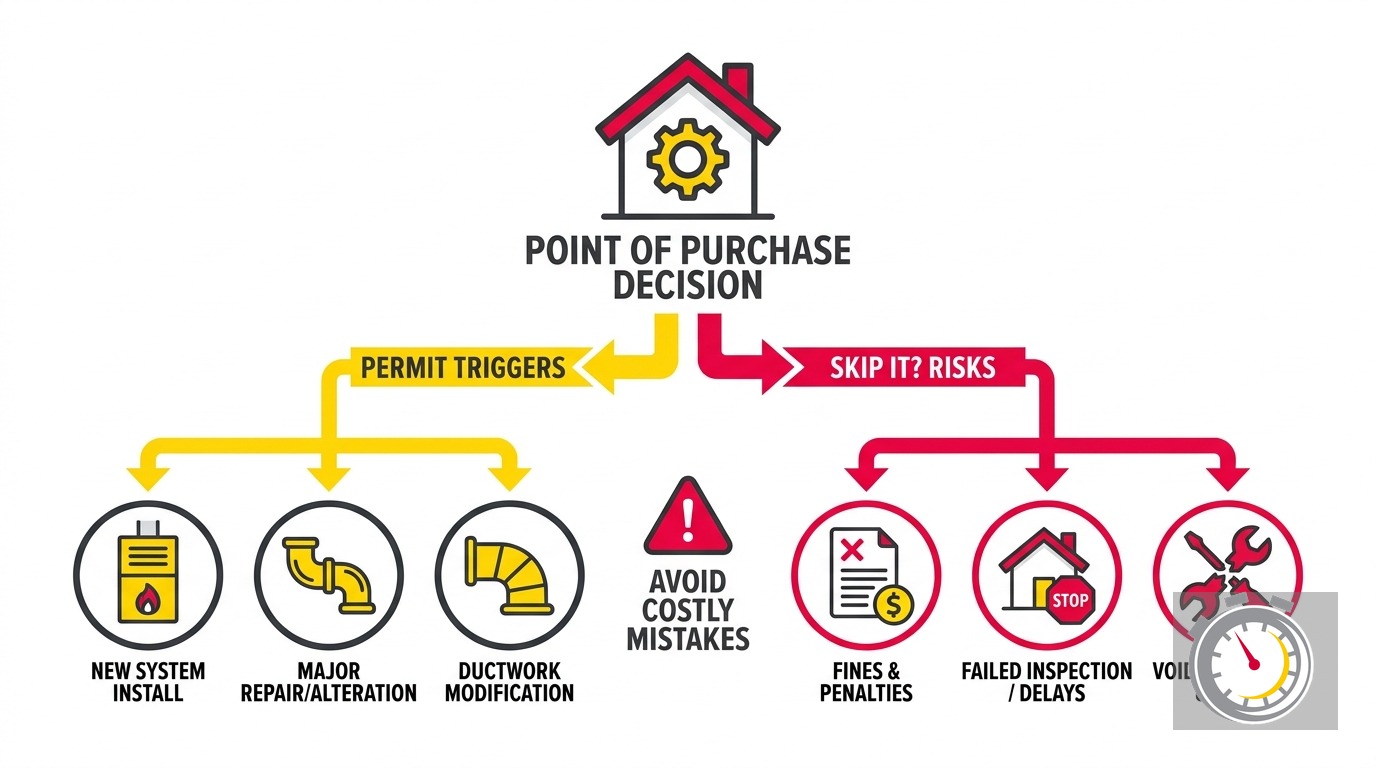
- Every HVAC replacement in Minnesota requires a mechanical permit: furnace, AC, heat pump, and boiler replacements all qualify. No like-for-like exceptions exist.
- Your licensed contractor pulls the permit. You confirm they will do it before work starts.
- Skipping the permit can cost you $4,000 to $5,000 in forfeited utility rebates and federal tax credits.
- A separate electrical permit is not required for a straight in-place swap. It is required if the unit moves to a new location or if the circuit is modified.
- Permit fees in the Twin Cities run $50-175 for a standard furnace replacement.
- If you inherit unpermitted HVAC work when buying a home, a retroactive path exists through the local building department.
- A contractor who skips the permit is not doing you a favor. They are passing the risk to you.
Why the Permit Question Costs Real Money
Most homeowners ask about HVAC permits because they want to know whether skipping one is risky. The honest answer: yes, but not mainly for the reasons you might expect.
Code violations are real. So is the possibility of a forced reinspection. But the most expensive consequence of skipping an HVAC permit in Minnesota in 2026 is losing access to rebates and tax credits worth up to $5,000 on a qualifying heat pump job.
Here is what you stand to lose if the permit is skipped on a heat pump replacement:
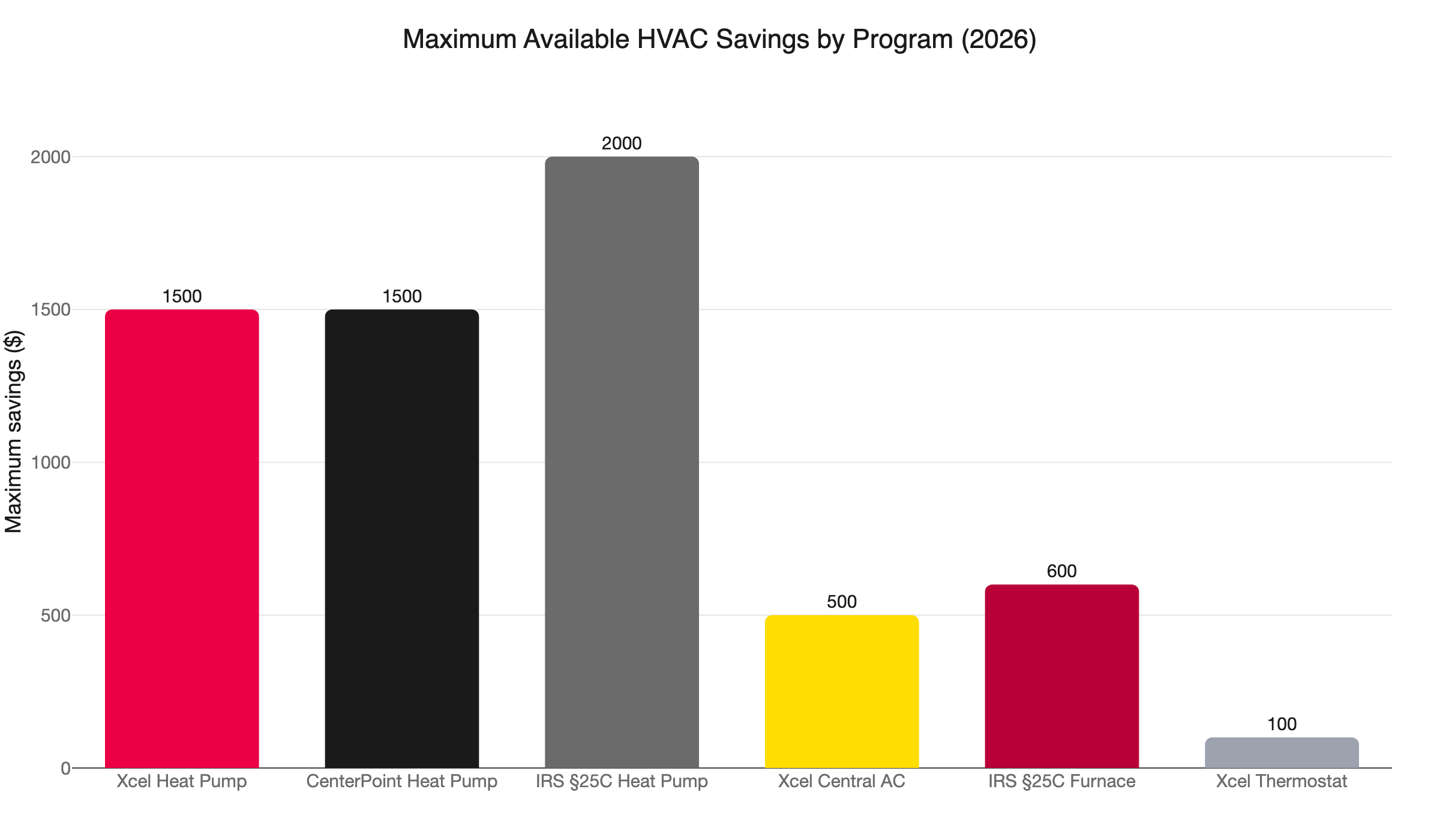
- Up to $1,500 from Xcel Energy.
- Up to $1,500 from CenterPoint Energy.
- Up to $2,000 from the IRS §25C federal tax credit.
- Your homeowner’s insurance coverage on incidents tied to unpermitted equipment.
- Clean title when you sell the home.
The permit fee in the Twin Cities runs $50-175. The rebates and credits it protects are worth 20 to 40 times that amount. This is not a close call.
Every one of those programs requires a permit. You cannot apply for the rebate without the permit number and a passed inspection date. The permit is not a formality. It is the key that unlocks the money.
Does Every HVAC Replacement Require a Permit in Minnesota?
Yes. Every HVAC replacement in Minnesota requires a mechanical permit under Minnesota Statutes Chapter 326B. This includes furnace, AC, heat pump, and boiler replacements, even when the new unit is identical to the old one.
The governing authority is the Minnesota Department of Labor and Industry (DLI). The adopted technical standard is the Minnesota State Mechanical Code, based on the International Mechanical Code. Fuel gas work follows the Minnesota Fuel Gas Code (NFPA 54/58).
The permit requirement applies to all of the following:
- Furnace replacement (gas or electric)
- Central AC replacement
- Heat pump installation or replacement
- Boiler replacement
- Adding or extending gas lines
- Modifying ductwork
- Installing HRV or ERV ventilation units
If a contractor tells you the job is too small for a permit, or that a like-for-like swap is exempt, that claim is not accurate under Minnesota law. Ask directly whether they will pull the mechanical permit. If they say no, choose a different contractor.
What HVAC Work Is Permit-Exempt?
Routine maintenance is exempt. Replacing filters, cleaning coils, lubricating motors, and repairing controls without changing system capacity or configuration all qualify. The line is drawn at any modification or equipment replacement. Once a unit is swapped, the permit requirement kicks in.
If a technician is performing annual maintenance on an existing, code-compliant system, no permit is needed. The visit does not require paperwork. But the moment a unit is removed and replaced - regardless of size, brand, or similarity to the old one - you are in permit territory.
Who Pulls the HVAC Permit in Minnesota?
Your licensed contractor pulls the permit. Only a DLI-licensed Mechanical Contractor or Residential HVAC contractor can pull mechanical permits for HVAC work. You do not file it yourself.
The permit is tied to the work and the property. Even if you purchase the equipment yourself and supply it to the installer, the installing contractor still pulls the permit. There is no homeowner-supply exception.
One carve-out exists: homeowners may pull their own permit for work on their primary residence in most Minnesota jurisdictions. But this applies when the homeowner performs the work themselves, not when they hire a contractor to do it.
The practical takeaway: when you receive bids for a replacement, ask each contractor whether the permit is included in the price. A contractor who quotes without it is not saving you money. They are transferring the risk to you. Verify any HVAC contractor’s license status at dli.mn.gov before work starts.
For more on what to look for when comparing replacement bids, see our furnace replacement cost guide for the Twin Cities.
Do I Need a Separate Electrical Permit for a Furnace or AC Swap?
No - not for a straight in-place replacement. Under Minn. Stat. 326B.38, a licensed HVAC contractor can disconnect and reconnect an existing branch circuit without a separate electrical permit. The unit must stay in the same location. The circuit must remain unchanged.
A separate electrical permit IS required in these situations:
- The unit moves to a new location in the home.
- This is a first-time installation with no existing branch circuit.
- The project involves adding or modifying the electrical circuit serving the unit.
Most articles on this topic either ignore this nuance or get it wrong. A furnace swap in place - same footprint, same circuit - does not require a second permit for the electrical disconnect and reconnect.
If a contractor quotes a separate electrical permit for an in-place swap, ask what circuit work requires it. Sometimes the answer is legitimate: the panel needs an upgrade, or the circuit is undersized for the new unit. Sometimes it is not. Knowing the rule helps you ask the right question.
What Does the Inspector Check on a Furnace Replacement?
The inspector verifies the installation against the Minnesota Fuel Gas Code and state mechanical code. The visit covers venting, combustion air, clearances, and a documented performance test. Here is the checklist for a standard Twin Cities furnace replacement.
Venting and exhaust:
- All horizontal vent connectors must slope upward at a minimum of 1/4 inch per foot toward the terminal.
- The common vent must terminate above the roofline with a listed cap.
- The entire common vent must be double-wall (B-vent). No single-wall allowed in the common vent.
- High-efficiency (96%+) furnaces use PVC venting instead of B-vent. The inspector checks that all PVC joints are properly sealed.
Combustion air intake:
- The bottom of the intake opening must sit at least 12 inches above grade on the exterior.
- The opening must be caulked on the top and sides where it penetrates the wall.
- On the interior, the intake terminates no more than 12 inches above floor level.
Clearances from combustibles:
- Minimum 1 inch between a combustible surface and B-vent.
- Minimum 6 inches between a combustible surface and single-wall vent connector.
Performance documentation:
- A furnace performance test must be completed before the inspection closes.
- A tag documenting the test attaches to the gas line near the furnace.
These are not bureaucratic checkboxes. Each item corresponds to a real failure mode: venting problems that allow carbon monoxide to backdraft into living space, clearance failures that cause fires, combustion air problems that cause incomplete combustion. The inspection is the independent confirmation that the job was done correctly.
For more on the carbon monoxide risks that make proper venting so critical, see our post on furnace safety and carbon monoxide.
How Much Does an HVAC Permit Cost in the Twin Cities?
Permit fees vary by jurisdiction. For most Twin Cities homeowners, a mechanical permit for a standard furnace replacement runs $50-175 based on current municipal fee schedules. Suburban communities on the lower end; Minneapolis and St. Paul closer to the top.
Here are the typical ranges by area:
- Minneapolis and St. Paul: $75-175.
- Suburban Twin Cities (Hennepin, Ramsey, Dakota, Washington counties): $50-150.
- Greater Minnesota: $50-155.
Most contractors include the permit fee in their installation quote. Confirm this before agreeing to a bid. The permit cost is a small fraction of any replacement job - and a small fraction of the rebates and tax credits it protects.
If a contractor’s bid is significantly lower than competitors and does not mention a permit, ask directly. The savings may not be savings at all.
What Happens If You Skip the HVAC Permit?
Skipping the permit creates four specific problems: forfeited rebates and tax credits, potential insurance denial, possible warranty voidance, and home sale complications. They can compound when they hit at the same time - often at the point of sale.
Rebates and tax credits are forfeited. Xcel Energy and CenterPoint require proof of a municipal permit and a passed inspection as conditions for rebate eligibility. The IRS §25C tax credit requires licensed professional installation, which the permit documents. No permit means no rebate. No rebate means no tax credit.
Your homeowner’s insurance may deny claims. If a fire or carbon monoxide incident is tied to unpermitted HVAC work, your insurer may refuse to cover it. Adjusters investigate the installation when processing claims. Unpermitted work gives them grounds to deny.
Your manufacturer’s warranty may be void. Some manufacturers explicitly require permitted installation as a condition of warranty coverage. Check the terms for the specific unit before agreeing to work without a permit. You may be buying equipment that has no warranty from day one.
Home sale complications follow. Unpermitted work surfaces during the buyer’s inspection or in a title search. The buyer’s lender may require the work to be brought up to current code before closing. In some cases, the equipment must be removed and reinstalled under permit. That cost comes out of the seller’s proceeds.
Every one of these consequences is avoidable. The permit costs $50-175. The protection it provides is worth orders of magnitude more.
I Just Bought a Home With Unpermitted HVAC Work. What Now?
This is a common scenario in the Twin Cities, particularly with older homes. It usually surfaces during a buyer’s inspection or when you pull permit records at the local building department. A retroactive path exists. Here is how it works.
Step 1: Contact the local building department. Bring the address and describe what work appears to have been done without a permit. Most Twin Cities jurisdictions have a process for retroactive permits on completed improvements.
Step 2: Request an inspection. A licensed inspector evaluates whether the existing installation meets current code. If the work was done correctly and nothing has changed since, the permit may be issued retroactively after a passed inspection.
Step 3: Correct any violations found. If the inspector identifies problems - improper venting, clearance violations, inadequate combustion air - a licensed contractor must correct them before the permit closes. Budget for this work. It can range from minor adjustments to a partial reinstall, depending on what was done originally.
Step 4: Address it in the transaction if you have not closed yet. If unpermitted work surfaces before closing, negotiate it into the purchase terms. A price reduction, seller credit, or seller-funded retroactive permit are all reasonable asks. Do not wait until you own the property to resolve it.
The worst move is ignoring it. Unpermitted HVAC work does not disappear at closing. It follows the property. The next buyer will face the same issue, and you will be the seller who has to explain it.
Our HVAC checklist for buying a home in Minnesota covers what else to verify before you close on a property with aging HVAC equipment.
How the Permit Protects Your Rebates and Tax Credits
For a heat pump or high-efficiency furnace replacement in 2026, the rebate and tax credit picture in Minnesota is significant. Here is the full stack available to Twin Cities homeowners.
Xcel Energy offers up to $1,500 for a qualifying cold-climate air-source heat pump, up to $500 for a qualifying central AC, and up to $100 for a qualifying smart thermostat. Equipment must be AHRI-certified and installed by a licensed professional.
CenterPoint Energy offers up to $1,500 for a ducted air-source heat pump installed in an existing home.
IRS §25C (Inflation Reduction Act) covers 30% of installed cost, including labor, on qualifying equipment. The maximum credit is $2,000 for a qualifying heat pump and $600 for a high-efficiency (95%+ AFUE) gas furnace. The heat pump must meet SEER2 16 and HSPF2 8.2 to qualify.
All three programs require proof of a permit and a passed inspection from utility programs, and licensed installation documentation for the IRS credit. There is no workaround. The rebate applications ask for the permit number and inspection date. If you cannot provide them, the rebate is denied.
On a cold-climate heat pump replacement in 2026, the combined Xcel + CenterPoint + IRS §25C stack could reach $5,000. The permit fee is $100. The math favors the permit every time.
Minnesota Commerce also administers a state heat pump rebate program tied to the federal HEAR program, though it was still pending federal DOE approval as of early 2026. For a full breakdown of what you can claim right now, read our Minnesota heat pump rebates and tax credits guide.
What Northern One Hour Does on Every HVAC Installation
We are locally owned and operated in Ramsey, MN. Our service area covers the Twin Cities metro: Minneapolis, St. Paul, Blaine, Maple Grove, Plymouth, Brooklyn Park, Woodbury, Bloomington, and surrounding communities.
On every installation we do, we pull the permit. That is not optional, and we do not offer a price-break option for skipping it. The permit protects your rebate eligibility, your equipment warranty, and your insurance coverage. It also gives you the documentation you will need when you sell.
Our technicians are DLI-licensed. When the inspection visit is scheduled, we coordinate it on your behalf. You do not have to track down the building department or figure out what the inspector needs to see. That is our job.
We back every job with our on-time promise: “Always On Time… Or You Don’t Pay a Dime!(R)”. That applies to the installation window and the inspection visit.
If you are planning a furnace replacement, AC installation, or heat pump upgrade this year, call us at (763) 260-6662 or book online. Financing is available on qualifying installations. We can also walk you through which rebate programs apply to your job and what documentation you will need to file.
Frequently Asked Questions
Who pulls the mechanical permit for HVAC work in Minnesota? +
Do I need a separate electrical permit for a furnace replacement? +
Will skipping the HVAC permit affect my utility rebates? +
What does an HVAC permit cost in the Twin Cities? +
What happens if I buy a home with unpermitted HVAC work? +
Need a technician now?