
HVAC Permit Cost Minnesota: What Minneapolis and the Suburbs Charge
Key Takeaways
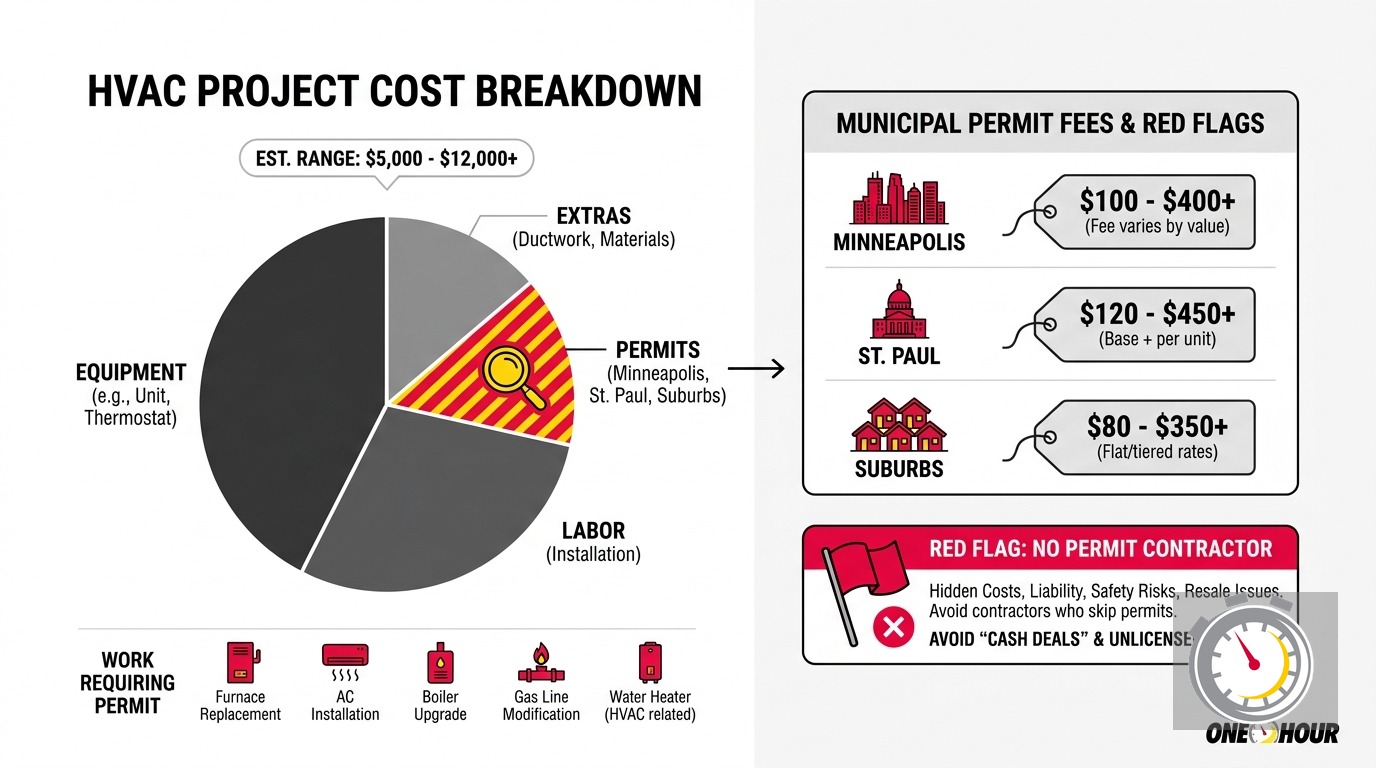
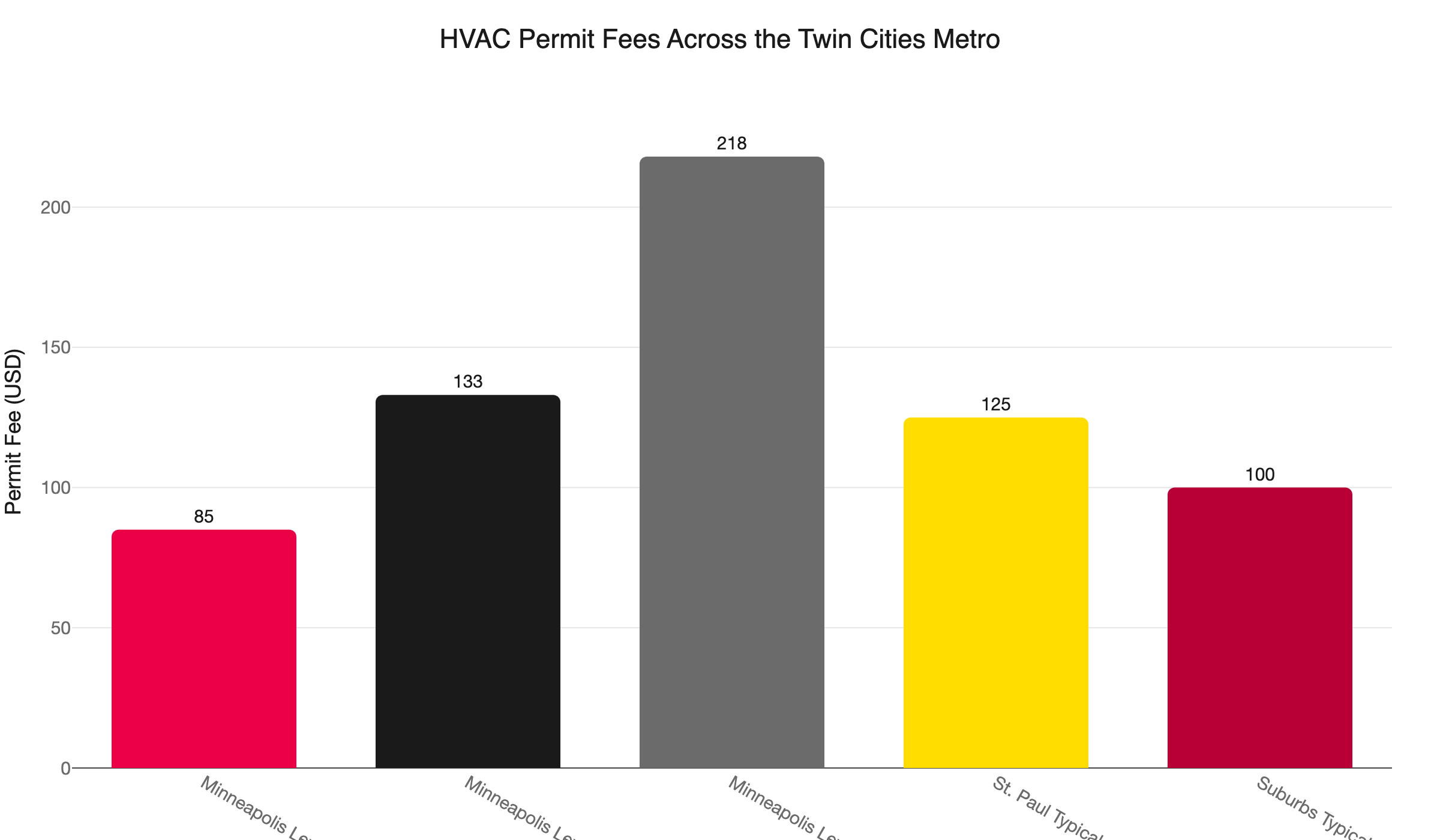
- Minneapolis charges $85.20 for minor HVAC work, $133.40 for a furnace or boiler replacement, and $217.60 for a complete system swap. These come from the city’s published flat-rate Director’s Fee Schedule.
- St. Paul calculates fees based on the declared value of the work. A standard furnace replacement typically falls between $75 and $175.
- Most Twin Cities suburbs run $50-$150 for a residential HVAC permit, using a valuation-based formula updated annually.
- Under the Minnesota Mechanical Code, furnaces, boilers, central AC systems, ductwork modifications, HRVs, and ERVs all require a permit. Thermostat swaps and filter changes do not.
- Minnesota requires 92% AFUE minimum for gas furnaces statewide. A permitted job enforces that minimum. An unpermitted job may not.
- A $217 permit on a $12,000 job is roughly 1.75% of the total cost. A contractor framing that fee as savings is shifting risk onto you, not reducing your bill.
- Northern One Hour is locally owned and operated in Ramsey, MN. We pull every permit a job requires. That is part of what you are hiring us to do.
If you are planning a furnace or AC replacement in the Twin Cities, the HVAC permit cost Minnesota requires is one line item worth understanding before you sign a quote. Fees range from about $50 to $220 depending on your city and the scope of work. This post breaks down the actual numbers from published city fee schedules - and explains why skipping that line item costs far more than it saves.
What Is the HVAC Permit Cost in Minnesota?
HVAC permit costs in Minnesota range from about $50 to $220 for most residential jobs. Minneapolis uses a flat-rate schedule capped at $217.60 for a full system replacement. St. Paul and most suburbs calculate fees on the job’s declared value and land in a similar range.
The permit fee is rarely the part of an HVAC quote homeowners ask about. A licensed contractor bundles it in, pulls the permit, and schedules the inspection. That is fine when everything is handled correctly. The problem arrives when a contractor suggests leaving the permit out - offering to “save you” a $150-$220 line item on a $10,000-plus job.
This post shows the actual numbers city by city, based on published fee schedules. It also covers what the inspector checks, how the permit connects to Minnesota’s efficiency requirements, and why the “skip the permit” offer costs far more than it saves.
Our companion post on when an HVAC permit is required in Minnesota covers the trigger question in detail. This post answers the cost question that one leaves open.
Minneapolis HVAC Permit Cost: What the City Fee Schedule Shows
Minneapolis publishes a flat-rate permit schedule by work category, which makes it the most transparent permit structure in the Twin Cities metro. The fees come directly from the Minneapolis Director’s Fee Schedule PDF:
| Work Category | Base Fee | State Surcharge | Total |
|---|---|---|---|
| Level 1: minor HVAC, no burner | $84.20 | $1.00 | $85.20 |
| Level 2: Level 1 plus furnace or boiler swap | $132.40 | $1.00 | $133.40 |
| Level 3: complete system replacement | $216.60 | $1.00 | $217.60 |
| Gas burner under 400,000 BTU/hr | $73.30 | $1.00 | $74.30* |
*Minimum $85.20 (surcharge included) applies to all gas burner permits.
For most homeowners replacing both a furnace and central AC at the same time, the applicable tier is Level 3 at $217.60. A furnace-only or AC-only replacement falls under Level 2 at $133.40. Minor service work with no burner involved is Level 1 at $85.20.
One detail worth flagging before we move on: Minneapolis charges double the standard permit fee when unpermitted work is discovered after the fact. If an inspector finds an HVAC system that was replaced without a permit, the homeowner owes twice the normal fee, plus the cost of the inspection and any required corrections. That penalty typically does not surface until a home sale brings in a buyer’s inspector.
The flat-rate structure is genuinely useful for homeowners doing their homework. You can know exactly what the Minneapolis permit will cost before your contractor submits, and you can verify it appears on the invoice.
What Does the St. Paul HVAC Permit Cost?
St. Paul does not use a flat-rate list. The Department of Safety and Inspections calculates fees against the declared material and labor value of the job. For a standard furnace replacement, that typically produces a permit fee between $75 and $175.
The process is described in the St. Paul DSI Mechanical Permit documentation. Because fees scale with the declared job cost, a high-efficiency furnace installation carries a slightly higher permit fee than a mid-efficiency swap of the same scope. The difference is not dramatic, but it is worth knowing.
St. Paul also issues separate permits by category of work. A job that includes both a mechanical replacement and a gas line modification requires two permits, each calculated independently. That is not a large added cost, but it does affect how the permit line appears on your invoice. Ask your contractor before the job starts whether more than one permit is needed for the scope of work.
For most St. Paul furnace replacements, budgeting $100-$175 for the permit is a reasonable estimate. Your contractor will have the current fee at submission time.
What Do Twin Cities Suburbs Charge for HVAC Permits?
Most Twin Cities suburbs use the International Code Council fee schedule, updated annually, and calculate fees on the declared value of the work. The typical permit range for a residential furnace or AC replacement in suburbs like Brooklyn Park, Blaine, Maple Grove, and Plymouth is $50-$150.
Brooklyn Park’s permit and plan review fee schedule confirms the ICC-based method and notes that fees are updated every February. The contractor filing the permit declares the total value of labor and materials, and the fee follows from that figure.
For a standard furnace swap, the declared job value typically produces a permit fee in the $75-$100 range for most suburbs. A full system replacement, with a higher declared value, moves toward the upper end. Either way, the fee is a small fraction of the total installed cost.
Permit data for the Minneapolis metro puts the average total HVAC replacement cost in the area at roughly $12,420 in 2026. A $100 suburban permit is about 0.8% of that job. A $150 permit is about 1.2%. These figures should not be driving decisions about which contractor to hire or whether to permit the work at all.
What Work Requires an HVAC Permit in Minnesota?
Any replacement or new installation of major HVAC equipment requires a permit under the Minnesota Mechanical Code. That includes furnaces, boilers, central AC systems, ductwork modifications, whole-home humidifiers, HRV and ERV units, gas fireplaces, and chimney liners.
The line between permit-required and no-permit-needed is drawn at equipment replacement and new installation versus routine maintenance:
Permit required:
- Furnace or boiler replacement or new installation
- Central AC or heat pump replacement or new installation
- Ductwork modification, extension, or full replacement
- Whole-home humidifier installation
- HRV or ERV installation
- Gas fireplace, wood stove, or insert installation
- Chimney liner replacement or installation
- Exhaust fan installation involving a new wall or roof penetration
No permit needed:
- Filter replacement
- Thermostat swap (no new wiring)
- Evaporator or condenser coil cleaning
- Motor lubrication and minor component servicing
Brooklyn Park’s mechanical permit page lists these categories explicitly, drawing from Chapter 1346 of the Minnesota Mechanical Code. The rules are statewide minimums. Individual cities can require permits for additional categories, but they cannot set a lower threshold than the state minimum.
If a contractor tells you a furnace replacement in Minnesota does not require a permit, that is incorrect. It always does. That kind of misrepresentation is one of the clearer HVAC contractor warning signs to watch for in the Twin Cities.
What Does the Inspector Actually Verify?
The inspector confirms the installation meets current safety and efficiency codes. Key checkpoints include the venting category matched to the equipment’s efficiency rating, gas line sizing and clearances, combustion air supply, refrigerant line integrity on AC work, and full operational function.
For high-efficiency condensing furnaces, the venting check is the most consequential. A unit rated at 90% AFUE or above produces acidic condensate and must vent through Category IV PVC pipe with proper drain provisions. A mid-efficiency furnace uses B-vent metal flue. These are entirely different installation requirements. A contractor who installs a 96% AFUE furnace and routes it through the original metal flue has created a code violation and a potential carbon monoxide pathway into the home.
The permit inspection catches that. Unpermitted work removes that check entirely.
A full summary of what inspectors verify in Minnesota is outlined by the Minnesota HVAC Authority, including:
- Venting type (Category I, III, or IV) matched to the equipment’s rated efficiency
- Gas line sizing relative to the equipment’s BTU demand
- Combustion air supply - adequate fresh air for safe operation
- Refrigerant line integrity and proper line set sizing on AC and heat pump work
- Controls, thermostat wiring, and final operational function test
The inspection is not a paperwork formality. It is a qualified, independent review of a system that will run in your home every day for the next 15-20 years. The permit fee buys you that second set of eyes. Skipping it saves you the fee while removing the safety net.
Why Does Pulling a Permit Trigger an Efficiency Requirement?
Minnesota requires a 92% AFUE minimum for gas furnaces in Climate Zones 6 and 7, which covers essentially all of the state. When a permit is pulled, the inspector confirms the new unit meets that minimum. There is no grandfathering from the original installation date.
This matters most when you are replacing an older furnace. If your current system is an 80% AFUE unit from 2007, a permitted replacement in Minnesota requires a 92%+ unit. That means a higher equipment price. It also means real efficiency gains that compound across every heating season.
A 92% AFUE furnace retains 12 more cents of every gas dollar burned compared to an 80% unit. In a Minnesota winter, with heating running for five or more months, that difference shows up on your CenterPoint or Xcel bill every year. Our post on furnace AFUE ratings and what they mean for Twin Cities homeowners works through the payback math in detail.
An unpermitted installation may bypass the efficiency verification. A contractor installs whatever equipment they have on the truck, and no inspector checks it against the code minimum. You could end up with a non-compliant unit, no documentation, and complications at resale. The efficiency requirement is not a burden. It is the state enforcing the fuel savings you will see for the next two decades.
Is a Contractor Who Offers to Skip the Permit Saving You Money?
No. A contractor offering to skip the permit on a $12,000 HVAC job is offering to save you $150-$220 while exposing you to far larger costs at resale, with your insurer, and with the equipment manufacturer. The math does not work in your favor.
Here is a breakdown of what that “savings” actually buys:
At home sale. A buyer’s inspector will find the unpermitted installation. The buyer can ask you to pull a retroactive permit, demand removal and a properly permitted reinstall, or reduce their offer to reflect the liability. Retroactive permits are not always available. When they are, they often require opening walls to verify what was installed. The cost to resolve this routinely exceeds the original permit fee by thousands of dollars.
With your home insurer. Homeowner’s policies routinely exclude losses caused by code violations. If a fire or carbon monoxide incident is traced to an improperly installed furnace, the insurer can deny the claim on the grounds that the installation was never inspected. That denial can arrive years after the job and years after the contractor who “saved” you the money has moved on.
With the manufacturer. Some HVAC equipment manufacturers require a permitted, inspected installation as a condition of the warranty. An unpermitted install can void coverage before the equipment has run through a single Minnesota winter. Warranty terms vary by brand, so ask your contractor directly - but the risk is real and worth understanding before you decide.
In Minneapolis specifically. If the city discovers unpermitted work, the homeowner owes double the standard permit fee, still needs the inspection, and still needs corrections if anything fails. The contractor has been paid and is gone. You are holding the liability.
As Furnace Direct’s analysis of Minnesota permit requirements makes clear, unpermitted work creates complications that consistently cost more to resolve than the original permit would have. The math is not close.
Any contractor who frames the permit as optional is not working in your interest. Our post on HVAC contractor red flags in the Twin Cities covers more of what a reputable contractor looks like before you sign anything.
How to Verify Your HVAC Contractor Is Properly Licensed
Minnesota Statute 326B.197 requires any contractor performing gas, heating, ventilation, cooling, or refrigeration work to carry a $25,000 bond with the Minnesota Department of Labor and Industry. Technicians handling refrigerant must hold EPA Section 608 certification.
Verifying a contractor’s license takes about 90 seconds at dli.mn.gov. Ask for the license number before any permit is filed or any work begins. A legitimate contractor will provide it without hesitation.
A licensed contractor pulls permits because not doing so puts their license at risk. When a contractor suggests skipping the permit, one of two things is true: they are not properly licensed, or they are cutting corners in ways that extend well past the permit fee. Neither scenario is worth the savings they are pitching.
Northern One Hour is locally owned and operated out of Ramsey, MN. Every technician on our team holds the required licensing, and every job we do that requires a permit gets one. You hire us to do the whole job correctly, not to save you $200 on a $12,000 installation.
What to Ask Your HVAC Contractor Before Work Starts
Before any HVAC contractor begins work at your home, ask these questions directly:
- Will you pull the permit? The answer should be yes, with no hedging.
- Which city’s process applies to my address? A contractor who works the Twin Cities regularly knows this without looking it up.
- Does the replacement equipment meet the Minnesota 92% AFUE minimum? For any gas furnace job in this state, the answer must be yes.
- Can I have your Minnesota contractor license number? Any licensed contractor will give it to you immediately.
- What does the inspector check for this type of job? A contractor who routinely pulls permits answers this question easily.
For a furnace replacement or full system installation in the Twin Cities, the permit process is one of the first things we confirm. We handle the filing, coordinate the inspection schedule, and make sure the job passes before we consider it finished. That is not an extra service. It is how a licensed contractor is supposed to work.
Call (763) 260-6662 or book online to schedule service or request a quote. We show up when we say we will. “Always On Time… Or You Don’t Pay a Dime!(R)”
Frequently Asked Questions
How much does an HVAC permit cost in Minneapolis? +
Does a furnace replacement require a permit in Minnesota? +
What happens if my HVAC contractor skips the permit? +
Need a technician now?