
How to Choose an HVAC Contractor in the Twin Cities
Key Takeaways
- Minnesota has no statewide HVAC license. The only state requirement is a $25,000 bond filed with DLI. Ask for proof before the estimate ends.
- Mechanical permits are required before any equipment swap in virtually every Minnesota city and county. “No permit needed” is a walk-away line.
- Manual J load calculations are code-required in Minnesota for HVAC sizing. “Same size as what you have” is not an acceptable bid.
- Xcel Energy eliminated gas furnace and boiler rebates on January 1, 2026. A contractor still quoting Xcel furnace rebates is working from an outdated price sheet.
- CenterPoint rebates are dealer-submitted. If your contractor is not a Trade Ally, you will not receive the rebate even if the equipment qualifies.
- The six questions in this guide are designed to fail dishonest contractors, not honest ones. A straight contractor answers all of them without hesitation.
Why This Decision Looks Different in Minnesota
Minnesota winters are not typical. Minneapolis carries a design temperature of approximately -16°F. That number matters when contractors from other climates apply rules written for warmer markets.
The regulatory picture is also unusual. Most homeowners assume HVAC contractors hold a state license, the way plumbers and electricians do in most states. They do not. Understanding what Minnesota actually requires is step one in evaluating any contractor who walks through your door.
What Does “Licensed” Actually Mean in Minnesota?
There is no statewide HVAC license in Minnesota. The only state requirement is a $25,000 mechanical contractor bond filed with DLI under Minn. Stat. § 326B.197. A contractor who cannot produce proof of this bond should not be working in your home.
That does not mean there are no licenses to check. Minneapolis requires city trade licenses by category: HVAC Class A, HVAC Class B, gas fitter, oil burner, and steam/hot water. St. Paul requires $500,000 in liability coverage. Minneapolis requires $100,000 per occurrence and $300,000 aggregate. A contractor licensed to work in Maple Grove may not be licensed to work in either city.
Federally, any technician who handles refrigerants on an air conditioner or heat pump must hold EPA Section 608 certification. Ask to see the cert card, not just verbal confirmation.
The practical check is simple. Ask for the DLI bond number and any city trade license covering your address. A legitimate contractor hands this over without hesitation.
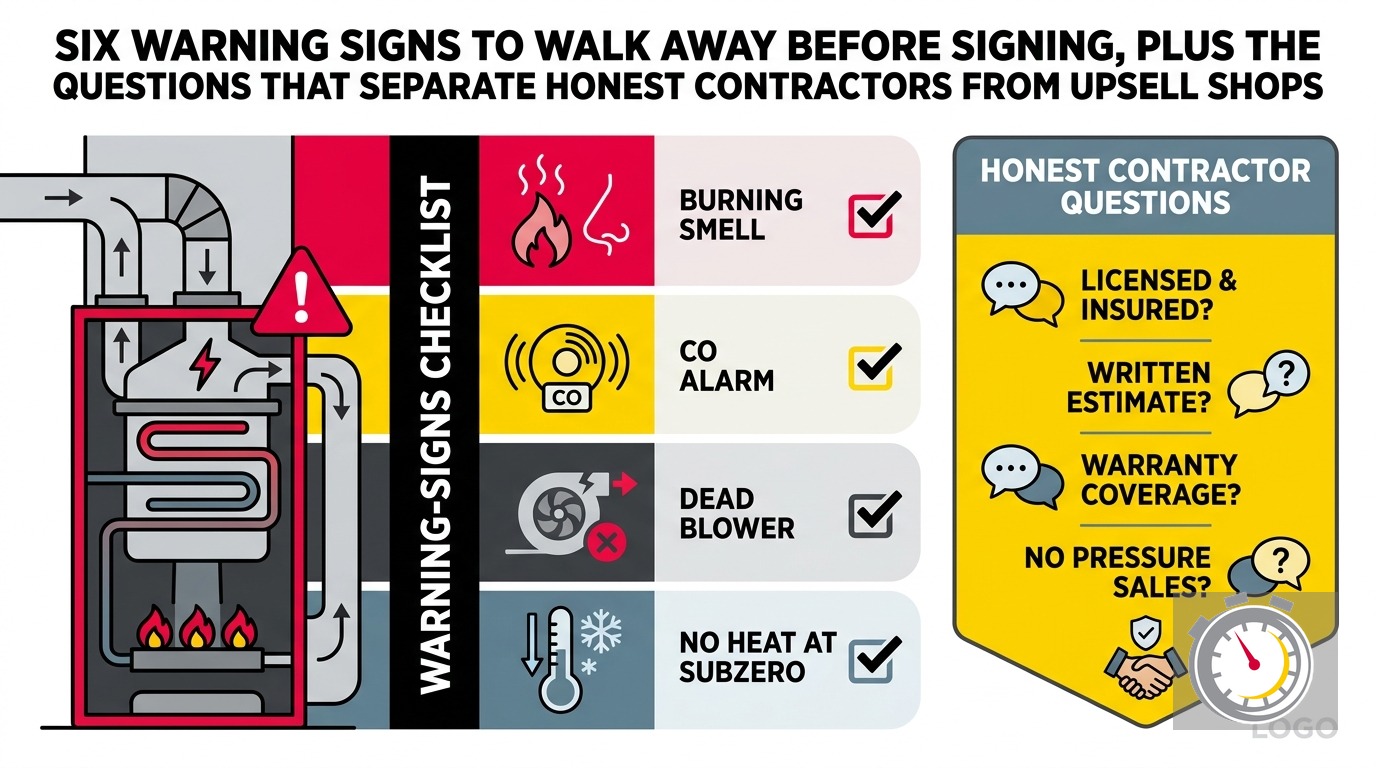
Six Warning Signs to Walk Away Before You Sign
These are not opinions. Each one maps to a Minnesota rule, a code requirement, or a documented pattern that costs homeowners money.
1. They cannot produce a DLI bond or local city license.
The bond is the minimum bar the state sets. If a contractor hedges, promises to email it later, or gets defensive when you ask, that tells you what you need to know. Ask before the estimate visit ends, not after you have signed.
2. They say no permit is needed for a full equipment swap.
Mechanical permits are required before work starts in virtually all Minnesota jurisdictions for any furnace replacement, AC installation, heat pump installation, or ductwork modification. “It’s a straight swap” is not a code exception.
A contractor who skips the permit is either uninformed or planning to cut a corner that protects you, not them. The consequences are real: your homeowner’s insurance may deny a fire or CO claim; unpermitted work can block a home sale; manufacturers may void the equipment warranty.
You can read more about when permits apply in our post on Minnesota HVAC permit requirements.
3. They quote a replacement size without mentioning a load calculation.
“Same size as what you have” is not an acceptable bid. ACCA Manual J load calculation is required by code under the Minnesota State Mechanical Code for HVAC sizing. The calculation accounts for your home’s square footage, insulation, windows, orientation, and local climate data, including that -16°F design temperature.
A contractor who skips the Manual J and quotes by gut is violating code. They are also guessing at the most important variable in your home’s comfort for the next 15 to 20 years.
4. They are still advertising Xcel Energy gas furnace rebates in 2026.
Xcel eliminated gas furnace and boiler rebates. A contractor quoting Xcel furnace rebates on a 2026 estimate is working from an old price sheet. That is a reason to question every other number on the quote.
Xcel still offers rebates on heat pumps and high-efficiency ACs, so not every rebate claim is wrong. The furnace line item is a concrete check you can run in seconds.
5. They are not enrolled as a Trade Ally with CenterPoint or Xcel.
CenterPoint rebates are dealer-submitted via form CNP-1375. Your contractor files the rebate on your behalf. You do not file it yourself. If your contractor is not a CenterPoint Trade Ally, you will not receive the rebate even if the equipment qualifies.
Some Xcel rebate programs for central and ground-source installations also require a participating contractor enrolled through hvacree.net/Xcel. Ask directly: “Are you a Trade Ally with both utilities? Can you file the rebates on my behalf?” Both answers should be yes.
6. They demand full payment or a large deposit before any work begins.
A deposit to cover materials on a large equipment order is normal, sometimes in the 30-50% range. Full payment before work starts removes your leverage. If the work is done wrong or the permit inspection fails, you have fewer options when you have already paid in full.
What Questions Should You Ask Before Signing?
Ask these six questions in any order. An honest contractor answers all of them without friction. A contractor who stumbles on more than one is telling you something worth paying attention to.
These questions do not catch good contractors off guard. They reveal process. A contractor who cannot answer them is a contractor who does not follow them.
“Will you pull the permit, or should I?”
The honest answer is direct: “We pull it, and it’s included in the price.” If a contractor says permits are optional, that you can save money by pulling it yourself, or that they usually skip it on simple jobs, stop the conversation there.
“Can I see the Manual J load calculation before you spec the equipment?”
You are not asking for a textbook. You are asking whether they ran one. A contractor following code can show you the output or walk you through the key inputs. A contractor who says “we just match the existing unit” skipped a step the Minnesota State Mechanical Code requires.
“Are you a CenterPoint and Xcel Trade Ally? Can you file my rebates?”
You want both answers to be yes. For a current breakdown of what is available this year, see our guide to Xcel and CenterPoint HVAC rebates.
“What efficiency tier are you recommending and why, not just the brand?”
An honest contractor explains why a 96% AFUE furnace makes sense for your home versus an 80%, or why a cold-climate heat pump might outperform a standard system at your address. A contractor who leads with brand loyalty over efficiency math is optimizing for their margin, not your outcome.
“What happens if the inspection fails?”
The right answer: they fix it, they reschedule the inspection, and they cover it at no additional cost to you. Any answer that shifts the risk back to you is a signal worth noting.
“What is your warranty on labor, separate from the manufacturer warranty?”
Equipment warranties cover parts. Labor warranties cover the install. These are different documents. A contractor confident in their work provides a written labor warranty. Get it in writing before you sign.
Will Your Contractor Handle the Permit?
In virtually every Minnesota city, pulling the permit is the contractor’s responsibility, and a formal inspection follows the install. If the contractor does not raise this during the estimate, ask directly. The permit record also protects you at resale and can be the deciding factor in an insurance claim.
Properties outside organized local building departments fall under the DLI’s direct permitting authority. Contractors who work across Minnesota’s 87 counties must verify the authority having jurisdiction at each address. A contractor covering the metro should know this and handle it without being prompted.
When a buyer’s inspector asks whether the furnace was permitted, a permit card in the city’s system is the cleanest answer you can give. Unpermitted work creates disclosure headaches and can derail a deal.
Does Your Contractor Know the 2026 Rebate Landscape?
Xcel eliminated gas furnace rebates on January 1, 2026. CenterPoint still offers them. The federal 25C credit stacks on top of both. A knowledgeable contractor knows all three programs and which apply to your specific project.
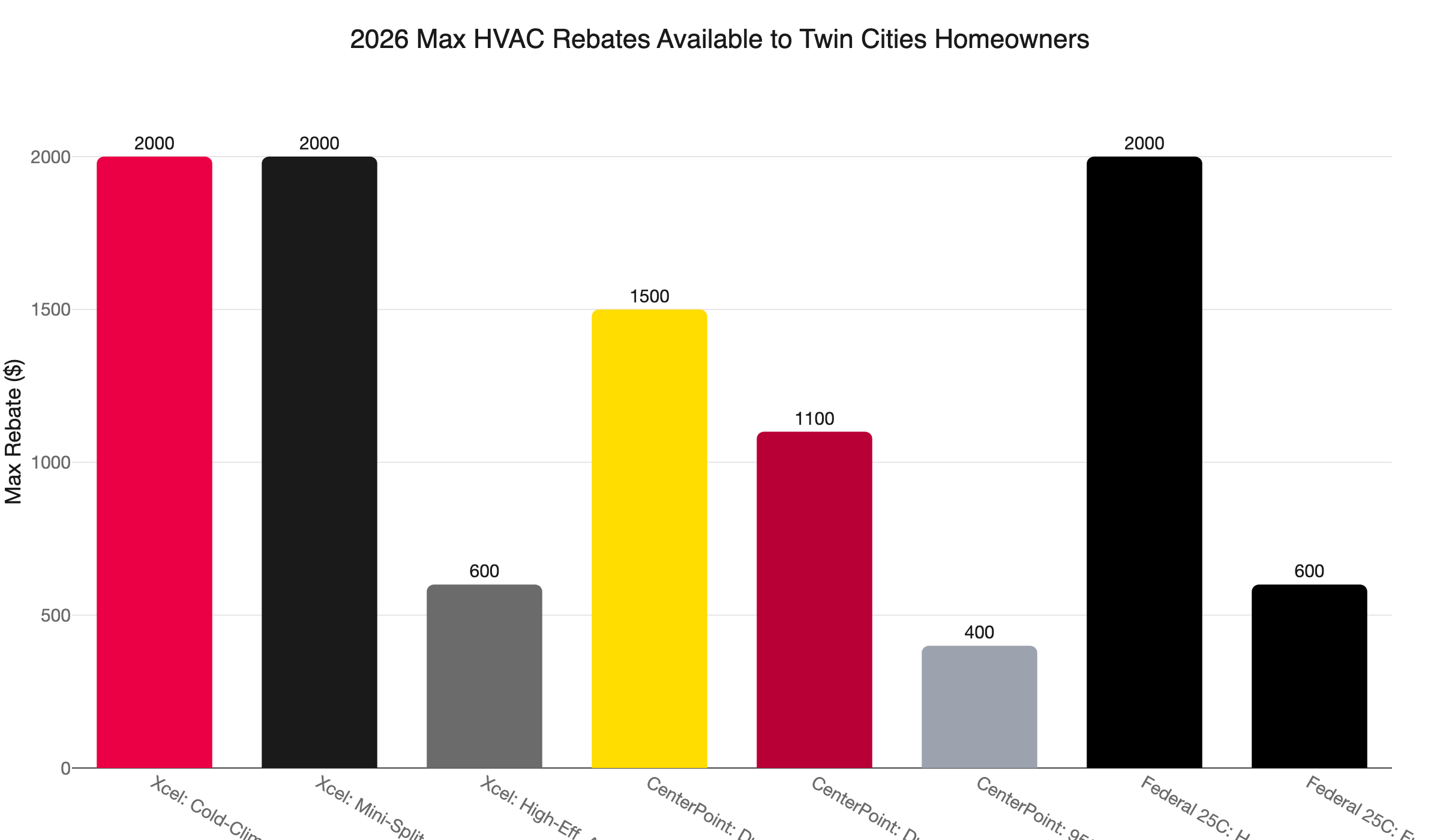
Xcel still offers real money on heat pumps and ACs. Qualifying cold-climate heat pumps, those with a COP of at least 1.75 at 5°F and listed on the NEEP database, are eligible for up to $2,000. Mini-splits qualify for up to $2,000. High-efficiency ACs fall in the $200-$600 range.
CenterPoint continues to offer rebates on gas equipment. A 95%-plus AFUE furnace qualifies for up to $400. Ducted air-source heat pumps are eligible for up to $1,500. Dual-fuel heat pump systems qualify for up to $1,100. CenterPoint rebates carry a December filing deadline, and your contractor submits the paperwork, not you.
On top of utility rebates, the federal energy tax credit covers a portion of project cost for qualifying heat pumps, furnaces, and ACs. That credit is yours to claim at tax time, separate from anything your contractor files.
Why Does Sizing Matter So Much in a Minnesota Winter?
Minneapolis has a design temperature of approximately -16°F. Oversized equipment short-cycles, fails to dehumidify in summer, and wears faster under cold-start stress. The only way to get sizing right is a code-required Manual J calculation.
Poor installation, including wrong sizing, can reduce system performance. That figure comes from ENERGY STAR quality installation research, not a contractor’s marketing sheet.
An oversized furnace is not more heat when you need it. It is short bursts of heat followed by cold drops. The system reaches setpoint too fast and shuts off before the air circulates evenly. An oversized AC chills the air without running long enough to pull humidity out. In a Minnesota summer, that means a house that reads 72 degrees on the thermostat but still feels clammy.
Contractors who skip the Manual J are not just cutting a paperwork corner. They are guessing at the most important variable in your home’s comfort for the next 15 to 20 years. For more on what a properly sized system looks like, see our post on HVAC sizing and Manual J calculations.
What Does a Quality Installation Include?
ENERGY STAR Quality Installation guidelines require right-sized equipment based on Manual J, proper airflow tested to manufacturer specs, and correct refrigerant charge with documentation. Ask whether the contractor follows these standards and will provide a written checklist when the job is done.
A complete quality installation includes:
- Manual J completed before equipment is ordered
- Equipment sized to the calculation, not matched to the old unit’s tonnage
- Ductwork inspected and tested for leaks before the new system runs
- Refrigerant charge verified with gauges, not estimated by feel
- Airflow tested and documented to manufacturer specification
- Permit pulled and inspection scheduled before work begins
- Written labor warranty provided at job completion
A contractor willing to put all of that in writing is a contractor confident in their own work. Our walkthrough of what to expect on HVAC install day in the Twin Cities covers what the day itself should look like from start to finish.
Is a Low Bid a Red Flag?
Yes, if it is significantly lower than other quotes. Low bids often reflect skipped load calculations, inferior equipment tiers, or a plan to skip the permit. They can also signal an intent to push add-ons once the job is open and your old system is already out.
Heating and cooling account for a large share of a home’s total energy use. Cutting corners on the install to save money upfront often costs more in energy bills, repairs, and shortened equipment life over time.
Get at least three quotes on any major HVAC project. If one is dramatically lower than the others, ask specifically what it excludes. A contractor who cannot explain the gap cannot be trusted to close it honestly.
How Northern One Hour Approaches Every Job
We are locally owned and operated in Ramsey, MN, and we serve homeowners across Minneapolis, St. Paul, Blaine, Maple Grove, Plymouth, Brooklyn Park, Woodbury, and Bloomington.
Every job starts with an honest assessment. We pull permits. We run Manual J calculations before we spec equipment. We are enrolled as a Trade Ally with both CenterPoint and Xcel, and we file rebates on your behalf. Our technicians hold EPA Section 608 certification for all refrigerant work. We maintain our DLI bond and carry all applicable city trade licenses for the markets we serve.
We back every appointment with our on-time promise: “Always On Time… Or You Don’t Pay a Dime!(R).”
If you are getting quotes on a furnace replacement, AC installation, or heat pump and you want a contractor who will answer all six of those questions without hesitation, call us at (763) 260-6662 or book online. If budget is a concern on a larger install, ask about our financing options when you call. Straight answers. No upsell.
Frequently Asked Questions
Do HVAC contractors in Minnesota need a state license? +
Are mechanical permits required for HVAC work in Minnesota? +
What HVAC rebates are available to Twin Cities homeowners in 2026? +
Need a technician now?