
HVAC Warranty Registration: The Window Most Homeowners Miss
Key Takeaways
- HVAC warranty registration takes about five minutes and doubles your parts coverage from five years to ten years on most major brands.
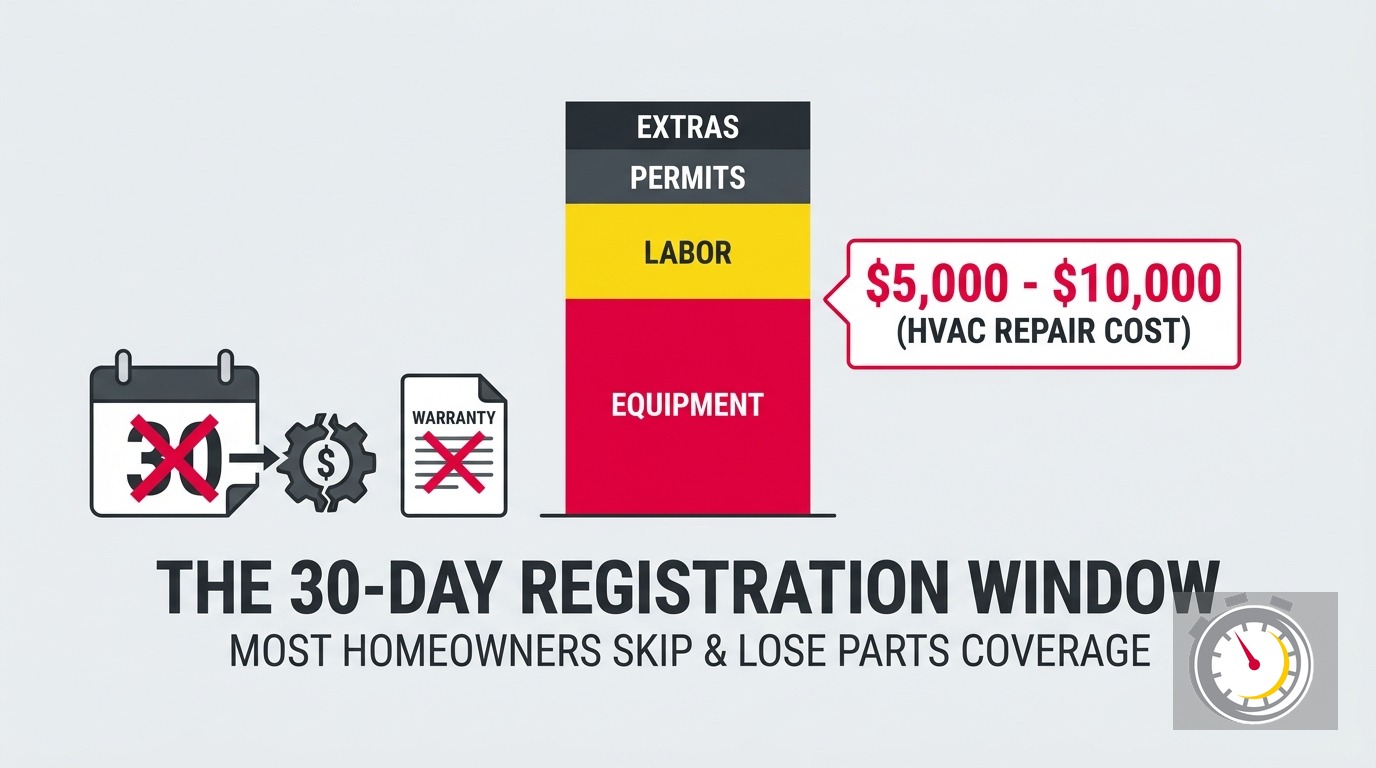
- The practical deadline to act is 30 days after installation. Most brand deadlines run 60-90 days, but registration is forgotten well before that window closes.
- Missing registration on a Trane or Carrier system can cost you $1,600-$3,100 more on a single compressor repair.
- Goodman offers a lifetime heat exchanger warranty on registered units only. In Minnesota, where furnaces run six months a year, the heat exchanger is the highest-stakes component on the list.
- Xcel Energy and CenterPoint rebate claims require the same four data points as warranty registration. Complete both tasks at the same sitting.
- If you purchased a home with existing HVAC equipment, transferred warranties must be filed within 60-90 days of closing for a $25-$100 fee.
What Is HVAC Warranty Registration?
New HVAC equipment ships with two warranty tiers. The base tier is automatic. It requires nothing from you and covers parts for five years. The registered tier requires one additional step: submit your equipment information to the manufacturer within a set window after installation. Complete that step and your parts coverage typically extends to 10 years.
Registration is not a service enrollment or a contract. You give the manufacturer your name, address, model number, serial number, and installation date. That is the entire transaction. The form takes about five minutes to complete.
The difficulty is not the paperwork. It is remembering to do it. Most homeowners assume the contractor handled registration. Some contractors do handle it at installation. Many do not. The responsibility defaults to the homeowner, and the consequences of missing the deadline are permanent.
Why Does the 30-Day Clock Matter When Most Deadlines Are Longer?
Most brand deadlines run 60-90 days after installation. But the first 30 days are when homeowners forget. Treating day 30 as your personal deadline keeps you safely inside every manufacturer’s window, regardless of which brand was installed. It removes the risk of checking the fine print too late.
Here is the pattern behind most missed registrations. The installer finishes and leaves. The new system runs quietly and perfectly for the first few weeks. There is no problem to solve, so the registration paperwork sits. Days pass. By the time 60 days arrive, most homeowners cannot tell you how many days have elapsed since the installation date.
The 30-day rule is a margin of safety, not a manufacturer deadline. Carrier’s window is 90 days. Trane and Lennox give you 60 days. Goodman, Daikin, and Amana also set their deadlines at 60 days. If you act within 30 days, you are well inside every window.
The practical tool is a single calendar reminder set on installation day. When it fires, you complete registration and rebate paperwork at the same sitting. The whole task takes under 20 minutes.
What Happens If You Miss the HVAC Warranty Registration Deadline?
Your warranty drops permanently to the five-year base tier. There is no reinstatement option, no grace period, and no appeals process with most manufacturers. The extended 10-year coverage is simply gone, and it cannot be recovered after the deadline passes.
Carrier states this plainly: “If you do not register your Carrier equipment within 90 days of installation, the standard 5-year parts-only limited warranty will apply.” Trane’s warranty terms follow the same structure: miss the 60-day window and the five-year base coverage applies going forward.
No amount of explanation after the fact changes this. The manufacturer records the installation date from the installer’s report. If registration arrives after the deadline, the extended warranty is denied.
The five-year base warranty is not without value. But most HVAC equipment is designed for a 15-20 year service life. Expensive component failures, such as compressor failure, heat exchanger cracks, and coil deterioration, tend to cluster between years 8 and 15. The five-year base warranty expires before those failures arrive. The 10-year registered warranty covers the exact window when the costliest repairs become likely.
How Much Does Missing HVAC Warranty Registration Actually Cost?
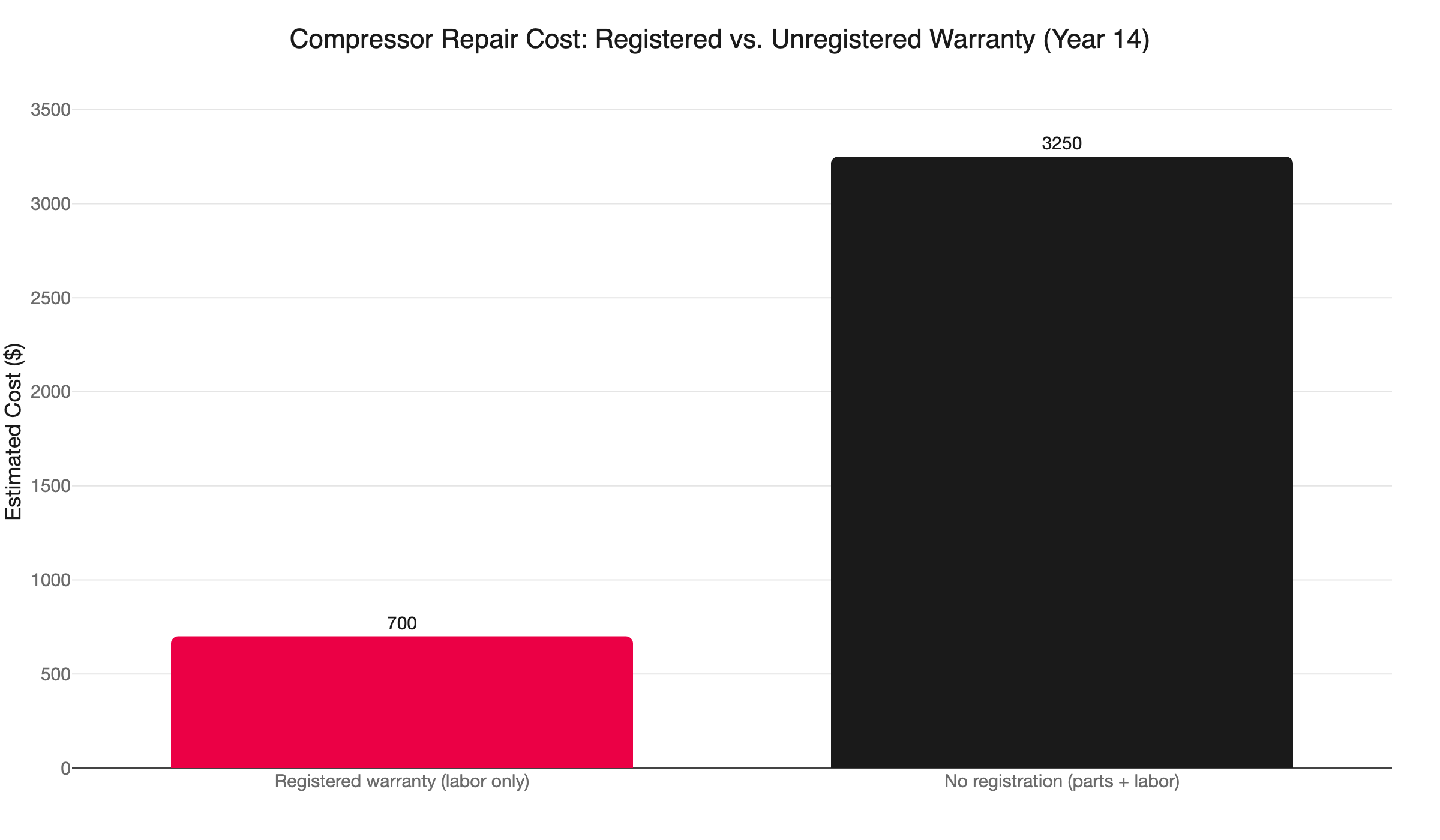
On a compressor failure at year 14, skipping registration can mean $1,600-$3,100 more out-of-pocket on a single repair. Parts are covered under a registered 10-year warranty. Without registration, you pay full parts and labor costs when the failure happens.
The Cooling Company illustrates this with a concrete Trane scenario. The compressor fails at year 14. With a registered 10-year warranty, the part is covered. You pay labor only: roughly $500-$900. Without registration, you pay parts and labor combined: $2,500-$4,000. The net cost of skipping a five-minute registration form is between $1,600 and $3,100 on that one repair.
Compressors are not the only high-cost failure. Heat exchangers run $1,500-$3,000 in parts alone. Control boards cost around $750 installed. Blower motors run $1,100-$2,200 depending on motor type. These components can all fail well outside the five-year base warranty window. A registered warranty shifts those parts costs off your bill when they do.
If your registration window has already closed, third-party extended warranties are available for $300-$800 over five to ten years. They provide a real fallback, but they carry deductibles and claim caps not present in the manufacturer’s registered program. Our post on extended HVAC warranties covers the trade-offs in detail.
How Do HVAC Warranty Terms Compare Across Brands?
Every major brand doubles your parts coverage at registration, from five years to ten. Daikin goes to 12 years. Goodman and Amana add lifetime coverage on specific high-cost components. Registration is the only variable between these two tiers. The cost to you is zero.
Current registration deadlines and warranty terms by brand, based on manufacturer warranty data:
| Brand | Registration Deadline | Registered Coverage | Unregistered Coverage |
|---|---|---|---|
| Carrier | 90 days | 10 yr parts | 5 yr parts |
| Trane | 60 days | 10 yr parts + lifetime compressor (XV20i) | 5 yr parts |
| Lennox | 60 days | 10 yr parts | 5 yr parts |
| Goodman | 60 days | 10 yr parts + lifetime heat exchanger | 5 yr parts |
| Rheem | 90 days | 10 yr parts | 5 yr parts |
| Amana | 60 days | Lifetime compressor + 10 yr parts | 5 yr parts |
| Daikin | 60 days | 12 yr parts | 5 yr parts |
| York / Bryant | 90 days | 10 yr parts | 5 yr parts |
A few items stand out. Daikin’s 12-year registered term is the longest standard benefit in the market. Most homeowners are not aware of this when comparing brands. Goodman’s lifetime heat exchanger warranty is particularly relevant for Minnesota, a point covered in detail in the next section. Amana and Trane’s XV20i both offer lifetime compressor coverage on registered units, which eliminates the single highest-probability major repair cost on an AC system.
None of these benefits cost anything additional. They require one form submission within the deadline window.
Why Minnesota Homeowners Have More at Stake
Twin Cities homes run their furnaces from October through April. That is six-plus months of daily use. The heat exchanger, blower motor, and draft inducer accumulate more annual run hours here than in most other U.S. markets. Wear compounds over a long heating season.
Goodman’s lifetime heat exchanger warranty is the most consequential registered benefit for Minnesota homeowners. The heat exchanger is the single most expensive replaceable component in a furnace. A crack is not a repair you can defer. It puts combustion gases at risk of entering your living space. When the heat exchanger fails outside of warranty, the decision between replacing the part and replacing the furnace is often a close call. Furnace replacement in the Twin Cities runs $3,900-$7,800 installed depending on efficiency tier. The heat exchanger alone is $1,500-$3,000 in parts before labor. The registered lifetime warranty eliminates the parts cost entirely.
All Pro HVAC’s Minnesota guide specifically notes Goodman’s lifetime heat exchanger benefit as a differentiator for MN homeowners. It is a real benefit that disappears entirely if registration is skipped within the 60-day deadline.
Knowing early warning signs matters more when you are carrying five-year coverage instead of ten. Our post on AC compressor failure symptoms and repair costs walks through the early indicators on the cooling side. Catching those signs early gives you time to address problems before a repair becomes fully out-of-pocket.
File Your Rebate Paperwork and Your Registration at the Same Sitting
This is the most practical tip in this post. HVAC warranty registration and utility rebate claims use the same four data points: model number, serial number, AHRI certification number, and installation date.
Xcel Energy’s 2026 rebates include up to $2,000 for a qualifying cold-climate heat pump and $400 for central AC equipment. CenterPoint Energy offers $150-$500 on qualifying gas furnaces rated 96% AFUE or higher. Both programs ask for the same equipment fields your manufacturer registration form requires.
The rebate stacking guide for Xcel and CenterPoint confirms that both programs pull from model number, serial number, AHRI, and install date. Your installer should leave behind a spec sheet or product data card with all four fields. If that documentation is not in your files, check the data plate mounted on the equipment itself. Your installation invoice typically includes the install date and AHRI number.
The workflow is simple. Set a 30-day calendar reminder on installation day. When the reminder fires, open the manufacturer’s warranty registration portal in one browser tab and the relevant rebate portal in a second. Fill both forms from the same documentation. The session takes 15 minutes or less.
One important note on federal credits: the 25C equipment tax credit expired on December 31, 2025. No federal equipment tax credit applies to HVAC installations completed in 2026.
What If You Just Bought a Home with an Existing HVAC System?
Check for registration paperwork at closing. If it is missing, you have limited time to initiate a warranty transfer before that window closes too. Most manufacturers allow transfers within 60-90 days of the home sale for a $25-$100 fee.
A significant share of Twin Cities homebuyers inherit HVAC equipment with no registration documentation. The previous owner may have never registered, or may have registered but not included the confirmation in the closing paperwork. Our HVAC checklist for buying a home covers what documentation to request from the seller, including warranty registration confirmation, before you sign.
If the previous owner registered the equipment, most manufacturers allow a one-time transfer. The transfer must typically happen within 60-90 days of the home sale closing date and costs $25-$100 in processing fees. Some brands reduce the remaining warranty term on a transferred unit. Read the specific brand’s transfer policy before you file.
If the equipment was never registered, that window is permanently closed. The five-year base warranty may still have time remaining if the system is new enough, but the extended registered warranty cannot be obtained retroactively. A third-party extended warranty is the practical fallback in that situation. It is worth considering especially on systems that are 6-10 years old, when the compressor or heat exchanger is approaching its higher-risk years.
Minnesota Statute § 327A.02 provides a two-year statutory warranty on mechanical systems, including HVAC, in new residential construction. This covers workmanship defects by the original builder or contractor. It does not substitute for manufacturer parts coverage and it does not extend or replace the registered warranty.
How to Register Your HVAC Equipment
The process is three steps and takes about 10 minutes.
Step 1: Gather your documentation. You need four fields: model number, serial number, AHRI certification number, and installation date. These appear on the data plate mounted on the equipment, typically on the side or back panel of the unit. Your installation invoice should also list all four. If either document is missing, the data plate on the physical unit is your fallback.
Step 2: Go to the manufacturer’s registration portal. Search for “[brand name] warranty registration” or check the paperwork your installer left behind. Most portals are straightforward online forms. Some brands send an auto-registration confirmation when an installer files a startup report. If you received that email, check whether registration was completed and save the confirmation regardless.
Step 3: Save your confirmation. Screenshot the confirmation page or save the confirmation email. Store it with your home records. If you ever file a warranty claim, that confirmation is the document the manufacturer will ask for first. A claim with no confirmation on file is treated as unregistered, regardless of your recollection.
That is the complete process. Set the 30-day reminder on installation day and you will never miss a deadline.
If you are not certain what brand or model was installed in your home, or if you need help locating the data plate, call our team at (763) 260-6662. We can pull your installation records and confirm or complete your registration status before the window closes.
Northern One Hour Has Your Back on the Details
Northern One Hour is locally owned and operated in Ramsey, MN. When our team installs equipment in your home, we walk you through registration before we leave. We hold ourselves to “Always On Time… Or You Don’t Pay a Dime!(R)” on both arrival windows and the steps that follow an installation.
If you had equipment installed recently and are not certain whether registration was completed, do not wait until the deadline passes. Call (763) 260-6662 or book online. We will pull your installation records and help you confirm or complete registration.
We also assist with:
- Rebate claim paperwork for qualifying Xcel Energy and CenterPoint Energy equipment
- Warranty transfer documentation when you purchase a home with existing HVAC equipment
- Third-party extended warranty guidance when the manufacturer window has already passed
Our team serves Minneapolis, St. Paul, Ramsey, Blaine, Maple Grove, Plymouth, Brooklyn Park, Woodbury, Bloomington, and the surrounding Twin Cities area. Call (763) 260-6662 to schedule service or ask about our 100% satisfaction guarantee.
Frequently Asked Questions
Can I register my HVAC equipment after the manufacturer's deadline has passed? +
Does my HVAC installer handle warranty registration for me? +
What happens to the HVAC warranty when I sell my home? +
Need a technician now?