
Is an HVAC Extended Warranty Worth It? Minnesota Guide
Key Takeaways
- Registering your new equipment within 60-90 days of install doubles your parts coverage from 5 years to 10 years. This is free.
- Manufacturer warranties cover parts. Labor coverage expires after year one on most brands. You pay the technician even when the part ships for free.
- Heat pumps in Minnesota see significantly more service calls than the same models in warmer states. The “not worth it” math is built on moderate-climate failure rates.
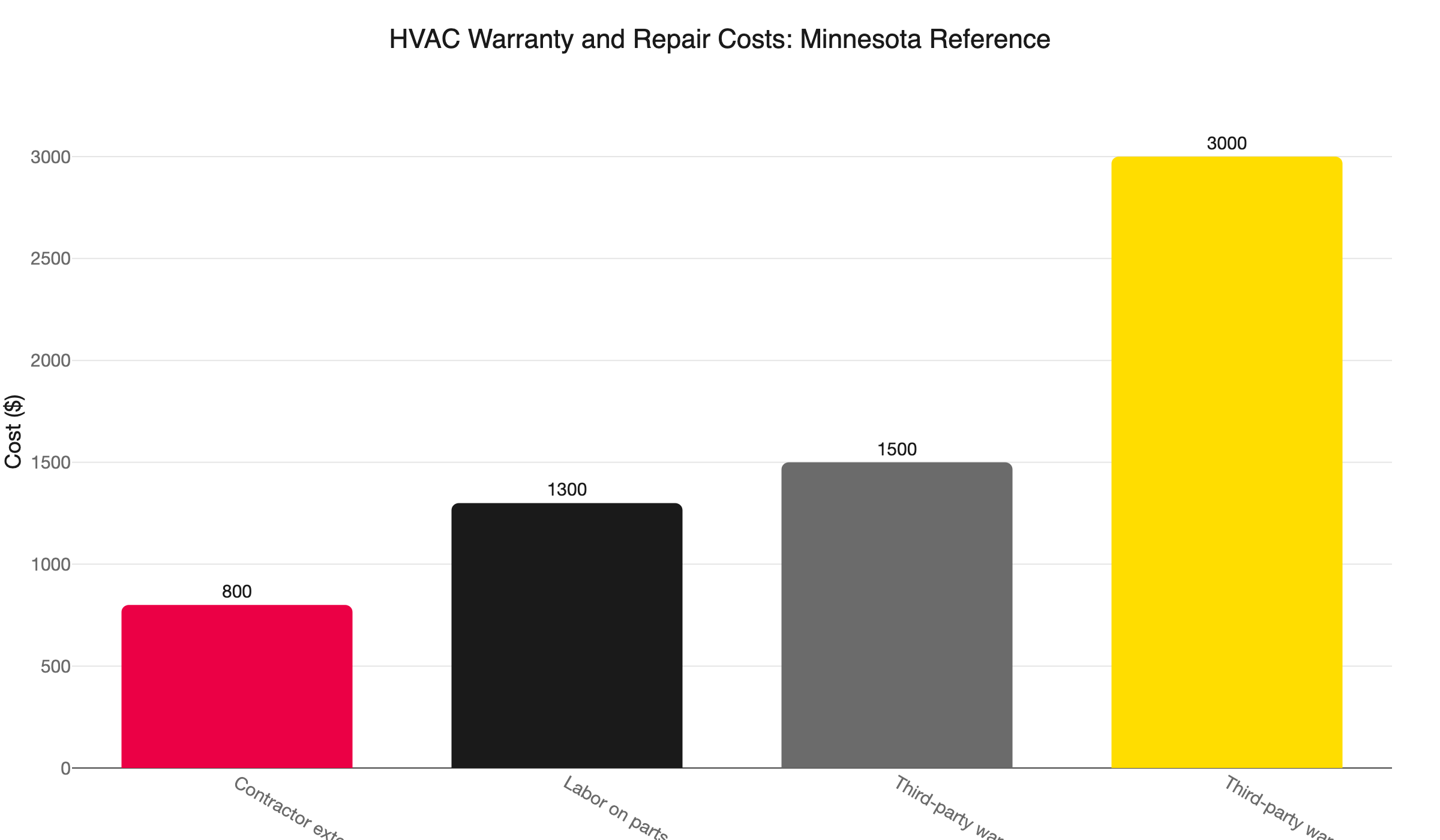
- Third-party home warranties cap HVAC claims at $1,500-$3,000 and commonly deny claims for missed maintenance or unpermitted installs.
- A contractor-issued extended labor warranty ($500-$1,550 one-time) paired with a registered manufacturer warranty covers the most likely gap for less than most home warranty premiums.
- Minnesota requires a mechanical permit for every furnace, AC, and heat pump replacement. An unlicensed install voids your manufacturer warranty.
What Does an HVAC Warranty Actually Cover?
Short answer: The part, not the labor, and only when the failure is a manufacturing defect rather than wear, neglect, or improper installation. Most homeowners learn this when a repair bill arrives for a system they thought was covered.
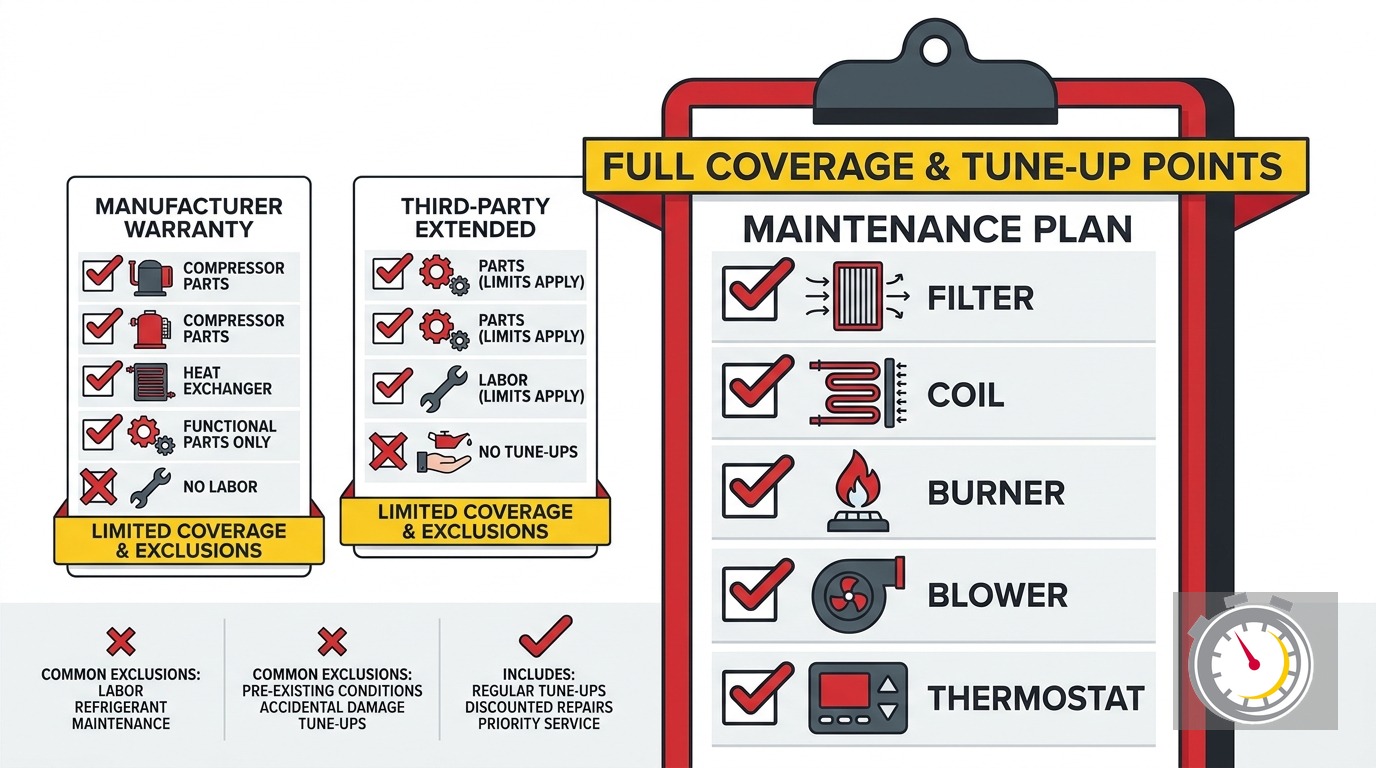
HVAC warranty coverage stacks in three layers:
Manufacturer warranty (included with the equipment)
- Parts: 5 years if you skip registration, 10 years if you register on time
- Labor: typically expires after the first year
- Covers: factory defects in materials and workmanship
- Does not cover: wear and tear, refrigerant leaks from an improper install, failures tied to skipped maintenance
Contractor labor warranty (offered at install)
- Standard: 1-2 years on workmanship
- Extended option: some contractors offer a paid add-on covering labor for 5-10 years
- Covers: technician time when a parts-covered component fails
Third-party home warranty (sold by warranty companies)
- Per-claim caps: $1,500-$3,000 on HVAC
- Common exclusions: pre-existing conditions, improper installation, lack of documented maintenance
- Added cost: most require an annual inspection at $150-$300 per year, separate from the plan premium
Understanding these layers tells you where your real exposure sits. It is almost always in labor, not parts.
Did You Know Your Manufacturer Warranty Can Double for Free?
Short answer: Yes. Every major HVAC brand offers a 10-year parts warranty if you register within 60-90 days of install. Miss the deadline and you fall back to a 5-year base. Registration costs nothing. Your contractor can handle it on install day.
This is the most valuable single step a homeowner can take for warranty protection, and it gets skipped constantly. The registration deadlines by brand:
- Carrier: Registration window; unregistered = 5-year parts, registered = parts
- Trane: Registration deadline; same 5-year upgrade - details here
- Lennox: 60-day window; registration also unlocks up to 3 years of labor coverage at no extra charge - see warrantyyourway.com for the terms
- Goodman: Registration window; same 5-year parts upgrade
That five-year difference in coverage is worth $1,000-$4,000 depending on the component. A compressor alone runs several thousand dollars as a part.
When we install a new system at Northern One Hour, we register the equipment for you. If a different contractor installed your current system, check your paperwork now. A quick call to the manufacturer’s warranty support line will confirm whether registration was completed.
If the window has already closed, that is still useful information. It tells you your current exposure and whether a contractor-issued extended labor warranty makes sense as a backstop going forward.
Is an HVAC Extended Warranty Worth It in Minnesota?
Short answer: It depends on which warranty. The free manufacturer registration is always worth claiming. Third-party home warranty coverage for HVAC rarely pencils out once you review the caps and exclusions. A contractor’s extended labor warranty often does, especially for heat pumps and high-efficiency furnaces.
The online consensus - “extended warranties are almost never worth it” - is built on national average data weighted toward mild-climate states. Minnesota is not a mild-climate state.
You run a furnace hard from October through April. You lean on your AC through July and August humidity swings. That is two systems under sustained stress, not one. Most Twin Cities homes also carry both a furnace and a central AC, and many add a heat pump for shoulder-season efficiency. Every system adds warranty exposure over time.
The failure rates that drive moderate-climate math simply do not port here. A heat pump working through a Minnesota January operates at the edge of its rated range. The math has to match the climate.
Does Minnesota’s Climate Make Extended Warranties More Valuable?
Short answer: Yes, materially. Heat pumps in DOE Climate Zone 6 - which covers Minnesota, Wisconsin, and Maine - generate 40% more service calls than the same models in warm-climate states. Standard heat pump lifespan here runs 8-12 years, compared to 15-20 years in moderate climates.
Gas furnaces carry an average lifespan of 15-25 years. Manufacturer parts warranties cover only the first 10 years, even when registered. That leaves a 5-15 year gap where you own a working furnace with no parts coverage. Replacement costs in that window.
Heat pumps in our climate also reach their balance point - the outdoor temperature where they need backup heat - more frequently than units in warmer zones. Every hour spent near the operating limits puts stress on compressors and reversing valves. Those are the expensive components. When they fail in Minnesota, labor alone can run 3-6 hours. The part may be covered. The technician is not.
This is the specific gap that cold-climate homeowners need to account for when evaluating any extended warranty product. The standard calculations assume milder failure rates.
See how long HVAC systems last in Minnesota for expected lifespans by system type, including furnaces, heat pumps, and central AC.
What Do Third-Party Warranties Actually Exclude?
Short answer: Pre-existing conditions, lack of documented maintenance, and improper installation are the three most common reasons HVAC claims get denied. Per-claim caps of $1,500-$3,000 can also fall short when a compressor quote arrives.
Third-party home warranty providers offer broad coverage across many home systems but manage costs with caps and exclusions. For HVAC, the key terms to read carefully:
- Maintenance documentation requirement: Many plans require dated service records to honor a claim. No records on file means a potential denial. The inspection may need to come from an approved provider list.
- Annual inspection add-on: Many plans require a separate inspection at $150-$300 per year on top of the plan premium. This is not always disclosed clearly at sign-up.
- Improper installation exclusion: If your system was installed without a permit or by an unlicensed contractor, the claim can be denied on installation grounds.
- Pre-existing condition language: Often defined broadly enough to capture a problem that began before you enrolled, even if no error code had appeared.
CBS News has reported that maintenance plans frequently outperform third-party home warranty products specifically for HVAC coverage. For a permitted, registered, maintained system, the math often favors the registered manufacturer warranty plus a maintenance plan over a third-party product.
Does Your HVAC Warranty Require Annual Maintenance?
Short answer: Yes. Both manufacturer warranties and third-party plans include maintenance requirements. Missing service records is the most common reason a warranty claim gets denied. A maintenance plan creates the paper trail that keeps your coverage valid.
Manufacturers list “improper maintenance” as an exclusion. If a technician opens your system and finds a coil caked with debris, or a heat exchanger that failed partly because of years of restricted airflow, the manufacturer can attribute the failure to neglect rather than a factory defect. The claim gets denied.
Third-party warranty providers list lack of maintenance explicitly in their exclusion language. File a claim without dated service records and expect questions. File without any records and expect a denial.
This means an annual maintenance plan is not just a tune-up. It is the documentation layer that keeps both your manufacturer warranty and any extended coverage valid. Each visit creates a dated, signed record.
Our post on whether an HVAC maintenance plan is worth it covers what a plan includes and how the annual visit protects more than just the equipment.
When Does a Contractor’s Extended Labor Warranty Make Sense?
Short answer: When you have a registered 10-year parts warranty but labor coverage that expired after year one. A one-time cost of $500-$1,550 can cover an $1,000-$2,300 labor bill on a parts-covered repair. For heat pumps and high-efficiency furnaces, it usually pencils out.
Here is the scenario it addresses. You install a new heat pump. You register it and get 10 years of parts coverage. Your installer gives you one year of labor warranty. In year four, the reversing valve fails. The part ships from the manufacturer for free. The 3-4 hours of technician time is your bill.
A contractor-issued extended labor warranty fills that specific gap. It is different from a home warranty product. It is an add-on from your installer that covers technician time specifically when an in-warranty part fails.
It makes the most sense for:
- Heat pumps (more mechanical complexity, shorter lifespan in Zone 6 than in mild climates)
- High-efficiency, variable-speed, or two-stage furnaces (more electronics and more potential failure points than a single-stage unit)
- Homeowners who want predictable costs over the first 5-10 years of a new system
Ask at install time. Adding this coverage before the first heating season costs less than trying to add it later, and some contractors do not offer it at all after the initial install window closes.
Can an Unpermitted Install Void Your HVAC Warranty?
Short answer: Yes, outright. Minnesota requires a mechanical permit for every furnace, AC, and heat pump replacement. An unlicensed install gives the manufacturer grounds to deny any warranty claim. Most homeowners are never told this at the time of the job.
The permit triggers a municipal inspection that confirms the system was installed to code. That inspection record is also proof of a proper, licensed install - which is exactly what manufacturers and warranty companies look for when evaluating a claim. No permit means no inspection record and no proof.
If you bought a home and are not sure whether the HVAC system was permitted, it is worth checking with your municipality. A missing permit does not automatically mean you have no options, but it narrows them if a covered component fails.
See our post on when an HVAC permit is required in Minnesota for the full list of what triggers a permit requirement and what the inspection process involves.
At Northern One Hour, we pull the mechanical permit on every installation. It is included in the job, not billed separately.
Minnesota Rebates and the Cost Picture
Available rebates shift the overall cost picture and can make a higher-tier system - with better built-in reliability and a longer expected lifespan - more accessible.
Current 2026 programs:
Xcel Energy:
- Cold-climate air-source heat pump: up to $2,000
- Standard central AC: $150-$450
CenterPoint Energy:
- Ducted ASHP hybrid system: $1,100
- 95%+ AFUE furnace: $200; 97%+ AFUE: $400
Federal 25C tax credit (IRA):
- Heat pumps: 30% of installed cost, up to $2,000
- Furnaces and central AC: up to $600
A licensed contractor completing a permitted install satisfies Xcel’s Quality Installation documentation requirement at the same time. One set of paperwork covers the permit, the rebate, and the warranty documentation record.
See the full breakdown in our post on Minnesota heat pump rebates and tax credits.
The Decision Framework for Twin Cities Homeowners
Here is a practical way to work through the warranty decision:
Always do this (free): Register your equipment within 60-90 days of install. It doubles your parts coverage and costs nothing.
Strongly consider ($150-$300 per year): An annual maintenance plan. It keeps your system running efficiently, extends component life, and creates the dated service records both manufacturer warranties and third-party plans require to pay a claim.
Worth evaluating ($500-$1,550 one-time): A contractor extended labor warranty. If you have a heat pump or a high-efficiency furnace and want labor coverage past year one, this fills the most common gap for less than most home warranty premiums. Ask your installer at the time of the new install.
Read carefully before buying: A third-party home warranty for HVAC. Check the per-claim cap, the maintenance documentation requirement, and the installation exclusions. For a permitted, registered, maintained system, the math often favors the registered manufacturer warranty plus a maintenance plan.
Non-negotiable in Minnesota: A licensed contractor and a pulled mechanical permit. No permit means no manufacturer warranty and no rebate documentation. A single permitted, licensed install satisfies both requirements.
Ask about financing options when you call if a full system replacement is part of the plan.
Northern One Hour is locally owned and operated in Ramsey, MN. We serve Minneapolis, St. Paul, Blaine, Maple Grove, Plymouth, Brooklyn Park, Woodbury, Bloomington, and the surrounding Twin Cities area. Every installation includes the mechanical permit, equipment registration, and our on-time commitment: “Always On Time… Or You Don’t Pay a Dime!(R)”
Call us at (763) 260-6662 or book a service appointment online today.
Frequently Asked Questions
Does registering my new HVAC system really double the warranty? +
What do third-party home warranties exclude for HVAC? +
Does Minnesota's cold climate change whether an extended warranty is worth it? +
Can an unpermitted HVAC installation void my manufacturer warranty? +
Need a technician now?