
How Long Do HVAC Systems Last? Your Twin Cities Guide
Key Takeaways
- Central AC in the Twin Cities typically lasts 12 to 17 years with average maintenance. That is shorter than the national benchmark due to freeze-thaw stress and summer humidity.
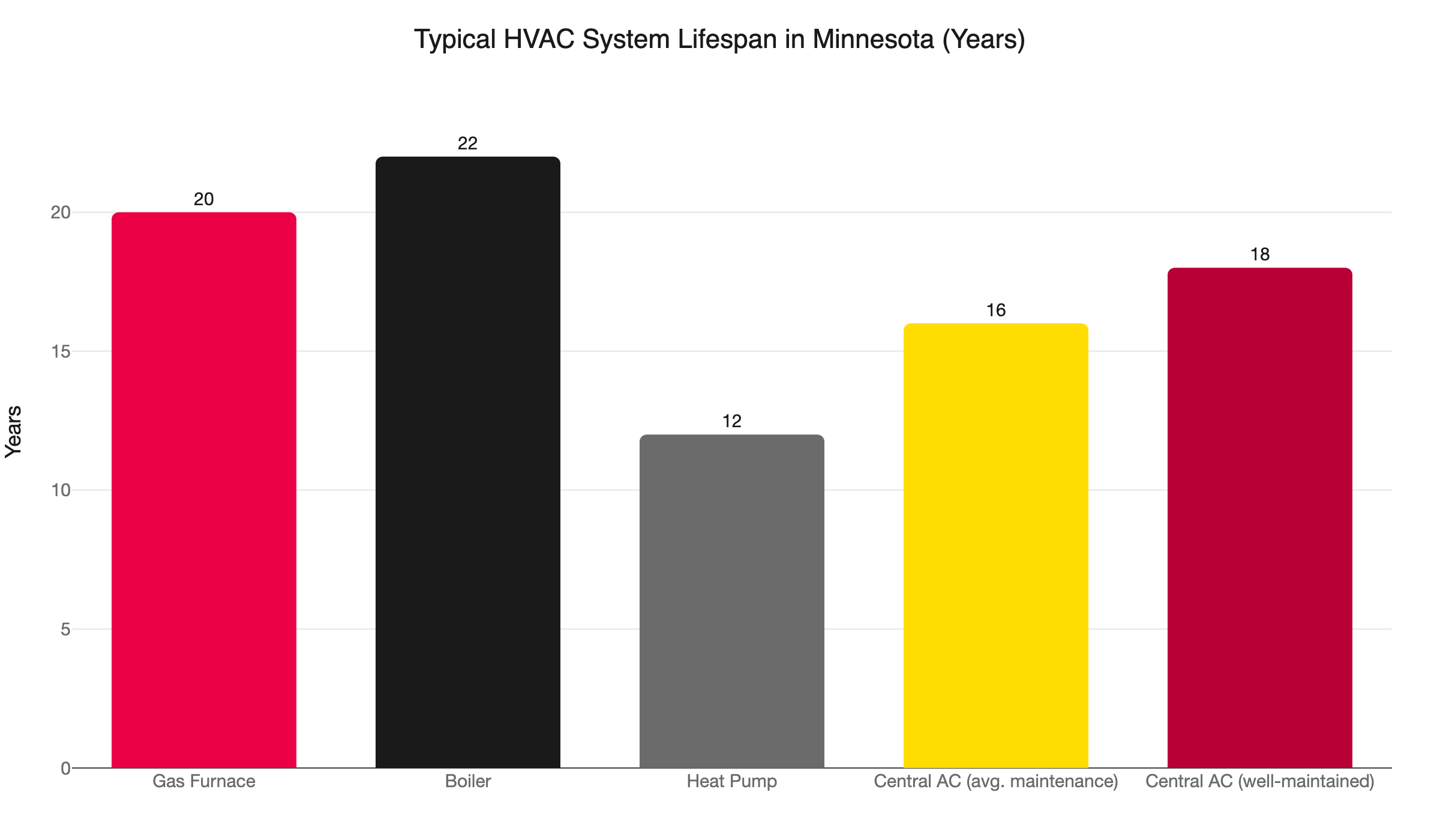
- Gas furnaces hold up 15 to 25 years. They are sheltered indoors and do not face the same outdoor stress.
- Heat pumps last 10 to 15 years in Minnesota because they run year-round in both heating and cooling modes.
- Boilers, common in older Twin Cities homes, last 15 to 30 years with proper maintenance.
- Use the Rule of 5000: multiply your system’s age by the repair quote. Above $6,500, replace.
- Pre-2010 systems likely run on R-22 refrigerant. Production is banned. Major repairs on these units rarely make financial sense.
- Federal 25C and 25D tax credits expired December 31, 2025. Utility rebates from Xcel and CenterPoint remain, up to $3,100 combined on a qualifying dual-fuel heat pump setup.
- Annual tune-ups are the highest-leverage move for extending any system’s life.
How Long Do HVAC Systems Last in the Twin Cities?
How long do HVAC systems last is a question with a regional answer. [National benchmarks from manufacturers like Bryant](https://www.bryant.com/en/us/products/how-long-do-hvac-systems-last/) put central AC at 12 to 15 years, heat pumps at 10 to 15 years, and furnaces at 15 to 25 years. Those numbers are accurate as far as they go. They just do not go far enough for our climate. Minnesota’s freeze-thaw cycle, humidity swings, and cottonwood season age outdoor equipment faster than most of the country. The result is a gap between the national benchmark and the real lifespan you can expect here.
This guide covers realistic ranges for every system type, the specific ways our climate shortens those ranges, and the decision rules for knowing when to repair versus replace.
Why Minnesota Winters and Summers Age Your Equipment Faster
Our climate does something most national guides ignore. The freeze-thaw cycle is the quiet killer for outdoor AC equipment.
Here is how it works. Moisture collects in the condenser’s base pan and between the fins on the coil. When that water freezes, it expands. The expansion warps aluminum fins and stresses copper refrigerant lines. Your AC then sits idle for six months in sub-zero conditions before the cycle repeats in spring.
Minneapolis averages 13 nights per year below 0°F, with the coldest nights reaching -15°F to -20°F. That kind of temperature swing, repeated season after season, takes a real toll on any condenser that was not designed to run through it.
Summer brings its own stressors. Minnesota’s humidity swings push cooling systems harder than a drier climate would. Then there is cottonwood season. Every May and June, cottonwood seeds drift into condenser coils and pack them tight. They act like a blanket, trapping heat and forcing the compressor to run hotter and longer. Clearing them takes a few minutes with a garden hose. Leaving them for a full season shortens compressor life measurably.
Research specific to Minnesota AC systems found that by year 12, many units here are operating at only 80 to 85% of their original efficiency. Energy bills creep up before any obvious failure signal appears. The national ASHRAE benchmark for central AC is 15 to 20 years. The Twin Cities functional tipping point is 12 to 15 years.
How Long Does a Furnace Last in Minnesota?
A well-maintained gas furnace lasts 15 to 25 years in Minnesota. Furnaces are sheltered indoors and do not face the freeze-thaw stress an outdoor condenser does. That is why they consistently outlast their cooling counterparts by a meaningful margin.
The lifespan shorteners for furnaces are different from AC. A consistently dirty filter makes the heat exchanger work harder and run hotter over time. Short-cycling - rapid on-off firing cycles - wears the igniter and limit switch faster than steady operation. A cracked heat exchanger is both a safety issue and typically a signal that the unit is near end-of-life.
Watch for these warning signs as your furnace ages:
- Rising energy bills with no change in how you use the system
- Difficulty holding setpoint temperature on the coldest January nights
- Short-cycling or a furnace that runs constantly and still falls short of the thermostat setting
- Unusual sounds: banging, rattling, or grinding that were not present before
- Yellow or flickering pilot flame instead of a steady blue
If your furnace is approaching 15 years and showing two or more of these, get a professional assessment before the next heating season begins. Waiting until January for a furnace that is already sending signals is a gamble in our climate. An honest diagnosis now gives you time to make a planned decision rather than an emergency one.
How Long Does a Central AC Last in Minnesota?
In the Twin Cities, expect 12 to 17 years depending on maintenance level and installation quality. That is a real haircut from the 15 to 20-year national benchmark.
Minnesota-specific data breaks this down by maintenance level:
- Well-maintained, properly sized: 17 to 20 years
- Average maintenance: 15 to 17 years
- Minimal maintenance or poor installation: 10 to 12 years
- High humidity exposure plus heavy summer use: 12 to 15 years
A 30-year AC in Minnesota is technically possible but extremely rare. Those units belong to homeowners who performed meticulous annual maintenance and kept the thermostat at a conservative 78 degrees throughout. For most households, that is not realistic.
The single best investment in AC longevity is a professional spring maintenance visit before cooling season starts. A technician cleans the evaporator and condenser coils, verifies refrigerant charge, inspects electrical connections, and clears the condensate drain. Each of those tasks catches a small problem before it cascades into a mid-July failure. Getting ahead of it in May costs a fraction of what an emergency call costs in August.
How Long Do Heat Pumps Last in Minnesota?
Plan on 10 to 15 years for a heat pump in the Twin Cities. That is shorter than a gas furnace for a specific reason. Heat pumps run year-round in both heating and cooling modes. That double-duty means heat pumps generally age faster than a gas furnace that only heats. More run hours over the same calendar period equals more accumulated wear.
The technology has improved significantly. Modern cold-climate units maintain meaningful heating capacity down to -13°F to -22°F. That changes the calculation for Twin Cities homeowners who previously ruled heat pumps out entirely based on older performance assumptions.
A dual-fuel setup can also reduce wear and extend heat pump life. In this configuration, the heat pump handles heating down to a set outdoor threshold. A high-efficiency gas furnace takes over below that point. CenterPoint Energy’s dual-fuel program requires a 92%+ AFUE furnace paired with a 40°F switchover point. The furnace carries the most punishing cold. The heat pump handles the shoulder-season load. That division reduces compressor hours during the most extreme cold and can meaningfully extend heat pump service life.
What About Boilers?
Boilers last 15 to 30 years with proper care. They are common in older Twin Cities homes and tend to be durable because they have fewer moving parts than a forced-air system. There is no blower motor, no filter bank, and no evaporator coil to maintain.
The lifespan shorteners for boilers are sediment buildup, poor water chemistry, and skipped annual service. A boiler that has missed several years of maintenance is not going to reach 30 years. Annual inspection clears sediment, checks pressure relief valves, and catches small leaks before they become structural problems. If you have a boiler and have not had it serviced in the last two years, scheduling that now is worth doing.
What Is the Repair-vs-Replace Tipping Point?
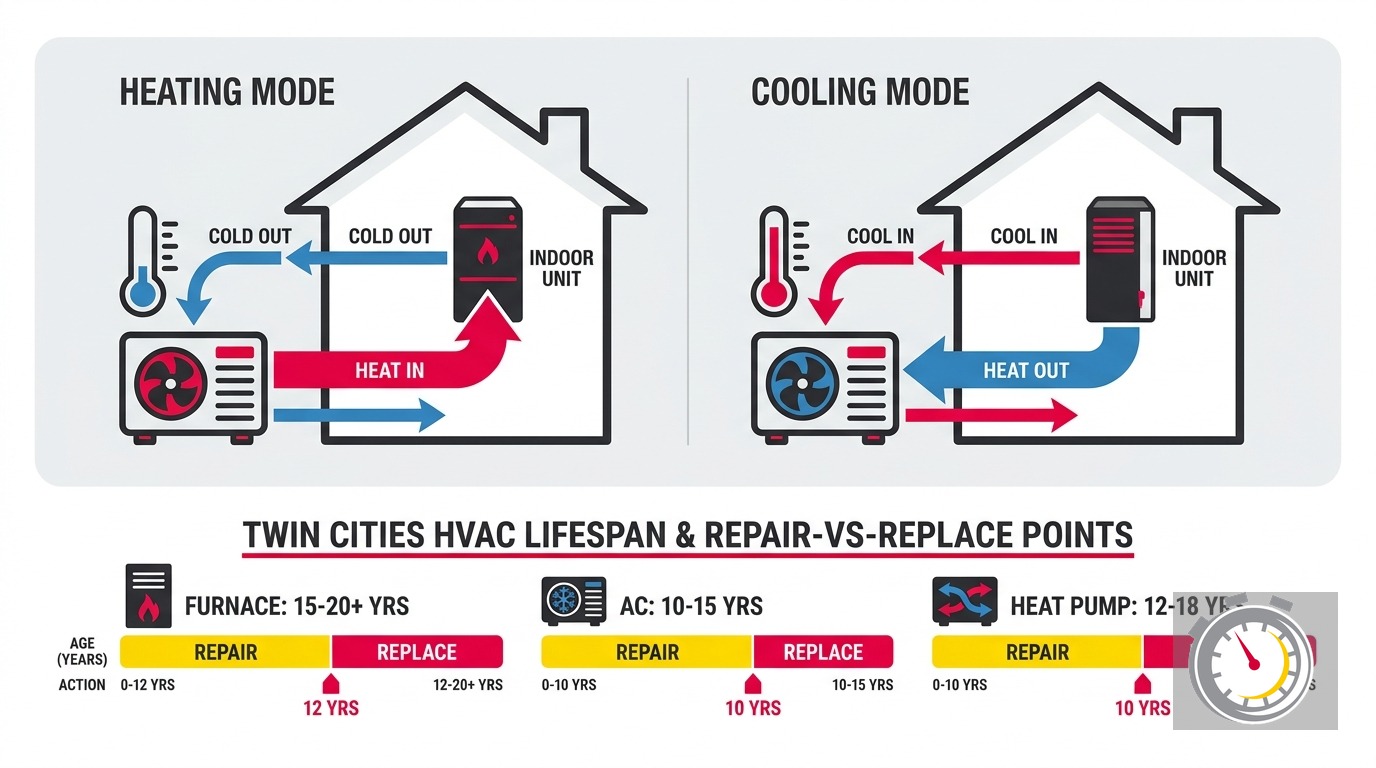
Apply the Rule of 5000: multiply your system’s age in years by the repair estimate in dollars. Above $6,500, replacement is the smarter call. Below $6,500, repair is often worth it.
A concrete example: a 12-year-old AC needing a $500 repair = 12 x 500 = $7,800. Replace. A 5-year-old unit with the same repair = 5 x 500 = $3,200. Repair.
A second check is the 50% rule. If the repair estimate exceeds 50% of what a new system costs, replace.
A quick age-bracket guide:
- Under 10 years: Repair is often viable. The equipment has meaningful life ahead.
- 10 to 15 years: Borderline. Run both rules before committing to a repair.
- Over 15 years: Replacement is generally recommended, especially if efficiency has declined or the system uses R-22 refrigerant.
The efficiency gain from replacing is real. A new SEER2 14 to 15 system cuts cooling costs 20 to 40% compared to an aging SEER 8 unit. That savings offsets a meaningful portion of the replacement cost over time. Our repair-or-replace guide walks through the full framework with additional scenarios.
The Refrigerant Factor: What R-22 and R-410A Mean for Your Decision
If your AC was installed before 2010, it almost certainly runs on R-22 refrigerant, also called Freon. R-22 production was banned in 2020. Recycled supply still exists, but the cost has skyrocketed. Supply is finite and shrinks every year.
The practical impact: a refrigerant leak in an R-22 system costs far more to repair than a leak in a current-refrigerant unit. Adding refrigerant is not a fix anyway. It is a patch on a system that is losing charge through a leak somewhere. Major repairs on R-22 systems rarely pencil out. The refrigerant cost alone often closes the case for replacement.
R-410A, which replaced R-22 in most systems installed between 2010 and 2025, is now entering its own phase-down. The new refrigerant standard is R-454B. Our post on the AC refrigerant change to R-454B explains what is coming and what to ask for when you replace your next system.
What Rebates Are Available in Minnesota in 2026?
Federal HVAC tax credits expired December 31, 2025. The 25C and 25D credits were eliminated by the One Big Beautiful Bill Act, signed July 4, 2025. They previously offered up to $2,000 for heat pumps and $600 for central AC. Equipment installed in 2026 does not qualify. Some older websites still display the pre-2025 credit amounts and may not have been updated. Verify any federal credit claim directly against current IRS guidance before making financial decisions based on it.
State and utility rebates remain active:
- Xcel Energy: Up to $2,000 for qualifying cold-climate heat pumps, plus a $600 insulation bonus.
- CenterPoint Energy: $1,100 for a ducted heat pump in a qualifying dual-fuel setup. Requires a 92%+ AFUE furnace and a 40°F switchover point. Does not cover full-electric or mini-split-only replacements.
- Both utilities: Stack Xcel and CenterPoint on a qualifying dual-fuel system for up to $3,100 combined.
- Minneapolis residents: Up to $14,000 in additional city rebates can layer on top of utility rebates.
- Minnesota Energy Resources customers: $500 furnace rebate; $400 for HRV or ERV installation.
Rebate programs change. Our Minnesota heat pump rebates and tax credits guide tracks the current landscape. Verify amounts directly with your utility before you sign any installation contract.
How Can You Extend Your System’s Lifespan?
The single highest-leverage move is annual professional maintenance. That is true for every system type. Everything else is a supporting role.
For your AC:
- Replace or clean filters every one to three months during cooling season.
- Clear cottonwood and debris from the condenser coil each May before the first hot stretch. A garden hose works fine.
- Keep two feet of clearance around the outdoor unit on all sides.
- Schedule a professional spring tune-up before the cooling season starts. Do not wait until the first 90-degree day.
- If you have a heat pump, do not skip the fall inspection. Heat pumps run year-round and need twice-a-year attention.
For your furnace:
- Annual tune-up in the fall, before heating season. A technician cleans the burners, inspects the heat exchanger, tests safety controls, and checks the flue for obstructions.
- Check filter condition monthly. A clogged filter is the most common cause of avoidable furnace problems and the easiest to prevent.
- Test carbon monoxide detectors at the start of each heating season. A cracked heat exchanger is a silent safety risk.
For any system:
- Know your installation year. It is on the data plate on the equipment. If you bought the home without knowing the system age, a technician can decode the serial number during a service call.
- Keep a service log. A documented maintenance history makes the repair-vs-replace conversation faster and gives you data to negotiate with if a contractor recommends replacement.
- Do not wait for failure. A system that is showing efficiency decline and occasional hiccups at year 12 is telling you something. A proactive conversation now costs a lot less than a midnight emergency call in February.
What Signs Mean Your HVAC System Is Done?
Age combined with two or more of the following signals usually points to replacement, not another repair.
- Energy bills climbing with no change in how you live in the home. A declining system works harder for the same output.
- Uneven temperatures throughout the house, regardless of what the thermostat says.
- More than one significant repair in the same season. One repair is maintenance. Two or three in a year is a trend.
- Unusual mechanical sounds: banging, rattling, screeching, or grinding that were not present in prior seasons.
- Humidity the system can no longer control in summer. An AC that is not dehumidifying is often worn out, oversized, or undersized.
- The system is over 15 years old and uses R-22 refrigerant. That combination almost always makes replacement the right financial call, even before a major failure.
No single signal is a verdict on its own. Two or three together, on a system past its midpoint, usually is.
How Long Do HVAC Systems Last? Find Out Where Yours Stands
The range is real. A well-maintained gas furnace can push 25 years. An AC running on deferred maintenance through a tough Minnesota summer might check out at 10. Age is one signal. Maintenance history, refrigerant type, efficiency trend, and repair cost together tell the full story.
We are locally owned and operated in Ramsey, MN. Our team knows what Twin Cities winters do to this equipment, and we give you a straight answer, with the numbers behind it, so you can decide with confidence rather than guessing.
Call us at (763) 260-6662 or book online. We live by “Always On Time… Or You Don’t Pay a Dime!(R)” - and that starts with showing up when we say we will.
Frequently Asked Questions
How long does a central air conditioner last in Minnesota? +
How long does a gas furnace last in Minnesota? +
When should I replace my HVAC system instead of repairing it? +
Are there HVAC rebates available in Minnesota in 2026? +
Need a technician now?