
R-22 Freon Phase Out for Older AC: Twin Cities Guide
Key Takeaways
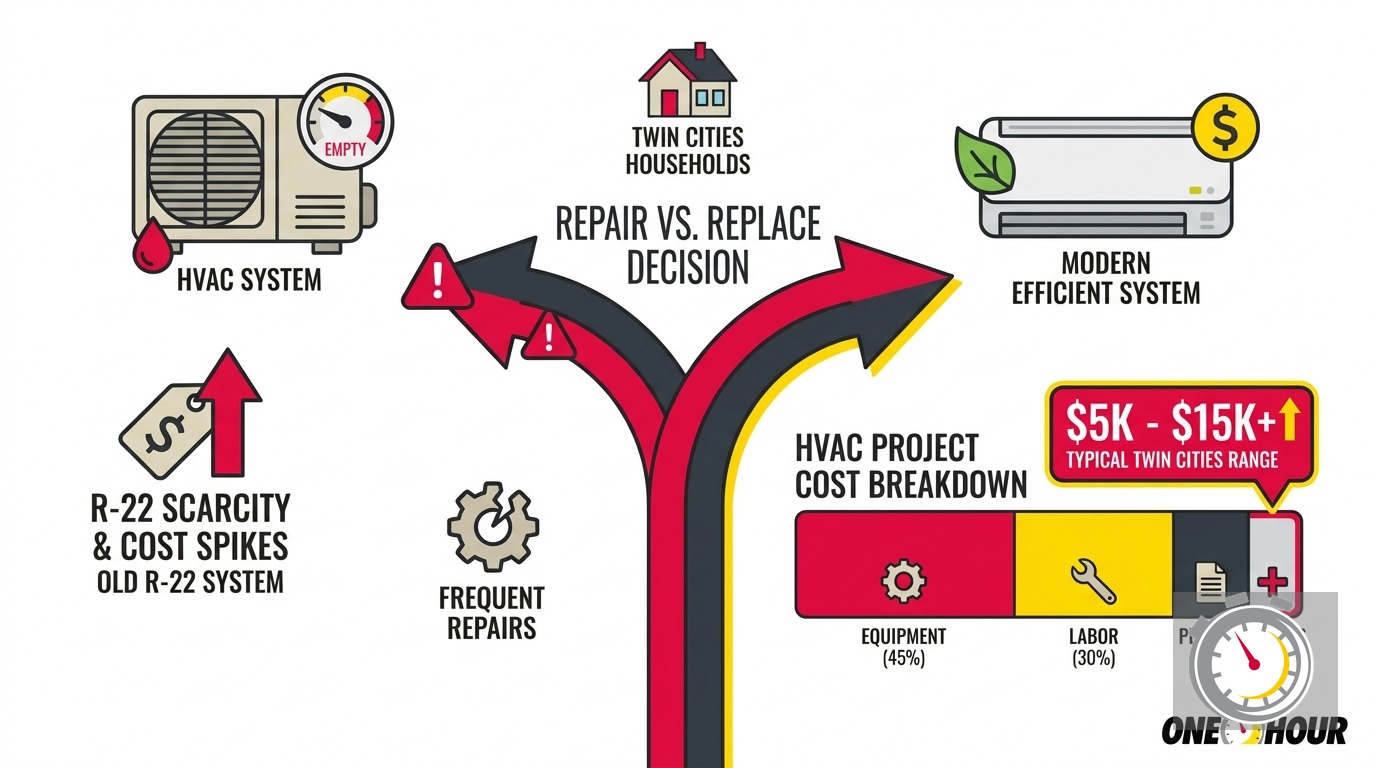
- R-22 refrigerant production and imports have been banned since January 1, 2020. Your system can still run on reclaimed R-22, but supply shrinks every year and prices rise with it.
- Installed R-22 costs $90-225 per pound in 2026. Projections for 2028 put it at $120-280 per pound. Every repair is priced against that trajectory.
- The $5,000 rule: multiply your system’s age in years by the repair cost. Above $5,000, replacement almost always wins financially.
- Retrofit refrigerants like MO99 exist and cost less per pound than R-22. They are not appropriate after a compressor or coil failure.
- New systems installed in 2026 use A2L refrigerants with a GWP under 700. Replacing today means no future refrigerant transition.
- The Section 25C federal tax credit (30%, up to $2,000 for heat pumps) expired December 31, 2025. The income-qualified HEAR program is the 2026 successor.
- Twin Cities homeowners can stack Xcel Energy rebates, city grants, and HEAR for a combined incentive that significantly offsets replacement cost.
- Call (763) 260-6662 or book online to get your R-22 system assessed before the summer cooling season peaks.
What Is the R-22 Freon Phase Out?
Production and imports of R-22 ended January 1, 2020. Existing systems can still be serviced with legally reclaimed gas, but the supply shrinks every year and prices rise with it. No new R-22 is being manufactured anywhere in the United States.
R-22 was the standard refrigerant in residential AC systems for decades. It cools homes well. It also depletes the ozone layer. The EPA phased it out under the Clean Air Act as part of a global agreement to eliminate ozone-depleting substances.
What changed: all new R-22 production is gone. The only gas still available comes from refrigerant recovered from decommissioned systems, reclaimed, and resold into the service market. That shrinking pool pushes prices higher every year.
What did not change: there is no federal mandate for homeowners to replace a working R-22 system. The EPA set no homeowner deadline. The pressure you feel is economic, not regulatory. But the economics get harder to ignore with each passing cooling season.
Is My Older AC System Still Running on R-22?
If your central AC was installed before 2010, check the data plate on your outdoor condenser unit. It lists the refrigerant type. R-22 is also sold under the brand name Freon, which is why homeowners use both names interchangeably. Systems from 2015 onward almost certainly use R-410A.
Finding the data plate is simple. Look for a sticker or metal nameplate on the side of your outdoor unit. It will have a line reading “refrigerant” or “ref type.” R-22 listed there confirms you are on the older refrigerant.
Systems manufactured from roughly 2010 onward began transitioning away from R-22. If your unit falls in that 2010-2014 window, the data plate is the only way to know for certain. Do not assume based on age alone.
One thing every R-22 homeowner should know: venting R-22 is illegal under EPA Section 608, with penalties up to $44,539 per day per violation. Only an EPA-certified technician can legally purchase or handle R-22. Any service call on an R-22 system must go through a licensed professional.
What Does It Cost to Recharge an R-22 System in 2026?
Expect $90 to $225 per pound installed. A typical top-off runs 2-4 pounds, putting a single recharge at $180 to $900 or more. R-22 wholesale prices have roughly tripled since 2020, and projections put the installed cost at $120-280 per pound by 2028.
That price trajectory is the most important thing to absorb. A repair that buys two or three more years of runtime is priced against a refrigerant that only gets more expensive. The second recharge costs more than the first. The third costs more than the second.
That is the first layer of cost risk. The second layer is a major component failure alongside the leak. A compressor replacement on an R-22 system, plus the refrigerant charge to fill it, can reach $2,600-$3,900 or more. That is where the $5,000 rule becomes the deciding factor.
If your system is running longer than normal, not cooling as well as it used to, or your utility bills have climbed without explanation, a refrigerant leak may be the cause. Our post on AC refrigerant leak signs in Minnesota covers the symptoms to watch for before your next service call.
Should I Repair or Replace My R-22 System?
Multiply your system’s age in years by the estimated repair cost. If the result exceeds $5,000, replacement makes more financial sense in almost every case. A compressor or coil failure on a 15-year-old R-22 system clears that threshold nearly every time.
The $5,000 Rule in Practice
The math is straightforward. Your system is 16 years old. The technician quotes $900 to top off the refrigerant after a minor leak. Sixteen times $900 equals $14,500. That is more than double the $5,000 threshold. Replacement wins.
Now say the compressor has failed. A compressor replacement on an R-22 system typically runs $1,550-$3,200 for parts and labor. Add the refrigerant charge on top of that. A 16-year-old system times $2,300 equals $37,400. The math is not close.
The rule is a shortcut, not a formula. A younger system with a small, straightforward repair may fall below $5,000 and still be worth fixing. But for most R-22 systems over 15 years old, any repair involving refrigerant or a major component tips the math toward replacement. And every subsequent recharge happens at a higher refrigerant cost than the last.
What Refrigerant Do New AC Systems Use?
New residential systems installed on or after January 1, 2025 must use refrigerants with a global warming potential (GWP) under 700. The industry standard is now A2L refrigerants, primarily R-454B and R-32. A system you install in 2026 will not face another mandatory refrigerant transition.
R-22 was phased out for ozone depletion, not flammability. Its GWP is 1,810. The new A2L refrigerants have a GWP under 700 and meet the EPA’s current equipment mandate. A2L refrigerants are mildly flammable. Modern equipment is engineered specifically around that property. Your home is not at elevated risk.
The practical outcome: a replacement today is future-proofed. You are buying into technology that regulators have already approved for the long term.
For more on what the refrigerant transition means for new equipment, see our post on the R-454B refrigerant change and what homeowners need to know.
What About Retrofit Refrigerants?
Drop-in alternatives like R-407C and MO99 (R-438A) exist and cost roughly half what R-22 costs per pound. They can extend a system’s life at lower refrigerant cost. They are only appropriate when the system has no major component failure and a technician confirms it is a good retrofit candidate.
R-407C runs $45-75 per pound installed versus $90-225 for R-22. That spread looks attractive. But R-407C requires a TXV adjustment and a partial oil change to work correctly. It is not a simple swap. MO99 and NU-22B (R-438A) are closer to true drop-ins and still require a POE oil conversion.
Neither alternative is appropriate if the compressor or evaporator coil has failed. Those failures make replacement the only sensible path, regardless of which refrigerant you use.
If your system is otherwise healthy and you want to extend its life another one to two years at lower refrigerant cost, a retrofit conversation with a licensed technician is worth having. Go in with clear expectations: it is a short-term bridge, not a long-term solution.
Why Minnesota’s Climate Makes This More Urgent
Most content about the R-22 freon phase out is written for national audiences, often from contractors in Sunbelt markets where AC runs nine months of the year. That framing does not translate to Minnesota.
The Twin Cities get roughly 700 cooling degree days annually, compressed into three to four months. A refrigerant leak in early July does not spread the pain across a long season. It eliminates your entire summer comfort in a single service call.
If your R-22 system fails mid-July and sourcing reclaimed refrigerant takes time, or the repair bill pushes past the $5,000 threshold and replacement becomes the right call, you could be without a functioning AC during the hottest stretch of the year. That is a different risk than a homeowner in a mild-climate market faces.
There is also a Minnesota-specific opportunity on the replacement side. Cold-climate air-source heat pumps operate down to -13°F. A dual-fuel hybrid setup pairs a heat pump with your existing furnace. Each handles what it does best: the heat pump runs efficiently above a balance point, and the furnace takes over below it. That configuration can stack rebates from Xcel Energy and CenterPoint simultaneously. No Sunbelt homeowner has access to that combination.
One logistics note: Minnesota requires a mechanical permit for refrigerant system replacement, with city inspections after installation. Build that into your planning timeline. A reputable contractor pulls the permit as part of the job, not as an add-on.
What Rebates and Incentives Are Available for Twin Cities Homeowners?
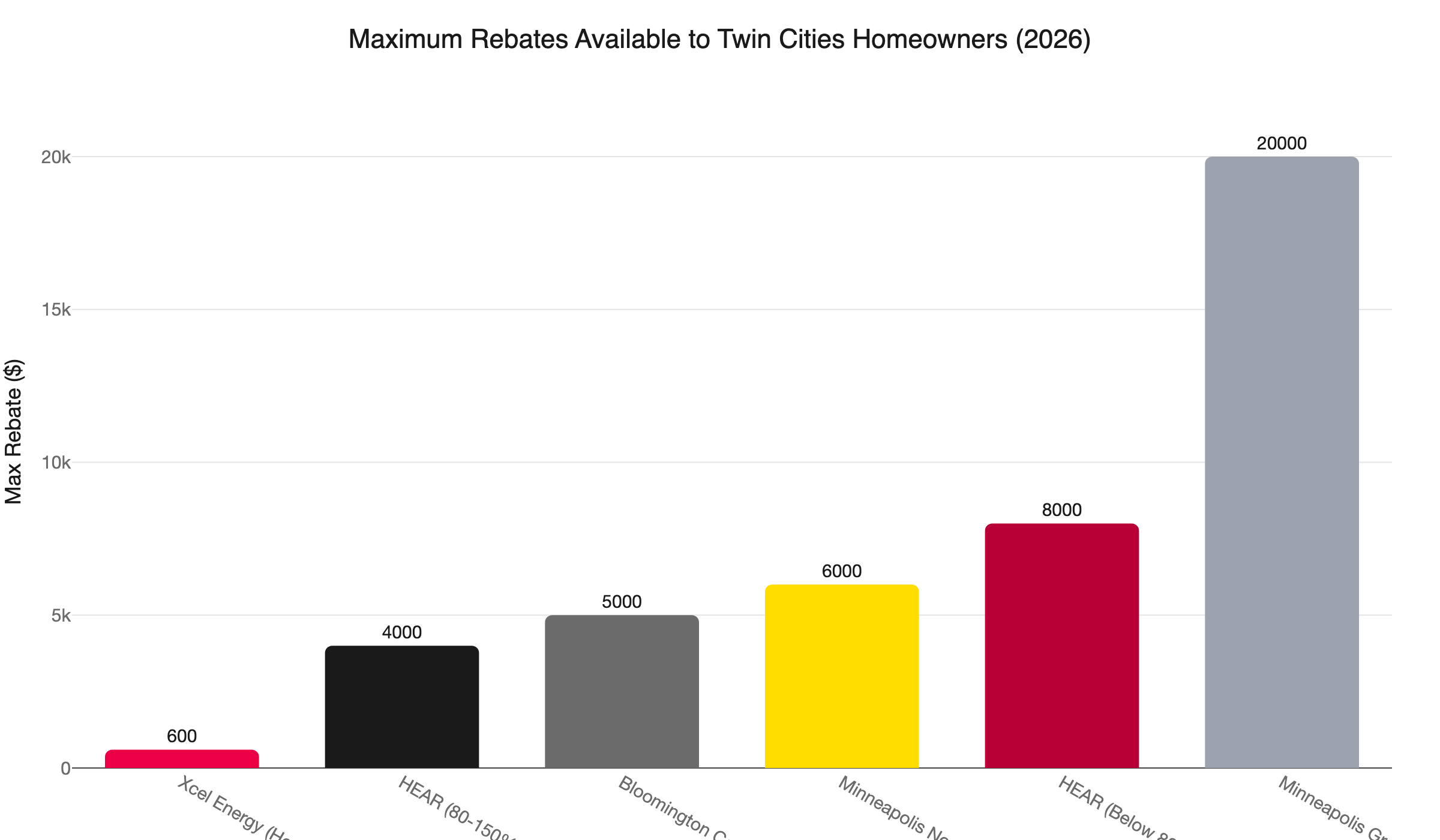
Xcel Energy offers up to $600 for qualifying heat pumps. Minneapolis homeowners in Green Zone neighborhoods may access up to $20,000 through the Green Cost Share program. Bloomington offers up to $5,000. Income-qualified households can apply for up to $8,000 through the HEAR program launching in 2026.
No national article covers this combination. It exists only in the Twin Cities.
Utility Rebates: Xcel Energy and CenterPoint
Xcel Energy offers up to $450 for central AC with SEER2 16 or higher, and up to $600 for qualifying heat pumps. Minimum efficiency thresholds are SEER2 16 and HSPF2 8.2 for heat pump eligibility.
CenterPoint customers have access to Home Service Plus heat pump programs as well. A dual-fuel hybrid configuration can sometimes qualify for rebates from both Xcel and CenterPoint simultaneously. That makes it the highest-rebate path for many Twin Cities households considering replacement.
City Grants: Minneapolis and Bloomington
Minneapolis homeowners in Green Zone neighborhoods can access up to $20,000 through the Green Cost Share program for a qualifying cold-climate air-source heat pump. Non-Green Zone Minneapolis residents are eligible for up to $6,000. Both tiers are first-come, first-served with annual funding caps.
Bloomington offers a 20% cost-share up to $5,000 for eligible HVAC upgrades. Confirm current availability and eligibility requirements with the city directly before committing to equipment.
Federal Program: HEAR
The Section 25C federal tax credit expired December 31, 2025. Equipment placed in service in 2026 does not qualify.
The HEAR (Home Electrification and Appliance Rebate) program is the successor. Households below 80% of area median income may qualify for up to $8,000. Households between 80% and 150% AMI may qualify for up to $4,000. Equipment must be an ENERGY STAR certified cold-climate heat pump, installed by an approved contractor. The program is administered through the Minnesota Department of Commerce and is targeting a 2026 launch.
How the Stack Works
Think of it in layers. Utility rebate first (Xcel or CenterPoint), city grant on top if you are in an eligible municipality, HEAR last if your household income meets the threshold. For some Twin Cities homeowners, the combined incentive approaches or exceeds the installed cost of a mid-tier replacement system.
For a full breakdown of current programs, eligibility requirements, and how to apply, see our guide to Minnesota heat pump rebates and tax credits.
How Much Does AC Replacement Cost in the Twin Cities?
A mid-tier central AC replacement in the Twin Cities runs $7,500-$10,400 installed. The full range spans $5,400-$14,900 depending on system size, efficiency tier, and installation complexity. Reaching SEER2 16 or higher unlocks Xcel Energy’s rebate eligibility, making the efficiency upgrade financially self-reinforcing.
Stack the rebates on top of that installed cost, and the net price after incentives drops substantially. An income-qualified household in a Green Zone Minneapolis neighborhood replacing with a cold-climate heat pump has access to incentives that can offset a significant share of the replacement cost.
Compare that against the R-22 repair trajectory. A recharge today. Another in two years at higher cost. Constant exposure to a compressor or coil failure that pushes the total past the $5,000 rule threshold. A new system eliminates all of that uncertainty in one move.
For detailed cost ranges by system type and efficiency tier, see our post on AC replacement cost in Minnesota.
If upfront cost is a concern, ask us about financing. Spreading a new system across manageable monthly payments is often more workable than absorbing another repair bill that only buys a few more years on aging, increasingly expensive equipment.
What to Expect During Replacement
Knowing the steps upfront prevents surprises.
Diagnostic and written quote. A certified technician confirms your refrigerant type, evaluates system age and condition, and provides a written quote before any work begins. No surprises on pricing.
Equipment selection. Based on your home’s square footage, existing ductwork, and utility provider, the technician recommends the right system and efficiency tier. Rebate eligibility gets locked in at this stage.
Mechanical permit. Minnesota requires a permit for refrigerant system replacement. Your contractor pulls it. A city inspector will sign off after installation.
Installation day. A full central AC replacement typically takes one day. The old R-22 refrigerant is recovered by a certified technician. Venting it is illegal under federal law, and no reputable contractor does it. The new system is charged with the correct A2L refrigerant and tested before the crew leaves.
Rebate documentation. Your contractor provides the paperwork you need for utility rebate applications, city grant submissions, and HEAR filings. The HEAR application goes through the Minnesota Department of Commerce.
Our team at Northern One Hour is locally owned and operated in Ramsey, MN. We know which rebate programs apply to which Twin Cities neighborhoods, and we handle the permit and documentation process as part of every installation. We show up when we say we will. “Always On Time… Or You Don’t Pay a Dime!(R)” is not a tagline we take lightly.
Ready to Replace Your R-22 System?
If your AC is running on R-22, you are not in an emergency today. But you are on a cost curve that only goes one direction. Refrigerant prices will keep rising. The $5,000 rule will keep making repair math harder to justify. And the incentive window, especially the income-qualified HEAR program, has limits on available funding.
The right time to have the replacement conversation is before a mid-July failure forces the decision for you.
Call (763) 260-6662 or book online to schedule a system assessment. We will confirm your refrigerant type, walk through the repair-versus-replace math for your specific system, and identify every rebate your household qualifies for. No pressure, no surprises.
Frequently Asked Questions
Is it illegal to keep running my R-22 air conditioner? +
How much does it cost to recharge an R-22 system in 2026? +
What rebates are available if I replace my R-22 system in the Twin Cities? +
Can I use a retrofit refrigerant instead of replacing my R-22 system? +
Need a technician now?