
R-410A Refrigerant Phase-Out: What Minnesota Homeowners Face
Key Takeaways
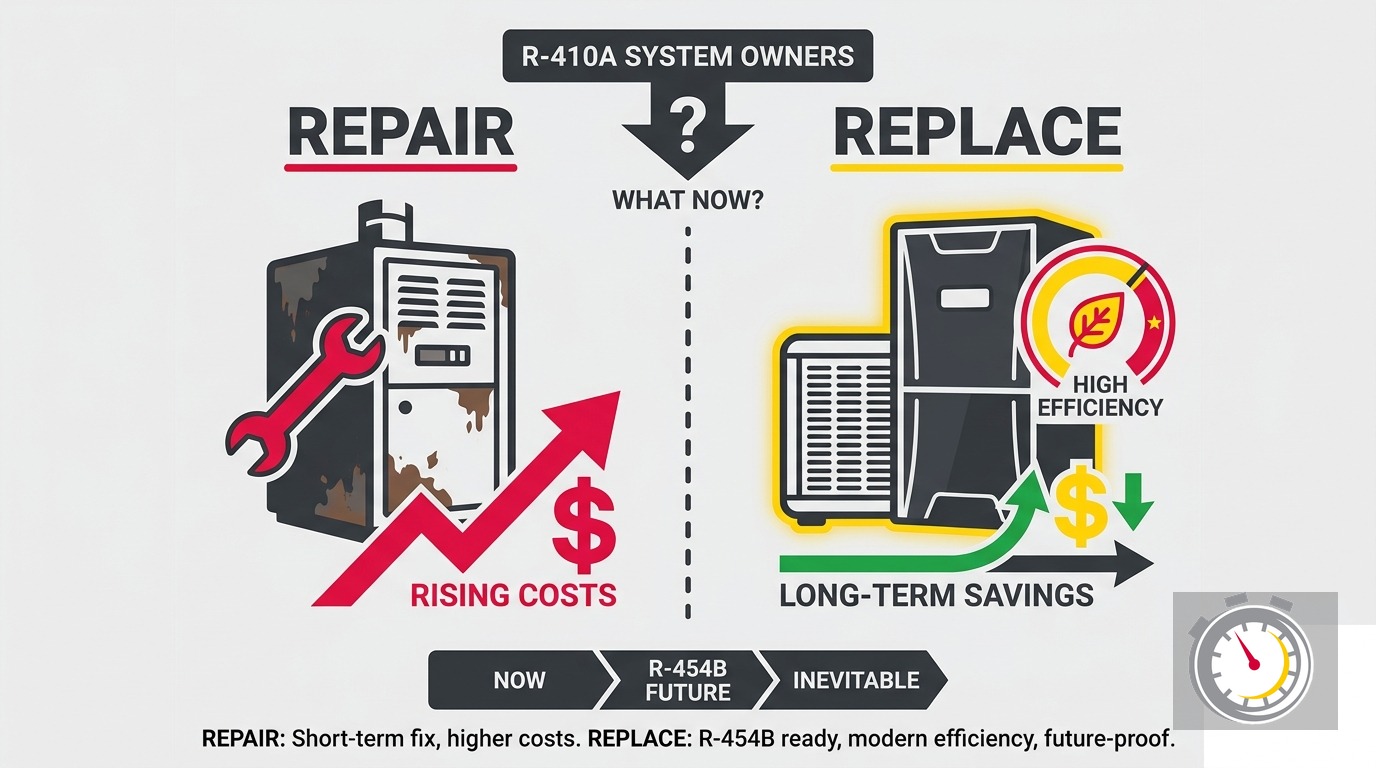
- The R-410A refrigerant phase-out in Minnesota follows federal EPA rules, not state rules. New equipment using R-410A was banned January 1, 2025. You are not required to replace a working system.
- R-410A service refrigerant is still legal, but a full recharge on a 3-ton system now runs $500-$1,500. In 2022, the same job cost $240-$560.
- A 2029 HFC production cut will roughly halve R-410A supply from 2024 levels, pushing repair costs higher on a defined schedule.
- The 25C federal heat pump tax credit expired December 31, 2025. It is gone for 2026 installations.
- Xcel Energy and CenterPoint rebates are still active. Stacking both programs can yield up to $3,100 in combined incentives right now.
- Systems 12 or more years old that face a refrigerant or compressor repair are strong replacement candidates. Systems under 8 years in good condition: service and wait.
What Is the R-410A Refrigerant Phase-Out?
The short answer: The EPA’s AIM Act banned the manufacture and import of new residential HVAC equipment using R-410A as of January 1, 2025. Minnesota has no separate state requirements. The federal timeline is the only one that applies here.
R-410A has a global warming potential (GWP) of 2,088. The AIM Act caps new residential HVAC equipment at a GWP of 750. R-410A is nearly three times that limit. Manufacturers shifted to alternatives like R-454B (GWP 466) and R-32 (GWP 675) for equipment built in 2025 and later.
There was also a question about whether pre-2025 R-410A inventory could still be installed. Originally, January 1, 2026 was the installation cutoff. The EPA issued a final rule effective July 27, 2026 that removed that installation deadline for pre-2025 R-410A inventory. Contractors can still legally install pre-2025 equipment.
This is not the first refrigerant transition Twin Cities homeowners have seen. R-22 (Freon) went through the same pattern: service refrigerant grew scarce, repair costs climbed, and replacement eventually became the obvious call. The direction is the same here. The timeline is different. See how that transition played out in our overview of the R-22 phase-out and what it meant for older AC systems in Minnesota.
Does This Mean You Have to Replace Your R-410A System?
No. You are not required to replace a working R-410A system. The EPA ban covers manufacturing, not the systems already in your home. R-410A service refrigerant is still legal to purchase and use. Your contractor can still legally recharge your system if it develops a leak.
The question is not what the law requires. The question is what the economics require. And for some systems, that answer is changing.
Two forces are raising R-410A repair costs every year. First, as manufacturers shift production to A2L systems, new R-410A supply is declining. Second, R-410A is a refrigerant blend that cannot be reclaimed by simple filtering. It requires full reclamation, which limits how much recovered refrigerant can offset the drop in new production. Both forces point the same direction: higher service costs over time.
You are not being pushed out. But staying gets more expensive on a predictable schedule.
How Much Does an R-410A Repair Cost in the Twin Cities Right Now?
At mid-2026 prices, a full recharge on a 3-ton central AC system runs $500-$1,500 installed. That compares to roughly $240-$560 at 2022 prices. Installed per-pound cost is now $80-$150, up significantly from what contractors paid per cylinder just a few years ago.
That cost jump matters because refrigerant leaks are rarely a one-time event. A leak repaired and recharged today may reopen within 12-24 months. Each repair cycle costs more than the last. And the cost will climb further after 2029 as supply tightens.
The cost also depends on the cause. A loose fitting on a 6-year-old system is a different conversation than a corroding evaporator coil on a 13-year-old system. If the coil itself is failing, a recharge buys months, not years. Our team will always tell you the underlying cause, not just top off the refrigerant and schedule the next call.
What Does the 2029 Supply Cut Actually Mean for Your Repair Bill?
In 2029, HFC production allowances drop to 30% of the 2011-2013 baseline, cutting R-410A supply roughly in half from 2024 levels. Allowances then drop to 20% in 2034 and 15% in 2036, representing an 85% total reduction from the baseline.
Put that in plain terms: the refrigerant your current system depends on will get more expensive in 2029, then more expensive again in 2034. There is no reversal in that trajectory. If your AC is 10 years old today, it will be 13 when the first major supply cut hits. It will need refrigerant service at least once in that window, possibly twice.
This is why “do I need to replace now” is not quite the right question. The better question is: given what refrigerant will cost between now and my system’s likely failure date, does the math of continued repair beat the math of a planned replacement today?
Keep vs. Replace: A Framework for Twin Cities Homeowners
This is the question the national articles skip. They explain the AIM Act, reassure you that your system is legal, and leave you to figure out the repair-or-replace math alone. Here is the framework our team uses when a homeowner calls about an R-410A repair.
Service and wait: system is under 8 years old, good condition
A system under 8 years old that needs a refrigerant repair is not a replacement conversation yet. The system has a decade or more of useful life ahead of it. A single refrigerant event on a young system is usually a fixable problem, not a pattern. Identify the root cause, make the repair, and revisit replacement when the system is older and the math changes.
Evaluate carefully: system is 8-12 years old
At this age, the system is approaching the later half of its expected service life. A refrigerant leak at year 9 or 10 is a signal worth taking seriously. It does not automatically mean replace, but it does mean get a full system assessment, not just a refrigerant check. Is the evaporator coil corroding? Has the compressor shown stress symptoms? Have you had refrigerant events before? If two or more of those are true, treat the repair cost as a down payment on a machine that may not reach 2029 in serviceable shape.
Replace: system is 12 or more years old, facing refrigerant or compressor repair
At 12-plus years, the math almost always favors replacement. You are paying $500-$1,500 for R-410A refrigerant on equipment headed toward compressor failure. A compressor replacement on a 3-ton central AC system runs $1,950-$4,500. Stack a refrigerant recharge and a compressor event together. You may spend $2,500-$6,000 on a machine that is already 12 years old. A new system often costs the same or less at that point. It comes with a 10-year warranty. And it runs on a refrigerant that will not get more expensive every few years.
You are also doing this repair before the 2029 supply cut makes refrigerant more expensive and before the current rebate landscape changes. That timing matters.
What Happened to the Federal Tax Credit?
The 25C Energy Efficient Home Improvement Tax Credit for air-source heat pumps expired December 31, 2025. It applied to products purchased and installed between January 1, 2023, and December 31, 2025. It is not available for 2026 installations.
If you were planning to use that credit and waited, that window is closed. The credit covered up to 30% of eligible costs, with a $2,000 cap for heat pumps. That is real money that does not come back by waiting longer.
The incentive picture is not empty. Minnesota utility rebates are still active, and they are significant. But the federal layer is gone for now, which is one reason “wait and see” carries a cost that homeowners do not always account for.
What Minnesota Utility Rebates Are Still Available in 2026?
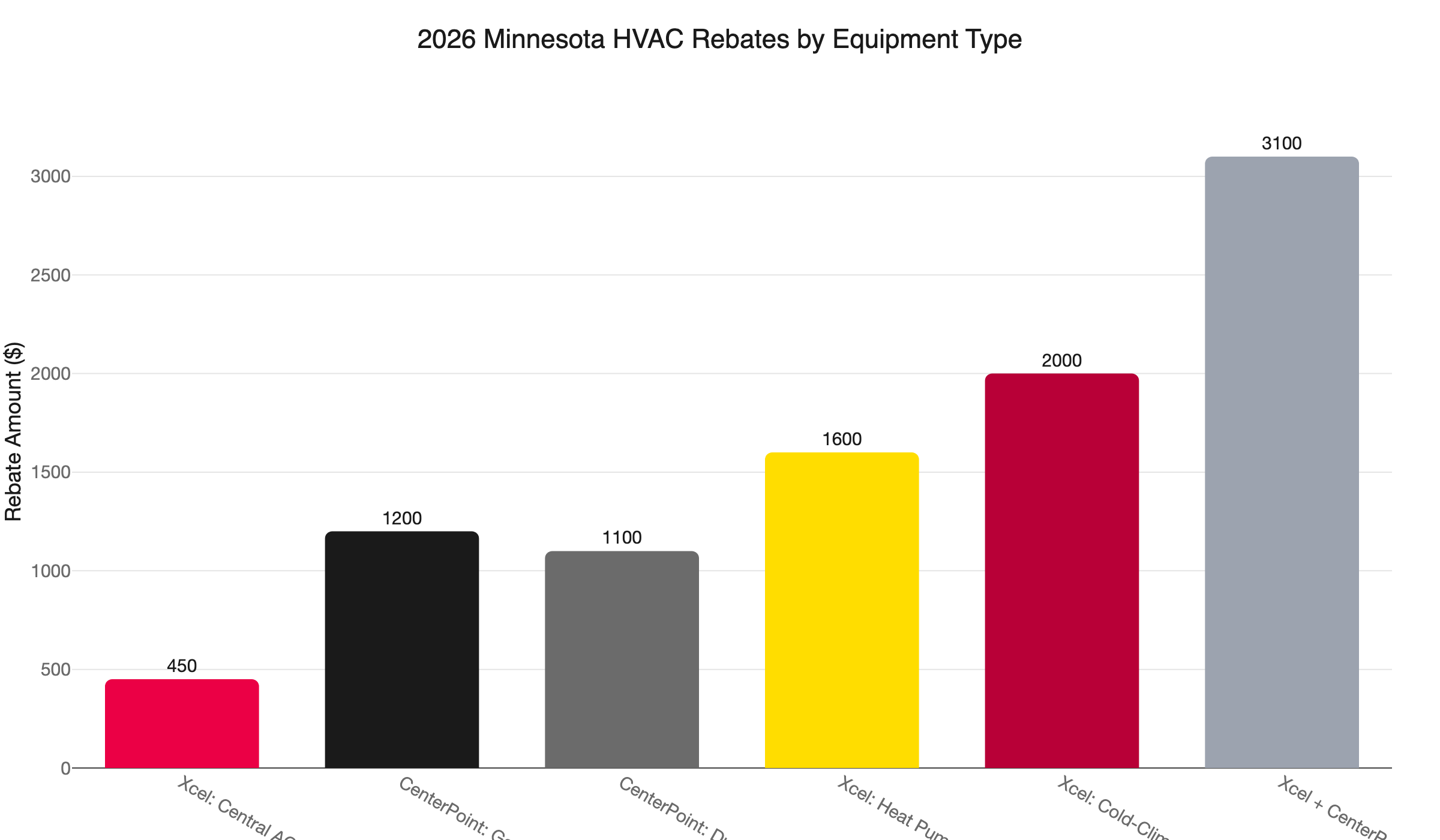
Xcel Energy and CenterPoint both have active rebate programs in 2026. Stacking both programs on a cold-climate heat pump installation can yield $3,100 in combined rebates before any income-qualified add-ons.
Here is what each utility offers:
Xcel Energy rebates (2026):
- Central AC: $150 (13.4 SEER2) to $450 (15.2 SEER2)
- Standard air-source heat pump: up to $1,600
- Cold-climate-rated heat pump: up to $2,000
- Requires Quality Install verification by a participating contractor
Note: Xcel discontinued its standalone gas furnace rebate program January 1, 2026. Furnace rebates from Xcel now require pairing with heat pump equipment.
CenterPoint Energy rebates (2026):
- Dual-fuel heat pump paired with a 92%+ AFUE gas furnace: $1,100
- High-efficiency gas furnace (95%+ AFUE): up to $400 standard, up to $1,200 income-qualified
Stacking the programs:
Xcel’s cold-climate heat pump rebate ($2,000) plus CenterPoint’s dual-fuel rebate ($1,100) totals $3,100. On a dual-fuel installation where both utilities serve the home, that combination meaningfully offsets the cost of a new system. Income-qualified tiers can push the total higher still.
We cover the full details of both programs, including how to verify which one applies to your address, in our Xcel and CenterPoint HVAC rebates guide.
Why Does Cold-Climate Rating Matter Here?
Standard heat pumps have a low-temperature lockout that can fire right when you need heat most. Twin Cities design temperatures run -15 to -20 degrees Fahrenheit. A heat pump rated to only -5F will stop delivering meaningful heat on our coldest nights, precisely when you depend on it most.
Cold-climate-rated units are engineered to deliver useful heating capacity at -13F or below. That threshold matters in Minnesota in a way it simply does not in warmer climates. It is also the threshold that unlocks Xcel’s higher $2,000 rebate tier instead of the $1,600 standard rate. Choosing a cold-climate unit is not just about January performance. For Xcel customers, it is also the financially correct choice when comparing rebate tiers.
Dual-fuel configuration is the practical sweet spot for most Minnesota homes. A cold-climate heat pump handles the bulk of the heating season efficiently. The gas furnace takes over below the switchover point, typically around 25-35 degrees. You get the efficiency of a heat pump for the majority of your heating hours and the reliability of gas on the nights that matter most. CenterPoint’s $1,100 dual-fuel rebate was built specifically for this pairing. Our post on dual-fuel heat pump and gas furnace systems in Minnesota walks through how the switchover point works and what to expect in practice.
One more factor worth raising: not every contractor is certified to install A2L refrigerant equipment. R-454B and R-32 are classified A2L, meaning mildly flammable. Proper installation requires specific handling protocols, leak detection sensors, and spark-proof components. New A2L equipment carries a 5-10% upfront cost premium over legacy R-410A models partly because of those added safety components. When choosing an installer, ask whether their technicians are A2L certified. Ours are. That training matters when the work involves mildly flammable refrigerant in your home.
For a broader view of what is replacing R-410A in new systems and how the transition affects equipment choices, see our overview of what homeowners need to know about the R-454B refrigerant switch.
What to Do If Your R-410A System Needs a Repair This Season
The decision is not complicated once you know the variables. Here is how to work through it:
Step 1: Find out your system’s age. The manufacture date is on the data plate on the outdoor condensing unit. It is usually embedded in the serial number. If you cannot read it, our technician can interpret it during a service call. Age is the single most important variable in the keep-vs-replace decision.
Step 2: Get a full system assessment, not just a refrigerant check. A refrigerant leak is a symptom. The cause matters as much as the cost. A corroding evaporator coil on a 13-year-old system is a different repair conversation than a loose service fitting on a 6-year-old system. Before authorizing a recharge, understand what failed and why.
Step 3: Run the repair-vs-replace math. Estimate the refrigerant repair cost. Factor in the realistic probability of another refrigerant event or a compressor failure within the next three to four years. Compare that combined total against a replacement with available utility rebates applied. On systems 12 years or older, that comparison closes faster than most homeowners expect.
Step 4: If replacing, act before 2029. The window between now and the next major R-410A supply cut is the best window for a planned replacement. Rebates are defined and available. Equipment selection is broad. Refrigerant costs on existing systems are already rising. Waiting until a system fails in the middle of a heat wave or a cold snap costs more in every direction.
Ready to Know Where Your System Stands?
We are locally owned and operated in Ramsey, Minnesota. Our team serves homeowners across Minneapolis, St. Paul, Blaine, Maple Grove, Plymouth, Brooklyn Park, Woodbury, Bloomington, and the surrounding Twin Cities.
When you call us, you get a technician who knows what Minnesota winters and summers ask of your HVAC system. Not a call center, not a national dispatch queue.
Our technicians are A2L certified and familiar with both the Xcel and CenterPoint rebate programs. We can assess your current R-410A system, tell you honestly whether the repair math works in your favor, and walk you through what a replacement looks like with rebates applied. If your system is worth repairing, we will tell you that. If the numbers point toward replacement, we will show you why.
We back every visit with our on-time promise: “Always On Time… Or You Don’t Pay a Dime!(R).”
Call us at (763) 260-6662 or book online to schedule a system assessment. If your R-410A system needs attention this season, now is the right time to get the full picture.
Frequently Asked Questions
Do I have to replace my R-410A air conditioner because of the phase-out? +
How much does an R-410A refrigerant recharge cost in Minnesota in 2026? +
What utility rebates are available for heat pumps in Minnesota in 2026? +
What refrigerant replaced R-410A in new AC and heat pump systems? +
Will R-410A service refrigerant still be available after 2025? +
Need a technician now?