
Dual Fuel Heat Pump Minnesota: How the Balance Point Works
Key Takeaways
- A dual fuel system pairs an electric heat pump with a gas furnace. The heat pump is the primary heat source; the furnace is the backup.
- Two balance points matter: the thermal balance point (can the heat pump keep up physically?) and the economic balance point (which fuel costs less right now?). Dual fuel controllers target the economic one.
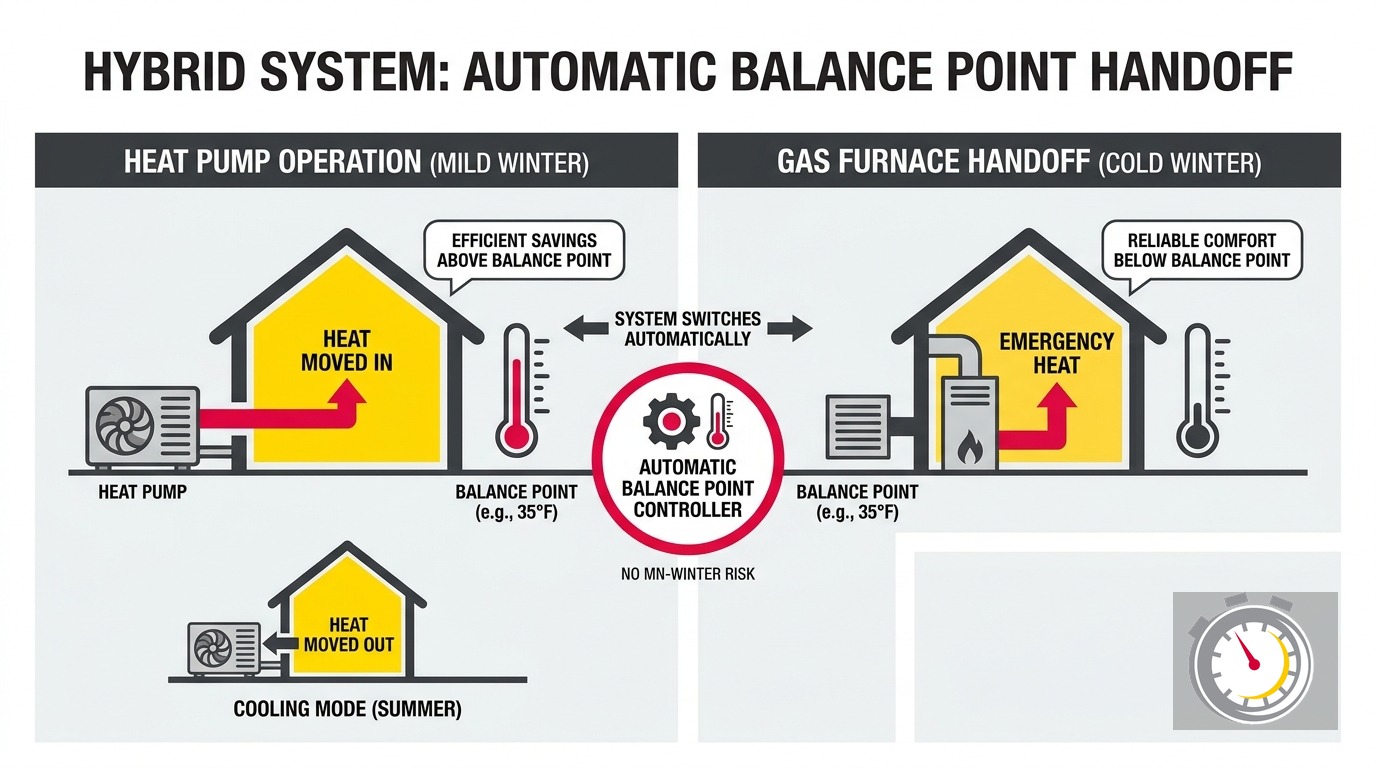
- CEE modeling puts the economic balance point for most Minnesota homes with natural gas backup between 25°F and 45°F. Manufacturers recommend starting the aux heat lockout around 35°F.
- You do not need a cold-climate heat pump for a dual fuel system. A standard single-stage or two-stage unit works because the furnace takes over before cold-climate performance matters.
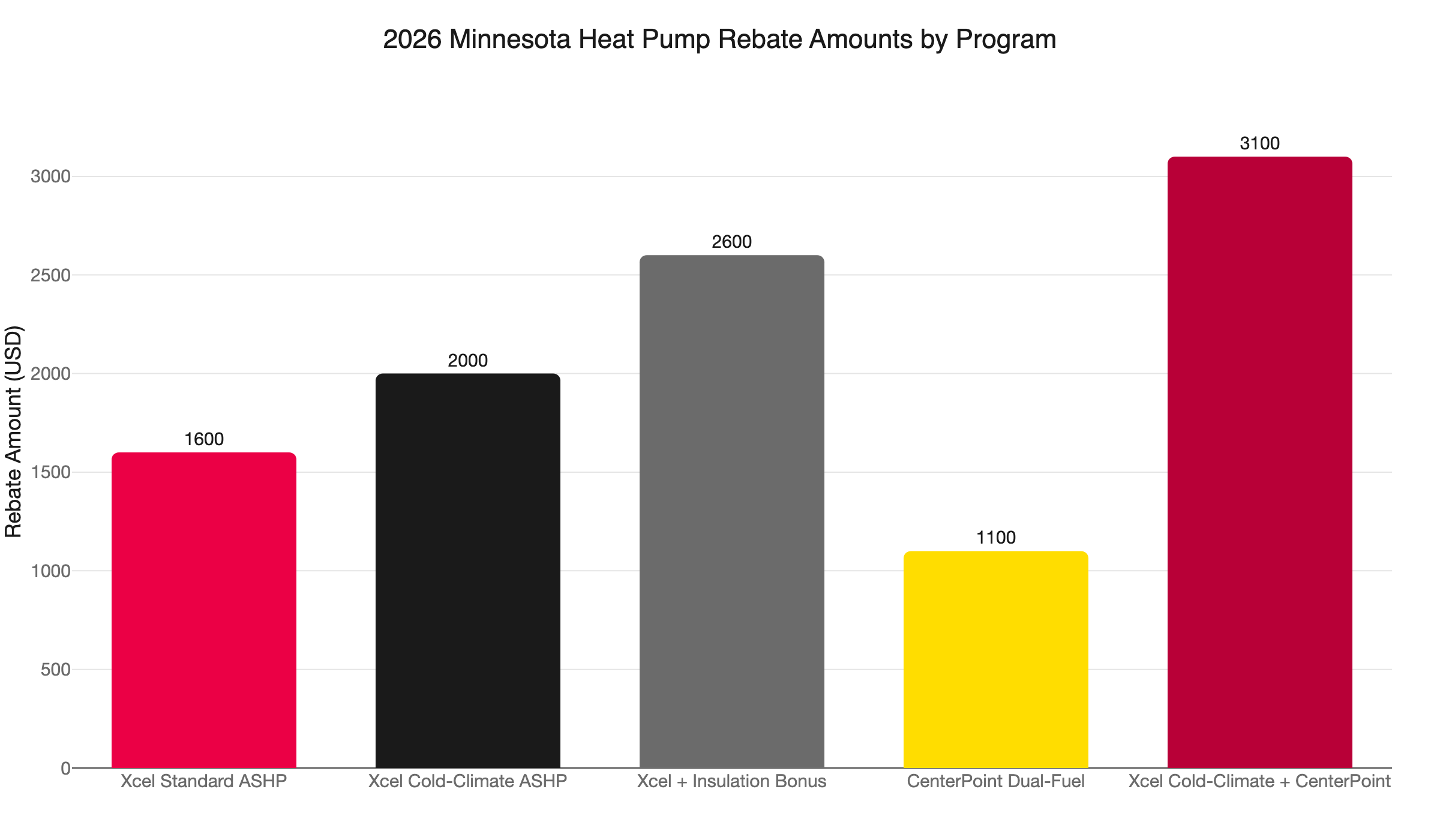
- CenterPoint Energy offers $1,100 for qualifying dual fuel installs in 2026. The switchover must be programmed at 40°F or lower and the paired furnace must be rated at 92% AFUE or higher. Miss either requirement and the rebate does not apply.
- Xcel Energy offers $1,600 to $2,000 for heat pump installs. Homes with Xcel electric service and CenterPoint gas service can stack both programs for up to $3,100.
- Federal 25C/25D heat pump tax credits expired December 31, 2025. Do not count them in a 2026 project budget.
- The balance point is adjustable after installation. Your technician can shift it up or down as fuel prices change over time.
The fear is understandable. Minnesota winters can hold below zero for days. The idea of trusting an electric heat pump when the polar vortex rolls through sounds like a risk no homeowner should take.
A dual fuel heat pump system does not ask you to make that gamble. It pairs an electric heat pump with a gas furnace. The heat pump handles the moderate cold, where it is far more efficient than any furnace. The gas furnace steps in when temperatures drop to the point where it makes more financial sense. The controller makes the switch automatically, with no action required from you.
This post explains how that handoff works, why there are actually two distinct balance points every dual fuel homeowner should understand, what happens when a system is misconfigured, and what the 2026 rebate picture looks like for Twin Cities homeowners.
What Is a Dual Fuel Heat Pump System?
A dual fuel system adds an electric air-source heat pump to an existing gas furnace. The heat pump is the primary heat source. At a preset outdoor temperature, the controller shuts off the heat pump and fires the gas furnace. The two systems never run simultaneously.
Most Twin Cities homes already have a gas furnace and ductwork. A dual fuel upgrade uses that infrastructure. You are not removing the furnace. You are adding a heat pump that covers the majority of your annual heating load, and letting the furnace do what it does best when temperatures fall deep into winter.
The efficiency case is clear. A heat pump operates at 300 to 400 percent efficiency, moving three to four units of heat for every unit of electricity it consumes. A high-efficiency 96% AFUE furnace cannot match that. From October through early December and again in March, the heat pump wins by a significant margin.
Over a full heating season, the heat pump typically covers 70 to 90 percent of annual heating hours. The furnace handles the coldest 10 to 30 percent. That ratio is what makes the financial case for a dual fuel system work.
Our heat pump service page covers the equipment options we install across the Twin Cities.
How Does the Handoff Between Heat Pump and Gas Actually Work?
A dual fuel controller monitors outdoor temperature continuously. When the temperature drops to the programmed balance point, the system turns off the heat pump and starts the gas furnace. When temperatures recover, the system switches back. The transition is automatic.
The heat pump and furnace are not designed to overlap. The control board ensures they never run at the same time. There is no gap in heating during the transition, and the switch is seamless from inside your home.
What surprises many homeowners is how often this can happen in a Minnesota shoulder season. A November day might start at 22°F, warm to 42°F by afternoon, and drop back to 26°F overnight. The system can shift between heat pump and furnace mode several times in one day. That is not a malfunction. That is the system doing exactly what it is designed to do.
The controller handles this continuously, season after season. The accumulated savings on moderate-temperature heating days are where the financial case is built.
What Is the Thermal Balance Point Versus the Economic Balance Point?
The thermal balance point is the outdoor temperature at which the heat pump can no longer match your home’s heating load. The economic balance point is the temperature at which running the gas furnace costs the same as running the heat pump. Controllers target the economic balance point, not the thermal one.
This is the concept most guides skip. The two balance points sound similar but drive different decisions.
Energy Vanguard defines the thermal balance point as the outdoor temperature where heat pump capacity equals the home’s heating load. Below that point, the heat pump physically cannot keep up on its own. A cold-climate heat pump might not hit its thermal balance point until -13°F or colder. That does not mean the system should wait that long before switching to the furnace.
The economic balance point is a cost calculation. It compares the per-unit cost of running the heat pump at a given outdoor temperature against the per-unit cost of running the furnace at that same temperature. Natural gas and electricity prices are not fixed. They shift seasonally, annually, and in response to supply disruptions. The economic crossover temperature moves with them.
CEE modeling from the Minnesota Air Source Heat Pump Collaborative puts the economic balance point for Minnesota homes with natural gas backup between 25°F and 45°F for most households. Your home’s exact number depends on insulation levels, duct efficiency, your utility rates, and your specific equipment.
When you sit down with a technician to program your dual fuel controller, ask about both numbers. The thermal limit tells you the system’s floor. The economic balance point tells you where to set it for the best outcomes today.
Do You Need a Cold-Climate Heat Pump for a Dual Fuel System?
No. A standard single-stage or two-stage heat pump is sufficient for a dual fuel setup in Minnesota. Because the gas furnace takes over at moderate temperatures, the heat pump never needs to perform at extreme cold. Cold-climate ratings are required for all-electric systems, not hybrid ones.
The Minnesota Air Source Heat Pump Collaborative confirms that standard units qualify for dual fuel because the economic balance point sits at temperatures well within reach of any modern heat pump.
Cold-climate heat pumps are engineered to maintain useful heating output at -13°F and below. That capability is critical if you plan to heat your home with electricity alone through a Minnesota winter. For dual fuel, the furnace covers that load. You do not need the extra hardware.
Where this gets more nuanced is the rebate math. Xcel Energy pays $1,600 for a standard ASHP and $2,000 for a cold-climate unit. If the $400 rebate difference offsets part of the equipment premium, a cold-climate unit can still make financial sense even in a dual fuel configuration. Have your technician run the numbers for your specific situation before assuming one way or the other.
What Happens When the Balance Point Is Set Too High?
Most problems with dual fuel systems come not from faulty hardware but from incorrect programming. Setting the balance point too high is the most common error, and it is a costly one.
If the aux heat lockout is programmed at 50°F instead of 35°F, the furnace turns on during every chilly fall and spring day. That is exactly the temperature range where a heat pump is most efficient. You end up paying gas prices for heating the heat pump should be handling at a fraction of the cost.
Furnace Outlet’s dual fuel setup guide identifies a balance point set too high as the primary driver of rapid cycling, uneven room temperatures, and elevated heating bills in dual fuel homes. The system short-cycles because the furnace heats the home quickly, shuts off, the home cools, and the furnace fires again. That pattern is hard on equipment and wastes fuel.
Manufacturer-recommended starting points are an aux heat lockout around 35°F and a compressor lockout near 5°F. Those are defaults, not final answers. Your technician should calculate your home’s specific economic balance point before programming the controller.
If your heating bills are higher than expected but nothing sounds broken, ask your technician to verify the balance point settings. It is a quick check that can uncover a significant ongoing cost.
Can You Adjust the Balance Point After Installation?
Yes. The balance point is a programmable setting in the dual fuel controller, not a fixed hardware specification. A technician can raise or lower it at any service visit. This makes a dual fuel system uniquely adaptable as fuel prices shift over time.
No other heating system offers this kind of ongoing flexibility. A gas furnace always burns gas. An all-electric heat pump always draws from the grid. A dual fuel system lets you lean toward whichever fuel is currently cheaper.
Natural gas prices in March 2022 were nearly 50 percent higher than in March 2021. When a swing like that happens, lowering the balance point keeps the heat pump running longer and cuts gas consumption. When gas prices fall, raising the balance point modestly can reduce your electric bill. No equipment changes needed.
This flexibility is one of the reasons dual fuel systems suit Minnesota especially well. Natural gas pricing here can move significantly from one winter to the next. You are not locked into one fuel’s price trajectory.
Having a local HVAC company you trust makes adjusting the balance point practical. It is a quick in-person service, not a warranty event or a parts order. We are locally owned and operated in Ramsey, and we hold ourselves to a straightforward standard: “Always On Time… Or You Don’t Pay a Dime!(R).“
2026 Minnesota Rebates for Dual Fuel Heat Pumps
The rebate picture changed significantly at the end of 2025. Here is what is confirmed for 2026 installations.
Xcel Energy
Xcel offers rebates on air-source heat pump installs for eligible customers:
- Standard ASHP: $1,600
- Cold-climate ASHP: $2,000 (unit must appear on the NEEP list with a COP of 1.7 or higher)
- Insulation bonus: an additional $600 if qualifying insulation was installed within the prior two years, bringing the cold-climate maximum to $2,600
CenterPoint Energy
CenterPoint offers $1,100 for a ducted ASHP installed in a dual fuel configuration. Three requirements must all be met:
- Heat pump rated at HSPF2 of 7.8 or higher
- Paired with a gas furnace rated at 92% AFUE or higher
- Switchover programmed at 40°F or lower at installation
The third requirement is the one most homeowners and even some contractors miss. If the balance point is programmed above 40°F, the CenterPoint rebate does not apply. The programming decision made on installation day has a direct $1,100 consequence. Confirm your contractor is aware of this requirement before the install begins.
Stacking both programs
Homes with Xcel electric service and CenterPoint gas service can apply for both rebates independently. A qualifying cold-climate dual fuel system can yield up to $2,000 from Xcel plus $1,100 from CenterPoint, for a combined total of $3,100.
If you are in northeastern Minnesota, Minnesota Power offers $1,000 for cold-climate ASHP installs in their service territory.
Rebate checks typically arrive six to ten weeks after installation. Most programs require a participating or Trade Ally contractor. Confirm enrollment before you sign any paperwork.
Our post on Xcel and CenterPoint HVAC rebates in Minnesota has additional detail on program requirements and how to verify your service territory.
What About Federal Tax Credits?
The federal 25C and 25D residential energy tax credits for heat pumps expired December 31, 2025. They are no longer available for new installations. Do not factor them into a 2026 project budget. Any resource still referencing these credits is working from outdated information.
Multiple competitor pages and general guides published before 2026 still mention these credits. They were worth up to $2,000 annually and were a meaningful part of the financial case for heat pump installs in prior years. They are gone now.
The Minnesota HEAR and HOMES state rebate programs are also not yet available as of July 2026. The Minnesota Department of Commerce is awaiting DOE approval, and no launch date has been set. Do not count on them when budgeting a 2026 project. If they launch after your installation, there may be a retroactive application window.
We will update our Minnesota heat pump rebates and tax credits post as the state program status changes. For now, budget based only on the confirmed utility rebates from Xcel and CenterPoint.
Is a Dual Fuel Heat Pump Right for Your Twin Cities Home?
A dual fuel system makes the most sense for homes that already have functioning gas service, a compatible furnace, and central ductwork. If you are planning a furnace replacement anyway, pairing that project with a heat pump install is the most cost-effective timing.
Minnesota’s climate is genuinely well-suited to this system. Our shoulder seasons are long. Weeks of 25°F to 45°F weather in fall and spring are normal. That is precisely the temperature range where a heat pump runs at peak efficiency. You capture real savings during those extended periods and let the furnace handle January and February without compromise.
A few questions worth working through before you call:
- Is your existing furnace rated at 92% AFUE or higher? If not, you may need to replace it to qualify for the CenterPoint rebate. That changes the total project cost and timeline.
- Do you have Xcel electric service? Confirming your service territory takes a few minutes and could put $2,000 to $2,600 back in your pocket.
- Is your cooling equipment nearing end of life? A heat pump handles both heating and cooling. If your AC is aging, replacing it with a heat pump and pairing it with the existing furnace covers two needs in one project.
One habit worth building after installation: revisit the balance point whenever your utility rates shift significantly. A fuel price swing of 20 percent or more can change the optimal balance point by several degrees. It is a simple service call, not a project.
For a broader look at how heat pumps fit Twin Cities homes year-round, our post on heat pumps in Minnesota covers the full picture.
We are locally owned and operated in Ramsey, MN, and we serve the full Twin Cities metro: Minneapolis, St. Paul, Blaine, Maple Grove, Plymouth, Brooklyn Park, Woodbury, Bloomington, and the surrounding area. If you want a straight answer on whether a dual fuel system makes sense for your home, call us at (763) 260-6662 or book online. We will calculate the balance point for your home, walk through your rebate eligibility, and tell you exactly what the project looks like before you commit to anything.
Frequently Asked Questions
What temperature does a dual fuel heat pump switch to gas in Minnesota? +
Do I need a cold-climate heat pump for a dual fuel system in Minnesota? +
Can I stack Xcel Energy and CenterPoint Energy rebates on a dual fuel heat pump? +
Is the balance point adjustable after a dual fuel heat pump is installed? +
Need a technician now?