
Heat Pump High Electric Bill in Winter: Why It Happens
Key Takeaways
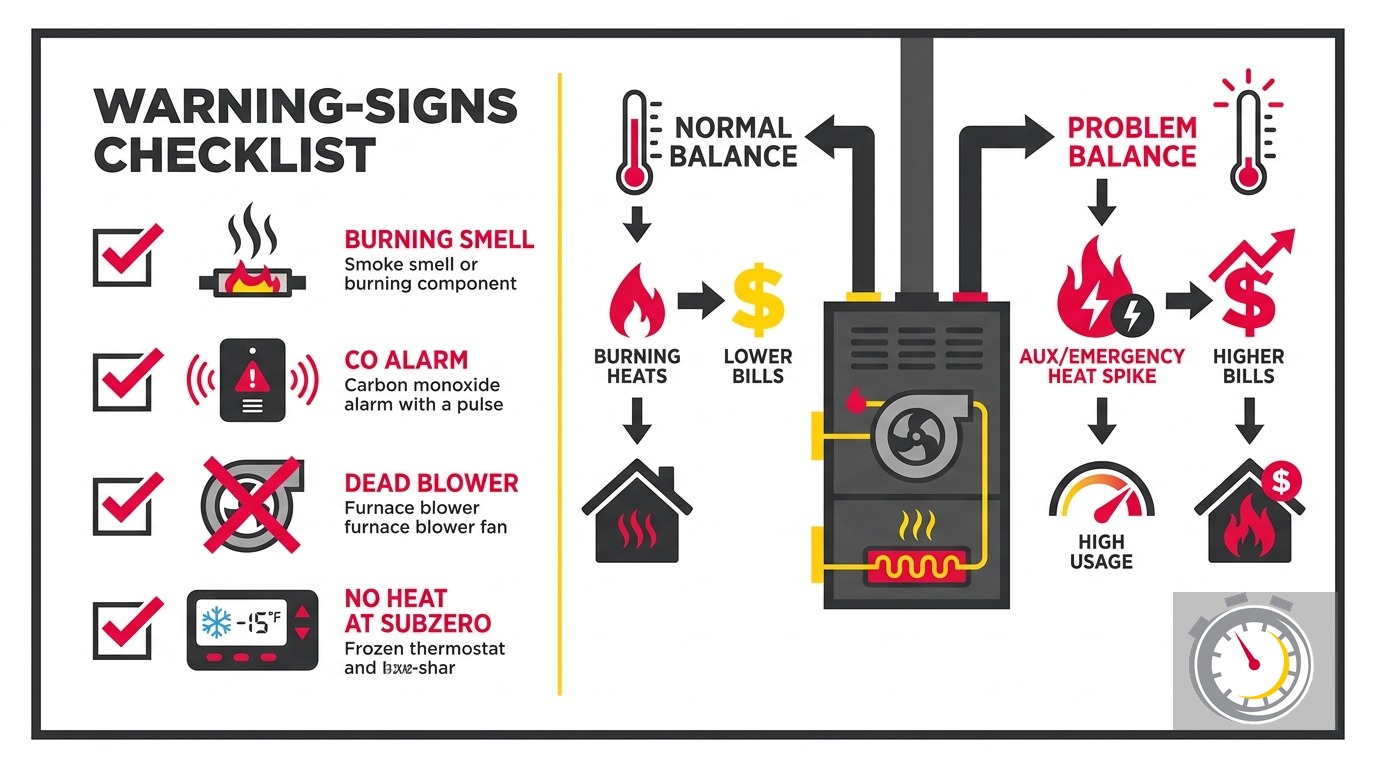
- Aux heat uses electric resistance strips. They deliver roughly one-third the heat output of your compressor per kilowatt-hour.
- Emergency heat bypasses the compressor entirely. Never leave it on unless the heat pump is broken.
- The balance point is the outdoor temperature where your heat pump needs backup help. It has two versions: a physics number (thermal) and a cost number (economic). Most technicians only set one.
- A lockout temperature set too high is the most common configuration error on heat pump systems. It forces aux heat to run at temperatures the heat pump could handle alone.
- Cold-climate heat pumps rated to -13°F should cover the large majority of your annual heating load without heavy aux heat use.
- Xcel Energy’s Electric Space Heating Rate lowers your per-kWh cost during heating season. Most homeowners who qualify have never enrolled.
Why Does Your Heat Pump Have a High Electric Bill in Winter?
Your heat pump ran all winter last year without issue. This year your bill spiked. What changed?
In most cases, auxiliary heat is running more than it should. Or someone accidentally left the thermostat in emergency heat mode. Both tap the same expensive source: electric resistance heating strips. Both show up on your utility bill within days.
The difference matters. One situation is a physics problem that is normal during hard cold snaps. The other is a configuration problem that a technician can correct in one visit.
This post explains both, introduces the concept of the balance point, and tells you exactly what to ask for when you call.
What Is Aux Heat, and Why Does It Cost So Much?
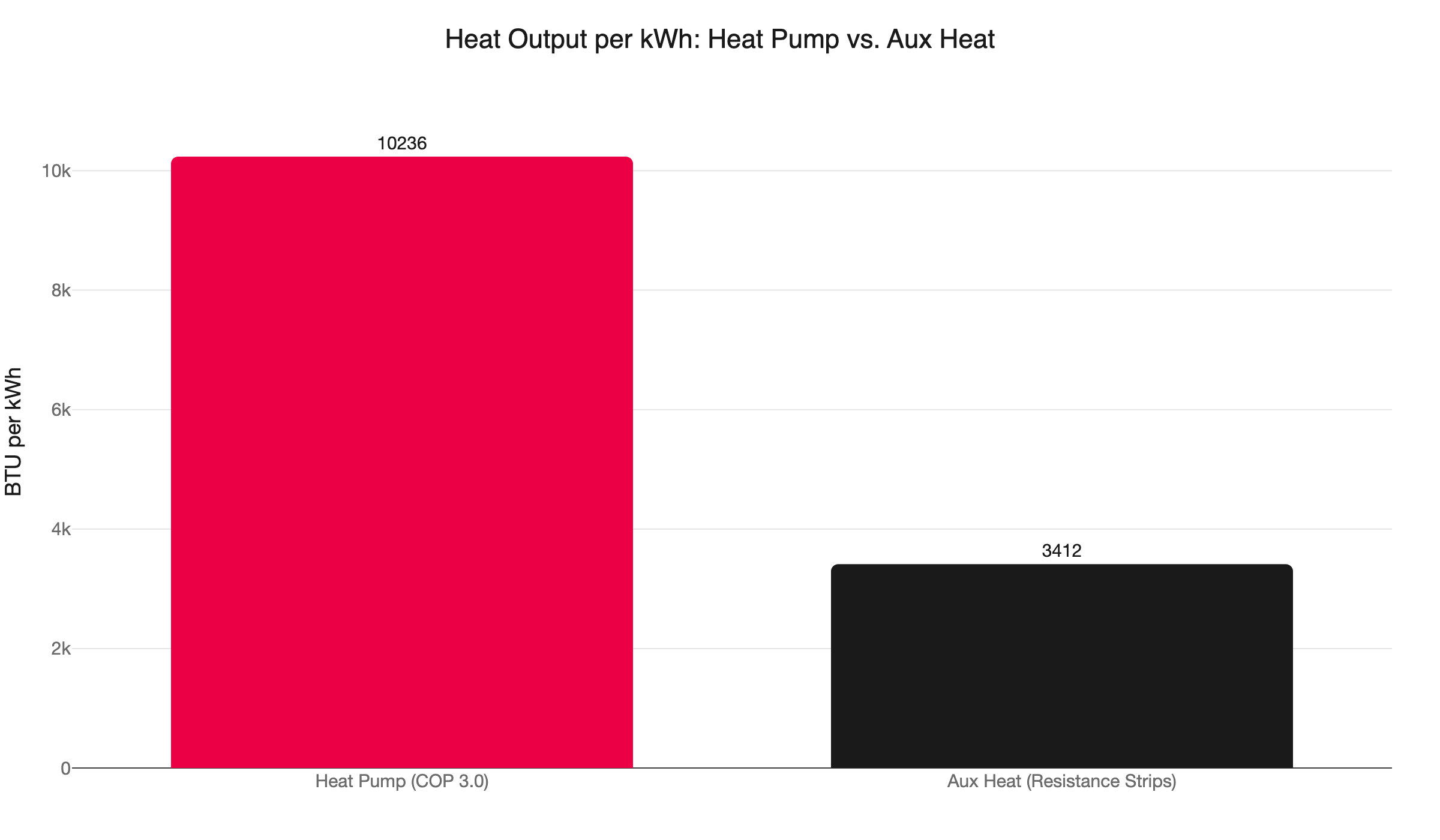
Quick answer: Aux heat is electric resistance backup heat. It draws two to three times more electricity than your heat pump compressor per unit of heat delivered. A heat pump at COP 3.0 produces roughly 10,200 BTU per kWh. Resistance strips produce only 3,412 BTU per kWh.
Here is the physics in plain terms. A heat pump does not burn fuel or run resistance coils to generate heat. It moves heat from outdoor air into your home. Even when it is 10 degrees outside, there is heat energy in that air. Your compressor extracts it and concentrates it inside.
That process is highly efficient. A heat pump operating at a coefficient of performance between 2.5 and 3.5 delivers between 8,530 and 11,940 BTU of heat per kilowatt-hour. A resistance strip delivers 3,412 BTU per kilowatt-hour. Same electricity in, one-third the heat out.
When aux heat runs, your system draws the same electricity but returns far less heat per dollar. Run it for several days through a cold snap and your bill climbs fast. Run it all winter because a setting is misconfigured and you have the mystery spike most homeowners cannot explain.
When Should Aux Heat Run?
Quick answer: Aux heat activating below 30 to 35 degrees Fahrenheit is normal. Below 20 degrees, expect it to run frequently and heavily. That is by design, not a malfunction.
Every heat pump has a thermal balance point. That is the outdoor temperature at which the compressor alone can no longer keep up with your home’s heat loss rate. Below that point, the system pulls in aux heat to fill the gap.
Aux activation below 30 degrees Fahrenheit is normal. Below 20 degrees, expect heavy aux heat use. In the Twin Cities, that means aux heat will run during cold nights. Minneapolis has a 99% design temperature of -10°F, meaning that is roughly as cold as 99% of winter hours ever get. A properly sized cold-climate heat pump is rated to deliver full capacity down to -13°F.
Cold-climate systems from brands like Mitsubishi Hyper Heat, Bosch IDS, and Carrier Greenspeed can operate rated capacity through a Twin Cities cold snap. Aux heat should supplement, not replace, the compressor. If your aux heat is doing the bulk of the work all winter, you have either an equipment problem or a configuration problem.
What Is the Balance Point, and Why Does It Have Two Versions?
Quick answer: The thermal balance point is the outdoor temperature where your heat pump can no longer cover your home’s heat loss on its own. The economic balance point is the temperature where switching to a gas furnace becomes cheaper than running the heat pump plus aux heat. They are not the same number, and confusing them is where bills go wrong.
The thermal balance point
Every home leaks heat at a rate that depends on insulation, windows, air sealing, and square footage. As outdoor temperatures drop, your heat pump works harder to replace what escapes. At some threshold, the compressor hits its output ceiling. That is the thermal balance point.
A tight, well-insulated Minneapolis home with a cold-climate heat pump can push its thermal balance point to near 0 degrees Fahrenheit, covering up to 90 percent of annual heating load before aux kicks in. A drafty older split-level might have a balance point at 20 degrees or even 30 degrees. The home’s envelope sets the number. Improving insulation and air sealing actually lowers your balance point, which means less aux heat use.
The economic balance point
For homes with a dual-fuel setup: a heat pump paired with a gas furnace, there is a second calculation. At some outdoor temperature, the gas furnace becomes cheaper to run than the heat pump plus aux heat, given your specific utility rates.
For Minnesota dual-fuel homes, the economic balance point is roughly 25 to 45 degrees Fahrenheit. That wide range reflects how much gas and electricity prices vary across utilities and regions. For natural gas customers, CEE modeling finds natural gas has the lowest lifetime operating cost when gas runs around $0.70 per therm and electricity around $0.13 per kWh. For all-electric homes or propane homes, the cold-climate heat pump wins on cost at nearly every temperature.
The key point: your thermostat’s lockout setting should match your economic balance point, not some default number a technician entered without doing the math. See our full breakdown on dual-fuel heat pump and gas furnace systems in Minnesota for the cost side of this calculation.
The Lockout Temperature: The Setting That Most People Don’t Know Exists
Your thermostat has a programmable parameter that tells the system: below this outdoor temperature, shut off the heat pump compressor and switch to aux heat or the gas furnace.
That is the lockout temperature. Set it correctly and it saves money. Set it too high and it is the single most expensive configuration mistake on a heat pump installation.
If your lockout is programmed at 40 or 45 degrees, the compressor shuts off at outdoor temperatures the heat pump could handle efficiently. Your system then runs resistance strips or a gas furnace in weather where the compressor could have delivered two to three times the output per dollar.
A lockout temperature set too high is the most common technician configuration error on heat pump systems. A well-configured system in Minnesota typically uses a 35-degree lockout or lower. Xcel Energy requires a switchover point at or below 35 degrees for its Electric Space Heating Rate, so if you are on that program, your setting should be correct. But if you bought the house used, switched HVAC companies, or had the thermostat replaced at some point, that parameter may have been reset to a default.
One service visit to check and correct that setting can eliminate a meaningful share of your winter electricity cost. It takes about five minutes to adjust once a technician is on site.
Normal vs. Problem: A Quick Reference
| Outdoor temp | What should happen | What signals a problem |
|---|---|---|
| Above 35°F | Heat pump only, no aux | Aux running here means lockout is set too high |
| 30-35°F | Heat pump primary, aux may supplement briefly | Aux running constantly in this range suggests a refrigerant or coil issue |
| 20-30°F | Aux supplements regularly | Heavy use is expected; compare your bill to the same period last year |
| Below 20°F | Aux runs heavily | Normal if the heat pump is still running; problem if only aux runs |
| Any temp | ”Em Heat” light is on | Switch off emergency heat immediately unless the compressor is confirmed broken |
What Is Emergency Heat, and When Should You Use It?
Quick answer: Emergency heat bypasses the heat pump compressor and runs only the electric resistance strips. Use it only when the heat pump is broken and you are waiting on a repair. Running emergency heat at normal outdoor temperatures will double or triple your electric bill within days.
Your thermostat has an emergency heat setting, usually labeled “Em Heat.” Most homeowners activate it at least once by accident. The name sounds like a cold-weather boost, not a breakdown bypass.
When you switch it on, your system behaves exactly like a purely resistance electric furnace. There is no compressor. There is no heat pump. Every dollar of electricity goes in at a 1:1 efficiency ratio. For a home that normally heats at a COP of 2.5 to 3.5, that is two to three times the electricity for the same heat output, starting the moment you make the switch.
Use it only when a technician has confirmed your compressor or refrigerant circuit has failed. Turn it off the moment the repair is complete.
For the full breakdown on this mode, see our guide on when to use heat pump emergency heat.
Is Your Aux Heat Running Too Much? Signs to Watch For
You do not need to be a technician to catch this problem early. Four signs point to aux heat running beyond what the system should need.
Your electric bill spiked compared to the same period last year. A colder-than-average winter can explain some increase. A 40 to 50 percent spike during a typical winter is worth investigating.
The “Aux” indicator lights up above 35 degrees Fahrenheit. Check your thermostat display on a routine 40-degree day. If aux is on, the lockout is almost certainly set too high.
Aux heat runs without cycling in the 20s and 30s. Some aux heat use in that range is normal. Constant, non-cycling aux heat in moderately cold weather suggests reduced heat pump output from a refrigerant issue, a dirty coil, or a failing component.
The outdoor unit has stopped running while the indoor unit still runs. A compressor that goes quiet while indoor heat continues means only the resistance strips are heating. That is either a tripped breaker, a refrigerant problem, or a compressor failure. All three need a technician.
For additional diagnostic steps, see our guide on heat pump balance point and backup heat in Minnesota.
How to Lower Your Heat Pump’s Winter Electric Bill
Five steps, in order of impact.
1. Have a technician verify your lockout temperature setting. This is the highest-impact change for most homeowners. A lockout at 45 degrees when it should be 30 degrees wastes electricity across weeks of moderate cold. Northern One Hour can check this setting on a standard service visit.
2. Enroll in Xcel Energy’s Electric Space Heating Rate. This is a free program that discounts all electricity from October through May for heat pump owners with a dual-fuel switchover point at or below 35 degrees. Call Xcel at 1-800-895-4999. Most homeowners who qualify have never heard of it and are paying the standard rate instead.
3. Ask your co-op about dual-fuel demand response rates. Most Minnesota electric cooperatives, Minnesota Power, and Otter Tail offer reduced electric rates in exchange for brief utility control of the heat pump during peak demand periods. The bill savings are real and the comfort impact is minimal. Worth a call to your electric provider.
4. Rule out an equipment problem. A low refrigerant charge, a dirty evaporator coil, or a failing reversing valve all reduce heat pump output and push the system into aux heat earlier than it should. If your system is struggling to reach setpoint during weather it handled well in prior years, schedule a diagnostic visit rather than adjusting the thermostat.
5. Check your thermostat mode before every heating season. If it reads “Em Heat,” switch it back to normal heat immediately. A single week of accidental emergency heat use can add hundreds of dollars to a monthly bill in a Minnesota winter.
Minnesota Programs That Can Offset the Cost
If you are considering upgrading to a cold-climate heat pump, or looking for ways to reduce the cost of running one you already have, several programs apply to Twin Cities homeowners.
City of Minneapolis: Up to $1,000 for all residents; up to $5,000 for Green Zone residents. Stackable with utility rebates.
City of Hopkins Climate Solutions Fund: Up to $1,500 for all residents; up to $2,500 for income-qualified households under $48,000 AGI.
Federal HEAR Rebate (new 2026, rolling out in Minnesota): Up to $8,000 for households under 80% AMI; up to $4,000 for households at 80 to 150% AMI. Equipment must be ENERGY STAR cold-climate rated. Details are at mn.gov/commerce/energy/consumer/energy-programs/hear.jsp.
The full current list of utility rebates and stacking guidance is at mnashp.org/incentives-rates-financing. For a guide tailored to what is available right now in the Twin Cities, see our Minnesota heat pump rebates and tax credits overview.
Get a Lockout Audit Before the Next Cold Snap
A heat pump’s high electric bill in winter is rarely a mystery once you know where to look. Most cases trace back to aux heat running at temperatures the heat pump could have handled on its own: because the lockout setting is off, a component is underperforming, or emergency heat was left on by accident.
None of those problems correct themselves. All of them are straightforward to diagnose.
Northern One Hour is locally owned and operated in Ramsey, serving homeowners across Minneapolis, St. Paul, Blaine, Maple Grove, Plymouth, Brooklyn Park, Woodbury, Bloomington, and the surrounding Twin Cities area. We show up when we say we will. “Always On Time… Or You Don’t Pay a Dime!(R).” And we tell you exactly what we find before any work begins.
Call (763) 260-6662 or book online to schedule a heat pump service visit. We will check your lockout setting, verify refrigerant charge, and give you a clear answer on what is driving your bill.
Frequently Asked Questions
Why is my heat pump causing a high electric bill in winter? +
What temperature should auxiliary heat turn on? +
What is the difference between aux heat and emergency heat? +
How do I lower my heat pump electric bill in winter? +
Need a technician now?