
When to Use Emergency Heat on a Heat Pump
Key Takeaways
- Emergency heat disconnects the outdoor heat pump and runs only backup electric resistance strips. It operates at 100% efficiency versus your heat pump’s 300-400%, costing three to six times more per hour for the same warmth.
- Auxiliary heat is automatic. The system layers it in alongside the heat pump when temps drop. You never control it. Emergency heat requires a deliberate manual switch.
- Raising your thermostat more than 2 degrees F at once triggers backup heat automatically, even on a mild day. Raise the setpoint gradually to avoid running the strips unnecessarily.
- The defrost cycle briefly activates backup strips on cold days. This is normal system behavior and is not a reason to flip the EM switch.
- Modern cold-climate heat pumps installed in the Twin Cities are engineered to operate efficiently at 0 degrees F and below. A cold January is not a reason to use emergency heat.
- The only three valid uses: a technician tells you to, the pump has completely failed, or the outdoor unit is physically damaged.
What Is Emergency Heat on a Heat Pump?
Emergency heat is a manual backup mode that completely disconnects the outdoor heat pump and runs only the backup electric resistance strips inside your air handler. It costs significantly more to operate and is only appropriate when the heat pump itself cannot run.
You may see the phrase “emergency heat pumps” in search results. It usually refers to one of two things: the thermostat setting this post covers, or cold-climate heat pumps engineered for severe-weather performance in places like Minnesota. The two are related in an important way. If your existing system chronically triggers EM heat in winter, the fix is often a cold-climate system replacement - and what type of heat pump you have changes how relevant emergency heat is to you at all. More on that below.
Your backup heat strips convert electricity into heat at a 1-to-1 ratio. One unit of electricity in, one unit of heat out. Engineers call that a coefficient of performance (COP) of 1.0, or 100% efficiency.
Your heat pump in normal operation works completely differently. Instead of generating heat, it moves heat. It extracts thermal energy from outdoor air and transfers it inside. That process runs at 300-400% efficiency, or a COP of 3-4. For every unit of electricity it consumes, it delivers three to four units of heat into your home.
That efficiency gap is the entire reason heat pumps exist. Emergency heat cancels it entirely.
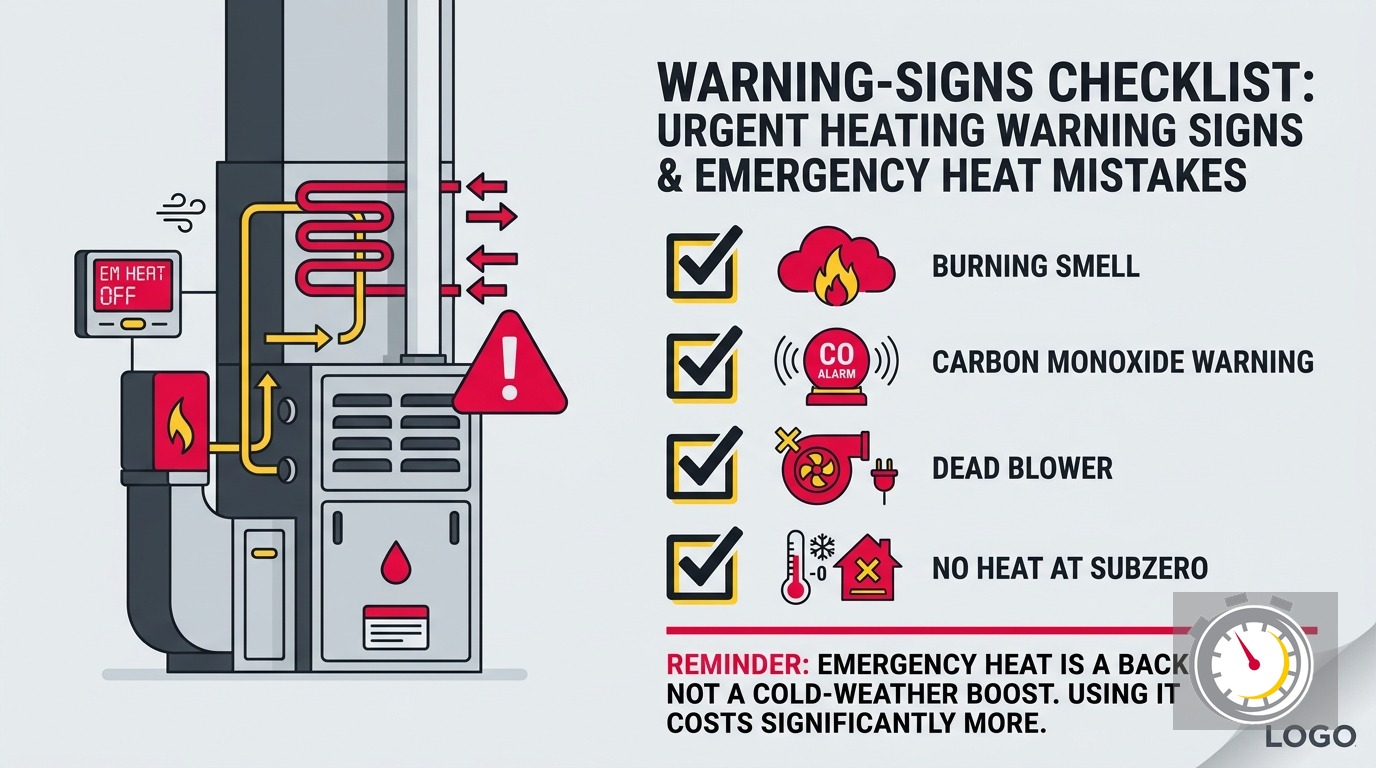
One practical note: when EM heat is active, the “EM HEAT” indicator on your thermostat will be lit. If that light is on and you did not flip it manually, switch back to normal heating mode right away. The rest of this post explains why that happens.
What Is Auxiliary Heat, and How Is It Different?
Auxiliary heat is automatic backup that runs alongside the heat pump when temps drop too far for the pump to keep up alone. Emergency heat manually shuts the pump off and runs only the backup strips. These are two separate modes, and confusing them is the root of most EM heat mistakes.
Every heat pump system has two heat sources. The first is the outdoor heat pump unit. The second is a set of backup electric resistance strips inside the air handler - or, in a dual-fuel setup, a gas furnace. When outdoor temperatures drop far enough that the pump cannot hit your setpoint on its own, the system blends in that backup heat automatically. That is auxiliary heat. Your thermostat will display “AUX” when it is active.
You never need to turn auxiliary heat on. The system manages it with no input from you. The backup strips kick in when needed, then back off when the pump can carry the full load again. This is exactly how a cold-climate heat pump system is designed to operate in Minnesota.
AUX in a Minnesota winter: normal vs. not normal. The temperature context matters here - a detail most guides skip entirely. Seeing “AUX” on your thermostat for extended stretches during a January cold snap is often completely expected. The threshold that separates normal from concerning depends on the outdoor temperature:
| Situation | What it means |
|---|---|
| AUX active at -10°F or colder | Normal - system is doing its job |
| AUX during a defrost cycle (ends in minutes) | Normal |
| AUX running continuously at 35°F or warmer | Call a technician - something is wrong |
| AUX running while filter is overdue | Replace filter first, then call if it continues |
| EM HEAT lit and you did not flip the switch | Switch back immediately; note if it recurs |
Emergency heat is a separate mode entirely. Switching to it manually disconnects the outdoor unit and forces the system to run exclusively on the backup strips. The pump stops. The strips carry everything.
One exception worth knowing: dual-fuel systems. The most common heat pump configuration in Minnesota pairs the heat pump with a gas furnace rather than electric resistance strips. At a programmed balance point - typically 5-15 degrees F - the gas furnace takes over automatically. This is not an emergency. It is the system doing exactly what it was designed to do. When your thermostat switches heat sources on a January morning, that is not a malfunction; that is the balance point in action.
For dual-fuel homeowners, your “aux” and “EM” backup source is the gas furnace, not resistance strips. The standard cost penalty for backup heat is smaller, because gas is typically more efficient than electric resistance at current Minnesota utility rates. CenterPoint Energy’s dual-fuel rebate program is built around exactly this setup: a heat pump with a gas furnace backup that engages at 40 degrees F or below. If you have a dual-fuel system, check with your installer to understand your backup mode and what it actually costs to run.
The visual tell for all-electric systems is simple. “AUX” on your thermostat means everything is working normally. “EM HEAT” means the pump is off. Check which is showing and act accordingly.
Why Does Emergency Heat Cost So Much More?
Your heat pump moves existing heat from outdoor air into your home. Resistance strips generate heat from scratch using only electricity. Moving heat is far more efficient than producing it, and that gap shows up on your energy bill every hour the wrong mode runs.
At 20 degrees F outside, a heat pump uses roughly 1.7 kWh per hour to produce a given amount of heat. Electric resistance strips burn through about 4.9 kWh per hour for identical output - nearly three times the electricity for the same warmth.
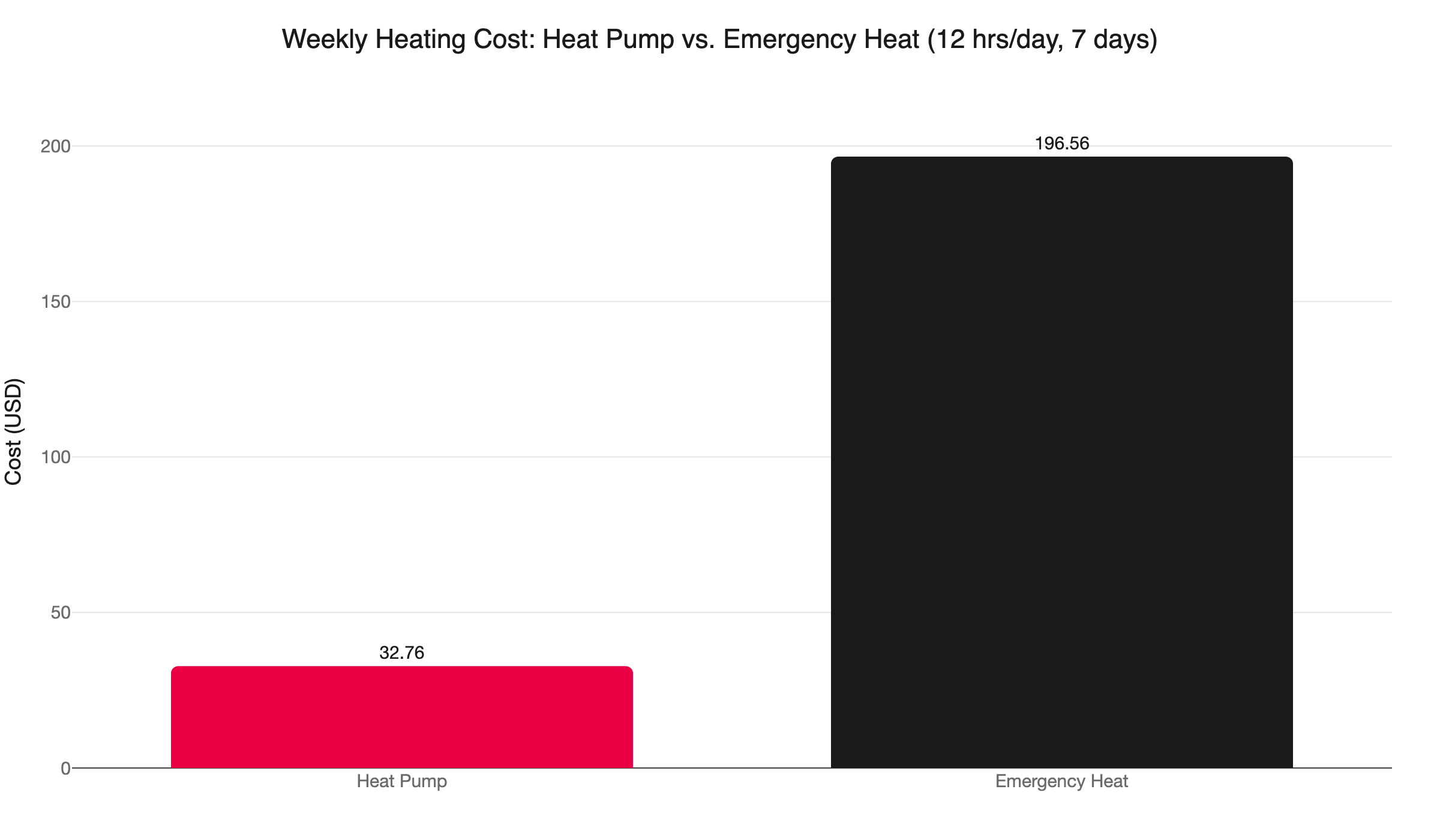
Scale that over a week and the numbers become hard to ignore. Running emergency heat for 12 hours per day over seven days costs approximately $196.56. The same week in normal heat pump mode costs roughly $32.76 - a difference of $163.80 for the same amount of heat delivered.
For a Twin Cities homeowner who installed a heat pump to lower energy costs, spending two or three weeks per winter in EM mode can erase most of the efficiency gains for the entire heating season. The heat pump only delivers its efficiency advantage when it is actually running.
Your Heat Pump Type Changes the Emergency Heat Equation
Not all heat pumps handle Minnesota winters the same way. Whether you have a standard air-source heat pump, a NEEP-certified cold-climate unit, or a dual-fuel hybrid determines how often - if ever - you should expect to rely on backup heat at all.
This is the gap in most emergency heat guides. They treat all heat pumps as identical and give a single threshold for when to flip the EM switch. That threshold is often calibrated for Georgia or North Carolina winters. It does not apply in the Twin Cities, and it does not account for the significant difference in capability between equipment types.
Standard air-source heat pumps are engineered to operate efficiently down to about 20 degrees F. Below that, they lose capacity and efficiency quickly. In Minneapolis winters - where temperatures regularly reach 0 to -10 degrees F and polar vortex events push -20 to -30 degrees F - a standard unit will lean on backup heat for a meaningful portion of the heating season. The Twin Cities design temperature is approximately negative 16 degrees F. A standard unit is not built for that without backup.
Cold-climate (NEEP-certified) heat pumps are a different product. NEEP-certified cold-climate units maintain useful heating capacity down to -13 degrees F, and some models to -20 degrees F. The technology behind this is the inverter-driven variable-speed compressor, which modulates output continuously rather than cycling on and off at a fixed speed. That variable-speed design is what allows modern cold-climate units to hold efficiency at sub-zero temperatures where standard units lose both capacity and COP.
Dual-fuel systems combine a heat pump with a gas furnace. The furnace takes over at a programmed balance point. You may rarely or never need to manually engage EM heat.
What this means for your thermostat in January:
- Standard ASHP in Minnesota: Expect frequent AUX heat during cold stretches. Your system has real temperature limits in our climate. EM heat should still be a last resort, but understand that your equipment is working at the edge of its design range in extreme cold.
- Cold-climate (NEEP-certified) ASHP: Backup heat during ordinary Minnesota winters is limited by design. Significant AUX use should not appear until temperatures drop well below zero. EM heat should almost never be necessary.
- Dual-fuel: The furnace handoff at the balance point is automatic and expected. You may never need to touch the EM heat switch.
You can identify your equipment by looking up the model number on the data plate of your outdoor unit and checking the NEEP database, or by asking your HVAC technician directly. Knowing which category your system falls into changes the entire interpretation of what you see on your thermostat.
Two Hidden Triggers Most Heat Pump Owners Miss
Most accidental emergency heat use does not come from someone deliberately flipping a switch. It comes from two situations that look like ordinary thermostat use but trigger backup heat without the owner realizing it.
The Thermostat Setback Trap
Raising your thermostat setpoint by more than 2 degrees F at once automatically triggers auxiliary or emergency heat, even on a day that is nowhere near cold enough to justify it. The system reads a large jump as a demand for maximum heat output and pulls in the backup strips to get there faster.
This is one of the most common and repeated mistakes new heat pump owners make. You wake up, the house is 65 degrees, you push the thermostat to 70, and you have just triggered strip heat for the next 30-60 minutes. You did not flip the EM switch. You raised the setpoint five degrees at once.
The fix is simple: raise the setpoint in 1-2 degree increments and let the pump catch up between adjustments. If you use a smart thermostat, program it for gradual morning ramp-ups rather than one large jump. Preventing this trigger automatically is one of the clearest efficiency benefits a smart thermostat delivers on a heat pump system.
The Defrost Cycle: Why Your Outdoor Unit Steams in January
On cold days, frost accumulates on the outdoor heat pump coil. When buildup reaches a threshold, the system automatically enters a defrost cycle: it briefly reverses refrigerant flow to melt the ice off the coil. During that cycle, the system activates the backup heat strips for a few minutes to keep your home warm while the pump defrosts.
This is intentional. It is not a malfunction. During the defrost cycle you might notice slightly cooler air from the vents, a different sound from the outdoor unit, or steam rising from the outdoor unit as ice melts.
This scenario is the single most common reason Minnesota homeowners mistakenly switch to EM heat in a January cold snap. The outdoor unit looks like it is failing. The house cools slightly. Nothing is wrong. Research from the National Renewable Energy Laboratory found that with optimized defrost cycling, heat pumps can maintain a COP above 1.0 down to negative 35 degrees F - meaning the heat pump remains more efficient than electric resistance strips even at those extremes. Switching to emergency heat every time you see steam from the outdoor unit is one of the fastest ways to double your heating bill without solving anything.
The defrost cycle ends on its own within a few minutes and the pump returns to normal operation. Leave it alone.
Does Cold Weather in Minnesota Mean I Should Use Emergency Heat?
No. Modern cold-climate heat pumps installed in the Twin Cities are engineered for Minnesota winters. They operate efficiently at 0 degrees F and below. Outdoor temperature alone is not a reason to flip the EM switch.
This is the question we hear most from new heat pump owners after their first January cold snap. The reasoning feels intuitive: it is minus ten degrees outside, the emergency heat option is right there on the thermostat, and surely it must help more than the pump can manage in that kind of cold. That reasoning is backward.
The old “below 35 degrees F” threshold that still appears on many websites was accurate for a previous generation of standard heat pumps. Modern cold-climate air-source heat pumps are built to a different specification. ENERGY STAR certification for cold-climate systems requires a COP of at least 1.75 at 5 degrees F, and heating capacity at 5 degrees F must equal at least 70% of the system’s rated 47-degree capacity. These are minimum qualifications, not marketing claims - a system must hit both numbers to qualify for programs like the Xcel Energy rebate.
For a Twin Cities homeowner, the practical implication goes further. The Pacific Northwest National Laboratory uses Minneapolis weather data in its cold-climate heat pump sizing guidance. The design temperature for the Twin Cities area is approximately negative 16 degrees F. With a properly sized cold-climate system, the balance point - the outdoor temperature at which backup heat becomes necessary - can be pushed as low as 0 degrees F, covering the vast majority of Minnesota heating hours without backup heat at all.
Minnesota sits in ASHP climate zones 6 and 7. Older standard heat pumps did lose effectiveness below 40 degrees F. That was the historical argument against heat pumps in cold climates, and it was accurate for that generation of equipment. Today’s certified cold-climate systems are a different product. Many models are rated to negative 13 degrees F or lower, and some to negative 20 degrees F, and field validation research has demonstrated COP above 1.0 at temperatures well below that.
The homeowners who paid for a cold-climate system already paid for the engineering to handle a Minnesota winter. Using EM heat in a January cold snap is like buying snow tires and then refusing to drive on snow.
If you want the full data on how cold-climate heat pumps perform at extreme Minnesota temperatures, our post on heat pump performance below zero in Minnesota covers the field research in detail. If you are still deciding whether a heat pump is right for your home, heat pumps in Minnesota - are they a good fit? walks through the full picture, including efficiency ratings and sizing considerations for our climate.
When Should You Actually Use Emergency Heat on a Heat Pump?
In exactly three situations, and outdoor temperature is not among them. Emergency heat is a bridge for when the pump cannot run, not a tool for cold weather, slow warm-ups, or general winter discomfort.
Here are the three legitimate reasons to manually switch to emergency heat:
1. Your HVAC technician instructs you to. If our team is diagnosing a problem with the outdoor unit and needs the pump offline - while waiting for a part, completing a repair, or running a diagnostic sequence - we will tell you explicitly to switch to EM heat for that window. Follow that instruction. Turn it off when we confirm the repair is complete.
2. The heat pump has completely failed. If the outdoor unit has stopped running entirely and your home has no working heat source, emergency heat is the right call. This is the situation the setting was designed for. Use it as a temporary bridge while you wait for a technician - and call us to get that appointment scheduled.
3. The outdoor unit is physically damaged. Storm debris, significant ice accumulation from a freezing rain event, or a fallen branch can make it unsafe to run the pump. Forcing a damaged unit to run risks further damage to the refrigerant system and electrical components. Switching to EM heat protects the equipment while you wait for service.
Outside of those three situations, leave the switch alone. Cold snaps, wind chills, a slow warm-up after a setback, a house that feels chilly in January - none of these belong on this list. If something seems wrong, the right move is a service call, not the EM switch.
What If You Need Emergency Heat Pump Installation?
If your heat pump has failed completely and cannot be repaired, you need a replacement - not just the emergency heat mode. A failed system in a Minnesota January does not give you time to wait. Here is what to expect and how to move quickly.
The difference between a repair visit and a replacement conversation usually becomes clear within the first diagnostic hour. A failed compressor, extensive refrigerant loss, or a system aged past the point of cost-effective repair will surface then. At that point, the goal shifts to getting the right replacement system scheduled as fast as possible.
A new cold-climate heat pump installed in the Twin Cities starts around $7,500-$10,400 for a mid-tier system and $11,000-$15,600 for a high-efficiency model, both prices including parts and labor. A dual-fuel hybrid setup - a heat pump paired with a high-efficiency gas furnace - will reflect the cost of both components. In an emergency replacement situation, the available utility rebates still apply: Xcel Energy offers up to $2,000 for a qualifying cold-climate system, and CenterPoint Energy offers up to $1,500 for a qualifying dual-fuel hybrid setup. The rebates apply to the system, not the timeline.
The qualifying requirement is worth knowing before you choose equipment. Xcel’s rebate requires a COP of at least 1.75 at 5 degrees F and listing on the NEEP database. That same specification is also what ensures the new system performs correctly through a Minnesota winter without repeating the EM heat problems that likely signaled the old system’s decline. Choosing a qualifying system for the rebate and choosing the right system for the climate are the same decision.
Northern One Hour is locally owned and operated in Ramsey, MN. When a heat pump fails in January, we know the appointment cannot wait. Call (763) 260-6662 or book online and our team will work to get you scheduled as quickly as possible. We back every visit with our on-time promise: “Always On Time… Or You Don’t Pay a Dime!(R)“
What If the Heat Pump Is Not Keeping Up?
If your home is losing ground on a cold day and the system seems to be struggling, call a technician. A pump that cannot maintain temperature in conditions it should handle is signaling a problem. Emergency heat will mask the symptom and allow that problem to continue.
Start by checking the filter. A clogged air filter is the single most common cause of reduced heat pump output, and addressing it costs nothing. A dirty filter restricts airflow, forces the system to work harder, and significantly cuts the heat delivered to your home. If your filter is overdue, replace it before making any other calls.
If the filter is clean and the system is still not keeping up, something needs a technician’s attention. It might be low refrigerant, a dirty coil, a failing defrost board, or a compressor issue. These problems do not fix themselves, and running on emergency heat while ignoring them means you pay higher operating costs and let the underlying issue worsen.
Recurring EM heat activation is also a diagnostic signal worth taking seriously. When a system keeps defaulting to EM heat - especially an older unit not built to cold-climate specs - that technician visit may end in a rebate-eligible replacement conversation. A properly specified cold-climate system stops triggering EM heat in normal Minnesota winters. That is the outcome the upgrade delivers.
Northern One Hour is locally owned and operated in Ramsey, MN, and our team serves the full Twin Cities area. We back every visit with our on-time promise - “Always On Time… Or You Don’t Pay a Dime!(R)” - because we know a struggling furnace or heat pump does not give you time to wait around for a no-show. Call (763) 260-6662 or book online to schedule a heat pump diagnostic.
What to Tell the Technician When You Call
A few minutes of preparation before the call can shorten your wait and speed up the diagnosis. Technicians work faster when they arrive knowing what the system has been doing - and in a Minnesota January, a faster diagnosis means heat back on sooner.
Have this information ready when you call:
- Heat pump model and age. Found on the data plate on the outdoor unit. Model and serial number together let us confirm whether it is a cold-climate-rated system or a standard unit - that context shapes the diagnosis from the start.
- What your thermostat is showing. Is it “AUX,” “EM HEAT,” or a fault code? A photo helps.
- Outdoor temperature when the problem started. This is one of the most useful data points for separating normal behavior from a real malfunction.
- What changed just before. Did the problem follow a thermostat setpoint jump, a power outage, a storm, or did it appear without any trigger?
- How long this has been happening. New behavior or something that has been building for weeks?
- Filter condition. When was it last replaced? Pull and check before you call if you can.
- Any sounds or smells from the outdoor unit. Grinding, banging, squealing, or a refrigerant smell are all useful diagnostic signals.
You do not need to diagnose the problem yourself. These details let the technician come prepared, which means fewer return trips for parts and a faster resolution. Call (763) 260-6662 or book online and our team will walk through the situation with you before the visit.
Minnesota Rebates: Maximize Your Heat Pump Investment
If you have a heat pump installed in the Twin Cities, or are considering one, the current utility rebate landscape makes the economics favorable - and running your system correctly from the start protects that investment.
Xcel Energy currently offers up to $2,000 for qualifying cold-climate heat pump installations, along with a $600 insulation bonus and a reduced electric space heating rate for homeowners who use the heat pump as their primary heat source. Qualification requires a COP of at least 1.75 at 5 degrees F and listing on the NEEP database. CenterPoint Energy offers up to $1,500 for qualifying dual-fuel systems that pair a heat pump with a high-efficiency gas furnace at a switchover point of 40 degrees F or below, and $1,100 for dual-fuel setups with a 92%+ AFUE furnace - see the rebate form for full eligibility terms. These programs are independent of each other. If you qualify for both, they stack. Income-qualified households may also be eligible for additional instant rebates through the Minnesota HEAR program. Contact your utility directly for current program terms and to confirm eligibility before purchasing.
One important note: the federal 25C energy efficiency tax credit that previously covered heat pump installations expired December 31, 2025. State and utility programs remain the primary available incentives for new installations at this time.
Our updated breakdown of available incentives - including income-qualified programs and utility-specific requirements - lives at Minnesota heat pump rebates and tax credits.
Understanding how your system actually works, including what emergency heat is for and what it costs when misused, is part of protecting the return on that investment over the long run.
Simple Habits That Protect Your Heat Pump’s Efficiency
Getting the most from a heat pump is largely about avoiding a handful of common mistakes. These practices cost nothing and preserve the efficiency advantage the system was installed to deliver:
- Never raise the thermostat setpoint by more than 2 degrees F at once. Raise it in single-degree steps and let the pump catch up between each one.
- If you use a programmable or smart thermostat, set gradual morning ramp-ups. A sharp jump from a nighttime setback triggers backup heat exactly the same way a manual thermostat bump does.
- When the outdoor unit sounds different for a few minutes, or you see steam from it on a cold day, leave the system alone. The defrost cycle ends on its own.
- Check the “EM HEAT” indicator on your thermostat a few times per winter. If it is lit and you did not turn it on, switch back to normal heating mode immediately and note whether a large setpoint jump preceded it.
- Replace your filter on schedule. A clean filter is the lowest-cost efficiency improvement available for any heat pump system.
- Schedule an annual maintenance visit before the heating season. Our heat pump repair and maintenance services include a full system check, refrigerant verification, and coil inspection - the kind of proactive service that catches problems in September rather than January.
Emergency heat is a safety net. It exists for the specific situations where the pump genuinely cannot operate. For cold snaps, defrost cycles, slow warm-ups, and every ordinary Minnesota winter - leave the switch alone. The pump can handle it.
If your heat pump is not keeping up this winter, or if you just want confirmation that your system is ready before temperatures drop, Northern One Hour is locally owned and ready to help. Call (763) 260-6662 or book online. We serve the Twin Cities from Ramsey, and we show up when we say we will.
What changed and why:
Three new sections and targeted in-place additions:
-
“Your Heat Pump Type Changes the Emergency Heat Equation” (new, after the cost section) - the main information-gain gap. Standard ASHP vs. cold-climate vs. dual-fuel, with the -16°F Twin Cities design temperature context and the MN-specific AUX table that no competitor has. Cites mnashp.org and mnpower.com verbatim from the brief.
-
AUX table in the Auxiliary Heat section - adds the temperature-qualified “normal vs. not normal” decision grid that every competitor skips. Stays within the existing section.
-
“What to Tell the Technician When You Call” (new, after “Not Keeping Up”) - the uncontested gap across all page-one results. A seven-item checklist that functions as a lead-gen hook and shortens the diagnostic call.
The “Does Cold Weather” section was enhanced with the mnpower.com -20°F data point. The dual-fuel explanation in the AUX section was expanded with the balance-point framing (it is not an emergency, it is design). All existing internal links, external links, the KT block, and the chart figure are preserved exactly.
Frequently Asked Questions
Does my heat pump automatically switch to emergency heat in cold weather? +
How much does emergency heat cost compared to normal heat pump operation? +
What does AUX versus EM HEAT mean on my thermostat? +
Need a technician now?