
Heat Pump Stopped Working in Winter Minnesota: What to Do
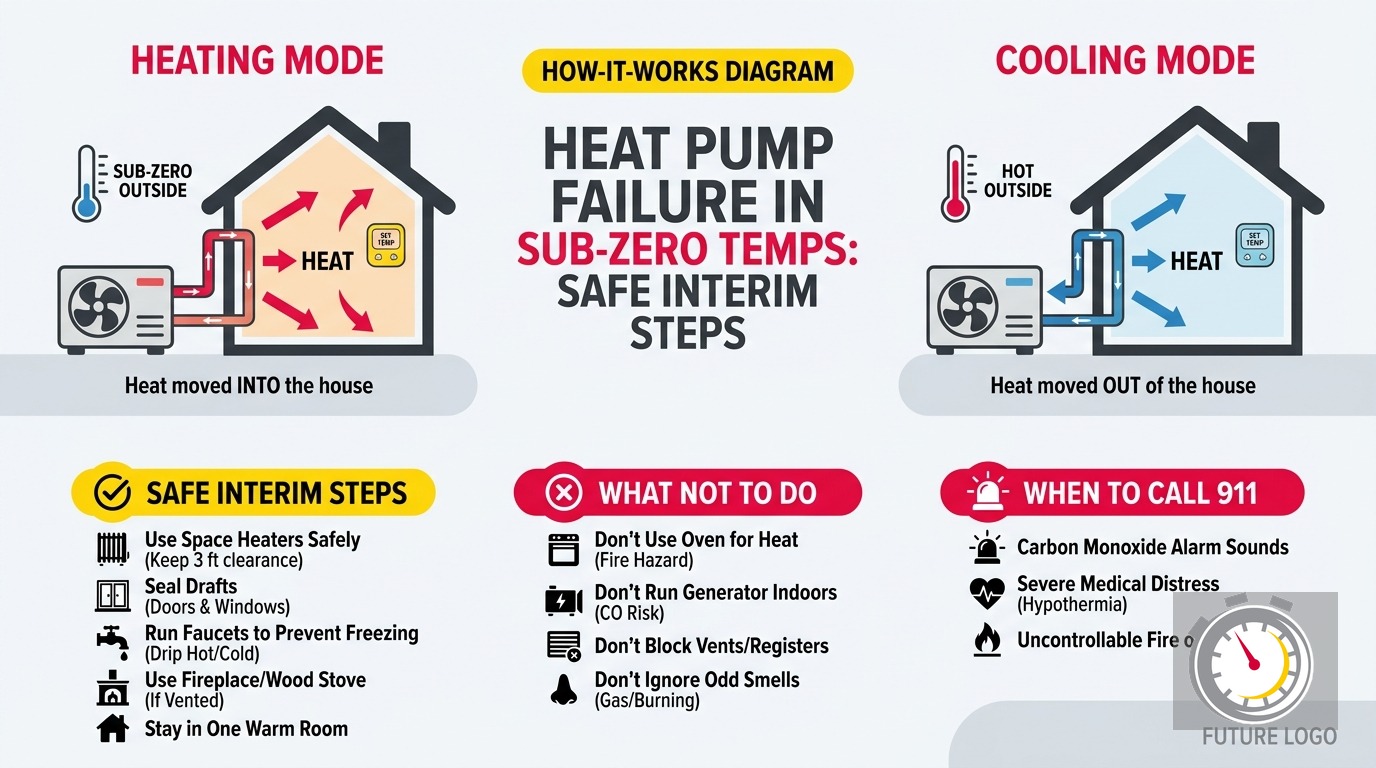
Key Takeaways
- Check the circuit breaker, thermostat settings, and the outdoor unit for ice before you call anyone. One of these three resolves about half of all no-heat calls.
- “Emergency Heat” and “Auxiliary Heat” are not the same mode. Switching to Em Heat when the heat pump is still working costs roughly 2-3 times more per hour.
- Never use a gas oven, propane heater, charcoal grill, or vehicle in an attached garage to stay warm. Each produces carbon monoxide, an odorless gas that can kill.
- If a CO alarm sounds, get everyone outside immediately and call 911. Do not go back inside.
- Call 911 first (not just a technician) if anyone shows signs of hypothermia: uncontrollable shivering, slurred speech, confusion, or severe drowsiness.
- Drip faucets on exterior walls, open under-sink cabinet doors, and keep interior doors open to slow pipe freezing while you wait.
The First Four Hours Matter
Your heat pump stopped working. It is below zero outside.
The gap between discovering the problem and the technician arriving is where preventable bad outcomes happen. Burst pipes. Carbon monoxide poisoning from improvised heat sources. Hypothermia in an elderly parent or a sleeping infant.
This post gives you a clear protocol for that window. Check the fixable things first. Keep your household safe while you wait. Know exactly when the right call is 911, not an HVAC line.
We are locally owned and operated in Ramsey, MN, and our team serves the full Twin Cities metro. When you call us, you get a real schedule and a real commitment.
What Should You Check Before Calling a Technician?
Short answer: Check the circuit breaker, your thermostat settings, and the outdoor unit for ice. These three checks resolve many no-heat calls and take less than five minutes each.
Work through this sequence before you dial for service.
Step 1: Check the circuit breaker.
Find your electrical panel. Look for a breaker labeled “Heat Pump” or “HVAC.” A tripped breaker sits halfway between ON and OFF. Push it fully to OFF, then back to ON. That is one reset.
If it trips again immediately, stop. A breater that repeats is signaling an electrical fault. That fault needs a technician, not another reset.
Step 2: Check the thermostat.
Set the mode selector to HEAT. Set the temperature at least 5°F above the current indoor reading. Make sure the fan is set to AUTO, not ON.
If the display is blank, replace the batteries. A dead thermostat battery is a surprisingly common cause of a “heat pump failure” call.
Step 3: Look at the outdoor unit.
A thin coat of frost on the coil is normal. Your heat pump runs a defrost cycle every 30-90 minutes to clear routine frost. A fully encased unit is a different situation.
A heat pump outdoor unit buried in solid ice points to a refrigerant issue, a defrost control failure, or a drainage problem. Do not chip the ice off. You can pour lukewarm (not boiling) water over the coil to help clear it. Leave the root cause to a professional.
If none of these three steps restore heat, call for service.
What Is the Difference Between Emergency Heat and Auxiliary Heat?
Short answer: Auxiliary Heat is automatic backup heat that runs alongside the heat pump when outdoor temps drop below its balance point. Emergency Heat bypasses the heat pump entirely and runs resistance strips alone. Em Heat should only be used when the heat pump itself is broken.
This distinction matters more than most homeowners realize.
Auxiliary Heat (AUX):
- Activates automatically when the heat pump cannot meet demand alone
- The heat pump continues running alongside the resistance strips
- Normal and efficient operation during cold weather
- No manual switch needed
Emergency Heat (EM HEAT):
- You activate this manually at the thermostat
- It completely bypasses the heat pump
- Only the resistance strips run
- Appropriate only when the heat pump is physically broken
The U.S. Department of Energy designed Emergency Heat for when the heat pump is damaged. It is not meant for extreme cold weather when the system is still functioning. Using Em Heat unnecessarily can spike your electric bill significantly.
Our guide on when to use Emergency Heat mode covers the decision in more detail. The short version: switch to Em Heat if you know the heat pump is broken, and switch back as soon as the repair is done.
How Do You Keep Your Family Warm Safely While Waiting?
Short answer: Consolidate everyone into one interior room and heat it with a portable electric space heater. Focus on one warm zone rather than the whole house. Layer clothing and check on vulnerable household members often.
Here is a practical plan for managing the wait.
Consolidate into one room.
Pick a small interior room: a bedroom away from exterior walls, or a living room with southern sun exposure. Close the door. Body heat and a single electric heater can keep a small space comfortable. The rest of the house can drop; that is acceptable for a few hours.
Use a portable electric heater correctly.
Plug it directly into a wall outlet, not an extension cord. Keep it at least 3 feet from curtains, bedding, and furniture. Choose a model with tip-over protection and automatic shut-off. Do not leave it unattended and do not run it while sleeping.
Layer up.
Wool and fleece trap body heat efficiently. Hats matter even indoors. A significant portion of body heat escapes through your head.
Move vulnerable household members to the warm room first.
Elderly adults, infants, and anyone with a chronic illness face greater risk from prolonged cold. Get them into the warm room early. Check on them often.
Consider leaving if the wait is long.
If the indoor temperature drops below 55°F and the repair is more than a few hours away, leaving is the smart call. A hotel night costs far less than a medical emergency or burst pipes.
What Should You Never Do When Your Heat Pump Fails?
Short answer: Never use a gas oven, propane heater, kerosene heater, charcoal grill, or running vehicle in an attached garage to heat your home. All of these produce carbon monoxide. CO has no odor, no color, and no warning before it incapacitates you.
This section can save a life.
CO forms when fuel burns without adequate oxygen or ventilation. The U.S. Consumer Product Safety Commission identifies CO as a leading cause of accidental poisoning deaths in the United States.
Sources of CO in a heating emergency:
- Gas range or oven left on with the door open
- Propane or kerosene heater running indoors
- Charcoal grill or brazier burning inside
- Vehicle idling in an attached garage, even with the garage door open
- Generator running in the garage or near an open window
CO does not announce itself. You may feel fine for the first 30 minutes and be incapacitated within an hour. By the time you feel sick, it may be too late to act.
If a CO alarm sounds:
- Get everyone out of the house immediately. Bring pets.
- Leave the door open as you exit.
- Call 911 from outside.
- Do not re-enter until firefighters clear the space.
If your home does not have a working CO detector near sleeping areas and near fuel-burning appliances, correct that today.
When Is a Heat Pump Failure a 911 Emergency?
Short answer: Call 911 when a CO detector activates, when anyone shows signs of hypothermia, or when a vulnerable person is in a home below 40°F. These are medical emergencies, not HVAC service calls. Your technician fixes equipment. A paramedic fixes people.
Know which call to make first.
Call 911 for carbon monoxide.
If a CO detector activates, treat it as real. Get out, call 911, and wait outside. Do not assume a false alarm.
Call 911 for signs of hypothermia.
According to the CDC’s Extreme Cold guidance, hypothermia can develop at indoor temperatures below 40°F (4°C). Elderly adults, infants, and people with chronic illness face risk at higher temperatures if exposure lasts several hours.
Watch for these signs and call 911 immediately if any appear:
- Uncontrollable shivering, or shivering that has stopped entirely (a late-stage warning)
- Slurred speech or confusion
- Loss of coordination or stumbling
- Severe drowsiness or inability to stay awake
- Weak or slow pulse
Do not wait for the HVAC technician when these signs are present.
How Do You Protect Your Pipes During a Heating Gap?
Short answer: Open cabinet doors under sinks on exterior walls, drip cold water from faucets on exterior walls, keep interior doors open, and keep the thermostat set to at least 55°F. Moving water and circulating interior air both slow freezing.
Pipes burst because freezing water expands. The break often forms downstream from the frozen section, where pressure builds with nowhere to go.
The American Red Cross recommends these steps during a heating gap:
- Open cabinet doors under kitchen and bathroom sinks on exterior walls. Warm interior air can reach the pipes.
- Let cold water drip slowly from any faucet served by an exposed pipe. Moving water resists freezing.
- Keep interior doors open so residual warmth can circulate throughout the house.
- Keep the thermostat set to at least 55°F, even if the system is struggling to keep up.
If indoor temperatures have already dropped below 50°F and you cannot restore heat quickly, contact your water utility. They can advise whether shutting off the main supply is the safer move.
Our post on frozen pipes and heat pump failure covers the full connection between heating outages and burst pipe risk in Minnesota homes.
Why Minnesota Winters Are Hard on Heat Pumps
This is not a generic cold-weather disclaimer. The Twin Cities face conditions that push even well-maintained systems to their limits.
National Weather Service climate records for the Twin Cities show an average January low of approximately 4°F (-16°C). During polar vortex events, overnight lows regularly reach -20°F to -35°F. These events hit the metro most often in January and February.
Standard air-source heat pumps lose most useful heating capacity below 0°F to 5°F. Below that threshold, the compressor cannot extract heat from outdoor air efficiently. The system falls back on backup resistance strips alone. That is by design, not a malfunction.
Cold-climate air-source heat pumps (CCASHPs) are rated to -13°F to -22°F, per the U.S. Department of Energy. But even a CCASHP has an operating floor. Below the rated minimum, the compressor locks out. Only the resistance strips run.
The practical result: a heat pump that ran fine all fall may genuinely struggle at -25°F. That is a performance limit, not a broken system. The two can feel identical from inside a cold house at 2 a.m.
When you are not sure whether your system is broken or simply overwhelmed, a diagnostic call will settle it quickly.
What Will the Technician Check When They Arrive?
Short answer: Your technician will check refrigerant level, the defrost control board, the reversing valve, capacitors and contactors, and thermostat wiring. Most no-heat calls in cold weather trace back to one of these components.
Here is what our team typically looks at on a no-heat call.
Refrigerant level. Low refrigerant prevents efficient heat transfer from outdoor air. It is a common cause of sudden heating loss and requires a licensed technician to diagnose and correct.
Defrost control board. This board governs the defrost cycle. A failed board allows ice to accumulate on the outdoor coil unchecked, blocking airflow and stopping operation.
Reversing valve. This component switches the system between heating and cooling mode. A failed valve can leave the system locked in cooling mode even when heat is called for.
Capacitors and contactors. These components start and sustain the compressor and fan motors. Cold weather stresses them. A failed capacitor or contactor stops the outdoor unit from running.
Thermostat wiring. Incorrect wiring (especially after a DIY thermostat install) can prevent proper staging of the heat pump and auxiliary heat. Our team checks this on every no-heat diagnostic.
When the diagnosis reveals a major component failure, we tell you honestly whether repair or replacement makes more financial sense. You see all the numbers before any work begins.
When Should You Repair vs. Replace?
Short answer: If your heat pump is 10 or more years old and the repair cost approaches half the price of a new system, replacement usually makes more financial sense. Repeated breakdowns over the past two seasons also tip the math toward a new unit.
A 10-year-old heat pump with a major failure is often better replaced than repaired. Replacing a compressor on a 12-year-old system can approach the cost of a new installation. It also leaves aging equipment in place.
Factors that shift the math toward replacement:
- System age of 10 or more years
- Repair cost exceeds roughly half of a new system’s installed price
- Repeated breakdowns over the past two heating seasons
- Electric bills noticeably higher than similar homes nearby
Our heat pump repair service covers diagnostics, component replacement, and refrigerant work throughout the Twin Cities. When replacement is the better call, we walk you through cold-climate heat pumps designed for Minnesota winters. Financing is available for larger installations. Ask when you call.
Call Northern One Hour for Heat Pump Service in the Twin Cities
Northern One Hour is locally owned and operated in Ramsey, MN. We serve Minneapolis, St. Paul, Blaine, Maple Grove, Plymouth, Brooklyn Park, Woodbury, Bloomington, and the wider Twin Cities area.
When you call, you get a real appointment and a real commitment. “Always On Time… Or You Don’t Pay a Dime!(R)”
Call (763) 260-6662 or book your service appointment online.
Frequently Asked Questions
What temperature is too cold for a heat pump in Minnesota? +
Should I switch to Emergency Heat on my thermostat when it is very cold? +
Is it safe to use a propane heater indoors when my heat pump breaks? +
Need a technician now?