
Frozen Pipes Heating Failure Minnesota: What Freezes First
Key Takeaways
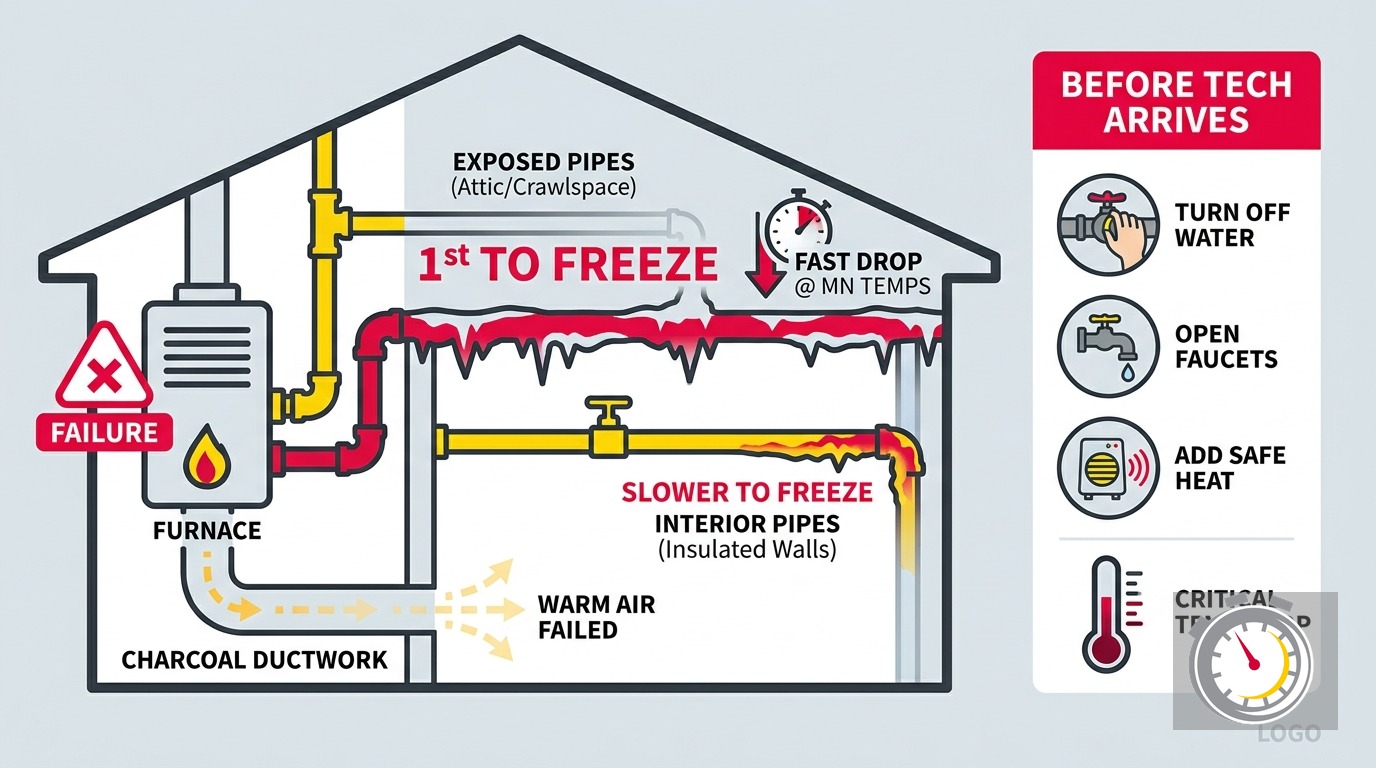
- Pipes do not freeze at 32°F. The real danger threshold is 20°F measured at the pipe, not the thermostat.
- After a furnace dies, attic pipes can freeze in as little as 2 to 3 hours during a Minnesota cold snap.
- Crawl space and basement pipes follow in 6 to 10 hours. Central interior pipes are last, at 12 hours or more.
- Uninsulated copper pipe in a drafty space freezes in 4 to 6 hours at 25°F. Wind cuts that to 2 to 3 hours.
- PEX is more forgiving than copper but is not freeze-proof. The fittings are the weak point.
- Five steps can buy you critical hours: drip every faucet, open cabinet doors, concentrate residual heat, locate your main shutoff, and never use combustion appliances indoors for warmth.
- Minnesota has emergency assistance programs that can cover furnace repair costs for qualifying households.
- Average burst pipe claims exceed $27,000. Getting the heat back on fast is always the cheaper outcome.
When Heating Fails: Your Frozen Pipe Clock
It is 9 p.m. in January. Your furnace just stopped. Outside it is 8 degrees and dropping.
The question is not whether frozen pipes from heating failure are a risk in Minnesota. The question is which ones freeze first and how much time you have.
In a well-insulated Twin Cities home, you likely have 24 hours or more before the most exposed pipes reach the danger zone. In a drafty older home or during a polar event, that window can shrink to 6 hours or less. Poor insulation plus extreme cold compress the timeline faster than most homeowners expect.
The Twin Cities averages 10 days per January at or below zero degrees Fahrenheit, with an average January low of 4°F. On those nights, this is not a situation you sleep on.
Northern One Hour Heating & Air Conditioning is locally owned and operated in Ramsey, MN. We serve the Twin Cities metro and back every call with our “Always On Time… Or You Don’t Pay a Dime!(R)” guarantee. Call (763) 260-6662 the moment the heat goes out. Do not wait for morning.
What Temperature Do Pipes Actually Freeze?
Short answer: The danger zone is not 32°F but approximately 20°F at the pipe. Your building envelope traps residual heat that keeps interior pipes above freezing long after outdoor temps drop below 32°F. Once the furnace fails, that buffer starts disappearing immediately.
Most homeowners assume a freeze starts the moment outdoor temperatures cross the 32°F mark. That is not how it works. Pipes become vulnerable when the ambient temperature around the pipe reaches about 20°F, not when the outdoor thermometer does. A pipe running through a conditioned wall is insulated by the structure around it. A pipe in an unheated attic or a drafty garage cavity is exposed to something much closer to outdoor air.
The distinction matters for timing. Once your furnace goes out, indoor temperatures begin falling. How fast depends on insulation quality, outdoor temperature, and wind. An uninsulated attic in a Minneapolis home during a polar vortex can drop below 20°F within an hour of the furnace shutting down. A finished basement with insulated walls may not reach that threshold for many hours.
Knowing the 20°F threshold - not 32°F - is what tells you which locations in your home are on a short clock.
Which Pipes Freeze First When Heating Fails in Minnesota?
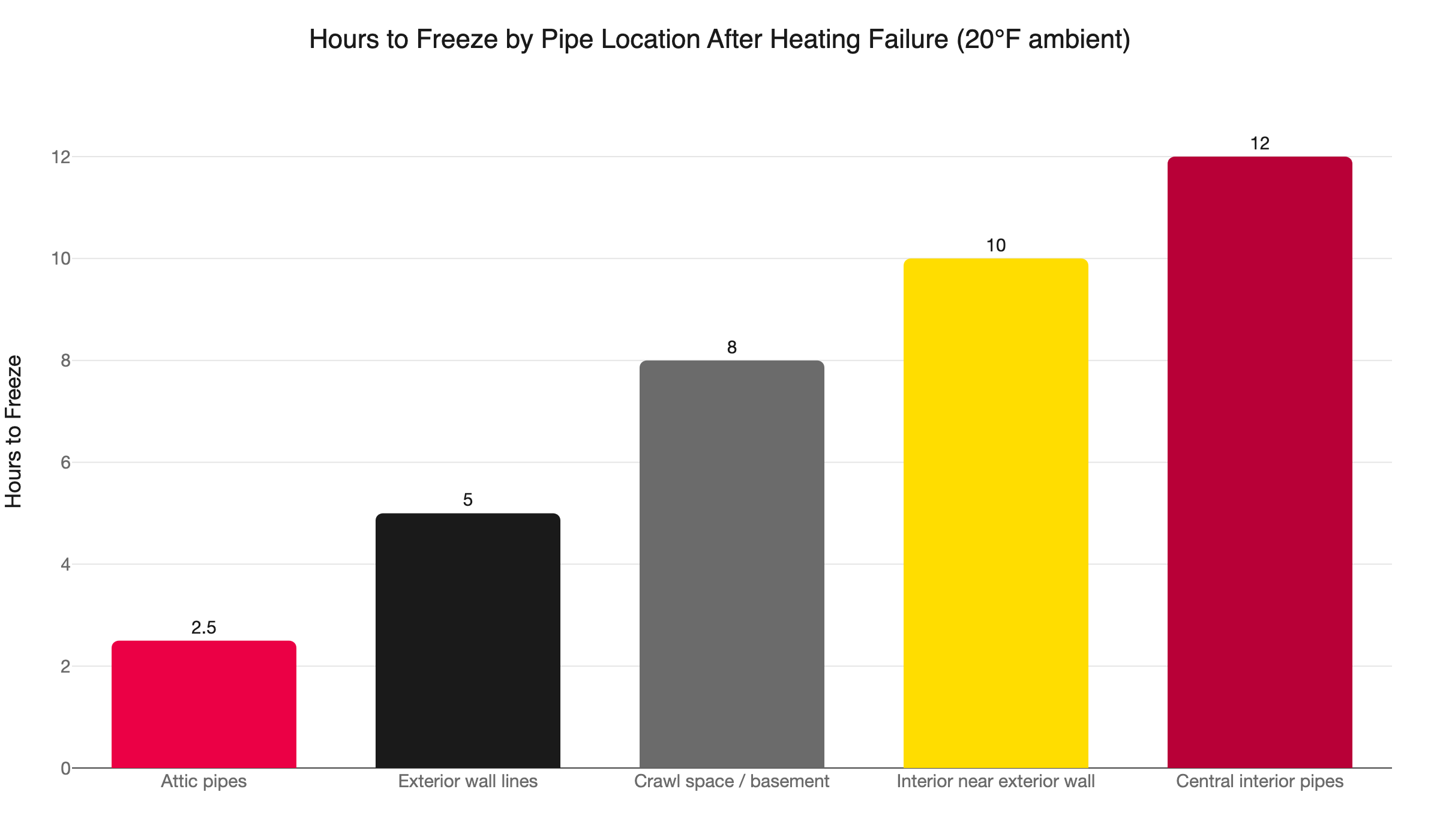
Short answer: Attic pipes go first, typically within 2 to 3 hours once surrounding air drops to 20°F. Exterior wall supply lines follow in 4 to 6 hours. Crawl space and basement pipes are next. Central interior pipes are last. Location determines sequence more than pipe diameter.
The freeze sequence follows heat loss from the outside in. The pipes farthest from your home’s thermal core lose heat fastest. Here is the order once ambient temperature around the pipe reaches 20°F or below:
- Attic pipes - 2 to 3 hours
- Exterior wall supply lines - 4 to 6 hours
- Crawl space and unheated basement pipes - 6 to 10 hours
- Interior pipes running adjacent to an exterior wall - 8 to 12 hours
- Central interior pipes - 12 hours or more
These are times from when the surrounding air hits 20°F, not times from furnace shutdown. During a polar event in the Twin Cities, the air in an uninsulated attic can reach 20°F within an hour of the heat going out. The clock starts before you realize it has started.
Older Twin Cities homes built before 1980 tend to have more uninsulated pipe runs in high-risk locations. If your home has original plumbing and minimal attic insulation, assume the short end of every range above. If you have had a modern insulation retrofit, assume closer to the long end.
How Fast Do Pipes Freeze at Minnesota Temperatures?
Short answer: At 25°F, uninsulated copper in a drafty space freezes in 4 to 6 hours. Wind cuts that to 2 to 3 hours. At 15°F, the timeline drops to 3 to 4 hours. At 10°F or colder, uninsulated pipe can ice up in under 2 hours. Insulation is the single biggest variable.
The temperature around the pipe is what drives timing. At 25°F, uninsulated copper pipe in a garage, crawl space, or exterior wall cavity freezes in 4 to 6 hours. Add wind exposure and that compresses to 2 to 3 hours. A pipe wrapped in R-3 foam insulation at the same temperature holds for 12 to 16 hours.
At 15°F, the timeline drops to 3 to 4 hours for uninsulated pipe. At 10°F or below, you are looking at under 2 hours.
The Twin Cities sees an average of 22 days per year at or below zero. On those days, the window between furnace failure and attic pipe freeze is not measured in days. It is measured in hours. It may be measured in the time it takes you to get dressed and make a phone call.
One note on Minnesota code: Chapter 7676 of the Minnesota Energy Code requires R-3.3 insulation with a vapor retarder on pipes in unconditioned spaces where the temperature differential exceeds 15°F, and on all pipes within 3 feet of the exterior. If your home was built before a renovation or has original plumbing, those code-required insulation runs may not be present. It is worth a look before the next cold season.
Does Pipe Material Matter? Copper, PEX, and PVC
Short answer: Material matters more for what happens after the freeze than for preventing it. Copper splits under ice pressure. PEX bends instead of bursting, but it still ices up solid. PVC can crack from cold brittleness before the water inside even freezes.
Understanding your pipe material changes what you should worry about most.
Copper conducts heat away from the water inside faster than any other common pipe material. That is excellent for hot water delivery. In a freeze event, it works against you. An uninsulated copper line in a garage or crawl space loses its heat to the surrounding air quickly and reaches the ice threshold sooner than other materials. When ice forms inside copper and expands, the pipe wall does not flex. It splits. Copper failures tend to be sudden and catastrophic.
PEX is the most forgiving material in a freeze. It is flexible enough to expand with ice formation without rupturing the pipe body itself. For most freeze events, the fittings are the weak point: the metal and rigid plastic connections at each end do not flex. PEX will still freeze solid and stop carrying water. It will not necessarily burst at the pipe body, but a fitting failure can release just as much water as a split copper line. PEX reduces burst risk. It does not eliminate freeze risk.
PVC becomes brittle at extreme cold. Below 20°F, the material loses impact resistance. It can crack under the mechanical stress of ice expansion, or even from frost buildup on the exterior of the pipe. PVC supply lines are uncommon in post-1990 Twin Cities homes but appear in older plumbing and in outdoor irrigation stub-outs that were never properly winterized.
The practical takeaway: if you have uninsulated copper runs in an attic, garage, or crawl space, your exposure is higher than a home that was repiped with PEX. In either case, the prevention strategy is identical. Keep the heat on, insulate the pipes, and act immediately when the furnace goes out.
What Should You Do Right Now Before the Tech Arrives?
Short answer: Drip every faucet, open cabinet doors under exterior-wall sinks, close off unused rooms, locate your main water shutoff valve, and do not use gas ovens or combustion appliances for heat. Taken together, these steps can add hours before a pipe freezes.
Here are the five steps in order of priority:
1. Drip all faucets. Turn every faucet to a cold-side trickle, roughly the width of a pencil lead. Moving water is harder to freeze than standing water. The slight flow also relieves pressure buildup if ice begins forming somewhere in the line. This applies to every faucet in the home, not just the ones nearest exterior walls.
2. Open cabinet doors under exterior-wall sinks. The cabinets beneath kitchen and bathroom sinks on exterior walls trap cold air away from the supply lines inside. Opening those doors lets whatever residual warmth remains in the home reach those pipes. It is not a substitute for heat, but it slows the rate of heat loss in a critical location.
3. Concentrate remaining heat. Close off unused rooms and open interior doors in the areas with the most pipe exposure. If you have a supplemental electric space heater, position it near the most vulnerable pipes rather than where you happen to be sitting. Keeping all interior doors open in active living spaces helps circulate the remaining warmth.
4. Know your main shutoff valve before you need it. A small crack in a pipe releases more than 250 gallons of water per day. The moment you hear a pop, see a wet spot on a ceiling or wall, or lose water pressure unexpectedly, shut the main water supply valve first and call us second. The valve is usually at the water meter or where the supply line enters the foundation. Know where it is now, not at midnight.
5. Do not use combustion appliances for heat. A gas oven left open, an outdoor grill brought inside, or a propane camp stove all generate carbon monoxide in an enclosed space. The appeal is obvious when it is cold and the furnace is out. The risk is fatal. An electric space heater is a safe bridge. For more on safe and unsafe heat options during a heating emergency, see our guide on what to do when a power outage affects your furnace.
One additional step if a pipe is accessible: if you can see the frozen section and it does not appear burst, apply a hair dryer or heating pad starting from the faucet end and work toward the frozen section. Never use an open flame. Keep applying heat until full water pressure returns at the faucet. Stop immediately if you see any bulging, cracking, or wet spots near the frozen area.
Hold indoor temperature at or above 55°F if at all possible. That is the standard the insurance industry and utility providers use as the minimum threshold for occupied and unoccupied homes in winter.
Minnesota Emergency Assistance Programs
Most families do not know these programs exist until a technician walks them through it on an emergency call. Knowing before the emergency is better.
Minnesota Cold Weather Rule: Regulated utilities including CenterPoint Energy and Xcel Energy cannot disconnect heating service between October 1 and April 30 for customers who set up a payment plan. If a billing dispute is part of your situation, call your utility provider before paying any shutoff or reconnection fee.
MN Energy Assistance Program (LIHEAP): Up to $2,000 for income-eligible households. This includes emergency furnace repair, not just utility bill assistance. A family of four earning up to $70,552 annually may qualify. Contact your county human services office or your utility provider to start the application.
Crisis Energy Assistance Program (MNVAC): Up to $600 emergency benefit for households facing shutoffs or disconnection notices. MNVAC can sometimes move faster than LIHEAP for acute situations and is worth a parallel call.
Reach Out for Warmth: A state-administered year-round emergency fuel fund that includes furnace repair assistance. The statewide number is 1-800-657-3710. This program is available year-round, not only during heating season.
When you call us for an emergency heating repair, we can help you identify which program applies to your situation while we work on getting the furnace running.
What If a Frozen Drain Caused the Furnace to Fail?
Short answer: It happens. High-efficiency furnaces use a condensate drain line to exhaust moisture from combustion. In extreme cold, that drain can freeze solid and trigger a pressure switch lockout. The furnace shuts itself off as a safety measure, and you lose heat without any obvious mechanical failure.
A blocked flue or a snow-packed PVC exhaust terminal can cause the same lockout. The furnace control board detects a restriction in the vent system and shuts down before carbon monoxide can build up.
If your furnace stopped during a polar event and you notice frost or ice near the exhaust vent terminals, or if the error light on the furnace control board points to a pressure switch fault, a frozen condensate drain is a likely cause. Do not try to thaw a drain that runs through an inaccessible wall cavity. Call us and we will diagnose it as part of the service visit.
Our post on high-efficiency furnace condensate drains freezing in Minnesota covers the symptoms and fixes in more detail. For a broader look at why furnaces stop mid-winter, see our emergency furnace repair warning signs guide.
How Do You Prevent This Before Next Winter?
A midnight heating failure in January is alarming. It is also usually preventable.
Most mid-winter furnace shutdowns are preceded by warning signs that a fall tune-up catches: a clogged filter starving the heat exchanger, a dirty flame sensor triggering repeated lockouts, a blower motor running hot enough to trip a high-limit fault, or a heat exchanger crack that the safety system correctly shuts down to protect your family.
A professional furnace tune-up costs a fraction of an after-hours emergency call. It costs far less than a burst pipe claim averaging $27,000. Scheduling it in October, before heating season peaks, means any parts needed are ordered and installed before you need the furnace to run all night at minus 10°F.
Pipe insulation is the other half of the prevention picture. If you have uninsulated copper runs in an attic, crawl space, or within 3 feet of exterior walls, adding R-3 foam insulation to those runs extends your window dramatically if heating failure does occur. It is a straightforward job during a mild weather window and a significant insurance policy against the worst outcomes.
Call Before the Pipes Do
Northern One Hour Heating & Air Conditioning is locally owned and operated in Ramsey, MN. We serve Minneapolis, St. Paul, Blaine, Maple Grove, Plymouth, Brooklyn Park, Woodbury, Bloomington, and the surrounding Twin Cities metro.
When your heat goes out on a January night, you need a team that shows up when they say they will. That is what we built this company around. Every call is backed by our “Always On Time… Or You Don’t Pay a Dime!(R)” guarantee and a 100% satisfaction guarantee.
Call (763) 260-6662 or schedule a heating repair online. If you suspect a pipe may already be frozen or burst, shut your main water valve first, then call us. Do not wait until morning.
Financing is available on larger repairs and system replacements. Ask us when you call.
Frequently Asked Questions
How fast do pipes freeze after a furnace fails in Minnesota? +
At what temperature do pipes start to freeze? +
Is PEX pipe freeze-proof? +
What should I do if my furnace dies in a Minnesota winter? +
Does the Minnesota Cold Weather Rule protect homeowners from heating shutoffs? +
Need a technician now?