
Frozen Gas Meter: Why Your Furnace Stopped in Minnesota
Key Takeaways
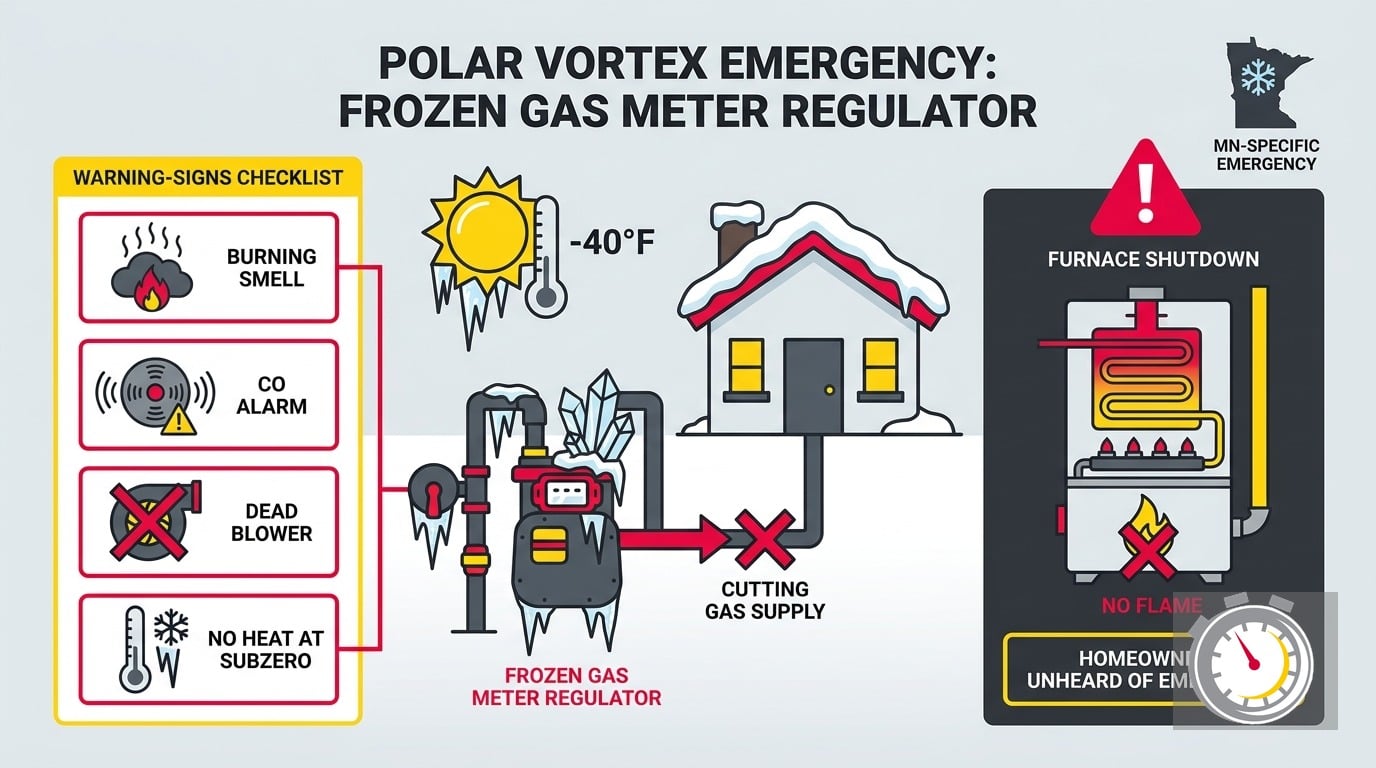
- A frozen gas meter regulator cuts gas to your entire home, not just the furnace.
- The regulator has a small vent that must breathe to regulate pressure. Ice blocks it, the diaphragm locks up, and gas stops flowing.
- A blocked vent can cause dangerous over-pressurization or allow gas to vent inside the home. This is a safety event, not only a comfort issue.
- Do not use hot water, deicer, a snow blower, or any tool on the meter. A soft broom on loose snow is the only exception.
- The gas meter belongs to CenterPoint Energy. Call 1-800-296-9815. They dispatch a technician at no charge.
- After CenterPoint restores service, call Northern One Hour at (763) 260-6662 if the furnace needs a restart, inspection, or repair.
- Prevention is free: maintain the gutter above the meter and know where the meter sits before winter arrives.
Your furnace stopped working. The thermostat looks fine. The circuit breakers are all on. The filter is clean. Then you check the kitchen: the stove burners will not light. The water heater is also out.
This is not a furnace problem. This is a gas meter problem.
In Minnesota winters, a frozen gas meter can cut gas to every appliance in your home at once. Most homeowners never consider the outdoor meter. They check everything inside first, losing time while the interior temperature drops. This post explains the mechanism, the real hazard, and the steps to take in the right order.
What Actually Happens When a Gas Meter Freezes and Your Furnace Stops Working?
The short answer: The gas meter contains a small regulator vent that must stay open to let the internal diaphragm breathe and balance pressure. Ice seals that vent, the diaphragm locks up, and pressure regulation fails. Gas stops flowing to every appliance in the home at once, not just the furnace.
This is not the same as the meter body freezing solid. The meter can look intact from the outside. The problem is that single small vent opening. It is just large enough for the diaphragm to breathe and just small enough to ice over under the right conditions.
CenterPoint Energy documents this mechanism on their meters safety page: the vent is a small opening that lets the regulator’s internal diaphragm move and balance incoming gas pressure against the lower pressure your appliances need. Block that vent and the whole regulation system stalls.
The result is a simultaneous shutdown of all gas appliances in the home. Furnace, water heater, stove, and gas dryer all go down at the same time. The furnace did not break. The fuel supply to it did.
That simultaneous failure is the diagnostic tell. If only the furnace is out, the furnace is the likely problem. If everything gas-powered is out at once, the problem is upstream of the furnace. Start at the meter.
Why Minnesota Winters Put Gas Meters at Risk
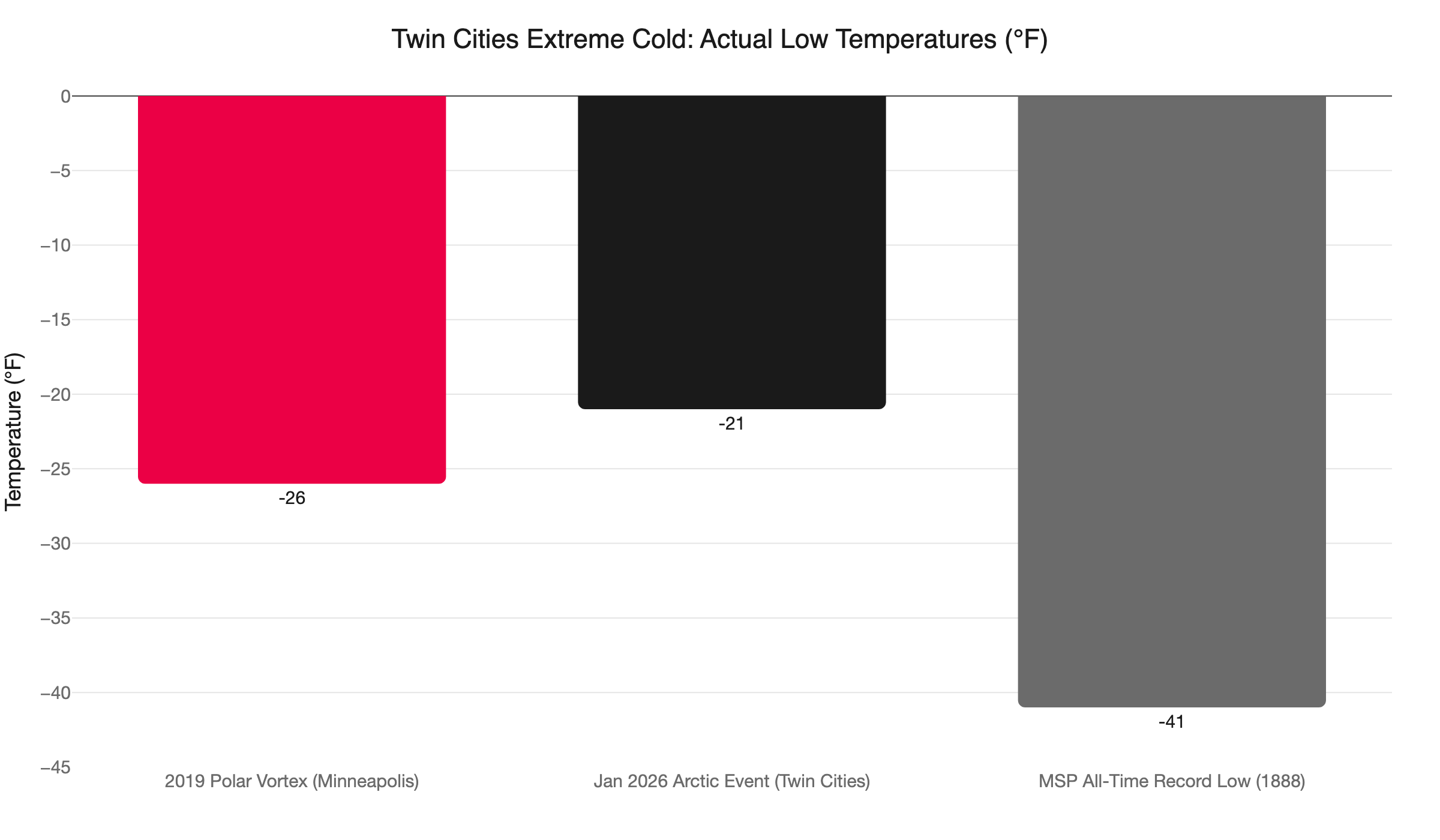
Minnesota does not have average winters. Minneapolis averages roughly 140 days below freezing each year. The all-time low for the Twin Cities airport is -41°F, set in 1888. That is the baseline your outdoor gas meter lives in every single winter.
Polar vortex events push well past that baseline. In February 2019, Minneapolis hit -26°F actual and -49°F wind chill. Cotton, MN recorded -56°F that same event, the coldest reading anywhere in the lower 48. In January 2026, the Twin Cities dropped to -21°F overnight, with wind chills reaching -63°F near Grand Marais.
The winter of 2013-14 brought 53 days at or below zero in the Twin Cities, tying a record that had stood since 1978. Wind chills reached -48°F in the metro that season.
Each of those events created conditions where outdoor meters could ice over. The homeowners who lost gas service during those nights were not unlucky. They were experiencing something Minnesota’s climate produces on a regular interval. A frozen meter is not a freak occurrence here. It is a statistically expected outcome of our winters.
How Do You Know It Is the Gas Meter and Not Your Furnace?
The short answer: Check your other gas appliances. If the stove, the water heater, and any gas fireplace are also out, the problem is upstream of the furnace. Go outside and look at the meter without touching it. Visible ice on or around the regulator vent is a strong confirmation.
Here is the checklist to run before calling anyone:
- Turn on two stove burners. No click, no flame.
- Check the water heater status light or pilot. No ignition.
- If there is a gas fireplace, try it. No flame.
- Go outside and visually inspect the gas meter. Do not touch it. Look for ice accumulation on the body, the regulator, or around the vent area.
If all gas appliances are out and the meter is visibly iced over, the problem is the meter. Stop there. The next call is not to an HVAC company. See the call sequence below.
If only the furnace is out and the meter looks clear, the furnace is the issue. Our guide to common reasons a furnace stops turning on in Minnesota is a good place to start. A related cause worth knowing: natural gas pressure dropping during a cold snap can look similar to a meter failure but has a different cause and a different response.
The Hazard Goes Beyond No Heat
Most discussions of frozen gas meters stop at “no service.” The actual hazard is more serious.
According to CenterPoint Energy’s safety guidance, a blocked regulator vent can contribute to dangerous over-pressurization of the home’s internal gas piping. It can also cause the regulator to malfunction in a way that vents gas inside the home rather than outside.
That second failure mode is not a comfort problem. It is a potential gas accumulation hazard inside a living space.
A properly working regulator steps down high-pressure gas from the utility main. It delivers the safe low pressure your appliances need. If the regulator locks in the wrong position, downstream pressure can exceed design limits. The fittings inside your home were not built for high-pressure supply.
This is why the correct response to a suspected frozen meter is not “wait and see.” Call the utility and treat the situation as a safety event until their technician confirms everything is safe.
For a broader look at indoor gas hazards and what to watch for when systems come back online, our guide on carbon monoxide safety during furnace season covers what to monitor after gas appliances restart.
What You Must NOT Do When You See Ice on the Meter
This section matters more than most homeowners expect. The wrong response can turn a service outage into an immediate safety emergency.
Do not pour hot or warm water on the meter. This is the most common DIY mistake and one of the most dangerous. A rapid temperature change causes a pressure surge inside the regulator. The internal mechanism and seals are not designed for that thermal shock under live pressure conditions.
Do not use deicer, rock salt, or any chemical treatment. These corrode seals and degrade metal components on a pressurized gas system. The damage may not be visible from the outside and may surface later under pressure.
Do not use a snow blower near the meter. Discharge impact can damage regulator components. The blower itself striking the meter is a worse outcome.
Do not use a shovel, ice pick, hammer, or any hard tool on the meter body. The meter is pressurized. It is not a surface to chip at.
Do not remove ice by any method except a soft-bristle broom on loose, dry snow. SEMCO Energy and other regional natural gas utilities are clear on this point: gentle broom strokes on loose snow only. If the ice is hard-packed or formed directly on the regulator housing, leave it completely alone and call CenterPoint.
The reason hot water is particularly dangerous comes back to pressure dynamics. When the regulator vent is blocked, the system is already in an abnormal pressure state. Adding rapid heat changes that state in an uncontrolled way. The result can be a sudden pressure surge that exceeds the safety rating of gas fittings inside your home. You cannot see those fittings from the driveway. You will not know there is a problem until it is already inside.
What Is the Right Call Sequence When Your Gas Meter Is Frozen?
The short answer: Confirm all gas appliances are out, not just the furnace. Look at the meter without touching it. If you see ice, call CenterPoint Energy at 1-800-296-9815. Once their technician restores service and confirms the system is safe, call Northern One Hour if the furnace needs help restarting or inspection.
Step by step:
- Confirm the scope. Try the stove and water heater. If only the furnace is out, this is likely a furnace issue rather than a meter issue.
- Go outside and look at the meter. Do not touch it. Check for visible ice on the body or around the regulator area.
- Call CenterPoint Energy at 1-800-296-9815. Describe what you see. They dispatch a technician at no charge for meter-related issues.
- Stay warm safely while you wait. If interior temperatures are dropping, use a secondary heat source with care. If you use a portable combustion heater or a generator indoors, follow all carbon monoxide precautions.
- After CenterPoint restores gas and confirms the meter is safe, attempt to restart your furnace. If it does not start cleanly, call Northern One Hour at (763) 260-6662.
That sequence addresses each part of the problem at the right layer. CenterPoint handles the utility equipment. Northern One Hour handles everything inside your home.
Why Is CenterPoint the First Call, Not Your HVAC Company?
The short answer: The gas meter is CenterPoint’s equipment. They own it, maintain it, and are the only party authorized to work on it. Calling an HVAC company first delays the actual fix, because the root problem is on equipment no HVAC tech is authorized to touch.
CenterPoint is Minnesota’s largest natural gas distribution company, serving more than 760,000 residential, commercial, and industrial customers across 240-plus communities. They have technicians specifically trained for pressurized meter restoration and equipped to handle it safely.
When CenterPoint’s technician arrives, they will:
- Safely clear ice from the meter and regulator without creating a pressure surge
- Verify that gas pressure is within normal range before restoring service
- Check for downstream pressure abnormalities
- Confirm the system is safe before they leave
No HVAC company can perform any of those steps. The gas meter is not a furnace component. It is utility infrastructure, and there is a clear boundary between what belongs to the utility and what belongs to the homeowner.
The gas meter and the service line feeding it are CenterPoint’s. The gas line from the meter into your home, your furnace, and every connected component are yours. When something fails on the utility’s side of that line, the utility is the first call. When something on your side of that line needs attention after gas is restored, that is when you call us.
What Causes the Meter to Ice Over?
The short answer: The most common trigger is drip from a leaky or clogged gutter directly above the meter. Water falls during a warm afternoon or snowmelt period, coats the meter and regulator, and refreezes when temperatures drop overnight. The roofline geometry and the gutter condition directly above the meter determine most of the risk.
CenterPoint and regional natural gas utilities have documented this pattern extensively. Leaky eave gutters and downspouts drip onto the meter during melt periods. When temperatures fall back below freezing, the meter is encased. CenterPoint screens for two things when assessing a meter’s vulnerability: the roof geometry above it and whether a functioning gutter is present. Those two factors predict most frozen-meter service calls.
Other contributing triggers include:
- Snow drifting against the meter base and then melting and refreezing in the next cold cycle
- Condensate dripping from a high-efficiency furnace exhaust pipe that exits near the meter (our post on high-efficiency furnace PVC exhaust vents blocked by snow and ice in Minnesota covers how to identify this)
- Runoff from a downspout that terminates too close to the meter pad
- Snow shoveled or plowed against the house wall where the meter is mounted
Most Twin Cities meters are on the exterior wall of the home, often on the north or west face. Those orientations receive less winter sun. Ice forms faster and melts more slowly. If your meter is on the north face of the house with a sagging gutter section directly above it, you have the full risk picture assembled in one spot.
Can You Prevent a Frozen Gas Meter?
The short answer: Yes, and the main prevention steps cost nothing. Keep the gutter above the meter clear and intact so meltwater cannot drip onto it. Clear loose snow from around the meter with a soft broom after each accumulation. Locate your meter before winter so you know where it is when you need that information fast.
Here is what to do each fall before the first freeze:
- Walk the gutters above the meter. Look for sections that are clogged, sagging, or pulling away from the fascia. Water goes somewhere when a gutter fails. If it cannot reach the downspout, it drips onto whatever is below. A gutter repair in September costs far less than a no-heat service call in January at -20°F.
- Find your meter. Know which face of the house it is on and exactly where. Many homeowners cannot locate it without searching. That is a problem at 1 a.m. in a polar vortex when CenterPoint needs a description.
- Note the roof geometry above the meter. Is there an overhang with a gutter? Is the gutter in good condition? Does a downspout shed water anywhere near the meter pad?
- Clear loose snow with a soft broom after each accumulation. Gentle strokes on loose snow only. Do not let a snow pile sit against the meter for days.
- Keep the area around the meter clear. No firewood stacks, no stored gear, no decorative skirting. These create pockets where moisture collects, traps, and refreezes.
- If your furnace has PVC exhaust pipes near the meter, confirm that they are not dripping condensate onto the meter housing. High-efficiency furnaces produce significant condensate in cold weather.
One additional note: if you have or are considering a protective cover over the meter, check with CenterPoint before installing anything. Some covers trap moisture rather than deflect it. The utility needs to approve any housing placed over or around their equipment.
When to Call Northern One Hour
When CenterPoint closes out the meter restoration and gas service is back on, your furnace may or may not restart cleanly. Many furnaces go through a startup sequence that stalls after a prolonged gas outage. The control board may have logged a fault. A pressure switch may need a manual reset. An igniter that cycled abnormally during the shutdown may have shortened its remaining service life.
This is when you call us: (763) 260-6662.
Northern One Hour Heating & Air Conditioning is a locally owned and operated Twin Cities HVAC company. We handle everything on your side of the gas meter, from the furnace to the thermostat. Our technicians show up when they say they will. That is the “Always On Time… Or You Don’t Pay a Dime!(R)” promise, and we hold to it on every call.
If the furnace restarts but you want a post-outage inspection after a prolonged cold-weather event, we can do that too. Extreme cold stresses heat exchangers, pressure switches, and control boards. A professional look is a reasonable precaution after any major temperature event. If everything came through clean, you will know. If something is worn, you will know before it fails.
Schedule online or call (763) 260-6662. We are local, we know Minnesota winters, and we will be there on time.
Frequently Asked Questions
What should I do if my outdoor gas meter is frozen? +
Why does a frozen gas meter stop the furnace from working? +
Can a frozen gas meter cause a gas leak or safety hazard? +
How do I prevent my gas meter from freezing in Minnesota? +
Need a technician now?