
Furnace Not Heating During Cold Snap in Minnesota
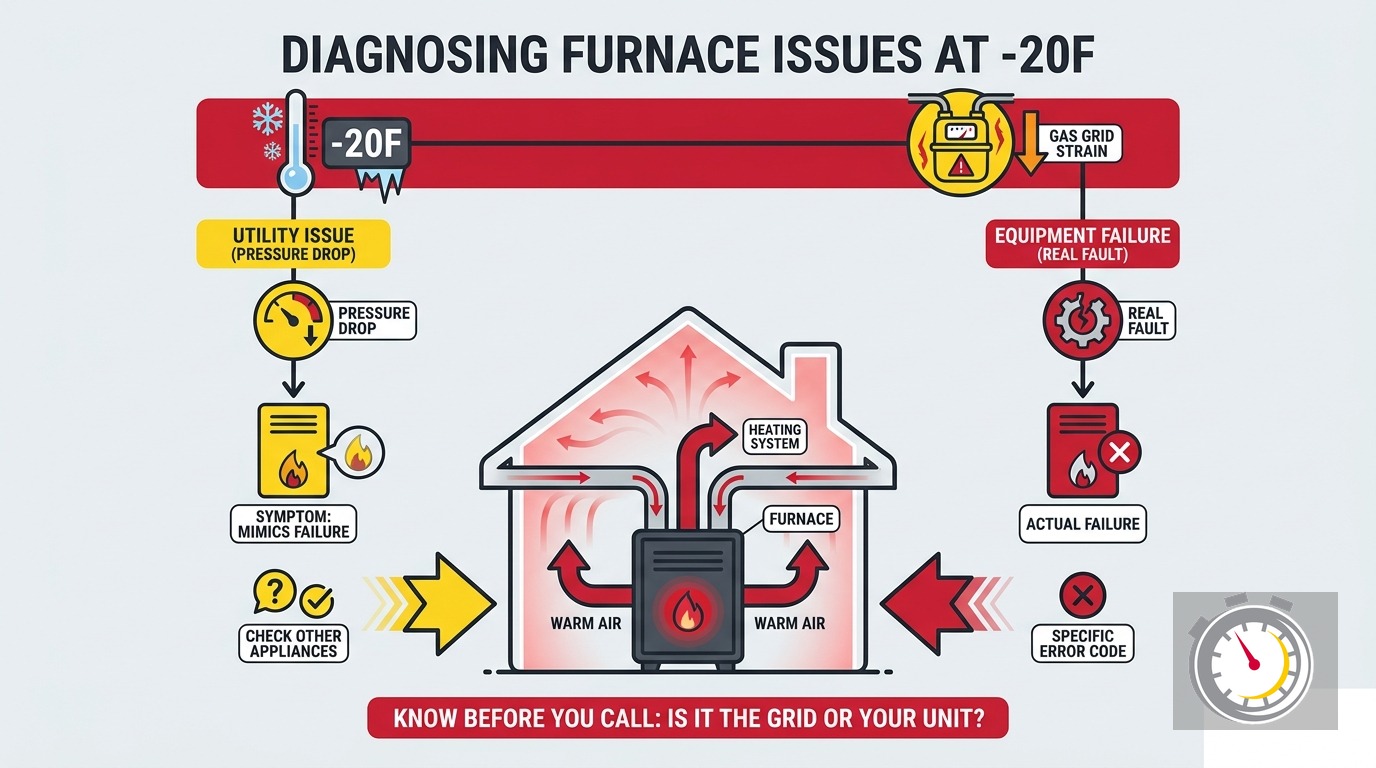
Key Takeaways
- If your furnace is not heating during a cold snap in Minnesota, the gas distribution grid may be the cause, not the furnace itself.
- At -30°F, sustained demand across an entire neighborhood can drop gas supply pressure below what your furnace needs to fire.
- Run the 2-minute water heater flame test before calling anyone. It tells you whether to call your gas utility or an HVAC company.
- If the water heater flame dims or turns yellow when the furnace fires, the problem is upstream of your house. Call Xcel Energy or CenterPoint Energy. That service call is on them.
- If other gas appliances work normally and only the furnace fails, you have an equipment fault. Call Northern One Hour at (763) 260-6662.
- Homes on the far ends of distribution mains in newer subdivisions face the highest pressure-drop risk during extreme cold.
Why Your Furnace May Not Be the Problem
When your furnace stops heating during a brutal Minnesota cold snap, the obvious move is to call an HVAC company. That instinct is sometimes right. But sometimes the furnace is not the problem at all.
During extreme cold, every home on your gas distribution main runs its furnace almost continuously. That sustained draw can drop supply pressure at the far ends of the line. When pressure falls below what your furnace needs to fire reliably, you get the same symptoms as a broken igniter, a faulty control board, or a bad flame sensor: no heat, failed ignition, error codes.
The 2-minute test below tells you which call to make before anyone rolls a truck and charges you a dispatch fee.
How Does Extreme Cold Strain the Gas Grid?
When temperatures drop to -30°F, every furnace on a gas distribution main runs almost continuously. That sustained demand drops supply pressure at the far ends of the line. When pressure falls far enough, burners cannot fire reliably and the furnace locks out.
Natural gas travels from the utility’s high-pressure transmission lines through progressively smaller distribution mains to your meter. Normal residential supply pressure is approximately 6.0 inches of water column, roughly one-quarter pound per square inch. Interior piping is designed to lose no more than 0.03 inches of water column under full load.
When every home on a local main pulls gas at the same time, pressure at the end of the line drops. If it falls far enough, your furnace’s gas valve and pressure regulator cannot fully compensate. The air-to-gas mixture goes wrong. Burners produce a weak or yellow flame. The furnace locks out on a safety fault.
This is exactly what happened in the Princeton and Hugo areas during a recent polar vortex. Temperatures hit -30°F and 152 families in Princeton and 30 in Hugo lost natural gas service for nearly three days. Xcel Energy’s pressure prediction model was calibrated to -26°F. Actual temperatures reached approximately -35°F, nine degrees colder than the model anticipated. The model underestimated demand and missed the pressure collapse entirely.
One Princeton homeowner cycled his circuit breaker and pressed the furnace reset switch repeatedly. From every visible sign, the furnace appeared broken. His home reached 68°F indoors with -30°F outside before help arrived. The actual cause was zero gas reaching the house.
The Twin Cities ASHRAE design temperature sits around -16°F to -20°F for the coldest 1% of winter hours. When actual polar vortex temperatures push 10 to 15 degrees below that, the gas distribution system operates outside the range it was engineered to handle reliably.
What Is the 2-Minute Water Heater Flame Test?
Watch your water heater burner when the furnace fires. If the water heater flame dims, shrinks, or turns yellow, the shared gas supply is being starved and the problem is upstream of your house. If the flame holds steady, the furnace has a real equipment fault.
The test works because your furnace and water heater share the same gas supply line inside your home. When the furnace draws gas, supply pressure briefly drops in the interior piping. If incoming supply pressure from the utility is already low, that brief drop shows up visibly at the water heater burner.
Here is how to run it:
Step 1. Find your natural gas water heater. Most Twin Cities homes have it in the basement or utility room. Look for the inspection window or viewing port near the base of the unit where you can see the burner flame.
Step 2. Turn the furnace off at the thermostat. Set it to OFF or well below room temperature. Wait two minutes.
Step 3. Look at the water heater flame. A healthy, stable flame is mostly blue and consistent. Note what it looks like with the furnace off.
Step 4. Turn the furnace back on. Set the thermostat above room temperature to call for heat. Watch the water heater flame as the furnace fires up.
Step 5. Read the result:
- Water heater flame dims, weakens, or turns yellow: Gas supply pressure is being shared too thin. The problem is upstream of your house. Call the utility.
- Water heater flame holds steady: Gas supply is fine at your house. The furnace has a real fault. Call Northern One Hour.
A secondary check is even simpler. Try a gas stove burner while the furnace is calling for heat. If it lights with a weak or mostly yellow flame, the supply is starved. If multiple gas appliances fail simultaneously, the problem is almost certainly upstream of the house, not inside the furnace.
What Does Low Gas Pressure Do to Your Furnace?
Low supply pressure causes the furnace to attempt ignition, fail to satisfy the call for heat, and lock out. The control board logs an error code that looks exactly like an ignition fault or a pressure switch fault. Other gas appliances in the house are also affected.
Low supply pressure typically shows as denser, cooler gas arriving from the street. The furnace’s gas valve and pressure regulator may not fully compensate. The symptom chain unfolds like this:
- The thermostat calls for heat.
- The draft inducer motor starts and runs normally.
- The furnace attempts ignition. The burner fires weakly or fails to light.
- The call for heat is not satisfied.
- The control board registers an ignition failure or a pressure fault.
- After one or more failed attempts, the board locks out.
- The furnace sits cold with a blinking fault code.
That sequence is nearly identical to a dirty flame sensor, a failing hot surface igniter, or a faulty pressure switch. Our post on furnace error codes and blinking light patterns explains what each sequence means. But run the water heater flame test before using that guide. A supply starvation event can trigger the same codes as hardware failures. Without the test, even an experienced technician dispatched to your home may begin replacing parts that are functioning perfectly.
How Can You Tell If the Furnace Itself Has Failed?
The furnace is the likely culprit when other gas appliances work normally, only the furnace is affected, and the water heater flame holds steady while the furnace struggles. Furnace faults isolate to the furnace. Supply failures affect multiple appliances at once.
Here is how the most common real furnace faults behave, and how each differs from a gas pressure event:
Clogged air filter. The furnace fires briefly, overheats, and shuts off on the high-limit switch. It typically restarts in 30 to 90 minutes. The water heater flame is unaffected. Pull your filter and hold it up to a light. If you cannot see light through it clearly, change it. A dirty filter is the most common cold-snap service call, and it is the cheapest to resolve.
Blocked PVC exhaust vent or frozen condensate drain. High-efficiency furnaces use white PVC pipes to exhaust combustion gas through the wall. In a Minnesota winter, ice can form at the outdoor termination. A blocked exhaust causes the furnace to lock out with an error code. Symptoms are furnace-only. Other gas appliances work normally. Our post on high-efficiency furnace exhaust vents blocked by snow and ice covers this scenario step by step.
Short cycling from an oversized unit or thermostat problem. The furnace fires and cuts off repeatedly in short bursts. The water heater flame is steady and unaffected. The pattern is intermittent, not a complete failure to produce heat.
Dirty flame sensor. The furnace lights and shuts off within a few seconds of ignition. The cycle repeats. Other gas appliances work fine.
Failed hot surface igniter. The furnace attempts a heat cycle, the inducer runs, but no ignition follows. The water heater works normally.
The shared pattern across every real furnace fault is isolation. The failure affects the furnace only. Gas stove burners light normally. The water heater flame is stable.
Is Your Neighborhood at Higher Risk?
Homes at the far ends of gas distribution mains, especially in newer residential subdivisions on the outer rings of the Twin Cities, face the highest pressure-drop risk during extreme cold. Older neighborhoods closer to the utility’s main feed see less exposure.
Xcel’s permanent fix for the Princeton area was replacing 2-inch distribution pipes with 4- or 6-inch substitutes to add carrying capacity. That infrastructure upgrade took years and followed a documented failure event. Until similar upgrades reach your neighborhood, the exposure remains.
If your home is in a newer subdivision in Blaine, Maple Grove, Plymouth, Woodbury, or similar outer-ring communities, your supply main may be sized tighter than older neighborhoods closer to the city. During a genuine polar vortex, pressure at the end of your street drops faster than it does for homes closer to the utility’s main feed.
This does not mean your furnace will definitely fail during extreme cold. It means the water heater flame test takes two minutes and can save you a dispatch fee. Run it first.
What Does the Utility Owe You If Supply Fails?
If Xcel Energy or CenterPoint Energy confirms their supply pressure caused your heat loss, the utility is responsible for the service call. They may also provide temporary heat equipment or alternative housing at their expense. You do not pay for a problem they created.
When Xcel confirmed the Princeton distribution failure, it provided 2,000 space heaters and covered hotel stays for affected customers. That response confirms the utility acknowledges responsibility when supply pressure fails at their end.
If your water heater test points to a grid problem, here is what to do:
-
Call the gas utility. Xcel Energy customers: 1-800-895-4999. CenterPoint Energy customers: 1-800-245-2377. Tell them your furnace is failing and you suspect low gas supply pressure. Ask them to measure pressure at your meter. That measurement is free.
-
Document the call. Write down the time, the representative’s name, and your case or confirmation number.
-
Ask about temporary equipment. If the utility confirms supply is the problem and restoration will take time, ask what they will provide in the meantime.
-
Keep your household safe. Use supplemental electric heat while you wait. Never use gas-powered camp stoves or portable generators indoors. Carbon monoxide is a genuine risk in a sealed Minnesota home in winter.
-
Do not pay for HVAC service until you know who owns the problem. If the utility confirms supply is the issue, the service call is their cost, not yours.
When to Call Northern One Hour
If the water heater flame holds steady while your furnace struggles, you have a furnace fault. That is the call to make to our team.
We are locally owned and operated in Ramsey, MN. Our technicians serve the Twin Cities metro including Minneapolis, St. Paul, Blaine, Maple Grove, Plymouth, Brooklyn Park, Woodbury, and Bloomington. They carry common parts on their trucks and arrive ready to diagnose, not just to look.
We offer honest, transparent pricing before work begins. No surprises. Every visit comes with a 100% satisfaction guarantee. We back our scheduling commitment with our promise: “Always On Time… Or You Don’t Pay a Dime!(R).”
Before our technician arrives, check these items:
- Filter. Pull it and hold it up to a light. If you cannot see clearly through it, replace it. A clogged filter is the most common cause of cold-snap service calls.
- Thermostat. Confirm it is set to HEAT and the setpoint is above room temperature. Replace the batteries if it is battery-powered.
- PVC exhaust vent. If your high-efficiency furnace has a white PVC pipe through the exterior wall, check that the outdoor termination is clear of snow and ice.
- Reset button. After checking the above items, press the reset button on the furnace control board once. One attempt is fine. Repeated resets can flood unburned gas into the heat exchanger and create a hazard.
If you smell gas, stop. Do not press reset. Leave the house, leave the door open, and call the utility from outside before calling anyone else. Our post on what to do if your furnace smells like gas in Minnesota has the complete safety protocol.
For everything else, call (763) 260-6662 or book service online. We provide emergency service for heating failures. After-hours response is available when Minnesota decides to hit -20°F overnight.
If your furnace has needed several repairs and is more than 15 years old, a cold-snap failure may be the right moment to weigh repair against replacement. Furnace replacement in the Twin Cities runs $3,900 to $7,800 installed for most homes, with higher-efficiency models running more. We offer financing options for larger jobs. If you are weighing that decision, our guide on when it is time to replace rather than repair your furnace walks you through the numbers.
The two-minute water heater flame test costs you nothing. It takes the guesswork out of who to call. And in a Minnesota cold snap, calling the right person first is the difference between a free utility pressure check and an unnecessary dispatch fee.
Frequently Asked Questions
How do I know if my furnace isn't heating because of low gas pressure or an equipment failure? +
What happens to gas pressure during a Minnesota polar vortex? +
Should I call Xcel Energy or an HVAC company when my furnace stops heating? +
Can I reset my furnace after a gas pressure event clears? +
Need a technician now?