
Furnace Can't Keep House Warm When It's Cold Outside?
Key Takeaways
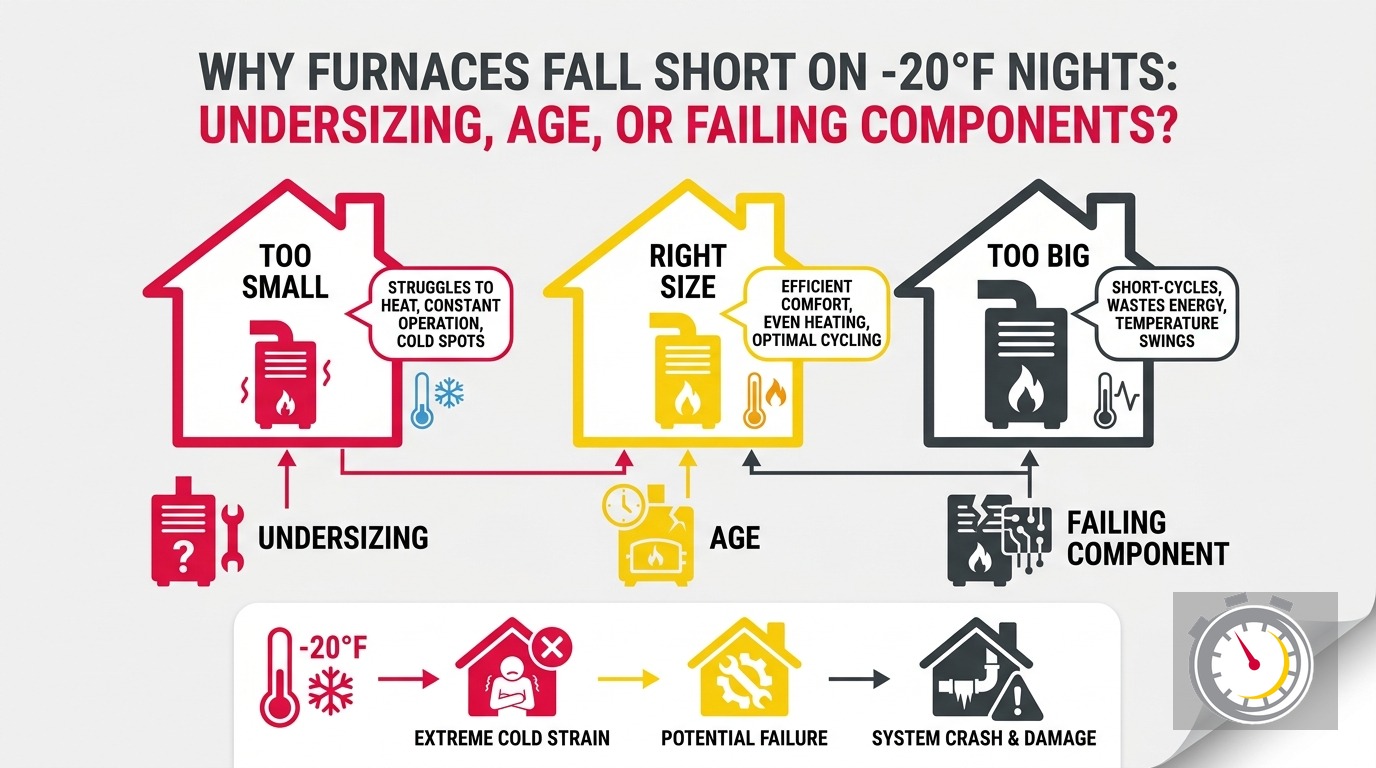
- Three structurally different problems share the same surface symptom: undersizing, age-related capacity decline, and acute component failure. Only one of them requires a new furnace outright.
- The Minneapolis-Saint Paul design temperature is approximately -16°F. A correctly sized furnace is engineered to struggle below that number. That is physics, not a defect.
- Frozen condensate lines on 90%+ AFUE furnaces are the most commonly misdiagnosed cold-weather failure in Minnesota. They present identically to a mechanical breakdown but have a different fix.
- Minnesota law requires a minimum 90% AFUE for any new or replacement gas furnace. An 80% unit is not a legal option in this state.
- Federal §25C tax credits and utility rebates from Xcel Energy and CenterPoint Energy can be stacked on a single high-efficiency furnace installation.
- A cracked heat exchanger is a carbon monoxide risk. If your CO detectors alarm, get everyone out first.
Why -16°F Is the Number That Matters in Minnesota
Before you can diagnose a furnace that isn’t keeping up, you need to understand what “keeping up” is actually supposed to mean.
Every furnace is sized to a design temperature. For Minneapolis-Saint Paul, the ASHRAE 99% heating design temperature is approximately -16°F. That number means the furnace is calculated to hold your thermostat set point during 99% of winter hours.
The coldest 1% of hours fall below -16°F. A correctly sized system is not guaranteed to maintain temperature in that range. That is the engineering, not a malfunction. Homeowners who moved here from the South or from milder northern climates often discover this the hard way.
Duluth’s design temperature is approximately -22°F. International Falls falls below -30°F. A furnace sized for Minneapolis is genuinely undersized if it ends up in Duluth, and a contractor who uses the same rules of thumb across all of Minnesota is not doing Manual J work.
Minneapolis-Saint Paul averages 54 days per year with overnight lows below 0°F. That sustained cold is what separates Minnesota from almost every other HVAC market in the lower 48, and it is why national averages and rules of thumb fail here.
What Does It Mean When Your Furnace Can’t Keep House Warm When It’s Cold Outside?
Short answer: Your furnace is running at or beyond its design limits, and one of three things is failing: the system was never the right size, its capacity has declined with age, or a specific component gave out during the cold snap. The timeline and pattern tell you which problem you’re dealing with.
The frustrating part is that all three failures produce the same symptom from the homeowner’s perspective: the thermostat says 68°F, the furnace is running, and the house is still cold.
The important difference is what comes next. Undersizing requires replacement with a correctly calculated unit. Age-related decline requires a repair-versus-replace assessment. An acute component failure often requires a targeted repair that costs a fraction of a replacement. Treating one as another wastes money and leaves your family cold while you wait for the wrong fix.
Why Is Your Furnace Running Constantly but Still Not Catching Up?
Short answer: Continuous operation without temperature recovery means the furnace’s output is lower than the heat loss from your home at that outdoor temperature. The gap between those two numbers is the problem. The question is whether the gap was always there, grew gradually, or appeared suddenly.
Three patterns point to three different causes.
Pattern A: Every winter during a hard cold snap, the house falls behind. It has always been this way. You’ve learned to live with it. This points to undersizing.
Pattern B: The furnace kept up fine for several years. The past two or three winters, it has struggled more on the coldest nights. The problem has been getting incrementally worse. This points to age-related decline.
Pattern C: The furnace was keeping up fine last week. It stopped keeping up when the cold snap arrived. This points to an acute component failure, and in a high-efficiency furnace, a frozen condensate line should be your first suspect.
How Do You Know If the Furnace Is Undersized?
Short answer: The clearest sign is continuous running that never recovers the temperature, and the problem appears even during moderate cold snaps, not only polar vortex events. A Manual J load calculation gives you a definitive answer.
Rules of thumb like “50 BTU/h per square foot” can undersize a Minnesota heating system by 30 to 50% when applied at -16°F design conditions. Those shortcuts were built for national average climates. They do not reflect Minnesota’s actual heating load.
Signs that support undersizing:
- The furnace runs without cycling for hours during any real cold snap, not just extreme events.
- Temperature loss starts in the afternoon and gets worse through the night with no recovery.
- The house was expanded, had the basement finished, or had a major window and insulation upgrade after the furnace was installed, and no one recalculated the heating load afterward.
- A previous technician mentioned the unit was “on the smaller side.”
Undersizing has one real fix: a properly sized replacement furnace calculated from a Manual J load analysis that accounts for your square footage, ceiling height, window area, insulation values, air infiltration rate, and the actual design temperature for your zip code.
One note on the opposite error: oversizing beyond about 40% of the Manual J calculated load creates its own problems, including short cycling, flue gas condensation in conventional furnaces, accelerated heat exchanger fatigue, and reduced steady-state efficiency. The goal is right-sized, not simply bigger. Our overview of HVAC sizing and the Manual J process explains what a legitimate load calculation involves.
What Happens When an Older Furnace Loses Capacity Over Time?
Short answer: Age-related decline is accumulated wear across multiple components simultaneously: the heat exchanger fatigues at its welds, the blower moves less air than it did at installation, the inducer loses draft strength. No single part is broken. The system is delivering less heat than it was sized to deliver.
Minnesota furnaces cycle 8 to 12 times per hour during extreme cold events. At 10 cycles per hour over 54 sub-zero days per year, that is a substantial fatigue load on heat exchanger welds, motor bearings, blower wheel blades, and inducer fan assemblies. A 15-year-old furnace that has run through a series of hard Minnesota winters has accumulated wear that doesn’t show up in a spot inspection.
The decline is typically gradual and directional: the furnace keeps up reasonably well in October and November, begins struggling in January and February, and each year the point at which it starts falling behind moves a few degrees warmer.
Signs of age-related decline:
- Heating bills have been climbing even when gas prices haven’t moved significantly.
- You’ve had two or more service calls in the past two winters for different issues.
- The system is 15 years or older.
- Some rooms hold temperature and others don’t, where the pattern wasn’t that way years ago.
- The problem has been getting worse gradually, not all at once.
A furnace showing these signs is usually a replacement candidate, not a repair candidate. The repair-versus-replace decision hinges on whether money spent on repair extends meaningful useful life or just delays an inevitable replacement by one more winter. In most cases, once a furnace over 15 years starts showing age-related capacity loss across multiple components, replacement is the financially sound call.
What Is a Frozen Condensate Line and Why Does It Shut the Furnace Down?
Short answer: High-efficiency furnaces (90%+ AFUE) produce acidic condensate as a combustion byproduct. That liquid drains out through PVC tubing. When those lines pass through unheated spaces, they can freeze in deep cold, block drainage, trigger a pressure switch lockout, and shut the furnace down completely. It looks exactly like a mechanical failure. It isn’t.
Frozen condensate lines are a concentrated seasonal failure in January and February in Minnesota. They are the single most commonly misdiagnosed acute furnace failure in high-efficiency systems, and nearly every national listicle on this topic leaves them out entirely because the writers are not working from Minnesota-specific failure data.
This failure mode only affects 90%+ AFUE furnaces. If your furnace vents through PVC plastic pipes rather than a metal flue, you have a high-efficiency condensing unit and this failure is possible.
How to recognize a frozen condensate failure:
- The furnace attempts to start, fires briefly, then shuts down with a pressure switch error code.
- The failure appeared during a deep cold snap, not ordinary winter weather.
- The condensate drain line exits through an uninsulated wall, a garage, a crawl space, or anywhere it runs through unheated space before reaching a floor drain.
- The furnace was working fine until this week.
The immediate fix is thawing the line using warm water poured carefully along the exterior section. Do not use boiling water. The durable fix is rerouting the drain line so it runs entirely through conditioned space, or adding heat tape and insulation to the exposed section. Our detailed breakdown of frozen condensate drain lines on high-efficiency furnaces covers both the emergency response and the permanent correction.
Other acute component failures that concentrate during cold snaps:
Pressure switch failure. The pressure switch monitors combustion draft from the inducer. If it fails or trips, the furnace will not fire. Repair typically runs $195 to $500 parts and labor.
Draft inducer motor failure. Without adequate draft, combustion cannot safely begin. Replacement runs $375 to $900 for most models, and $500 to $1,650 for some brand-specific inducer assemblies.
Blower motor failure. The furnace heats air but cannot distribute it. A standard PSC blower motor replacement runs around $1,100 installed. An ECM variable-speed motor runs around $2,200 installed.
Gas valve failure. The igniter fires, but no gas reaches the burner. Gas valve replacement typically falls in the $400 to $700 range.
Capacitor failure. Less common in heating systems than cooling systems, but a failed run capacitor can prevent the blower motor from starting. Repair typically runs $195 to $500.
Should You Be Worried About Carbon Monoxide?
Yes, and this point separates routine troubleshooting from an emergency.
Age-related capacity decline in a gas furnace frequently involves the heat exchanger. The heat exchanger is the sealed metal assembly that separates combustion gases from the air circulating through your home. When it develops a crack, carbon monoxide can enter your living space. The CPSC classifies carbon monoxide as a leading cause of non-fire-related poisoning fatalities in the U.S. It is odorless and colorless.
If your CO detectors have alarmed, or if multiple household members are experiencing headaches, nausea, or dizziness during the heating season, get everyone out of the house and call for service from outside. Do not go back in to reset the furnace. Do not troubleshoot. Call.
Our post on cracked heat exchanger warning signs covers what technicians look for and why a cracked heat exchanger almost always leads to a replacement recommendation rather than a repair.
Carbon monoxide detectors belong on every level of your home and within 10 feet of every sleeping area. If you don’t have them in place, add them before the next cold snap.
What Does a New Furnace Cost in the Twin Cities?
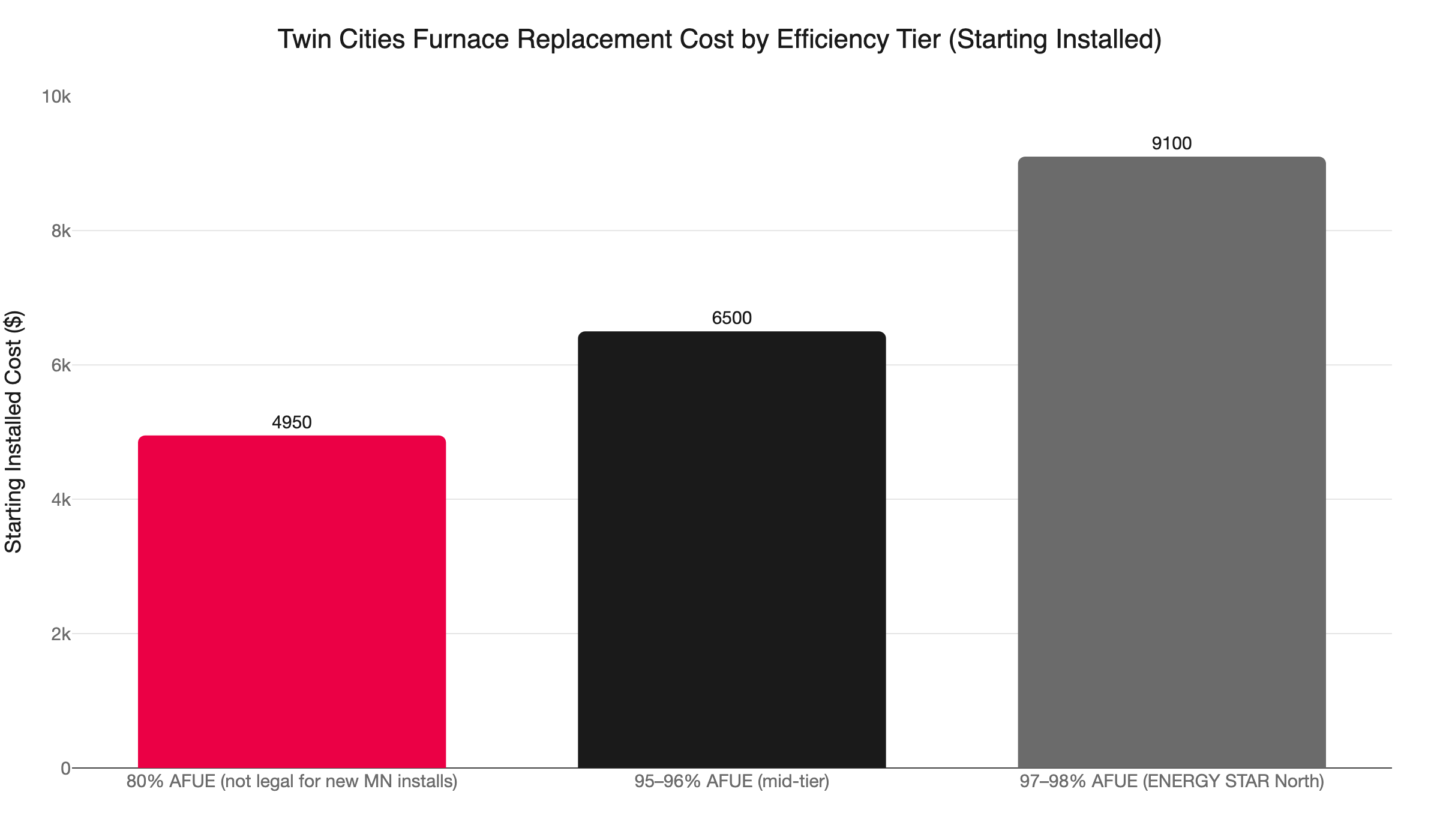
Short answer: Expect a starting installed price around $6,500 for a mid-tier 95-96% AFUE furnace and $9,100 or higher for a premium 97-98% AFUE modulating unit. Final price depends on your equipment selection, home configuration, and labor. An 80% AFUE unit is not a legal option in Minnesota.
Minnesota sets a minimum of 90% AFUE for any new or replacement gas furnace. The requirement has no local waiver provision. If a contractor quotes you an 80% unit for a Minnesota installation, that is a red flag worth noting before you sign anything.
ENERGY STAR requires 97% AFUE for gas furnaces in northern U.S. states including Minnesota. A furnace at that threshold qualifies for the federal §25C tax credit. ENERGY STAR-certified northern gas furnaces save an average of $160 per year compared to baseline models.
For most Twin Cities homeowners replacing an aging system, the 95-96% AFUE tier is the practical starting point. It clears the Minnesota minimum by a comfortable margin, qualifies for utility rebates, and delivers meaningful efficiency gains over the equipment it replaces.
Are Rebates and Tax Credits Available for a New Furnace?
Short answer: Yes, and they can be stacked. The federal §25C tax credit covers up to 30% of installed cost, capped at $600 for a qualifying 97% AFUE gas furnace, claimed via IRS Form 5695. Xcel Energy and CenterPoint Energy both offer utility rebates for 95%+ AFUE equipment, and a federal credit and a utility rebate can apply to the same installation.
Xcel Energy and CenterPoint Energy utility rebates require a minimum 95% AFUE for gas furnaces. Upgrading to 97% AFUE unlocks the federal credit on top of the utility program. If the out-of-pocket cost after incentives still requires financing, ask our team about current options when you call. We will tell you what rebate amounts are in effect at the time of your installation.
What Should You Do Right Now?
If your furnace can’t keep house warm when it’s cold outside, run through this checklist before calling:
- Identify your furnace type. Do you have PVC (white plastic) exhaust and intake pipes rather than a metal flue? You have a 90%+ AFUE condensing furnace. Look for a frozen condensate drain line before assuming a mechanical failure.
- Check your CO detectors. If they have alarmed, leave first and call from outside.
- Note the timeline. Did this start suddenly during the current cold snap, or has the furnace been losing ground gradually over several winters? That distinction tells you which of the three causes is most likely.
- Look for error codes. Most modern furnaces blink a fault code sequence. Count the blinks and note the pattern before calling.
- Note the furnace’s age. A system that is 15 years or older showing gradual decline is a replacement candidate. Come into the call ready to discuss options.
When you call Northern One Hour, we will ask you all of these questions. Having the answers ready speeds the diagnosis significantly.
We’re Locally Owned, and We Show Up When It’s -20°F
Northern One Hour Heating & Air Conditioning is locally owned and operated out of Ramsey, MN. We serve the Twin Cities metro: Minneapolis, St. Paul, Maple Grove, Plymouth, Blaine, Brooklyn Park, Woodbury, Bloomington, and the communities between them.
When your furnace can’t keep house warm and it is -20°F outside, you need a company that shows up when it says it will. That is what this company was built on. Our promise is “Always On Time… Or You Don’t Pay a Dime!(R).” We back every job with transparent pricing before any work begins and a 100% satisfaction guarantee.
Call us at (763) 260-6662 or book online. If the furnace is failing in deep cold, call directly rather than waiting for a booking form confirmation.
Key Takeaways
- Furnaces that can’t keep up in extreme cold have one of three causes: undersizing, age-related decline, or an acute component failure. Each requires a different response.
- The MSP design temperature is approximately -16°F. Struggling below that threshold is expected behavior for a correctly sized system. Struggling at -5°F or warmer is not.
- Frozen condensate lines are the most frequently missed diagnosis in Minnesota cold-weather furnace failures. They only affect 90%+ AFUE units. Check the drain line first when a high-efficiency furnace locks out suddenly during a cold snap.
- Minnesota requires a minimum 90% AFUE for any new or replacement gas furnace.
- Federal §25C credits and utility rebates from Xcel Energy and CenterPoint can be stacked on one installation. Ask about current rebate amounts when you call.
- A cracked heat exchanger is a carbon monoxide risk. Treat it like one.
Frequently Asked Questions
Why does my furnace run constantly but the house keeps getting colder? +
Is it normal for my furnace to struggle at -20°F outside? +
What is the most commonly misdiagnosed furnace failure in a Minnesota winter? +
Need a technician now?