
HVAC Sizing Manual J: Why Bigger Isn't Better in Minnesota
Key Takeaways
- HVAC sizing Manual J calculations use local climate data, insulation values, and infiltration rates to determine your home’s exact heating and cooling load. Square-footage rules cannot do that.
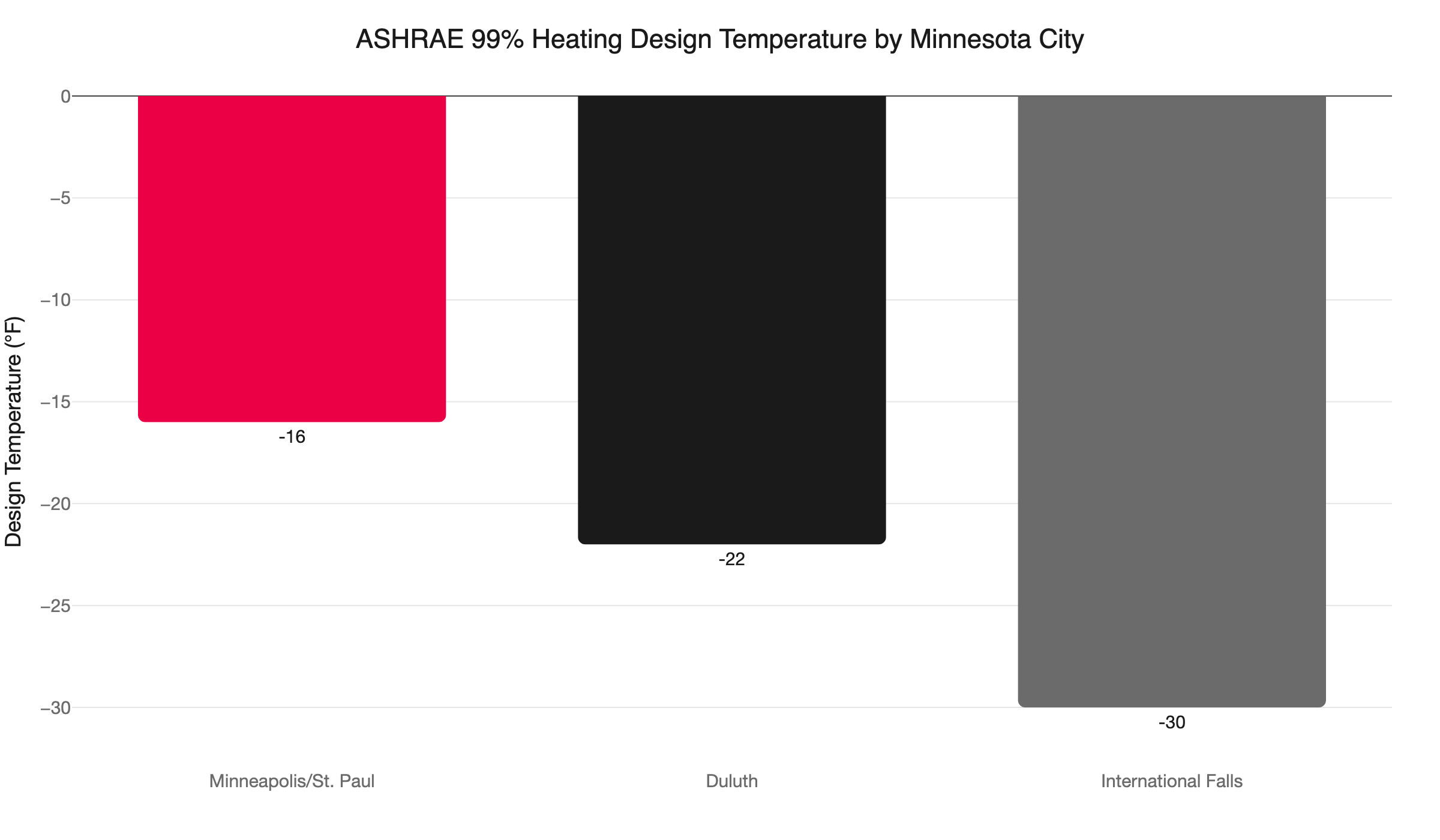
- The Minneapolis/St. Paul ASHRAE 99% heating design temperature is approximately -16°F. That number drives your furnace’s required capacity more than any other single factor.
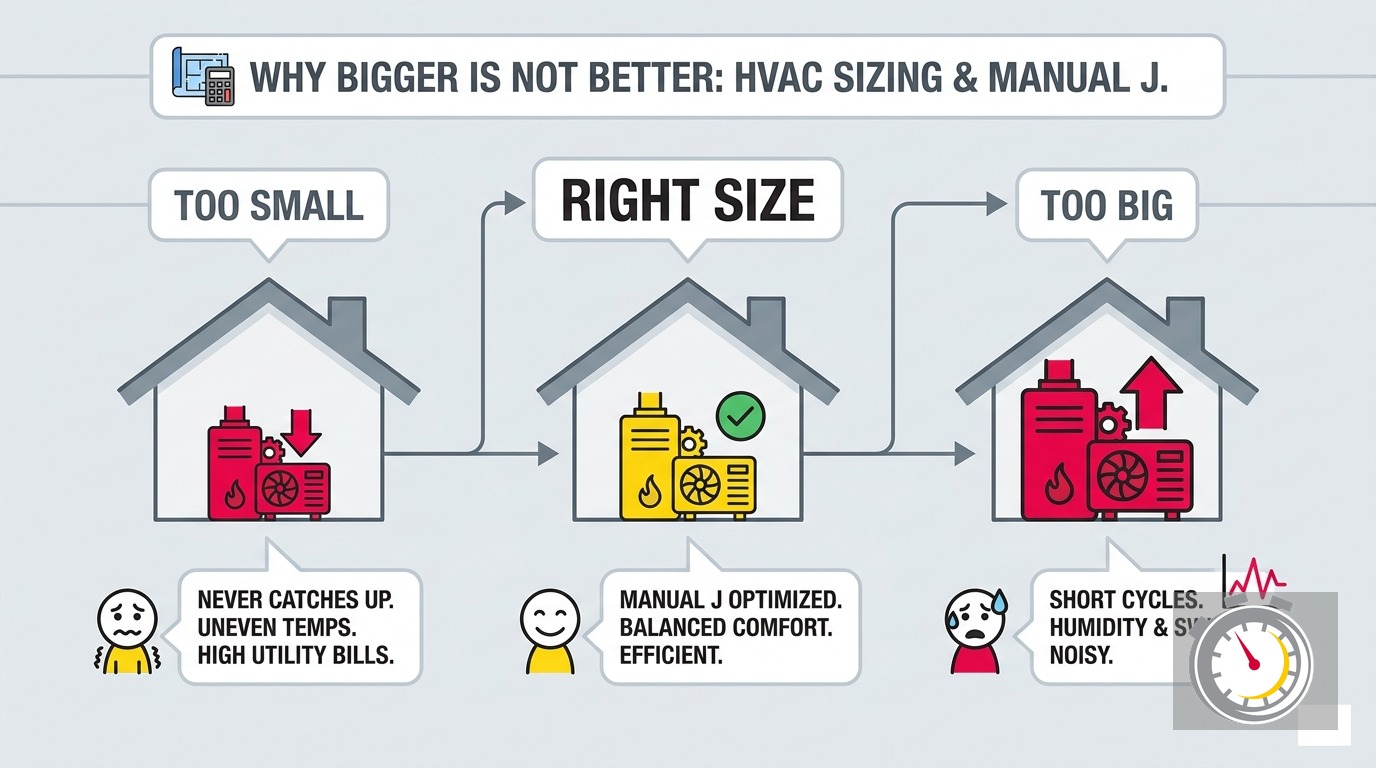
- An oversized furnace short-cycles. That accelerates heat exchanger fatigue, raises flue gas condensation risk in conventional units, and leaves your home with uneven temperatures.
- An oversized AC short-cycles, too. Short runtimes cool the air temperature but fail to remove humidity, leaving your home feeling clammy even when the thermostat reads correctly.
- Minnesota code requires Manual J under ACCA 8th Edition. Permits and utility rebates both flow from a compliant, documented installation.
- Xcel Energy and CenterPoint Energy rebates for high-efficiency furnaces and heat pumps are real money. Ask your contractor whether the proposed equipment qualifies before you sign.
What Is HVAC Sizing Manual J?
HVAC sizing using Manual J means calculating your home’s exact heating and cooling load with climate data, insulation levels, window area, infiltration rates, and internal heat sources. The result is a precise BTU figure, not an estimate. It tells your contractor exactly how much capacity your home needs - no guessing required.
The calculation is published by the Air Conditioning Contractors of America (ACCA). ACCA also publishes Manual S for equipment selection and Manual D for duct design. A proper installation follows all three in sequence. Manual J determines the load. Manual S matches equipment to that load. Manual D sizes the duct system to deliver it.
Most Twin Cities homeowners never see the calculation. But it determines whether your system runs efficiently, heats evenly, and lasts as long as it should.
The alternative is a rule of thumb: one ton per 500 square feet, or 50 BTU per square foot for heating. Those rules are calibrated to national averages. They are not calibrated to a Minnesota winter.
Why Rules of Thumb Fail in Minnesota
The common square-footage heating rules are not calibrated to -16°F.
According to the Minnesota HVAC Authority, when applied at Minnesota’s ASHRAE 99% heating design temperature, these rules can undersize heating by 30-50% for tight, well-insulated modern homes. For older, leakier homes, the same rule may oversize the system. One shortcut produces opposite errors depending on the home.
The reason comes down to delta-T: the difference between your indoor setpoint and the outdoor design temperature. Your indoor setpoint is typically 70°F. At -16°F outdoors in Minneapolis, the delta-T is 86 degrees. That number drives your heating load more than your square footage does.
Design temperatures also vary significantly across the state. The Twin Cities design temperature is approximately -16°F. Duluth’s is approximately -22°F. International Falls drops below -30°F. A calculation done for Minneapolis cannot be applied in Duluth without revision. More than 14 degrees of variation across a single state is not a rounding error - it is the difference between a correctly sized furnace and one that falls short on the coldest nights.
A well-insulated 2,400-square-foot home in Ramsey needs a different furnace than the same footprint in an older, drafty build. Square footage tells you one thing. A Manual J tells you what actually matters.
What Happens When Your Furnace Is Too Big?
An oversized furnace short-cycles: it fires at full capacity, satisfies the thermostat before heat distributes evenly, and shuts off. The area near each supply register overheats. The rest of the home stays cold. Then the cycle repeats. More frequent starts and stops mean more mechanical wear on every component.
ACCA Manual S sets the maximum oversizing limit for furnaces at 40% above the calculated load. That cap is not an arbitrary preference. It reflects the failure modes that appear when a furnace runs above that threshold - especially in cold climates like ours.
The most serious cold-climate risk is flue gas condensation. When a conventional (non-condensing) furnace short-cycles, the burner fires and the heat exchanger heats up fast. The burner then shuts off before the flue gases fully clear. Condensation forms inside the flue and the heat exchanger. Repeated exposure corrodes the heat exchanger from the inside. A cracked heat exchanger is a carbon monoxide risk, not just an efficiency problem.
Beyond corrosion, there is straightforward mechanical fatigue. Every start-up and shutdown stresses the inducer motor, the igniter, the gas valve, and the heat exchanger. A furnace sized to the calculated load cycles less often, runs more steadily, and ages more gracefully.
The “buy bigger for Minnesota winters” instinct is common. But the furnace is not a space heater. It is an engineered system designed to sustain a calculated output against a calculated heat loss. Match it to the load and you get even heat, lower bills, and a longer service life.
For a closer look at what happens when a furnace cycles too often, see our post on furnace short-cycling causes and fixes.
The Minnesota Cold-Climate Problem
Minnesota’s heating season is not the Sun Belt’s heating season.
The Minnesota HVAC Authority documents that the heating-to-cooling load ratio exceeds 3:1 on a seasonal energy basis for most Twin Cities homes. In northern Minnesota counties, that ratio can approach 6:1 or higher.
That ratio shapes how a contractor should think about sizing. The furnace is the lead actor in a Minnesota HVAC system. The air conditioner is the supporting player. A contractor who sizes primarily around summer cooling loads - the way many Sun Belt contractors do - will produce a system that is wrong in the direction that costs you the most.
It also means design temperature assumptions matter more here than in nearly any other region. Every year, Twin Cities winters produce hours that reach -16°F or close to it. Your furnace needs to handle those conditions without short-cycling, without struggling, and without burning out early.
A furnace sized correctly for a Twin Cities home will run steadily on the worst days of the year. A furnace sized too large will short-cycle all winter. A furnace sized too small will run continuously at design temperature and still not keep pace. Manual J is the only tool that tells you which outcome you are heading toward before the equipment goes in.
What Happens When Your AC Is Oversized?
An oversized AC satisfies the thermostat before completing a full dehumidification cycle. Short runtimes cool the air temperature but fail to remove enough moisture. The result: 73°F on the display and you still feel sticky. In summer, humidity controls comfort as much as temperature does.
ACCA Manual S caps AC oversizing at no more than 15% above the calculated cooling load. That is a much tighter limit than the furnace cap. The reason is dehumidification sensitivity.
Research from HVAC engineering practice explains the mechanism: moisture removal happens during the full runtime of a cooling cycle. The evaporator coil must stay cold long enough to condense water vapor from the air passing over it. Short-cycle runtimes - the direct product of oversizing - do not give the coil time to finish that job. The air leaves the coil cooler in temperature but still loaded with humidity.
Minnesota’s cooling season is shorter than the heating season. But a humid August afternoon in the Twin Cities is genuinely uncomfortable when the AC cannot pull moisture. The fix is not adding a standalone dehumidifier as a workaround. The fix is correct sizing at installation.
For a deeper look at why summer comfort fails even with a working AC, see our post on why your AC keeps running but your home still feels warm.
What Goes Into a Manual J Calculation?
A Manual J calculation integrates your home’s physical characteristics with verified local climate data to produce a room-by-room heating and cooling load in BTUs per hour. It requires specific measured inputs. A contractor cannot complete one accurately without them.
Here is what a proper Manual J needs:
- Local ASHRAE design temperatures. For heating in the Twin Cities, that is approximately -16°F. For cooling, it is the outdoor temperature the AC must hold comfort against.
- Indoor setpoint. Typically 70°F for heating and 75°F for cooling.
- Envelope U-values. The thermal resistance of your walls, ceiling, floor, windows, and doors. Better insulation means lower heat loss per square foot.
- Infiltration rate. How much outside air leaks in. A blower door test measures this directly. Manual J also provides default estimation tables. A tight, well-sealed home loses far less heat than a drafty older build.
- Internal and solar gains. Heat from appliances, lighting, and the people in your home. South-facing windows can meaningfully reduce your heating load on clear winter days.
- Latent loads. The moisture component: how much humidity the AC must remove in summer, and how your humidification system should be sized for winter.
Duct losses belong in the analysis, too. The U.S. Department of Energy estimates duct leakage in unconditioned spaces represents 20-30% of delivered heating and cooling capacity. An attic full of leaky ducts is giving away a meaningful slice of what the furnace produces before that heat reaches your living space. Manual J for load sizing and Manual D for duct design work together. Swapping a furnace without assessing the duct system leaves the efficiency problem in place.
Is Manual J Required in Minnesota?
Yes. Minnesota State Building Code references ACCA Manual J, 8th Edition as the approved method for residential HVAC sizing, enforced through the Minnesota Department of Labor and Industry’s permitting and inspection framework. A contractor who skips it is not cutting a corner - they are building out of code.
Twenty-nine states, including Minnesota, require Manual J calculations for new residential construction under Section 403.6 of the 2009 IECC and Section 1401.3 of the 2009 IRC. Minnesota has since adopted the IECC 2021 with state amendments as Chapter 1322 of the Minnesota Energy Code. Those requirements remain in force.
When a contractor pulls a permit for a furnace or AC replacement, the sizing methodology is part of what the building department reviews. This applies across Twin Cities jurisdictions. “We’ll just match the old unit” is not a compliant answer. Neither is a square-footage estimate on a paper napkin.
There is a practical upside beyond compliance. A permitted installation with documented Manual J calculations is a clean record for a home sale. Buyers and inspectors increasingly ask for it. A well-documented HVAC installation supports the transaction rather than creating questions at the closing table.
Rebates, Permits, and Why Manual J Is the Gate to Both
Minnesota’s utility rebate programs are funded under Minnesota Statute § 216B.241. That statute requires investor-owned utilities above a defined revenue threshold to invest a percentage of gross revenues in energy conservation. That mandate is why Xcel Energy and CenterPoint Energy offer meaningful equipment rebates year after year - it is not optional for them.
The rebate requirements are specific:
- Xcel Energy residential furnace rebates require a minimum 96% AFUE to qualify for the highest tier.
- CenterPoint Energy CIP similarly covers 96%+ AFUE condensing furnaces.
- Heat pumps must appear on the NEEP Cold Climate Heat Pump List to qualify for Xcel rebates. That is a performance gate tied directly to Minnesota’s climate demands.
Correct sizing and correct efficiency ratings work together. An oversized system that short-cycles cannot demonstrate the steady-state efficiency that rebate programs reward. Running the numbers with Manual J before selecting equipment confirms that both conditions are met.
Modern cold-climate variable-speed heat pumps maintain rated heating capacity down to -13°F or lower. ACCA Manual S includes specific procedures for matching heat pump capacity curves to Minnesota’s design conditions. A heat pump sized too large will short-cycle in heating mode just like an oversized furnace does - all the same failure modes, a different fuel source.
On the federal side: the §25C Energy Efficient Home Improvement Credit (up to $2,000 for qualifying heat pumps; up to $600 for 97% AFUE furnaces) was repealed for equipment placed in service after December 31, 2025. If you completed a qualifying installation in 2025, that credit is still claimable on your 2025 tax return. The §25D Residential Clean Energy Credit for geothermal and ground-source heat pumps remains at 30% of total installed cost through 2032, with no dollar cap.
If you are weighing a heat pump for your Twin Cities home, our post on heat pumps in Minnesota covers the cold-climate performance picture in detail.
What Should You Ask Your Contractor Before an HVAC Installation?
Ask to see the Manual J report. A contractor who has done the calculation will have one. If the answer is “we’ll just match what’s in there now” or “we size by square footage,” ask more questions before signing anything. Those answers are not Manual J.
Here are the right questions:
What heating design temperature are you using? In the Twin Cities, the correct figure is approximately -16°F. A milder assumption produces an undersized heating system that will struggle on the coldest days.
Is this a full Manual J calculation or an estimate? A real Manual J has a printed or digital report with room-by-room load figures. An estimate has a number written on a quote sheet. They are not the same thing.
Does the calculation include duct losses? If your ducts run through an unconditioned attic or crawlspace, duct leakage affects delivered capacity. It should appear in the analysis, not be left as an assumption.
Will you pull a permit? Replacing major HVAC equipment requires a permit in most Twin Cities jurisdictions. Permitted work gets inspected. That inspection protects you and documents the installation correctly.
Does this equipment qualify for Xcel or CenterPoint rebates? If the system meets efficiency thresholds and is correctly sized, you may recover several hundred dollars. Your contractor should know the current rebate schedule and whether the proposed equipment makes the cut.
Northern One Hour is locally owned and operated in Ramsey, Minnesota. We serve Minneapolis, St. Paul, Blaine, Maple Grove, Plymouth, Brooklyn Park, Woodbury, Bloomington, and the surrounding Twin Cities metro. When we size a system, we run a real Manual J using your home’s specific details and Minnesota’s actual design conditions - not a national average and not a shortcut.
Every installation we do comes with our satisfaction guarantee and our on-time promise. “Always On Time… Or You Don’t Pay a Dime!(R)”
Call us at (763) 260-6662 or book online to schedule a sizing consultation. We provide upfront pricing, documented calculations, and no surprises. Ready to talk furnace replacement or new AC installation? We are ready when you are.
Frequently Asked Questions
What is a Manual J load calculation? +
Is a Manual J calculation required in Minnesota? +
Can a furnace be too big for a home? +
What HVAC rebates are available in Minnesota? +
Need a technician now?