
HVAC for Minnesota Cabin: Freeze Protection and Sizing
Key Takeaways
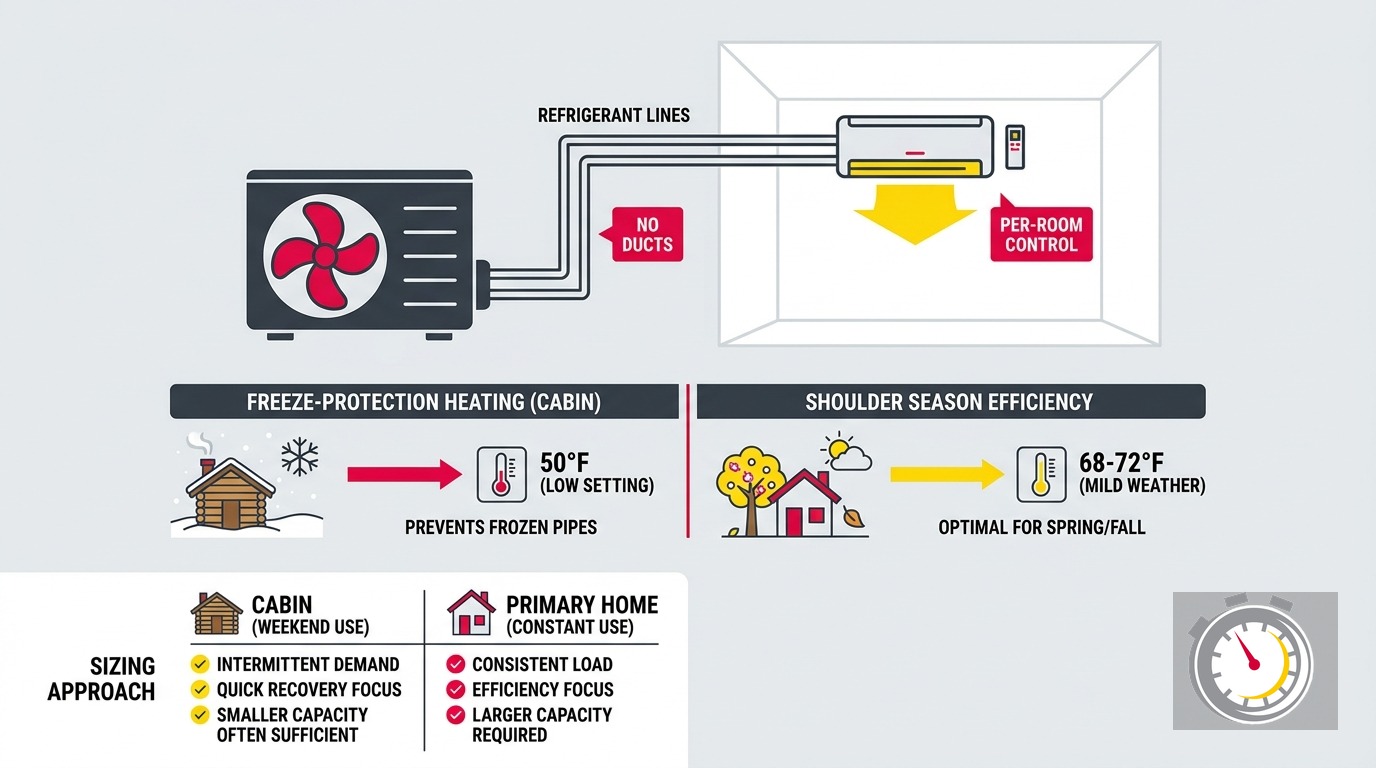
- A weekend cabin must be sized for recovery load, not maintenance load. A cabin at 45°F setback requires meaningfully more peak capacity than one coasting at 68°F.
- Hold the interior above 55°F continuously when the cabin is unoccupied, or drain all water-bearing systems. At -10°F outdoor temperature, an unprotected hydronic coil can rupture within two to four hours of heating loss.
- Modern cold-climate mini-splits include an autonomous freeze-protection mode. The unit holds the space above approximately 50°F even when set to “off.”
- Manufacturers enrolled in the DOE Cold Climate Heat Pump Challenge are rated for full output at -13°F. Standard heat pumps lose up to 60% of their capacity at that temperature.
- Xcel Energy’s $2,000 cold-climate heat pump rebate, plus a $600 insulation bonus, is active through September 30, 2026. Federal 25C tax credits expired December 31, 2025.
- A mechanical permit is required before any HVAC installation, including mini-splits, even at a rural cabin. Skipping it voids most warranties.
- The practical design for most Minnesota cabins: a cold-climate mini-split as the primary system, with propane backup for nights below -15°F to -20°F.
HVAC for a Minnesota cabin is not the same problem as HVAC for your primary home. Your house runs at 68°F around the clock. Your cabin doesn’t. It sits at 45-50°F most of the week. When you pull in Friday evening, every wall, floor, and stick of furniture has been shedding heat for five days. Getting the place to comfortable in two to three hours on a cold afternoon is a different engineering problem.
Most HVAC guidance for cabins misses this. It treats the cabin like a smaller house and applies the same sizing logic. That produces a system that either runs out of capacity on a bad winter Friday or costs far more than it should.
This post explains the three-part logic that governs every cabin HVAC decision: freeze protection, recovery sizing, and shoulder-season efficiency. Get all three right and you have a system that works. Miss any one and you’re overspending on propane, underpowered when it matters, or staring at a burst pipe come spring.
Why HVAC for a Minnesota Cabin Is a Different Problem
Minnesota falls in IECC Climate Zones 6 and 7 - the two coldest non-subarctic designations in the contiguous U.S. Metro-area lakes (Mille Lacs, Brainerd, St. Croix) land in Zone 6. Northern Minnesota (Boundary Waters, Grand Marais) reaches Zone 7. Zone determines minimum insulation requirements, duct leakage limits, and equipment efficiency thresholds. A system designed for a milder climate will not hold up here.
Design temperature varies significantly across the state. The Twin Cities metro design temperature is roughly -16°F. Cabins north of Brainerd, on the Iron Range, or near the Boundary Waters face -25°F to -30°F. That 10-15°F difference changes every system decision. It affects the cold-climate rating you need, the backup heat sizing required, and the insulation threshold below which a mini-split alone can’t keep up.
The second problem is occupancy pattern. A primary home runs at 68°F continuously. A weekend cabin drops to 45-50°F every time you leave. When you arrive Friday evening, the structure is cold-soaked. Every surface has been shedding heat for five days. Warming that thermal mass in two to three hours is a different load. It is not the same calculation as maintaining 68°F in a home that never cools way down.
Three questions govern every cabin HVAC decision:
- Freeze protection: Will the system hold the interior above a safe threshold autonomously when you’re gone?
- Recovery capacity: Can it bring a cold-soaked structure to comfort in two to three hours?
- Shoulder-season efficiency: Does it run cheaply in September and October, when cabin use peaks before freeze-up?
Answered together, those three questions point to the same design most of the time: a cold-climate ductless mini-split as the primary system, with propane backup for the coldest nights.
What Temperature Should You Hold in a Minnesota Cabin When You’re Not There?
Hold the interior above 55°F continuously, or drain all water-bearing systems before you leave. At -10°F outdoor temperature, an unprotected hydronic coil can freeze and rupture within two to four hours of heating loss. The 55°F threshold is the standard protocol for Minnesota vacation properties.
Running an old propane furnace as a week-long freeze guard has real costs. Propane prices swing. Rural tank runs can be unpredictable. A furnace cycling to hold 55°F for five days also operates inefficiently. It burns fuel and equipment cycles on a task it wasn’t designed to run continuously.
Cold-climate mini-splits handle this differently. Most modern units from manufacturers like Mitsubishi, Daikin, and Bosch include a frost-guard or freeze-protection mode. When you set the unit to “off” before leaving, it does not fully shut down. It continues sampling interior air temperature. If the cabin drops toward 50°F, the unit switches on and heats until the threshold is met. Then it goes quiet again.
That behavior eliminates a frustrating tradeoff. You no longer have to choose between running the heat at setpoint all week or draining the plumbing before every departure. The mini-split monitors the space and responds. You get freeze protection without a propane furnace running a long, inefficient duty cycle for one degree of margin.
For guidance on setback temperatures during extended winter absences, see our post on what temperature to set your thermostat when leaving a Minnesota home in winter.
Does a Cold-Climate Mini-Split Actually Work at Minnesota Temperatures?
Yes, if the unit is rated for cold-climate operation. Modern cold-climate heat pumps maintain full rated capacity to -13°F and useful output to -22°F or colder. Through the DOE Cold Climate Heat Pump Challenge, eight major manufacturers have committed to those specifications: Bosch, Carrier, Daikin, Johnson Controls, Lennox, Midea, Rheem, and Trane Technologies.
Standard heat pumps are a different product. They can lose up to 60% of their heating capacity at -13°F. If you’re installing at a cabin where the design temperature is -16°F, you need a unit explicitly rated for cold-climate operation. A standard unit marketed with vague cold-weather language is not the same thing.
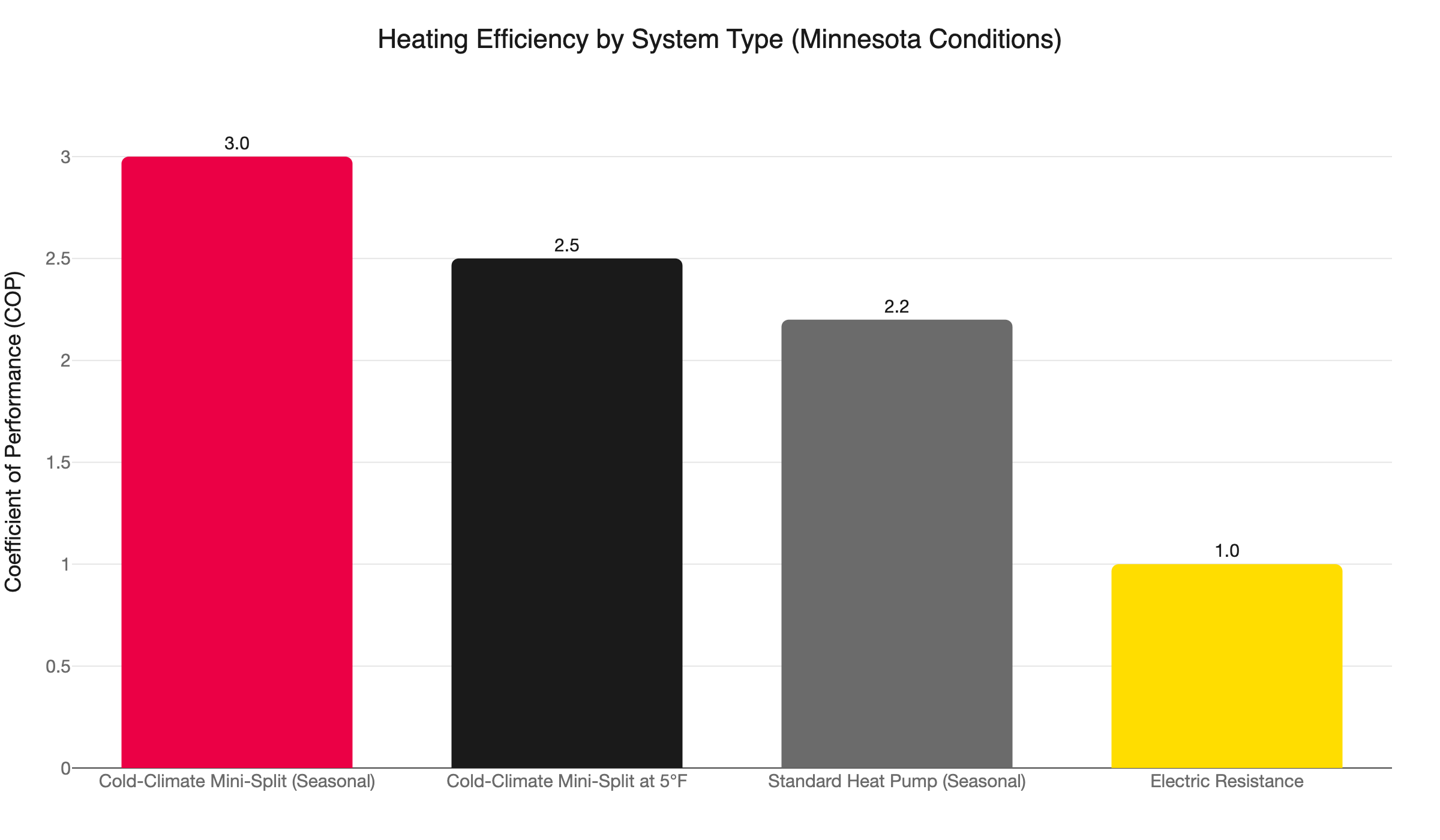
The efficiency case for shoulder seasons is the clearest argument for the mini-split. A cold-climate mini-split delivers a seasonal COP of 2.8 to 3.1, meaning each unit of electricity produces 2.8 to 3.1 units of heat. At 5°F outdoor temperature, COP holds at 2.4 to 2.6. Compare that to a standard heat pump at 2.2 seasonal COP, or electric resistance heat at 1.0 by definition.
In September and October, when Minnesota temps run 35-55°F, cold-climate COP climbs to 3.5 or above. That is the cheapest heat available in the structure short of a geothermal system. It is also when cabin use peaks. The last weekends before freeze-up are the ones people fight to keep. Running a propane furnace at $2-plus per gallon for those weekends costs significantly more than a mini-split at Minnesota electric rates.
The dual-season argument is often underweighted in cabin planning. Many owners focus on the heating question and treat summer cooling as secondary. August weekends at a Minnesota lake cabin can be warm enough to want air conditioning. A cold-climate mini-split handles both seasons from one installation.
For a comparison of how cold-climate brands perform in real Minnesota conditions, see our post on cold-climate heat pump brand performance in Minnesota.
How Should You Size HVAC for a Minnesota Cabin?
Start with a Manual J calculation for the steady-state load, then account for recovery. Minnesota mechanical code (MN Rule 1346) requires equipment to be sized per ACCA Manual J, but permits oversizing up to 43%. A cabin recovering from 45°F to 68°F in two to three hours on a cold design day justifies using most of that allowance.
The steady-state Manual J tells you how much capacity you need to hold 68°F when the structure is already at 68°F. That is the maintenance load. The recovery load is different. It accounts for heating every wall, floor, ceiling, piece of furniture, and any slab from a cold setback temperature in a fixed window. Those two numbers are not equal.
A contractor who quotes a system based only on square footage is using the wrong design basis. They need to ask about setback temperature, insulation level, and design temperature. A 1,000 square-foot cabin at 45°F on a -10°F afternoon demands more peak capacity than that same cabin maintaining 68°F under identical outdoor conditions.
Ask your contractor to show you the Manual J inputs and outputs before they recommend equipment. Any competent HVAC contractor can run Manual J. A contractor who can’t show you the calculation is working from intuition, not engineering.
Bring these questions to any contractor you evaluate:
- What is the design outdoor temperature for this specific location?
- What is the cabin’s current insulation level, and how does it affect the Manual J?
- What setback temperature are we targeting, and what recovery window is realistic?
- Are we sizing for maintenance load or recovery load?
What Happens Below -15°F?
A cold-climate mini-split will operate below -15°F, but its output drops and may not keep pace with a poorly insulated cabin on the coldest Minnesota nights. The practical design for most northern Minnesota cabins: mini-split as the primary system, propane backup for the coldest stretches. Backup heat is a design requirement, not an afterthought.
Even the best cold-climate units have a performance floor. Full rated capacity holds to -13°F, useful output extends to -22°F or colder. Below that, the unit still runs but delivers less. On the Iron Range or near the Boundary Waters, where temperatures can sit at -20°F or lower for days, a cabin with thin walls will lose heat faster than the mini-split can replace it.
The propane backup fills two roles. First, it handles the cold extremes the mini-split cannot cover alone. Second, it provides redundancy. If the mini-split needs service in February, the propane backup holds the pipes safe.
The right framing: the mini-split isn’t replacing propane entirely. It covers freeze protection, all shoulder-season weekends, and most of the heating season. A cabin with a cold-climate mini-split and propane backup may use 30-50% less propane than a propane-only setup. The backup runs when it needs to. The mini-split handles the rest.
For more on how heat pumps and backup systems interact at extreme Minnesota temperatures, see our post on heat pump balance point and backup heat in Minnesota.
What Rebates Are Available Right Now for Cabin HVAC in Minnesota?
Xcel Energy offers up to $2,000 for a qualifying cold-climate air-source heat pump, plus a $600 insulation bonus, for Minnesota residential electric customers. CenterPoint Energy offers up to $1,500 for ducted heat pump systems. These utility CIP rebates are the active incentive stack as of August 2026. Federal 25C tax credits expired December 31, 2025 and are not available for new installations.
The full rebate picture:
- Xcel Energy: Up to $2,000 for a cold-climate ASHP, plus a $600 insulation bonus. Applications accepted through September 30, 2026. Confirm eligibility at the Xcel Energy heat pump rebate page.
- CenterPoint Energy: Up to $1,500 for ducted heat pump systems. Can stack with Xcel if the cabin has dual-utility service.
- Federal 25C/25D credits: Expired December 31, 2025. Any source still citing these for 2026 installations is giving outdated guidance.
- MN HEAR/HOMES state rebates: Not yet launched as of mid-2026. Minnesota Department of Commerce is awaiting federal DOE approval with no confirmed launch date. Do not budget on these for a 2026 installation.
The Xcel rebate is meaningful money on a mini-split job. If the cabin is on Xcel electric service, that $2,000 should be captured before the September 30 deadline. Verify the cabin’s utility service territory with Xcel directly. Rural lake properties sometimes fall outside Xcel’s coverage area.
For a full summary of current incentives, see our post on Minnesota heat pump rebates and tax credits.
Do You Need a Permit to Install HVAC in a Minnesota Cabin?
Yes. Minnesota State Mechanical Code (MN Rule 1346.0105) requires a permit for any HVAC installation, including ductless mini-splits, in a cabin or vacation property. In rural counties without their own inspection program, the Minnesota Department of Labor and Industry serves as the Authority Having Jurisdiction. The permit must be pulled before work begins, not after.
Cabin installations get skipped more often than homeowners expect. The job is at a remote property. The contractor is a local operator. Nobody seems to be watching. The permit feels like unnecessary paperwork for a small structure.
Skipping it has consequences. An unpermitted installation voids most manufacturer warranties. It can complicate an insurance claim after a freeze event. It creates problems at resale. The Department of Labor and Industry has authority to require removal and reinstallation of unpermitted work in the counties it covers.
Ask your contractor to confirm they will pull the permit before the job is scheduled. Reluctance to pull a permit on a remote cabin job is a red flag.
The Practical Setup for Most Minnesota Cabins
Most lake and weekend cabins in Minnesota arrive at the same system design once the three-part logic is applied.
Primary system: cold-climate ductless mini-split. A single-zone wall unit handles an open-plan cabin with a great room and sleeping loft. Multi-zone is the right call for separated bedrooms or a finished lower level. This unit handles freeze protection autonomously, covers all shoulder-season weekends efficiently, and carries most of the heating season. It covers summer cooling, too.
Backup: propane wall heater or small propane furnace. Set to 50°F as a hard floor. This handles nights below -15°F to -20°F and provides redundancy if the mini-split needs service in deep winter. It is the last freeze-protection line if the primary system and its controls ever fail.
Setback strategy: Engage the mini-split’s freeze-protection mode before leaving. The unit monitors the interior autonomously and responds to drops near 50°F. Neither system needs to run at full setpoint all week.
Cabin layout shapes the mini-split decision more than square footage alone. An open great room with a sleeping loft may work perfectly with one wall unit. A cabin with a back bedroom and a walk-out lower level requires a conversation about head placement and zone count before equipment is chosen.
Building envelope matters as much as equipment selection. A cabin with thin walls, single-pane windows, and little attic insulation loses heat rapidly. A system sized for a well-insulated cabin may be undersized in a drafty one. If the building envelope hasn’t been addressed since the cabin was built, that conversation should happen before the equipment is specified.
Ready to Get Your Cabin HVAC Right?
Getting HVAC right in a Minnesota cabin requires someone who knows cold-climate equipment, can size for recovery load, and understands what a Zone 6 or Zone 7 design temperature actually demands.
Northern One Hour Heating & Air Conditioning is locally owned and operated out of Ramsey, MN. We serve the Twin Cities metro and the surrounding communities. We back every job with our on-time promise, “Always On Time… Or You Don’t Pay a Dime!(R),” and a 100% satisfaction guarantee.
If you’re planning a mini-split installation before the Xcel rebate deadline, or you want an honest assessment of what your current cabin setup can handle in a Minnesota winter, call us at (763) 260-6662 or book online. Financing is available for larger installations, including new mini-split systems and full HVAC replacements.
Frequently Asked Questions
Does a mini-split work in a Minnesota cabin in winter? +
What temperature should I set my cabin heat when I leave? +
Are there heat pump rebates available for a Minnesota cabin in 2026? +
Need a technician now?