
Heat Pump Balance Point Minnesota: Get the Crossover Right
Key Takeaways
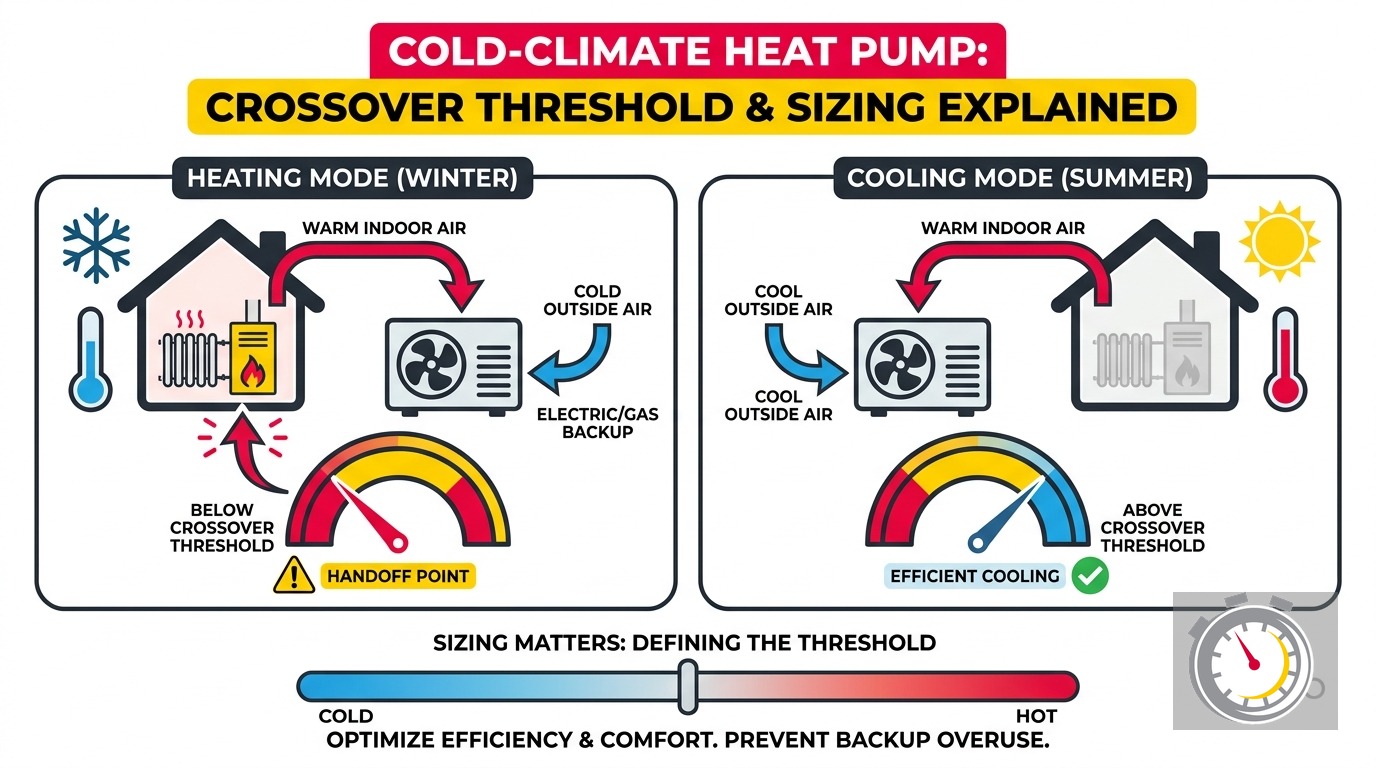
- The capacity balance point is the outdoor temperature at which your heat pump can no longer cover your home’s heat loss on its own. Below it, backup heat must assist.
- The economic balance point is a separate number: the outdoor temperature at which your backup fuel (gas or propane) costs less per BTU than running the heat pump.
- Old single-stage heat pumps had balance points of 30-35°F, so backup heat ran through most of a Minnesota winter. Modern cold-climate inverter units push that threshold down to 5°F or lower.
- Setting the switchover too high forces backup heat to run at temperatures the heat pump could have handled at two to three times the efficiency.
- Xcel Energy customers can qualify for a reduced electric space-heating rate. That rate shifts the economic balance point lower - meaning the pump should run deeper into the cold than many contractors currently set it.
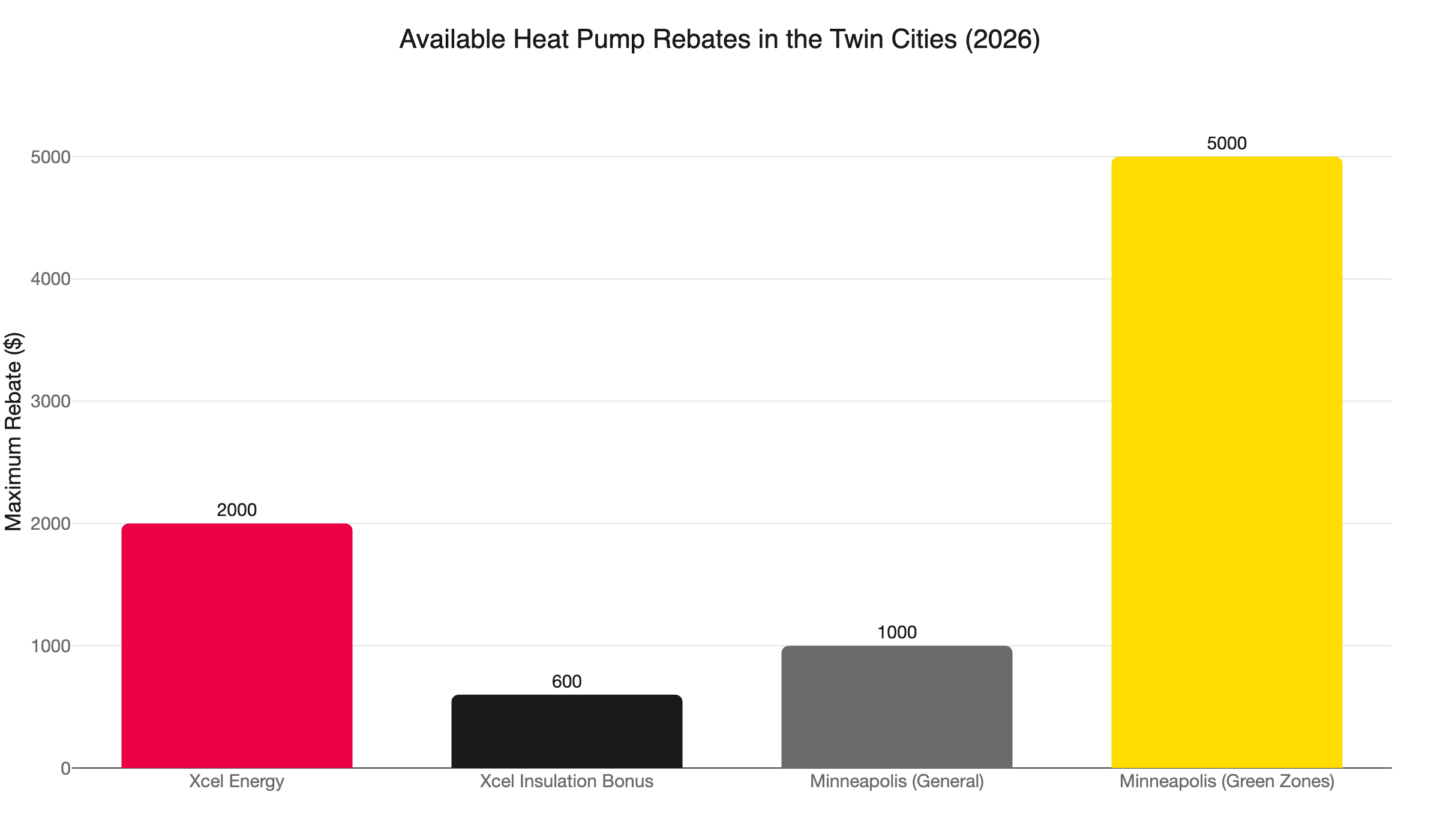
- Available rebates as of mid-2026: Xcel Energy up to $2,000 (plus $600 insulation bonus), Minneapolis up to $5,000 in designated Green Zones, and CenterPoint stacking rebates for dual-fuel systems.
What Is the Heat Pump Balance Point, and Why Does It Matter in Minnesota?
The heat pump balance point is the outdoor temperature at which your heat pump’s output exactly meets your home’s heat loss rate. Above it, the pump handles everything. Below it, backup heat must step in. In Minnesota, where temperatures regularly drop into the single digits, getting this number right has a direct impact on your heating bill.
Most homeowners hear “balance point” once, during a system install, and never think about it again. That’s understandable. But the switchover temperature is not a passive factory setting you accept and move on from. It’s a calculated number - one that should be specific to your equipment, your home, and your current utility rates.
Here’s what most sales conversations leave out. There are actually two balance points, and they usually sit at different temperatures. One is about what the equipment can physically do. The other is about what makes financial sense at current energy prices. Understanding both changes how you evaluate any dual-fuel system installation in Minnesota.
Does a Heat Pump Have One Balance Point or Two?
Two - and they often disagree. The capacity balance point is set by physics: what can the equipment do at this temperature? The economic balance point is set by your utility rates: what fuel is cheaper per BTU right now? For natural gas customers, the economic balance point is often higher than the capacity balance point.
The MN Air Source Heat Pump Collaborative defines both concepts clearly. The capacity balance point is where your pump’s heating output curve and your home’s heat loss curve intersect. It’s determined by the equipment you have and how tight your building envelope is. You can’t override it by adjusting a dial.
The economic balance point works differently. It shifts with energy prices. For natural gas customers, there is often a temperature range where the heat pump is still physically capable of heating the house, but natural gas is cheaper per BTU than the electricity needed to run the pump. At those temperatures, switching to gas saves money.
Propane customers see a different picture. Propane costs enough that running the heat pump longer almost always wins on cost per BTU. The capacity and economic balance points tend to converge for propane users. This matters at installation. A contractor who uses the same switchover default for a natural gas home and a propane home is almost certainly wrong for at least one of them. The fuels are priced differently, and the calculation should reflect that.
Why Did Old Heat Pumps Struggle in Minnesota Winters?
They lost capacity quickly as temperatures fell. Old single-stage heat pumps had balance points around 30-35°F, so backup heat ran from early November through late March. That history is why heat pumps earned a bad reputation in cold climates - but the technology has changed significantly.
Modern cold-climate inverter-driven heat pumps push the balance point down to 5°F or even -5°F. Top-rated units maintain rated capacity down to 5°F and continue producing heat at -13°F or lower before backup fully takes over. Eight major manufacturers are now committed to DOE’s Residential Cold Climate Heat Pump Challenge, targeting reliable operation at -22°F.
A properly sized cold-climate air source heat pump can cover 100% of a home’s heating needs down to 0°F, which accounts for roughly 90% of all heating hours in a Minnesota winter. The backup system exists for the brutal outlier days - not for routine cold-weather operation.
One caveat worth knowing before you shop. Real-world Minnesota performance sometimes runs below lab-rated efficiency numbers. The Minnesota Center for Energy and the Environment measured field performance of a 12.5 HSPF heat pump across several Minnesota installations and found actual efficiency roughly 30% below the rated figure - equivalent to about HSPF 9. Rated numbers are measured under controlled conditions that don’t fully represent Minnesota cold. This doesn’t disqualify cold-climate heat pumps as a choice for this climate. It means sizing and switchover settings should account for real field performance, not just the specification sheet.
What Temperature Should Your Contractor Set the Switchover?
For most natural gas dual-fuel systems in typical Twin Cities homes, a switchover in the 20-25°F range is worth discussing - lower than most factory defaults. For propane dual-fuel systems, the number should be lower still. The right answer depends on your specific equipment and your actual utility rates.
Dual-fuel systems use an outdoor sensor to monitor temperature and trigger the transition to backup heat. Most come factory-preset between 25-40°F. Those defaults were calibrated when balance points of 30°F were standard. A modern cold-climate inverter unit can operate efficiently well below those thresholds - and leaving the factory preset in place means the furnace takes over at temperatures the heat pump could have handled for a fraction of the cost.
If your contractor installs a cold-climate unit and walks away with the preset at 35°F, your gas furnace is activating on every night below that temperature. In Minnesota, that covers a substantial portion of the heating season.
Three questions worth asking at installation:
- What is this unit’s rated heating capacity at 5°F and at 17°F?
- What is my home’s calculated heat loss rate at the design temperature?
- At what outdoor temperature does my backup fuel become cheaper per BTU than electricity at my current rate?
A contractor who can answer all three with confidence is doing the job correctly. If the answer is “we just leave it at the default,” that’s a gap worth closing before the first cold snap.
What Lowers the Balance Point in Your Home?
Insulation and air sealing. The better your home’s thermal envelope, the less heat your system has to replace at any outdoor temperature. That directly pushes the capacity balance point lower and reduces how often backup heat activates.
This is the principle building-science professionals have been making for years, and it applies directly to a typical 1970s Twin Cities ranch house. Reducing a home’s heating load through air sealing and insulation drops the capacity balance point on the same heat pump. The pump can cover the home’s heating needs at colder outdoor temperatures because there’s less heat loss to overcome.
In a very tight, well-insulated home, the outdoor temperature at which the heating system even needs to activate can drop from around 65°F to 55°F. A home with R-40 walls, R-50 ceiling, and triple-pane windows - documented in a Minnesota case study by Energy Vanguard - ran through a full Minnesota winter with almost no backup heat activation. That’s an exceptional home, not a typical one. But the principle scales down to everyday houses.
For the average Twin Cities home built in the 1970s, with original insulation and 2x4 wall cavities, the balance point will sit higher than it would in a newer, tighter building. This has a practical consequence. Addressing attic insulation or air sealing before installing a heat pump isn’t just about energy savings. It directly lowers the temperature at which backup heat kicks in - making the heat pump system more effective every winter.
For a closer look at how envelope work connects to system performance, our guide to attic insulation, ventilation, and HVAC bills in the Twin Cities covers the relationship in detail.
How Does the Xcel Reduced Heating Rate Change the Math?
It shifts the economic balance point lower. When electricity costs less per BTU than the standard rate, the outdoor temperature at which natural gas becomes the cheaper option shifts downward. Your heat pump should run deeper into the cold than it would under standard pricing - and many contractors don’t adjust the switchover to reflect this.
Xcel Energy customers who use a qualifying heat pump as their primary heat source can apply for a reduced electric space-heating rate. This stacks on top of Xcel’s rebate of up to $2,000 for a qualifying cold-climate heat pump and the $600 bonus available when qualifying insulation or air-sealing work is completed first.
The reduced rate is a detail many homeowners and some contractors miss. If the economic balance point was calculated at standard electric rates and you later enrolled in the reduced rate, your switchover setting may now be set higher than it should be. That’s worth a follow-up call to your HVAC contractor.
There is also a layering opportunity. CenterPoint Energy offers stacking rebates through their Home Service Plus program for dual-fuel systems, with Daikin featured as one option. Combining Xcel equipment rebates with CenterPoint stacking rebates, then adding Minneapolis city incentives for eligible homeowners, can meaningfully reduce the installed cost of a new dual-fuel system.
What Does a Mis-Set Switchover Actually Cost?
Every degree you set the switchover above the true economic balance point is a degree at which you’re burning a more expensive fuel instead of running a heat pump at two to three times the efficiency. Across a full Minnesota heating season, that difference is not small.
Consider what a typical winter looks like. Minnesota delivers many nights in the 15°F to 35°F range. Weeks at a time. That’s exactly the zone where a mis-set switchover does its most consistent damage. If your switchover is set at 35°F and your cold-climate unit is capable of running efficiently down to 5°F, your furnace is activating every night below that threshold - instead of the heat pump doing the work at a fraction of the fuel cost.
At 20°F outdoors, a modern cold-climate heat pump is still delivering more BTUs of heat than BTUs of electricity it consumes. A high-efficiency gas furnace converts its fuel at 96% efficiency. On standard electric rates, gas can win at that temperature. On Xcel’s reduced heating rate, the heat pump often wins. The right answer depends on current prices - not a setting chosen at install and never revisited.
The inverse error is also real. Set the switchover too far below the economic balance point for your home and your utility rates, and the heat pump works hard in conditions where gas would be the cheaper choice. Neither extreme is free.
This is why the switchover temperature belongs on a maintenance checklist - reviewed at installation, and revisited whenever utility rates shift meaningfully. It’s not a set-it-and-forget-it number.
For a deeper look at how cold-climate heat pumps perform when temperatures really drop, our post on heat pump performance below zero in Minnesota covers the specifics.
What Rebates Are Available Right Now?
As of mid-2026, Xcel Energy and the City of Minneapolis offer the most meaningful available incentives. CenterPoint has stacking options for dual-fuel systems. The federal HEAR program has not launched in Minnesota yet. The 25C tax credit expired at the end of 2025.
Here is the current breakdown:
Xcel Energy: Up to $2,000 for a qualifying cold-climate heat pump. An additional $600 bonus is available if you complete qualifying insulation or air-sealing work before installation. Customers using the pump as primary heat can apply for the reduced electric space-heating rate. See Xcel’s heat pump rebate page for current eligibility requirements.
CenterPoint Energy: Stacking rebates through the Home Service Plus program for dual-fuel systems. See CenterPoint’s dual-fuel resource page for current amounts.
City of Minneapolis: Up to $1,000 for all Minneapolis residents. Up to $5,000 for homes in designated Green Zones. Check directly with the city for zone boundaries and current program availability.
Federal HEAR program: Not yet active in Minnesota as of June 2026. The state is waiting on formal DOE approval with no estimated launch date. The program would offer up to $8,000 for households below 80% of area median income and up to $4,000 for households between 80-150% AMI. Track current status at mn.gov’s heat pump program page.
25C federal tax credit: Expired December 31, 2025. Not currently available.
For a full current breakdown, including how to layer these programs, see our guide to Minnesota heat pump rebates and tax credits.
Ready to Have Your Heat Pump Balance Point Set Correctly?
The balance point is not a factory setting you leave alone and hope for the best. It’s a calculated number - specific to your equipment’s capacity curve, your home’s heat loss rate, and your current utility pricing. Getting it right at installation saves money starting the first winter. Revisiting it when rates or home conditions change saves more.
Our team at Northern One Hour Heating & Air Conditioning is locally owned and operated in Ramsey, MN. We have served Twin Cities homeowners long enough to know that a dual-fuel system running with the wrong crossover costs real money, season after season. We’ve seen systems running gas at 25°F that had no business doing so. We’ve also seen heat pumps cranking away at temperatures where gas would have been the smarter choice.
The goal isn’t a preset. The goal is a setting that reflects how your system actually performs in a Minnesota winter - with your home, your utility rates, and your comfort requirements.
We back every job with honest, transparent pricing, a 100% satisfaction guarantee, and our commitment to showing up when we say we will: “Always On Time… Or You Don’t Pay a Dime!(R)”
Call (763) 260-6662 or schedule service online to talk with a technician who understands how these systems perform in real Minnesota conditions.
Frequently Asked Questions
What is the heat pump balance point in Minnesota? +
Should the switchover be set higher or lower to save money? +
Does Xcel Energy offer rebates for cold-climate heat pumps? +
Need a technician now?