
How Does Heat Pump Staging Work? A Minnesota Guide
Key Takeaways
- Single-stage compressors run at 100% capacity or stop entirely. Two-stage adds a lower gear at roughly 65%. Variable-speed modulates continuously from about 25% to 100%.
- In mild climates, staging is a comfort and efficiency trade-off. In Minnesota, it is a cold-weather capacity question. When a two-stage unit maxes out, it hands off to electric resistance heat, costing two to four times more per BTU.
- MNASHP confirms that only variable-speed compressors can meet NEEP’s cold-climate specification. Two-stage units are classified as standard equipment.
- Xcel Energy’s rebate of up to $2,000 requires NEEP cold-climate listed equipment. NEEP listing requires variable-speed, by definition.
- The federal 25C Energy Efficient Home Improvement Credit expired December 31, 2025. No federal credit applies to 2026 heat pump installs, regardless of equipment type.
- Your thermostat tries Stage 1 first. If Stage 1 cannot close the gap in 10-15 minutes, it escalates to Stage 2. On most heat pumps in heating mode, Stage 2 triggers electric resistance strips, not a higher compressor speed.
How Does Heat Pump Staging Work?
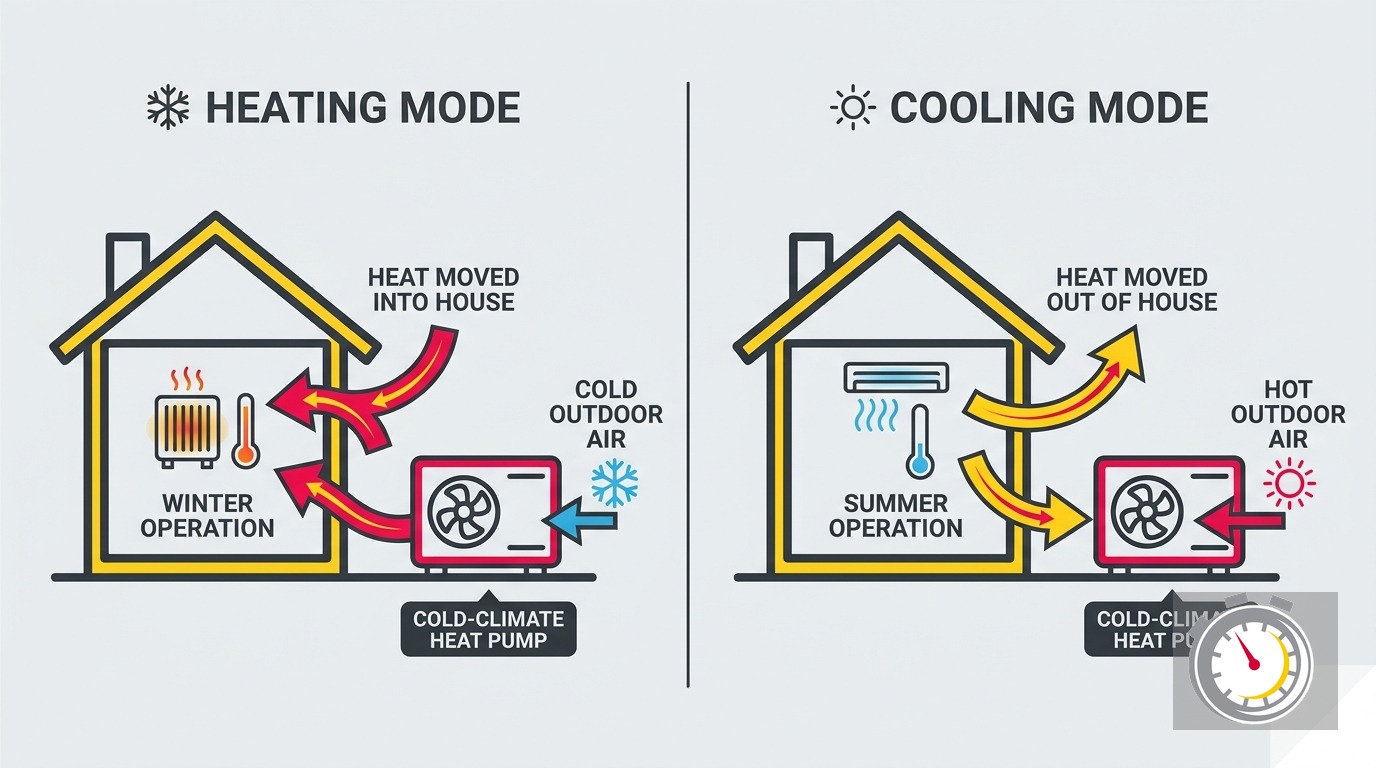
Short answer: A heat pump’s “stage” describes how many output levels the compressor has. Single-stage runs fully on or fully off. Two-stage adds a lower gear at about 65% capacity. Variable-speed modulates continuously, the same way cruise control adjusts engine output instead of alternating between flooring it and coasting.
Understanding how does heat pump staging work starts with the compressor. The compressor is the heart of every heat pump. It pressurizes refrigerant to pull heat from outdoor air and move it inside your home. A single-speed compressor does one thing: runs at 100%. A two-stage compressor adds a lower gear. A variable-speed compressor, driven by an inverter motor, operates at nearly any point between 25% and 100% of its rated capacity.
Think of your furnace first. Most Twin Cities homeowners already understand this comparison. A single-stage furnace fires at full blast or sits cold. A modulating furnace simmers at low flame for hours and rarely needs full output. Heat pumps work the same way. The compressor is the “flame.”
MNASHP describes variable-speed operation as cruise control: better fuel economy at steady speed than constant stop-and-go cycling. Your car burns more fuel toggling between zero and 60 mph than holding a steady 45 mph on the highway. A heat pump compressor works on exactly that principle.
The Three Compressor Types: How Heat Pump Staging Works at Each Level
Single-stage runs at 100% capacity or shuts off entirely. The system turns on, runs at full power, and stops when the thermostat is satisfied. It cycles more frequently in mild weather. That cycling adds wear to the compressor and creates indoor temperature and humidity swings. In summer, short run times mean the coil has less contact time to pull moisture from indoor air, so humidity control suffers.
Two-stage adds a low gear at roughly 65-70% of full capacity. The thermostat calls Stage 1 first. If Stage 1 cannot close the temperature gap within 10-15 minutes, or the gap between setpoint and room temperature exceeds about 2°F, the thermostat escalates to Stage 2. In mild weather, Stage 1 handles most of the load. In a cold snap, Stage 2 engages and the compressor runs at full output.
Variable-speed modulates in small steps from roughly 25% to 100%. Some cold-climate units can exceed 100% of rated capacity in heating mode. It can run for hours at low speed, keeping indoor temperature nearly flat. Longer run times improve summer dehumidification for the same reason: extended coil contact time with indoor air. The compressor adjusts continuously to match your home’s exact heating or cooling load.
The trade-off is real. Variable-speed units cost more upfront. For Minnesota homeowners using a heat pump as the primary heat source, the cold-weather performance difference usually justifies that cost over the system’s life. For a supplemental system backed by a gas furnace and used mainly for cooling, a two-stage unit is a reasonable and lower-cost fit.
Why Does Staging Matter More in Minnesota Than in Milder States?
Short answer: In mild climates, the two-stage vs. variable-speed choice is a comfort and efficiency comparison. In Minnesota, it determines how often your backup electric strips run in January. When a two-stage unit hits its heating ceiling, it surrenders to electric resistance heat, costing two to four times more per BTU than the heat pump mode it just left.
Standard heat pumps - single-stage and two-stage - deliver efficient heat down to about 20°F. Minneapolis logs many hours below that threshold in a normal winter. When a two-stage unit runs at full output and still cannot match your home’s heat loss, the thermostat calls for backup heat.
For most ducted heat pump systems, backup heat means electric resistance strips in the air handler. Those strips carry a coefficient of performance (COP) of 1.0. One unit of electricity in, one unit of heat out. The heat pump it just replaced was running at a COP of 2.0 to 2.5 or better. Switching to electric strips roughly doubles or triples your heating cost per BTU for every hour those strips run.
A variable-speed cold-climate unit responds differently. Instead of topping out and calling for backup, it raises compressor speed to match the increasing load. Field measurements from a Minneapolis installation recorded a COP of 1.98 at -17°F and 1.37 at -27°F. Both numbers beat electric resistance heat at COP 1.0 by a significant margin.
MNASHP is direct about the comparison: “Modern, variable-speed heat pumps are better suited to our heating needs in Minnesota. Standard heat pumps (single-stage or two-stage) have more limited heating capabilities in comparison.”
Staging choice is not just a budget decision in Minnesota. It is a climate-dependent decision. The same two-stage unit that performs perfectly well in Kansas City falls short during a January cold snap in Bloomington.
What Happens When a Two-Stage Heat Pump Tops Out in January?
Short answer: It calls for auxiliary heat. On most systems, that means electric resistance strips running at COP 1.0. The heat pump was running at COP 2.0 or better moments before. In Minnesota, this handoff can last for hours during a cold snap and adds meaningfully to your monthly electric bill.
The outdoor temperature at which the heat pump’s maximum output equals your home’s heat loss is called the balance point. Below the balance point, you need backup heat to maintain comfort. The lower you push the balance point, the less your electric strips run.
A two-stage unit’s balance point typically falls between 15°F and 25°F, depending on home size, insulation level, duct condition, and system capacity. Below that range, every degree of temperature drop means more backup strip runtime. On a -5°F night in Maple Grove, a two-stage unit in a modestly insulated home may run electric strips for several hours continuously.
A variable-speed cold-climate unit extends the balance point toward 0°F or below. It keeps doing useful heat pump work in conditions that force a two-stage unit to rely heavily on strips. Over a full Minnesota heating season, the difference accumulates in your utility bill in a way that is often significant enough to affect payback calculations.
For a detailed breakdown of how balance points are calculated and what to expect from each equipment type in extreme cold, see our post on heat pump balance points and backup heat in Minnesota.
How Does Your Thermostat Read Staging Demand?
Short answer: Your thermostat makes a polite request first (Stage 1 / Y1). If the room does not respond in 10-15 minutes, or the gap between setpoint and room temperature exceeds about 2°F, it makes a louder request (Stage 2 / Y2). On a heat pump in heating mode, Stage 2 usually triggers electric resistance strips, not a higher compressor speed.
The terminal wiring works like this on most systems:
- Y1: Stage 1 call. The thermostat energizes this terminal first, calling the compressor at lower capacity in both heating and cooling.
- Y2: Stage 2 call. Energized when Stage 1 cannot close the temperature gap. In cooling mode on variable-speed systems, this often requests higher compressor speed. In heating mode on two-stage heat pumps, it typically triggers the electric resistance strips, not a second compressor gear.
- AUX / W2: Auxiliary heat terminal. On a standard two-stage heat pump, this activates the electric resistance strips in the air handler.
This logic matters for how you program your thermostat. Large overnight setbacks create a problem. If you drop the house from 70°F to 62°F at 10 p.m. and call for 70°F again at 6 a.m., the thermostat faces an 8°F gap. That exceeds the Stage 1 threshold immediately. The system calls Stage 2 and AUX heat, and expensive electric strips carry the entire morning warmup.
For a heat pump home, gradual setbacks of 2-3°F are more efficient than deep ones. The system can hold temperature on Stage 1 for extended periods without triggering aux heat. A smart thermostat can manage this automatically, enforcing shallow setbacks overnight and recovering temperature slowly so Stage 1 does the work.
For a deeper look at heat pump thermostat wiring and aux heat staging - including terminal label variations by brand, common wiring mistakes, and what to do if your AUX light runs continuously - we have a dedicated post.
The NEEP Cold-Climate Specification
To qualify as cold-climate under the NEEP standard, a heat pump must meet all three of the following criteria:
- Variable-speed (inverter-driven) compressor
- COP of at least 1.75 at 5°F at maximum capacity
- HSPF of 9 or higher
Two-stage units cannot meet this specification by definition. They do not have a variable-speed compressor. MNASHP categorizes single-stage and two-stage units as “standard equipment,” appropriate when gas heat handles the coldest days and the heat pump role is supplemental.
There is also a limitation in how HSPF is calculated. HSPF test protocols include no data points below 17°F. The protocol assumes electric resistance heat fills all demand below that threshold. For Minneapolis, where the heating system logs many hours below 17°F in a normal winter, the HSPF on the label overstates real seasonal efficiency relative to what you will see on your actual utility bill.
A variable-speed unit with a high HSPF delivers better real-world efficiency in Minnesota than a two-stage unit with a similar rating. The reason: it continues doing heat pump work well below 17°F instead of handing off to electric strips early. Be cautious comparing HSPF numbers across staging types without accounting for your actual heating hours below 17°F.
The NEEP listing database is the practical shortcut for both homeowners and rebate submissions. A NEEP cold-climate listing means the unit has been independently verified to meet the COP and HSPF thresholds at temperatures Minnesota winters actually produce. The list is publicly searchable and updated regularly.
Do Minnesota Utility Rebates Depend on Which Stage You Choose?
Short answer: Yes. Xcel Energy’s rebate of up to $2,000 requires NEEP cold-climate listed equipment. NEEP listing requires variable-speed. A two-stage or single-stage unit disqualifies you from Xcel’s rebate entirely. CenterPoint’s rebate applies to dual-fuel setups and does not require NEEP listing.
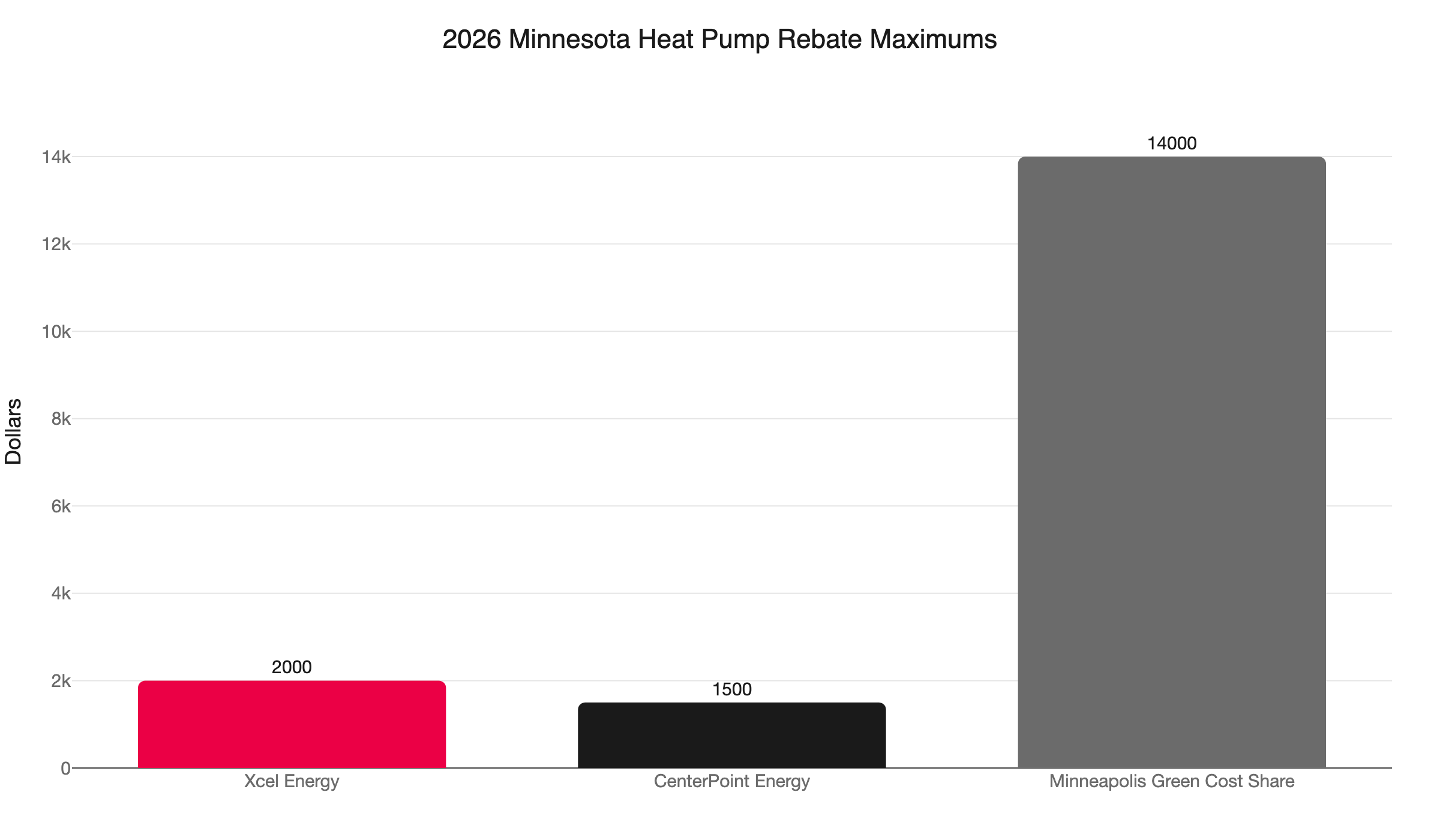
Here is the 2026 rebate picture for Minnesota homeowners, per Heat Pump Network’s verified guide:
- Xcel Energy: Up to $2,000 for a NEEP-listed cold-climate heat pump. An additional $600 insulation bonus is available when the install is paired with qualifying air sealing or insulation work. NEEP listing requires variable-speed.
- CenterPoint Energy: Up to $1,500 for a ducted air-source heat pump in a dual-fuel or hybrid configuration. $1,100 for a dual-fuel pairing with a 92%+ AFUE gas furnace. Does not require NEEP listing.
- Minneapolis Green Cost Share: Stacks on top of utility rebates and can reach up to $14,000 for Green Zone homes. Utility rebates and the Green Cost Share can be combined in the same project.
One correction that matters: the federal 25C Energy Efficient Home Improvement Credit expired December 31, 2025. Any article or contractor still quoting the 30% federal tax credit is citing outdated information. No federal offset applies to 2026 heat pump installs, regardless of equipment type or efficiency rating. Build your budget without it.
When you subtract Xcel’s $2,000 rebate from the installed cost of a variable-speed unit, the price gap between variable-speed and two-stage narrows significantly. For many homeowners, the rebate alone closes most of the difference. That conversation is worth having before you commit to a staging tier.
Our Minnesota heat pump rebates and tax credits page covers current stacking strategies and how to document equipment for utility submissions. Financing is available for larger installs. Ask our team about current terms when you call.
Variable-Speed or Two-Stage: Which Is Right for Your Home?
Short answer: If the heat pump is your primary heat source in a Minnesota home, variable-speed cold-climate is the right choice. It reduces backup heat runtime, qualifies for Xcel’s rebate, and handles extreme cold better than any two-stage unit. If you have a gas furnace and want the heat pump for cooling with supplemental heating, a two-stage unit can be a practical, lower-cost fit.
Three questions help narrow the decision for most homeowners:
1. Is the heat pump the primary heat source, or a supplement to gas? A primary heat pump must carry the full heating load through a Minnesota January. Cold-climate variable-speed capability is necessary to do that without running electric strips constantly. A dual-fuel hybrid system pairs a heat pump with a gas furnace and lets the furnace carry the coldest nights. In that configuration, the heat pump’s low-temperature ceiling matters less, and a two-stage unit is a reasonable fit.
2. Are you on Xcel Energy? The $2,000 rebate applies only to NEEP-listed variable-speed equipment. When you subtract the rebate from the total installed cost, the price gap between staging tiers often shrinks to a manageable amount. The rebate alone can close most of the difference between a two-stage and a variable-speed install.
3. How is your ductwork? Variable-speed operation is quieter and more efficient, but those gains require adequate duct sizing and minimal leakage. Leaky or undersized ducts blunt the efficiency advantage before it shows up on your utility bill. Duct condition is worth assessing before you select a compressor tier. An efficient compressor working against poorly sealed ductwork delivers neither the comfort nor the operating cost savings its spec sheet promises.
Staging choice and system sizing are connected decisions. A properly sized variable-speed unit in tight ductwork is the best-performing option for Minnesota primary heating. The wrong size, or a right size in leaky ducts, underperforms regardless of staging.
Ready to Match the Right System to Your Home?
If you still have questions about how heat pump staging works for your specific home - primary heat source vs. supplement, Xcel territory vs. CenterPoint, older ductwork vs. newer construction - the next step is a proper in-home assessment.
Our team is locally owned and operated in Ramsey, MN. We serve Minneapolis, St. Paul, Blaine, Maple Grove, Plymouth, Brooklyn Park, Woodbury, Bloomington, and the wider Twin Cities area. Before recommending any system, we run a Manual J load calculation. You get a system sized to how your home actually loses heat on a -10°F January morning, not a size based on square footage and a general rule of thumb.
Our promise: “Always On Time… Or You Don’t Pay a Dime!(R)” - and a 100% satisfaction guarantee backs every installation we complete.
Call (763) 260-6662 or book online to schedule a heat pump assessment. If you are on Xcel Energy, mention NEEP-listed equipment when you call. That rebate conversation is worth having before you commit to a staging tier.
Frequently Asked Questions
Does a two-stage heat pump qualify for Xcel Energy's rebate? +
What temperature does a heat pump stop working in Minnesota? +
Is the federal heat pump tax credit still available in 2026? +
What does AUX on my heat pump thermostat mean? +
Need a technician now?