
Why Heat Pump Thermostat Wiring Trips Up Minnesota DIYers
Key Takeaways
- A heat pump thermostat has terminals and installer-menu settings that a furnace thermostat does not. Getting the wires in the right holes is necessary - but it is not sufficient.
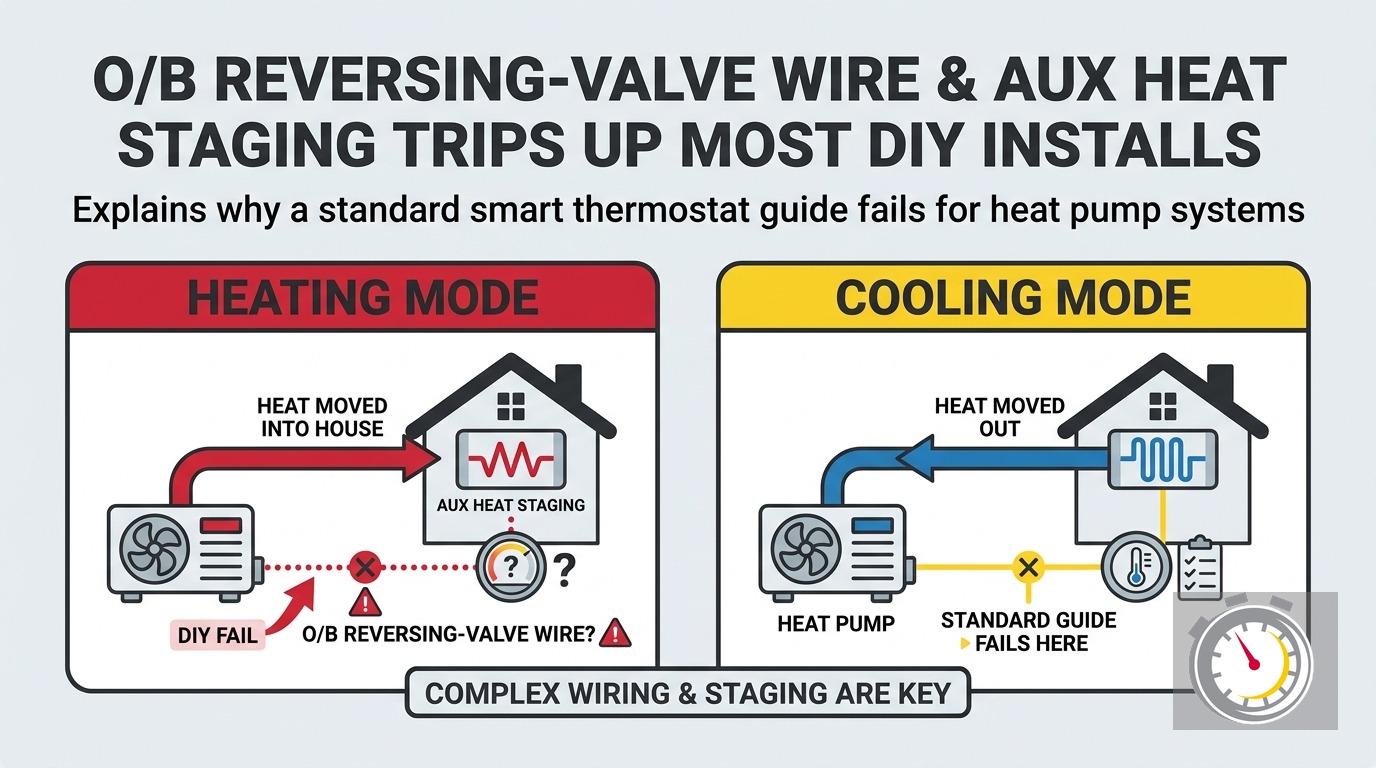
- The O/B terminal controls the reversing valve. The correct setting depends on your heat pump’s manufacturer. A wrong selection runs the system in reverse: heating when you call for cooling, cooling when you call for heat.
- Minnesota’s Climate Zone 6 winters push outdoor temps below the heat pump’s balance point regularly from November through February. Aux heat is routine here, not a backup system.
- The aux heat lockout temperature must be set at or below 35°F. Many thermostats ship with this unset. The result is expensive electric resistance heat running when the heat pump could handle the load alone.
- Dual-fuel systems need a thermostat that can issue a fuel-source switchover command at a programmed outdoor temperature. That temperature must be set in the installer menu - not the app.
- A misconfigured thermostat can drive aux heat to run two to three times more than necessary. In a Minnesota January, that gap can add $150 to $250 to a single electric bill.
When the Wiring Is Right and the Bill Still Doubles
Getting heat pump thermostat wiring and aux heat right in Minnesota takes more than matching wire colors. You followed the color-coded diagram. You matched every wire to the app’s on-screen guide. Your new smart thermostat powered on, showed the correct temperature, and seemed to work. Then your January electric bill arrived.
This is the most common complaint our team hears after a DIY heat pump thermostat swap in the Twin Cities. The wiring itself is correct. The three installer-menu settings the app never prompted you for are not. Heat pump thermostat wiring and aux heat configuration in Minnesota is a two-part job. Most homeowners only know about the first part.
Why Heat Pump Thermostats Are Different From Furnace Thermostats
A gas furnace thermostat has one job. Signal a call for heat. The furnace fires. The set temperature is reached. The furnace stops.
A heat pump works differently. It moves heat instead of generating it. In heating mode, it extracts thermal energy from outdoor air and delivers it inside. In cooling mode, it reverses that process. The reversing valve is the component that flips the refrigerant flow direction. Your thermostat controls that valve through a dedicated terminal called O/B.
Standard furnace thermostats use R (24V power), C (common), Y (cooling compressor), G (fan), and W (heat call). Heat pump thermostats add the O/B terminal for the reversing valve and often a second W terminal for supplemental heat staging. Those additions carry real stakes when the corresponding installer-menu settings are not configured correctly.
A wrong wire connection is visible. You can trace the wire back to the terminal and catch the error immediately. A wrong installer-menu setting is invisible. It runs silently through every heating cycle and shows up only on the electric bill.
What Does the O/B Wire on a Heat Pump Thermostat Control?
The O/B wire energizes the reversing valve, which switches refrigerant flow direction between heating and cooling modes. Whether your thermostat energizes it during cooling (O) or during heating (B) depends on your heat pump’s manufacturer. Getting this wrong causes the system to heat when you call for cooling and cool when you call for heat.
Different manufacturers choose a different default valve position. That creates two distinct wiring conventions.
O convention (energize in cooling): Carrier, Lennox, Goodman, Bryant, and York. The thermostat energizes the valve when you call for cooling. When you call for heat, the wire is not energized, and the valve rests in its default heating position.
B convention (energize in heating): Rheem, Ruud, Bosch, Trane, and American Standard. The thermostat energizes the valve in heating mode. When you call for cooling, the wire is not energized.
HVAC field documentation confirms that swapping O and B does not blow a fuse or trip a breaker. The system runs. It just runs backward. Your heat pump blows warm air when you call for air conditioning on a July afternoon. Your electric bill arrives with no obvious explanation, and a service call follows.
Both Nest and Ecobee ask you to select O or B during setup. The app does not know your equipment brand. Check the outdoor unit’s model label or the original installation manual to confirm which convention applies before you finish the setup sequence. This single setting is the most common reason our team gets called back after a DIY thermostat swap.
Why Does Aux Heat Cost So Much More in Minnesota Than Anywhere Else?
Minnesota is in IECC Climate Zone 6. Outdoor temps fall below the heat pump’s balance point - roughly 35 to 40°F - from November through February. That means aux heat stages in regularly here, not only during rare cold snaps. Every configuration error compounds across months of continuous winter operation.
In Charlotte or Phoenix, the balance point may be crossed a handful of nights per year. In the Twin Cities, it is crossed routinely for four solid months. A staging error that costs a Phoenix homeowner $15 a month costs a Minnesota homeowner $150 or more.
The Department of Energy lists incorrectly wired aux heat controls among the most commonly violated heat pump installation practices. The error is widespread everywhere. The cost of that error scales with how cold your winters are.
Minnesota winters make correct aux heat configuration mandatory, not optional. The system is doing exactly what the installer menu told it to do. The problem is that the installer menu was never set.
What Is the Aux Heat Lockout Setting, and Where Do You Find It?
The aux lockout temperature tells the thermostat to stop calling for electric resistance strips when outdoor temps are above a set point. Set it at or below 35°F in Minnesota. This setting lives in the installer menu, not the user-facing app - and many thermostats ship with it unset or left at a factory default that is far too high.
When outdoor temps are above the heat pump’s balance point, the unit handles the heating load on its own. Running electric resistance strips alongside it at 40°F wastes money with no benefit to comfort. The lockout setting is what prevents that.
Energy Trust field specifications require the aux heat lockout to be set at or below 35°F. The setting is adjustable over a wide range - typically 5°F to 80°F - but the thermostat may ship without this configured at all.
On a Nest, reach it through Settings > Equipment after the initial guided setup. On an Ecobee, find it under Main Menu > Installation Settings > Thresholds > Heat Pump Options > Aux Heat Only Above. The standard app-guided setup flow does not walk you to this screen. Most homeowners who complete the guided installation have never seen it.
The DOE warns that at 50°F outdoor temp, strip heat should never activate on a 4-degree setpoint rise. An unset lockout allows exactly that to happen every time the thermostat calls for a morning recovery from overnight setback.
What About Dual-Fuel Systems in the Twin Cities?
A dual-fuel system pairs a heat pump with a gas furnace for the coldest days. It needs a thermostat that can issue a fuel-source switchover command at a programmed outdoor temperature. That switchover temperature must be set in the installer menu. Standard app-guided setups never prompt you for it.
Many Twin Cities homes run a hybrid setup. The heat pump handles mild-weather loads efficiently. Below about 25 to 35°F, the gas furnace takes over because gas often costs less per BTU at those temperatures. That handoff is automatic only if the thermostat’s switchover temperature is configured correctly.
DOE Building Science training documentation confirms that the dual-fuel outdoor temperature setting for fuel-source switching must be programmed in thermostat installer settings. The thermostat must also support dual-fuel operation natively. A standard smart thermostat that does not have this capability will treat the gas furnace as simple electric strip backup, which eliminates the efficiency advantage of the hybrid setup entirely.
Generic thermostat guides treat aux heat as electric resistance strips only. None of them mention fuel-source switching. If you have a CenterPoint gas furnace paired with a heat pump and the switchover temperature was never programmed, you may be running electric strips at 15°F when the gas furnace should have taken over. That is the costliest configuration error on this list.
Our post on dual-fuel heat pump and gas furnace hybrid systems covers how these systems are sized and staged for Minnesota’s climate.
How Does Staging Logic Affect Your Monthly Electric Bill?
Staging logic controls how the thermostat calls for heat across W1 and W2 terminals. W1 calls for first-stage supplemental heat; W2 calls for full electric resistance. Leaving the thermostat in “conventional” mode instead of “heat pump” mode causes it to call for strip heat immediately rather than ramping the heat pump through its stages first.
The DOE notes that programmable thermostats are generally not recommended for heat pumps in heating mode unless the thermostat uses special algorithms to ramp temperature slowly and avoid triggering resistance elements. A standard setback program wakes up at 6 a.m. and calls for a 4-degree setpoint recovery all at once. That triggers electric strips immediately. A heat-pump-aware thermostat spreads recovery across time and lets the heat pump do the work without staging in resistance heat.
Ecobee and Nest both include heat-pump-specific recovery logic. You must enable it in the installer settings. You must also confirm that the thermostat is operating in “heat pump” mode and not “conventional” mode. If the mode is wrong, the staging logic never activates. The thermostat treats your heat pump like a gas furnace, and the consequences appear on the electric bill.
The cumulative impact is substantial. Field research indicates incorrect staging and aux lockout settings cause aux heat to run two to three times more than necessary. On a January bill in the Twin Cities, that is not a rounding error. It is $150 to $250 in a single month, every month from November through February.
For a side-by-side look at how Nest and Ecobee handle heat pump staging, see our comparison of Nest vs. Ecobee for Minnesota homes.
Does Thermostat Replacement Require a Permit in Minnesota?
Swapping a thermostat on existing low-voltage wiring is typically a minor repair that does not require a permit. Running new wiring, adding terminals, or modifying control boards at the air handler may trigger a mechanical permit requirement under Minnesota Chapter 1346. Check with your local building department before starting any work beyond a straight swap.
Minnesota mechanical code Chapter 1346 governs heat pump installation. Any new heat pump system requires a mechanical permit. Supplementary heater operation is permitted during transient periods of no more than 15 minutes. A two-stage thermostat controlling supplementary heat on the second stage satisfies this requirement and is standard practice for properly staged installations.
For most homeowners replacing one thermostat with another on the same existing wiring, no permit is required. Add a C-wire at the air handler, modify control terminals, or run new cable between the thermostat and the unit, and the scope may no longer qualify as a simple component swap.
A licensed HVAC contractor handles permits and inspections as part of the job. That protects your homeowner’s insurance coverage and keeps the equipment warranty intact.
What Rebates Could You Lose by Getting the Configuration Wrong?
Minnesota utility rebates are paid on qualifying equipment, not on thermostat configuration. But a misconfigured thermostat steadily erodes the efficiency the rebate was designed to fund.
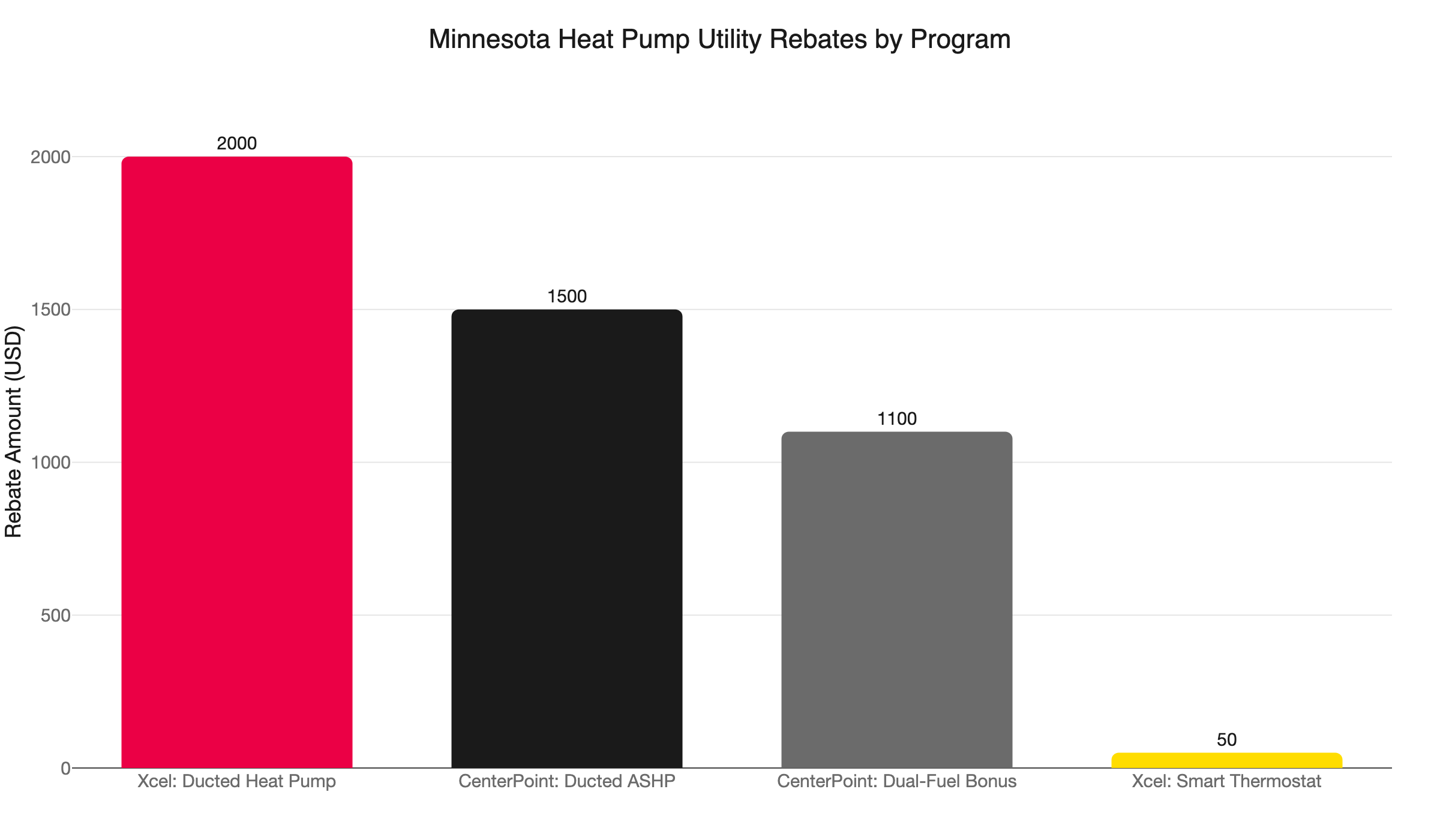
Xcel Energy offers up to $2,000 for a ducted cold-climate heat pump with a COP of at least 1.75 at 5°F. The system must appear on the NEEP qualifying products list at ashp.neep.org. Xcel also offers a $50 rebate for an ENERGY STAR certified smart thermostat.
CenterPoint Energy offers up to $1,500 for a ducted air-source heat pump, with an additional $1,100 available for dual-fuel systems in existing homes.
You keep the rebate check regardless of how the thermostat is configured. But if the aux lockout is never set and electric resistance strips run at 40°F all winter, you spend the rebate on electric bills within two heating seasons. The equipment delivered the efficiency it was rated for. The configuration threw it away.
The federal 25C heat pump tax credit and IRA provisions ended December 31, 2025. Minnesota’s HEAR program state rebates have not launched as of this writing. No rollout date has been announced.
For a full breakdown of what is still available, see our post on stacking HVAC rebates and tax credits in Minnesota.
Should You Call a Pro for Heat Pump Thermostat Configuration?
Replacing the thermostat itself is a manageable DIY project if you know your equipment’s O/B convention and can navigate to the installer menu on the new thermostat. The mechanical risk is low. The invisible configuration risks are significantly higher.
A reversed wire is visible and correctable in minutes. An unset aux lockout produces no error code, no alert, and no symptom beyond a high electric bill. A dual-fuel switchover temperature that was never programmed is completely silent until you notice that your gas furnace never seems to run in January. These errors only surface weeks after the install, when the configuration is the last thing on your mind.
If you have a dual-fuel system, if your heat pump was installed without a thorough thermostat configuration walkthrough, or if you are uncertain which settings apply to your specific equipment combination, a thermostat verification visit pays for itself quickly. Our team checks every setting in the installer menu: O/B by brand, aux lockout temperature, staging mode, heat-pump recovery logic, and dual-fuel switchover temperature when the system has one.
We are locally owned and operated in Ramsey, MN, and we serve the full Twin Cities metro - Minneapolis, St. Paul, Blaine, Maple Grove, Plymouth, Brooklyn Park, Woodbury, Bloomington, and the surrounding communities. We show up when we say we will. That is the promise we back every day: “Always On Time… Or You Don’t Pay a Dime!(R)”
Call (763) 260-6662 or visit our thermostat services page to book a configuration visit. If you have a CenterPoint gas system paired with a heat pump, mention dual-fuel when you call so we bring the right installer documentation for your equipment.
Frequently Asked Questions
What is the O/B wire on a heat pump thermostat? +
What temperature should I set the aux heat lockout in Minnesota? +
Does replacing a thermostat require a permit in Minnesota? +
Can a misconfigured thermostat erase my Xcel Energy heat pump rebate? +
Need a technician now?