
C-Wire Smart Thermostat Installation Minnesota: Fix It First
Key Takeaways
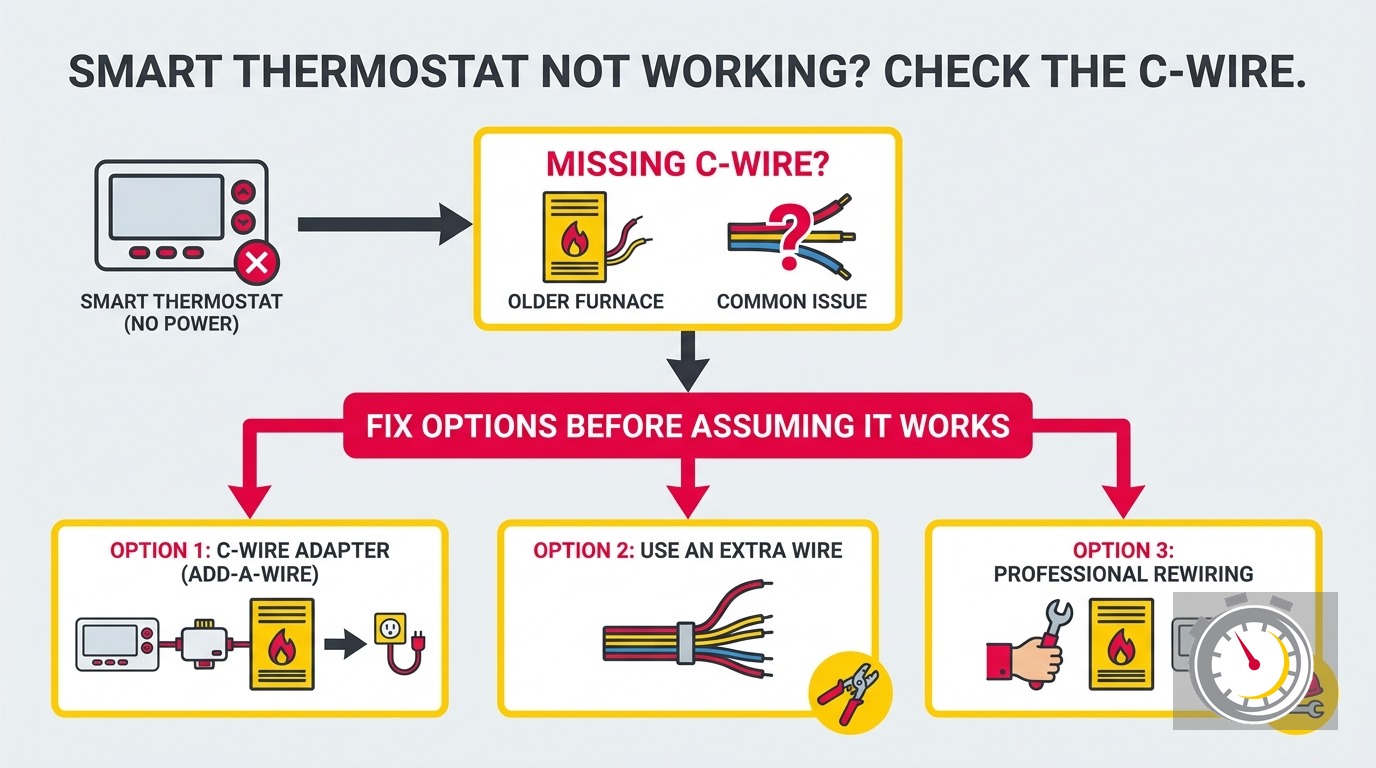
- C-wire smart thermostat installation in Minnesota requires five thermostat conductors. Most Twin Cities homes built before 1990 have only four.
- The first diagnostic step is free: pull the thermostat faceplate and check whether a fifth wire already exists at the furnace control board.
- There are four fix options. The right one depends on your cable type, your system, and your risk tolerance.
- A new 18/5 cable is the correct permanent fix when no fifth conductor exists in the run.
- Xcel Energy offers up to $100 back on a qualifying ENERGY STAR smart thermostat. The federal Section 25C credit expired December 31, 2025.
- In Minnesota, a thermostat failure in January is a pipe-freeze risk. Get the wiring right before the heating season peaks.
What Is a C-Wire and Why Does Your Smart Thermostat Need One?
A C-wire (“common” wire) completes the 24V circuit between your furnace transformer and your smart thermostat. Without it, the thermostat cannot draw continuous low-voltage power and will steal it from another terminal instead.
Old mercury-bulb and bimetallic thermostats needed zero continuous power. They switched a circuit open or closed based on temperature. They drew no current in between. Smart thermostats are different. They run Wi-Fi radios, color displays, occupancy sensors, and scheduling software around the clock. They need a steady 24V supply at all times. The C-wire is the conductor that completes that circuit.
Without a C-wire, a smart thermostat uses power-stealing. It draws a small current across the Y terminal (which controls cooling) or the G terminal (which controls the fan). That current keeps the display alive. But it also sends a faint signal to the furnace. On an older single-stage furnace, this can trigger phantom fan calls, brief cooling cycles during a heat call, or short-cycling. The behavior looks random from inside the house. The cause is the thermostat borrowing power from the wrong wire.
Why Don’t Older Twin Cities Homes Have a C-Wire?
The thermostat cables in most pre-1990 Twin Cities homes carry only four conductors because that was all a thermostat of that era required. No installer pulled a fifth wire.
The HVAC industry wired homes to the standard of the time. A four-wire run covered R (24V power), G (fan), Y (cooling), and W (heating). That is a complete set for a mercury-bulb thermostat. Those devices sensed temperature with a physical coil and switched a circuit mechanically. They needed no continuous supply voltage. So nobody ran one.
The Twin Cities housing stock skews heavily toward the post-war construction era. A large share of homes in Minneapolis, St. Paul, Ramsey, Blaine, Maple Grove, and surrounding suburbs were built between 1950 and 1985. Many still have the original four-wire thermostat cable. The person who rough-wired that house had no reason to pull a fifth conductor.
When you open the wall and find only four wires, that is not an oversight. That is working-to-spec construction from 40 years ago. The spec changed when smart thermostats came to market. The cable did not.
Two distinct situations exist when you go to check:
- A fifth wire exists but was never connected. The installer pulled 18/5 cable (five conductors) but only landed four. A blue or black wire sits coiled loose in the bundle behind the thermostat plate. This is the best-case scenario. Connecting it is a free 15-minute job.
- The cable has only four conductors, period. No fifth wire exists anywhere in the run. You need an adapter or a new cable pull.
The diagnostic is to count conductors at both ends of the cable before buying anything.
How Do You Know Whether Your Home Has a C-Wire?
The check is two steps: look at the thermostat end, then look at the furnace board. Both take under five minutes combined. If a wire lands on the C terminal at both ends, you already have what you need. If a wire exists in the cable but was never landed, connect it.
Here is the full process:
- Turn the furnace off at the switch or breaker.
- Remove the thermostat faceplate. Write down the label of every terminal and the color of the wire on it.
- Count the conductors entering the wall. If more conductors exist in the cable than are connected at the thermostat, you have a spare.
- Go to the furnace and find the control board. Look for the terminal labeled C or COM. Check whether a wire is landed there. Also check whether a spare wire sits loose in the cable sheath at the board end.
- If a spare exists at both ends, strip a quarter inch of insulation at each end and connect it to the C terminal at the board and at the thermostat base.
One note for heat pump and multi-stage furnace owners: those systems use more terminals, so the cable may already be fully subscribed with no spare wire left. Our post on heat pump thermostat wiring and auxiliary heat staging covers that situation in detail.
Four Fix Options, Ranked by Invasiveness
Option 1: Land the existing spare wire
Cost: $0. Time: 10-15 minutes.
This only works when a fifth conductor already exists in the cable. If the diagnostic above finds a spare wire, connect it to the C terminal at the furnace board and at the thermostat base. Restore power and test. This is always the first check on every job.
Option 2: Add-A-Wire adapter
Cost: roughly $20-30 for the part. DIY-eligible for single-stage systems.
An Add-A-Wire adapter piggybacks the C signal onto the G terminal via a small relay module at the furnace. The Venstar ACC0410 is a common option, widely stocked at HVAC supply houses across the Twin Cities. The thermostat reads the result as a real C-wire.
This works well on simple single-stage heating and cooling systems. The limits are real. Add-A-Wire adapters can interfere with variable-speed fan operation. They are not compatible with all multi-stage furnaces or heat pumps that use auxiliary heat staging. Confirm compatibility before buying.
Option 3: Plug-in USB or 24V power adapter
Cost: roughly $30-40 for the kit.
Some smart thermostat manufacturers sell a plug-in power adapter that connects to a standard 120V outlet within reach of the thermostat. A small transformer converts it to the 24V the thermostat needs. This is reliable but adds visible wiring near the thermostat plate. It requires an accessible outlet nearby.
Option 4: Run a new thermostat cable
Cost: professional labor, typically a few hours for a single-story home.
This is the correct permanent fix when no fifth conductor exists and adapters do not fit your system. An 18/5 cable gives you five conductors and covers all standard single-stage setups. An 18/8 cable is worth the modest extra cost if you plan to add a multi-stage system or heat pump later. Future-proofing the wire count costs little now compared to pulling a new cable a second time.
In a two-story home with finished walls, routing a new cable is more involved. A licensed technician will assess the path before starting. In most Twin Cities jurisdictions, adding low-voltage thermostat wiring does not require a permit. However, if the furnace control board also needs repair in the same visit, that work requires a licensed contractor. Most jurisdictions require a permit for control board work under Minnesota Mechanical Code Rule 1346.
What Happens If You Skip the C-Wire Fix in Minnesota?
Skipping the fix means your smart thermostat will power-steal through the G or Y terminal. On an older single-stage furnace, this causes phantom fan calls, brief cooling cycles during a heat call, and short-cycling. In Minnesota, a thermostat failure in January is a pipe-freeze risk, not just a discomfort issue.
The phantom signals play out differently depending on the furnace and the thermostat model. The most common symptom is the fan running for a few seconds after the thermostat satisfies. The more serious symptom is short-cycling: the furnace fires, heats briefly, then shuts off before the house reaches setpoint. Short-cycling accelerates wear on the heat exchanger and the inducer motor.
The winter risk is what generic thermostat guides consistently miss. Minnesota temperatures reach -25°F. A thermostat that locks up, loses its Wi-Fi connection, or loops on a bad power-stealing signal can stop calling for heat without the homeowner noticing. A furnace that silently stops running at those temperatures can freeze a pipe inside a wall cavity within hours.
Getting the C-wire right before cold weather arrives is not a refinement. It is a basic safety step for any Minnesota homeowner installing a smart thermostat.
Does Minnesota Offer Rebates for Smart Thermostat Installation?
Xcel Energy offers up to $100 back when you purchase a new ENERGY STAR-certified smart thermostat. Submit the rebate form and invoice within 90 days of purchase. Verify current program terms and eligible models at xcelenergy.com/programs_and_rebates before buying, since rebate amounts and qualifying models can change by program year.
CenterPoint Energy does not currently list a standalone smart thermostat rebate. CenterPoint’s residential rebate focus is on heat pumps and high-efficiency heating and cooling equipment. If you are a CenterPoint customer, confirm directly with them before counting on a rebate.
The federal Section 25C credit is gone. The IRS Section 25C energy-efficient home improvement credit expired December 31, 2025. Equipment installed in 2026 carries no federal credit regardless of ENERGY STAR rating. Many homeowners are still searching for this credit, so it is worth being clear: even when Section 25C was active, smart thermostats were not independently eligible for it. The credit applied to HVAC equipment itself, including heat pumps, furnaces, and central AC, not to the thermostat controlling it.
The ENERGY STAR federal incentives page provides current context on what federal credits remain in force for HVAC equipment. For the full picture on Minnesota utility rebates available on heating and cooling upgrades, see our breakdown of Xcel and CenterPoint HVAC rebates for Minnesota homeowners.
When Is C-Wire Work a DIY Job vs. a Professional Call?
Landing a spare wire that already exists in the cable is a safe DIY task for most homeowners. Confirm the circuit is off, connect the wire at both ends, restore power, and test. Installing an Add-A-Wire adapter is also DIY-eligible for standard single-stage systems with basic heating and cooling.
Call a licensed technician when:
- You need to route a new cable through finished walls in a multi-story home.
- Your system is multi-stage, uses auxiliary heat, or is a heat pump with a variable-speed blower.
- The furnace control board shows error codes or blinking light sequences before or during the job.
- You are not comfortable identifying live 24V circuits at the furnace board.
Northern One Hour is locally owned and operated in Ramsey, MN. Our technicians handle thermostat wiring on smart thermostat installs across the Twin Cities. We serve Minneapolis, St. Paul, Maple Grove, Blaine, Plymouth, Brooklyn Park, and Woodbury. We show up when we say we will. That is the promise behind “Always On Time… Or You Don’t Pay a Dime!(R)”.
What If Your Home Has a Multi-Stage Furnace or Heat Pump?
Multi-stage and heat pump systems need more thermostat conductors than a basic single-stage setup. A two-stage furnace uses W1 and W2. A heat pump adds an O/B reversing valve terminal and often Y1/Y2 staging wires. An Add-A-Wire adapter will not work when the cable is already fully subscribed.
For a basic single-stage gas furnace with central AC, five conductors cover every terminal. For a two-stage furnace or heat pump, the terminal count grows quickly. On an older four-conductor cable, no spare wire exists to begin with. On a five-conductor cable, C takes the last available slot. Either way, the Add-A-Wire workaround cannot free up a conductor that is not there. For these systems, the correct fix is a new cable pull. The new cable needs enough conductors for all stages: heating, cooling, C, G, and the reversing valve. An 18/8 cable handles most heat pump and two-stage configurations with conductors to spare.
Our post on heat pump thermostat wiring and auxiliary heat staging covers the full staging terminal map for heat pump systems. If you are not sure which category your system falls into, a technician can assess it on the same visit.
The Bottom Line for Minnesota Homeowners
Smart thermostats save real money in a climate that swings from -25°F to 95°F. Setback scheduling and occupancy sensing cut heating and cooling costs meaningfully over a full season. But the C-wire is the prerequisite. Skipping it puts the thermostat in conflict with your furnace.
The diagnostic is free. Pull the faceplate and count the conductors. If a fifth wire already exists in the cable, the fix takes 15 minutes and costs nothing. If it does not, three other options cover most single-stage systems before reaching for a full cable replacement.
Claim the Xcel Energy rebate before you buy the thermostat. Skip the Section 25C credit search; that program closed December 31, 2025. For a side-by-side look at today’s top smart thermostat options for Twin Cities conditions, see our Nest vs. ecobee comparison for Minnesota homeowners.
When the job is more complex than landing a free spare wire, our team is ready. Schedule your thermostat service online or call us at (763) 260-6662. We are locally owned, we stand behind our on-time guarantee on every call, and we serve the Twin Cities from our base in Ramsey.
Frequently Asked Questions
What is a C-wire on a thermostat? +
Will a smart thermostat work without a C-wire? +
How do I know if my home already has a C-wire? +
Does Xcel Energy offer a rebate for smart thermostats in Minnesota? +
Is the Section 25C federal tax credit still available for smart thermostats in 2026? +
Need a technician now?