
Nest vs Ecobee Thermostat Minnesota: Cold-Climate Guide
Key Takeaways
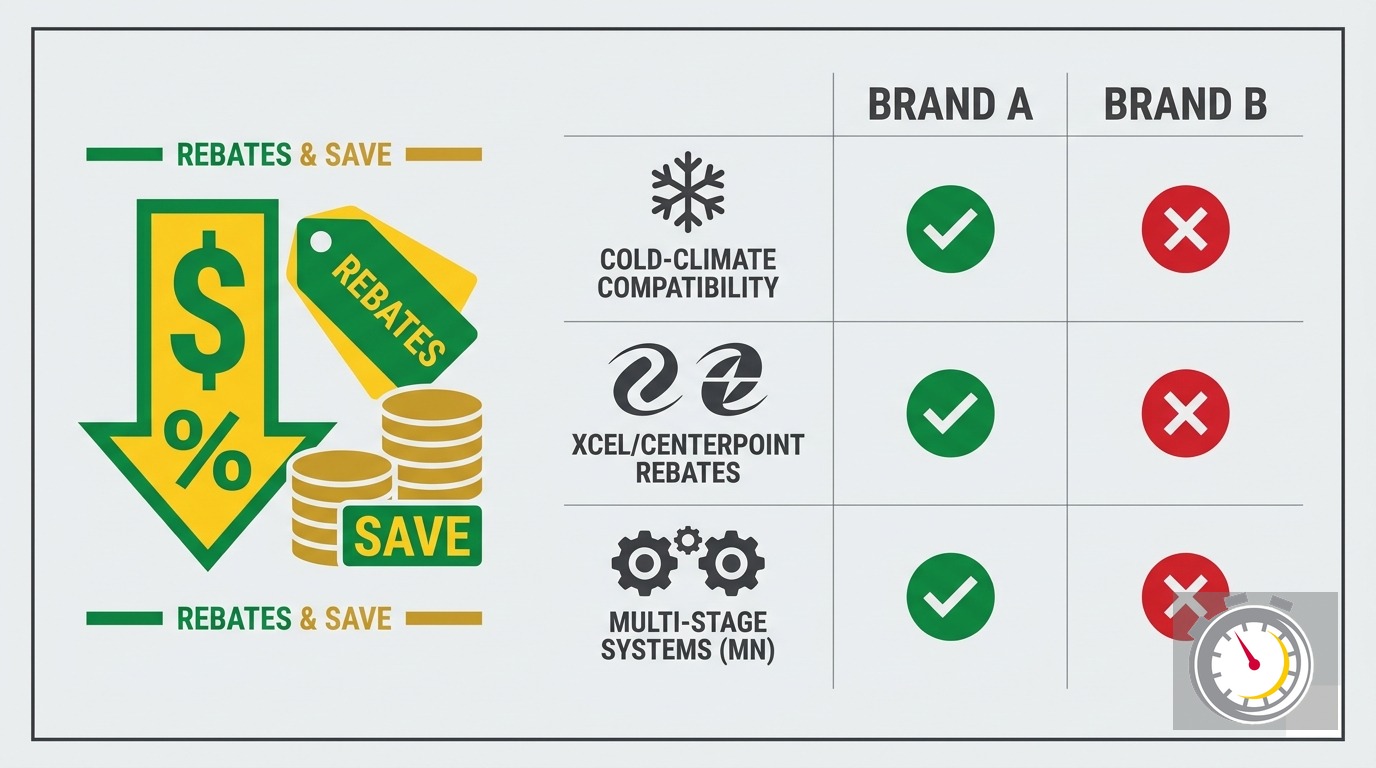
- The entry-level Nest Thermostat (~$130) does not support two-stage furnaces. Most Minnesota homes need the Nest Learning Thermostat 4th Gen ($279) or the Ecobee Smart Thermostat Premium ($249).
- Both brands qualify for the same $50 rebates from CenterPoint Energy and Xcel Energy. Rebates are not a tiebreaker between the two.
- For heat pump homes, Ecobee’s configurable aux heat lockout is a genuine cold-climate advantage over Nest’s preset-based approach.
- Ecobee includes a built-in humidity sensor. Nest does not. That gap matters across a long Minnesota heating season.
- Minnesota’s HEAR and HOMES state rebate programs are not yet available as of mid-2026. Utility CIP rebates are the main stacking incentive today.
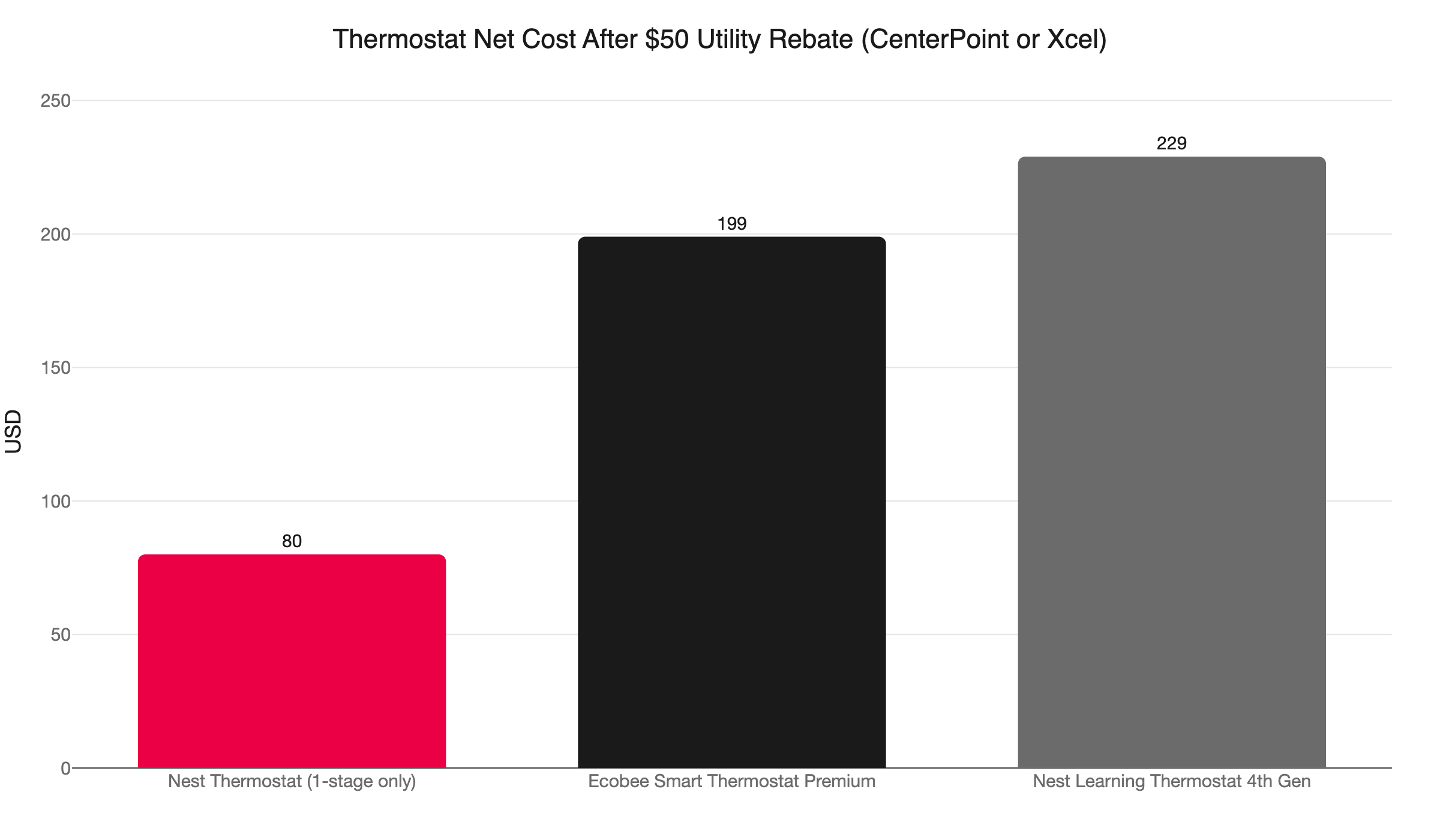
- Net cost after a $50 utility rebate: Nest Thermostat ~$80, Ecobee Smart Premium ~$199, Nest Learning 4th Gen ~$229.
What Makes Minnesota Different for Thermostat Shoppers?
Short answer: Minnesota’s heating demands are extreme by national standards. A 99% heating design temperature near -16°F and 6,000 to 8,500 annual heating degree days mean aux heat control, multi-stage compatibility, and indoor humidity monitoring matter more here than in most US markets.
Minnesota falls in IECC Climate Zone 6A, a cold and humid classification. The Twin Cities carry a 99% heating design temperature of approximately -16°F and log between 6,000 and 8,500 heating degree days per year. That is not a worst-case scenario. That is a normal Minnesota winter.
A thermostat that performs fine in Colorado or Illinois operates in a different environment here. Multi-stage compatibility, auxiliary heat management, and indoor humidity monitoring all become more important when your system runs for six months straight.
Air-source heat pumps lose efficiency as outdoor temperatures fall. Below roughly 0°F, the system leans on electric resistance backup heat. Minneapolis exceeds 0°F on approximately 50 days per winter. How your thermostat manages the handoff between heat pump and backup heat has a direct effect on your utility bill. Most national comparison guides never raise this point. Twin Cities homeowners have real reason to care about it.
Indoor humidity is the other factor. Minnesota winters are long and dry. Indoor humidity commonly drops below 30% during the heating season, causing static, wood shrinkage, and respiratory irritation. The thermostat you choose either gives you visibility into that or it does not.
Nest vs. Ecobee Thermostat: Minnesota-Relevant Specs Compared
Both thermostats offer Wi-Fi control, scheduling, energy reporting, and integration with major smart home platforms. Here is where they diverge on specs that matter for Minnesota homes:
Nest Learning Thermostat 4th Gen ($279)
- Supports up to 3 stages of heating and 2 stages of cooling on conventional systems
- Heat pump support: 4 total stages (2 heat pump + 2 auxiliary/alternate heat), plus humidifier, dehumidifier, and ventilation terminals
- No built-in humidity sensor
- Google Home native; compatible with Amazon Alexa
- No C-wire required: uses a power-sipping method from the HVAC system
Nest Thermostat (non-Learning, ~$130)
- Supports 1 stage of heating, 1 stage of cooling, plus 1 additional stage only
- Not compatible with two-stage furnaces
- Entry-level price; single-stage systems only
Ecobee Smart Thermostat Premium ($249)
- Supports 24V systems including dual-fuel, 3H/2C + auxiliary heat, and heat pumps with reversing valve
- Compatible with 95% or more of US HVAC systems
- Built-in humidity sensor and indoor air quality alerts
- Works with Google Home, Amazon Alexa, and Apple HomeKit natively
- No C-wire required: includes Power Extender Kit (PEK)
The price spread is narrower than most shoppers expect. After a $50 utility rebate, the Ecobee Smart Premium lands at roughly $199 and the Nest Learning 4th Gen at roughly $229. A $30 difference at that price point should not be the deciding factor.
Does the Nest Thermostat Work With Two-Stage Furnaces?
Short answer: The entry-level Nest Thermostat ($130) does not support two-stage systems. Only the Nest Learning Thermostat 4th Gen ($279) handles two-stage heating. Many Minnesota homes have two-stage furnaces. Buying the wrong Nest model is the most common purchase mistake we see.
Two-stage furnaces are widespread in the Twin Cities because they run efficiently at a lower first stage during moderate weather and ramp up to full capacity only when temperatures drop hard. A thermostat that cannot communicate with both stages leaves that efficiency on the table.
The Nest Learning Thermostat 4th Gen supports up to 3 stages of heating on conventional systems. The non-Learning Nest handles only 1H/1C plus one additional stage, which is not sufficient for a standard two-stage gas furnace.
The Ecobee Smart Thermostat Premium handles two-stage heating without special configuration. It supports 3H/2C plus auxiliary heat, which covers the most common Minnesota residential HVAC configurations.
Before you buy either thermostat, remove your current thermostat from the wall and photograph the wiring. Terminals labeled Y2, W2, or a second G wire confirm a two-stage or multi-stage system. If you see any of those, skip the entry-level Nest entirely.
Our team verifies your system’s stage configuration during any furnace tune-up. See our furnace tune-up services if you want a professional check before purchasing.
Which Thermostat Handles Heat Pump Aux Heat Better in Cold Climates?
Short answer: Ecobee. Its aux heat lockout temperature is fully user-configurable. You set the exact outdoor temperature at which backup heat engages. Nest’s “Heat Pump Balance” uses preset modes and gives you less control. When sub-zero temperatures are routine, that precision difference is worth money.
Heat pumps run efficiently down to a threshold temperature. Below that point, electric resistance backup heat carries the load. Electric resistance is significantly more expensive to operate than the heat pump. The thermostat setting that governs when the switch happens affects every utility bill through a Minnesota winter.
Ecobee’s aux heat lockout lets you enter a specific outdoor temperature. If your heat pump runs efficiently to -5°F, you can set the lockout there and extract every hour of efficient heat pump operation before the more expensive backup kicks in. Nest’s “Heat Pump Balance” mode offers preset efficiency or comfort options rather than a specific temperature threshold. It works, but it hands less control to the homeowner.
For a Twin Cities home with a heat pump, that granularity has real dollar value across 50-plus sub-zero days per year.
For more on how balance point logic works and how to set it correctly for a Minnesota climate, see our post on heat pump balance point and backup heat in Minnesota.
What Rebates Are Available for Minnesota Thermostat Shoppers?
Short answer: Both brands qualify for the same rebates. CenterPoint Energy and Xcel Energy each offer approximately $50 for qualifying Wi-Fi smart thermostats. Both Nest and Ecobee are eligible. Rebates should not drive your thermostat choice, but they reduce your net cost and are worth claiming.
CenterPoint Energy (natural gas customers)
CenterPoint Energy offers a $50 rebate on Wi-Fi enabled smart thermostats installed between January 1 and December 31, 2026. One rebate per gas service address. The thermostat must be new and listed on the manufacturer’s current website. Both Nest and Ecobee meet that requirement.
You or your dealer can submit the application. Dealer online submission is the fastest processing path. Mail applications go to: CenterPoint Energy, PO Box 59038, Minneapolis MN 55459-0038.
Xcel Energy (electric customers)
Xcel Energy’s Minnesota residential rebate for qualifying connected thermostats is approximately $50. Both Nest and Ecobee qualify. Apply at xcelenergy.com/rebates. Note: Xcel’s gas furnace rebates were discontinued January 1, 2026. The thermostat rebate remains.
Minnesota Energy Resources (MER)
MER runs a bonus rebate period from July 15 through November 15, 2026: 50% of thermostat cost up to the program maximum. The standard application deadline is December 4, 2026. One qualifying thermostat per natural gas service address.
State HEAR/HOMES Programs
Minnesota’s HEAR and HOMES federal rebate programs are not yet available as of mid-2026. The state is awaiting formal program approval. Utility CIP rebates are the main stacking incentive available today.
The chart above shows net cost for each thermostat after a standard $50 utility rebate. The Nest Thermostat drops to roughly $80, but remember: it does not support two-stage systems. The practical comparison for most Minnesota homeowners is $199 for the Ecobee versus $229 for the Nest Learning 4th Gen.
Our guide to Xcel and CenterPoint HVAC rebates in Minnesota covers the full current incentive picture across heating, cooling, and IAQ categories.
Does Ecobee’s Built-In Humidity Sensor Matter in a Minnesota Winter?
Short answer: Yes. Minnesota indoor humidity typically drops below 30% during heating season. Ecobee’s built-in sensor surfaces that data in the app and sends air quality alerts. The Nest Learning Thermostat has no built-in humidity sensor. Over a six-month heating season, that gap is real.
Sustained low humidity causes static electricity, cracking hardwood floors, dry skin, and increased susceptibility to respiratory illness. Minnesota’s heating season is long enough that unmonitored dry air is not a brief nuisance. It is a sustained condition that affects comfort and the home itself.
The Ecobee Smart Thermostat Premium includes a built-in humidity sensor and alerts you through the app when indoor conditions fall outside a healthy range. You see the problem and can respond before the effects compound.
Nest’s Learning Thermostat can control a whole-home humidifier wired to your system, and so can the Ecobee. Both have a humidifier terminal. Only the Ecobee tells you in real time what the humidity actually is, without an additional sensor purchase.
If your home has a whole-home humidifier, Ecobee simplifies the feedback loop. If it does not, and you have noticed static, cracking trim, or persistent dry air in January, the monitoring capability alone can tip the decision.
No C-Wire? Here Is What Each Brand Does
Short answer: Both brands handle homes without a dedicated C-wire. Ecobee includes a Power Extender Kit that repurposes an existing wire. Nest uses a power-sipping method from the system. On older or complex Twin Cities wiring, Ecobee’s PEK is the more reliable option.
Older Twin Cities homes frequently lack a C-wire at the thermostat. This is common in homes built before the 1990s, when continuous 24V power became standard on most installs. Neither brand requires you to run new wire in most cases.
Ecobee’s Power Extender Kit repurposes one of your existing thermostat wires to deliver continuous power. It installs at the furnace or air handler, not at the thermostat, and works reliably on most multi-stage, dual-fuel, and older wiring configurations.
Nest draws small amounts of power from your heating and cooling wires directly. This works on most standard systems. On sensitive control boards or complex multi-stage setups, it can occasionally cause intermittent issues.
For straightforward single-stage or two-stage gas furnace installations, either approach generally works. For dual-fuel systems or homes with aging wiring of uncertain origin, Ecobee’s PEK is the lower-risk starting point. Our technicians check wiring as part of any thermostat installation, before the new thermostat comes out of the box.
Nest vs. Ecobee Thermostat in Minnesota: Which Should You Choose?
Short answer: For heat pump homes, Ecobee wins on aux heat control. For standard two-stage gas furnace homes, both perform well and smart home ecosystem is the tiebreaker. For Apple HomeKit households, the choice is effectively made: Ecobee is the only one of the two with native HomeKit support.
Here is the recommendation broken down by situation:
Standard two-stage gas furnace: Both the Nest Learning 4th Gen and the Ecobee Smart Premium work well. After a $50 utility rebate, the gap is roughly $30. Google Home households fit naturally with the Nest Learning model. Apple HomeKit users should choose Ecobee.
Heat pump with auxiliary heat: Ecobee. The configurable aux heat lockout setting is worth more than a $30 price difference over a full Minnesota heating season. Nest’s preset modes do not give you the same level of control over an expensive variable.
You want humidity monitoring without extra hardware: Ecobee. The built-in sensor is standard on the Smart Thermostat Premium, not an optional add-on. It gives you real-time indoor humidity data and alerts through the app.
Budget-conscious, confirmed single-stage system: The Nest Thermostat at roughly $80 net after a rebate makes sense if your system has only one heating stage and the wiring is simple. Confirm the stage count first. Do not buy it assuming it will work on a two-stage furnace.
Older home, complex or unknown wiring: Ecobee. The Power Extender Kit handles non-standard wiring more reliably than Nest’s power-sipping approach.
Is Professional Installation Worth It?
Short answer: For systems with multiple stages, a heat pump, or older wiring, yes. A professional confirms compatibility before the box is opened, configures the aux heat lockout correctly for your specific system, and can submit the CenterPoint rebate through the dealer online portal.
Self-installation is manageable on simple single-stage systems with clean, identifiable wiring. Before removing your current thermostat, photograph the wiring. If you see more than five wires, terminals labeled W2, Y2, or O/B, or anything you cannot identify, stop and call a technician.
For heat pump homes, professional configuration of the aux heat threshold matters most. A lockout set too warm means your electric resistance backup runs more hours than it needs to. A lockout set too cold means your heat pump labors through conditions where backup heat would have been the right call. Either misconfiguration adds cost across a season. Getting it set correctly once, by someone who knows your specific system, is worth the installation fee.
We are locally owned and operated, serving Twin Cities communities including Ramsey, Blaine, Maple Grove, Plymouth, Brooklyn Park, Woodbury, and Bloomington. Our team shows up when it says it will. “Always On Time… Or You Don’t Pay a Dime!(R)“
Ready to Upgrade Your Thermostat?
A smart thermostat configured correctly for your specific system pays for itself across a few heating seasons. The right model, with the right aux heat and humidity settings dialed in, earns its cost in comfort and efficiency.
Our team installs and programs both Nest and Ecobee thermostats. We check your wiring before the box is opened, set up the thermostat for your system type, and handle CenterPoint rebate submission through the dealer online portal so you get the fastest turnaround on your $50 back.
Call (763) 260-6662 or visit our thermostat services page to schedule your installation.
Frequently Asked Questions
Do both Nest and Ecobee qualify for the CenterPoint Energy thermostat rebate? +
Will a Nest thermostat work with a two-stage furnace in Minnesota? +
Which thermostat is better for a heat pump in Minnesota? +
Do I need a C-wire to install Nest or Ecobee in an older home? +
Need a technician now?