
How Much Does Thermostat Setback Save in Minnesota?
Key Takeaways
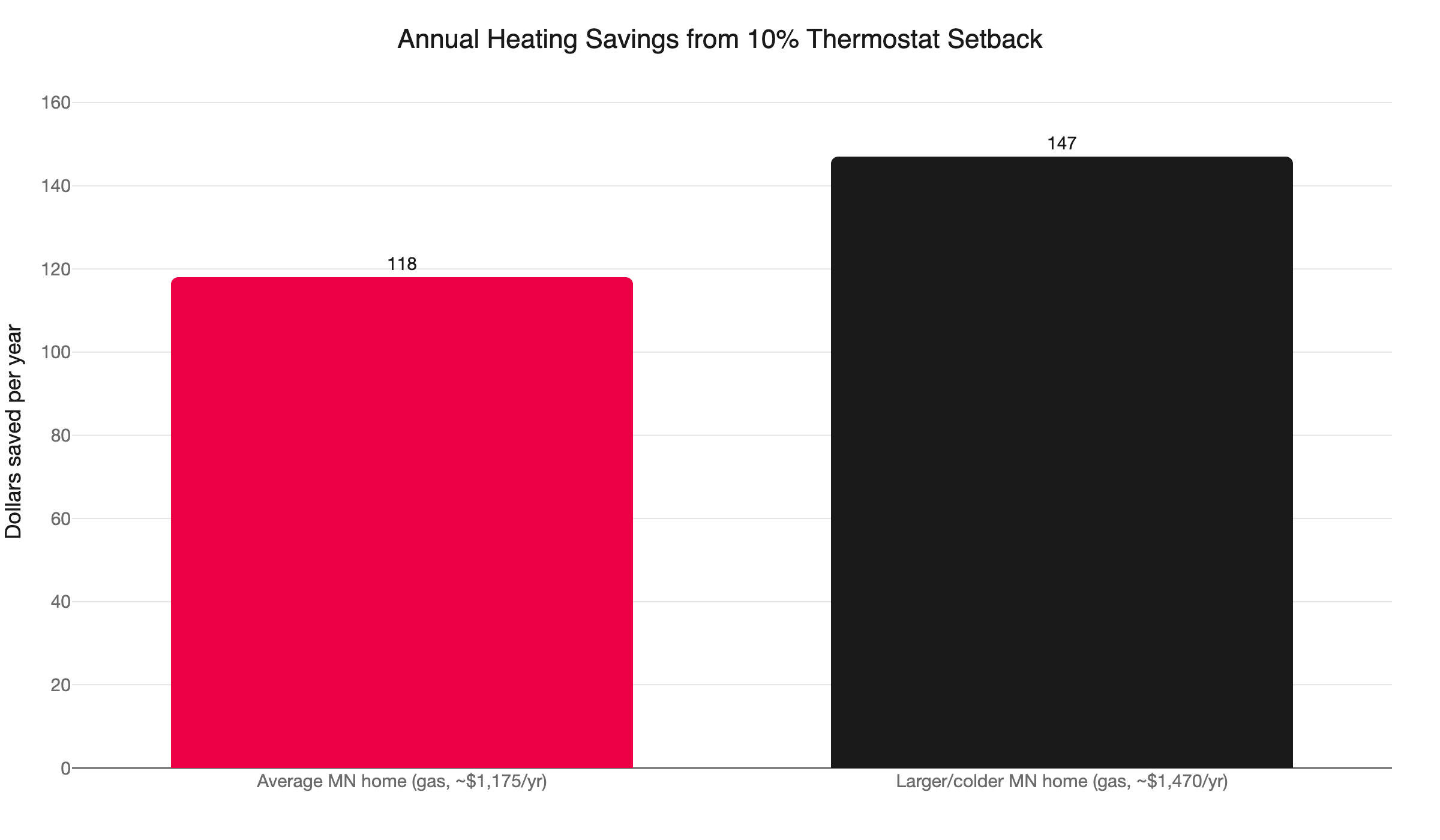
- A gas-heated Minnesota home spending roughly $1,175 per year on heating can save about $118 annually from a disciplined 8-10°F setback schedule - around 10% of the heating bill.
- Larger or colder homes save more in raw dollars. Add 25% to the annual gas bill and the savings scale to roughly $147 per year.
- Cold Minnesota winters amplify the physics of setback. The same 8°F drop saves more BTUs here than it does in a mild-climate state because our baseline heat loss rate is so much higher.
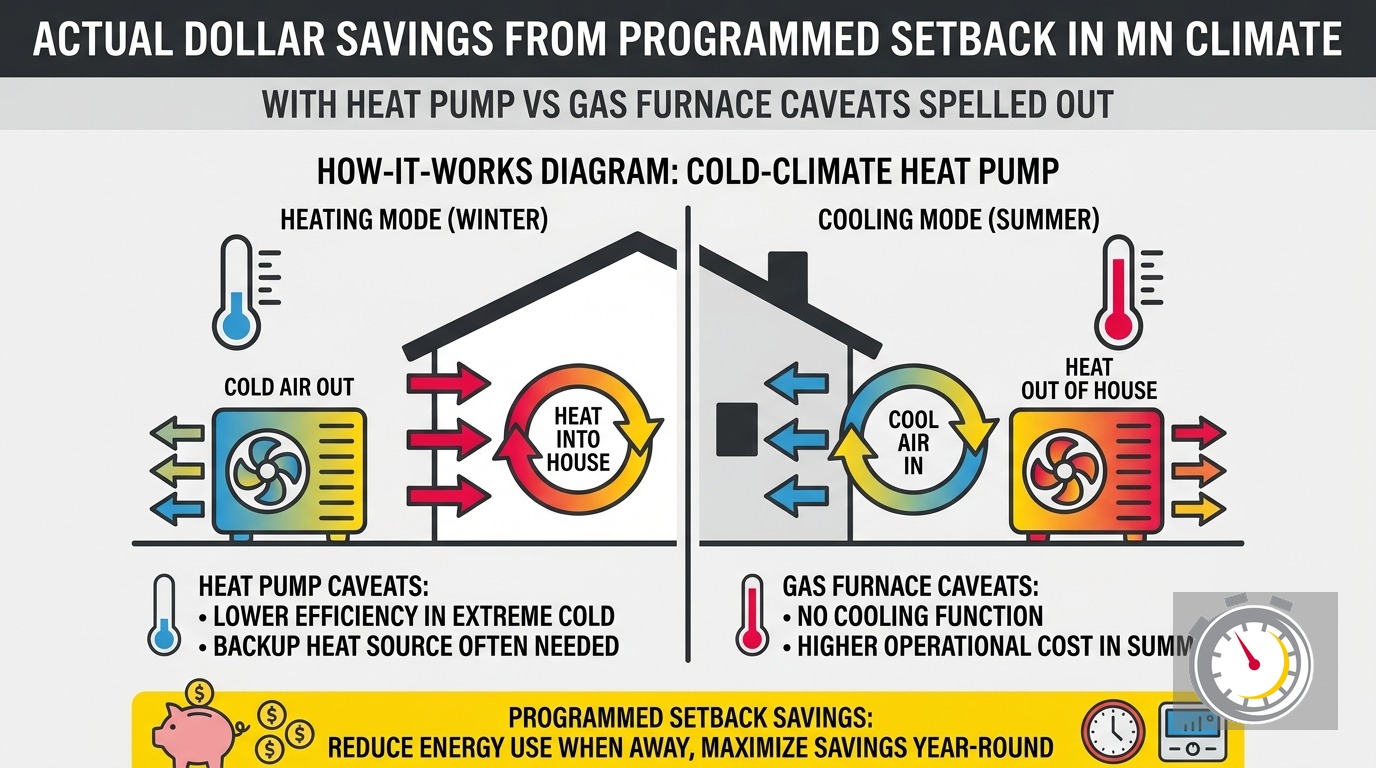
- Heat pumps and large daily setbacks are a mismatch. A deep setback that triggers electric resistance backup strips can erase or reverse your savings. Cap setbacks at 2-3°F with a heat pump-only system.
- Dual-fuel systems handle standard setbacks well. The gas furnace absorbs the recovery load, keeping the economics closer to a furnace-only home.
- Xcel Energy customers can stack a $50 smart thermostat rebate with AC Rewards enrollment for up to $175 in first-year value.
- A smart thermostat automates the schedule your manual thermostat probably skips. At $118 in annual gas savings, payback on the hardware happens in under two years without any rebate.
How Much Does Thermostat Setback Save in Minnesota?
The short answer: A typical gas-heated Twin Cities home can save around $115-$118 per year by setting back 8-10°F for 8 hours twice per day. That works out to roughly 10% of annual heating costs. Larger or colder homes see proportionally higher savings. Heat pump homes require a different strategy entirely.
Most national articles on this subject quote the DOE 10% figure and stop there. They do not convert it to actual dollars, and they do not explain why Minnesota homes benefit more than the national average suggests. Here is the full picture.
The national baseline comes from DOE Building America research: for every 1°F setback held over 8 hours, heating energy consumption drops roughly 1%. Two 8-hour setback periods of 10°F each - one overnight, one while the house is empty during the day - can theoretically reduce heating energy use by up to 35% compared to holding a fixed temperature all day.
That 35% ceiling is a physics upper bound. Real-world results land lower. Building scientist Michael Blasnik reviewed eight field studies of gas-heated homes and found incremental setback savings of 5.0% to 8.2% per study. The DOE’s 10% figure sits near the high end of what well-maintained systems actually deliver.
Here is what 10% means in Minnesota dollars.
ENERGY STAR data puts heating and cooling at nearly half of the average household energy bill - over $900 per year for most U.S. homes. Minnesota runs higher. A typical 1,800-square-foot Twin Cities home with a 96% AFUE gas furnace spends roughly $1,175 per year on natural gas heating. A 10% reduction from a consistent setback schedule saves about $118 per year, or just under $10 per month.
A larger or older home with higher bills - say $1,470 per year - saves around $147 annually from the same schedule. Northern Minnesota homes can run 20-30% higher than Twin Cities averages, so the savings scale up from there.
Propane-heated homes pay two to three times the equivalent cost per BTU compared to natural gas. A $3,000 annual propane bill could yield $300 or more in annual setback savings with the same 10% schedule.
These figures apply to gas and propane furnace households. Heat pump and dual-fuel households have a separate set of rules, covered in the sections below.
Why Minnesota’s Cold Climate Amplifies the Savings
Most national setback guides use the same DOE 10% number regardless of where you live. The physics tells a different story. Cold climate states like Minnesota get more raw value from setback than mild-climate states do, and understanding why helps you trust the math.
Heat escapes your home in direct proportion to the temperature difference between inside and outside. That gap is called the delta-T. The bigger the delta-T, the faster heat moves through walls, windows, insulation, and the ceiling. When you lower the indoor temperature, you narrow the delta-T. A narrower gap means a slower rate of heat loss, which means your furnace runs less.
In Minneapolis in January, outdoor temperatures average 15-20°F, with lows routinely reaching -10°F to -20°F. When your home sits at 70°F and it is 15°F outside, the delta-T is 55°F. Setting back to 62°F reduces the delta-T to 47°F - a 14.5% reduction that holds for the entire setback period.
Now compare that to a home in Atlanta where the January outdoor temperature is 50°F. That delta-T is 20°F at a 70°F indoor setpoint. The same 8°F setback produces a 40% relative reduction in delta-T - impressive in percentage terms, but applied to a baseline heat loss rate that is less than a third of what a Minnesota home faces. The raw BTU savings are far larger in the Twin Cities.
As the Minnesota Center for Energy and Environment confirms, even a 5°F setback toward outdoor temperature during unoccupied hours produces significant furnace runtime reduction. And that effect grows as outdoor temperatures fall, because the baseline heat loss rate rises with every degree of delta-T.
One more factor makes Minnesota setback more valuable than national numbers suggest: gas prices here vary sharply by season. The EIA tracks Minnesota residential gas prices that ranged from $9.43 to $18.13 per Mcf across 2025. The coldest months - when setback saves the most BTUs due to high delta-T - also carry the highest seasonal gas rates. High prices and high delta-T compound each other directly.
Does Thermostat Setback Work with a Heat Pump?
The short answer: Not for large daily setbacks. A 7-10°F setback can trigger your heat pump’s electric resistance backup strips during morning recovery. Those strips operate at roughly one-quarter the efficiency of the heat pump itself. The electric bill for that recovery can exceed what you saved overnight. Limit daily setbacks to 2-3°F with a heat pump-only system.
This is the caveat that most general-audience setback articles skip entirely. In Minnesota, where cold-climate heat pump adoption is growing, it matters a lot.
Here is the mechanism. Your air-source heat pump, running in heating mode on a 25°F morning, delivers roughly 2.5 to 4 watts of heat energy for every watt of electricity it consumes. That ratio is the coefficient of performance, or COP. Your electric resistance backup strips deliver exactly 1 watt of heat per watt consumed - a COP of 1.0.
When you set back 10°F overnight and call for full recovery at 6 a.m., the heat pump alone may not recover the temperature fast enough. The thermostat calls for auxiliary or emergency heat and the resistance strips fire. You pay full watt-for-watt electric rates to recover the temperature you intentionally shed overnight. Depending on how long the strips run, you may spend more on electricity than you saved during the setback.
The MN Air Source Heat Pump Collaborative states this clearly: minor setbacks of a few degrees have negligible efficiency impact on a heat pump. Large setbacks are the problem. Their guidance for daily cycling: limit setbacks to 2-3°F to avoid triggering strip heat.
The exception is an extended absence. If you drop to 60°F for a week-long vacation, the accumulated savings during the setback period can outweigh even a strip-heat recovery event on your return. For normal daily cycles, though, the 2-3°F limit stands.
If your system is heat pump-only and you want to understand what it can handle in a Minnesota winter, our heat pump service page is a good starting point.
What About a Dual-Fuel System?
The short answer: Dual-fuel households can use a standard 8-10°F setback without the strip-heat trap. When the heat pump cannot handle the recovery load, the gas furnace takes over - and gas backup heat at high AFUE is far cheaper per BTU than resistance strips.
A dual-fuel or hybrid system pairs an air-source heat pump with a gas furnace. The heat pump runs as the primary heating source down to its balance point, typically around 30-35°F. Below that outdoor temperature, the gas furnace takes over. Xcel dual-fuel rate customers are required to switch to gas at 35°F or below.
When you set back overnight and demand full recovery at 6 a.m. on a 10°F January morning, the dual-fuel system routes the recovery load to the gas furnace. That recovery runs at gas rates and furnace efficiency, not at electric rates with strip efficiency. The economics look much more like a furnace-only home.
Dual-fuel homeowners get close to the full DOE setback savings during the shoulder seasons when the heat pump is on duty - roughly October through mid-December and March through April in the Twin Cities. During the deep-cold months when the gas furnace runs continuously, setback works the same way it does on any other gas-heated home. Program a standard 8-10°F setback and let the equipment manage the recovery load.
What Temperature Should I Set My Thermostat When Away?
The short answer: Most Minnesota utilities recommend 68°F when home and dropping 8°F to 60°F when away or asleep. That pairing is the DOE benchmark for roughly 10% annual heating savings. Do not go below 55-58°F during a Minnesota winter to protect pipes from freezing.
Here are the setpoints that work for most Twin Cities households:
- Home and awake: 68-70°F for most families.
- Asleep (8 hours): 60-62°F. This is the first of the two main setback windows.
- Away at work or school (8 hours): 60-62°F. The second window. Combined with the overnight setback, this covers 16 hours of every day.
- Extended vacation (gas furnace home): 55-58°F. Low enough to save energy, high enough to protect pipes during a cold snap.
Do not drop below 55°F if you have any pipes running through exterior walls, in a crawl space, or in an attached but unheated garage. Pipes freeze faster than most people expect when outdoor temperatures fall below -10°F and interior temperatures have been held low for multiple days.
A smart thermostat handles recovery timing automatically. Most devices include a recovery feature that calculates how early to begin heating so the home reaches your target temperature exactly when you wake up or arrive. That gradual ramp-up is gentler on the system and captures most of the setback savings without demanding a full heat call all at once.
For full guidance on managing the thermostat during a Minnesota winter absence, see what temperature to set your thermostat during a Minnesota winter vacation.
Is a Smart Thermostat Worth It in Minnesota?
The short answer: Yes, for most gas-furnace households. Hardware and installation typically costs $150-$250. With the Xcel Energy rebate and AC Rewards enrollment, the first-year net cost can drop to $25-$75. At $118 in annual heating savings, payback on the hardware arrives in one to two years.
The core problem with manual and basic programmable thermostats is follow-through. Most households program a setback schedule once and then override it constantly - guests arrive, plans change, someone comes home early. The thermostat drifts back to a fixed temperature and stays there. A smart thermostat runs the schedule every day, including the days no one thinks about it.
Beyond scheduling, smart thermostats offer features that extend their value:
- Remote access via your phone to adjust settings before you arrive home
- Learning mode that detects your household’s typical occupancy pattern and builds a schedule automatically
- Geofencing that triggers setback when your phone leaves the neighborhood
- Alerts when the system runs abnormally long, an early warning of a maintenance issue
- Utility demand-response enrollment, which is required to access the AC Rewards credit
Xcel Energy’s Minnesota smart thermostat program offers a $50 rebate on any ENERGY STAR certified model. Add AC Rewards enrollment and you receive a $100 one-time credit plus $25 per year - up to $175 in total first-year value. Customers of Minnesota Energy Resources in southeastern Minnesota can access smart thermostat rebates through that utility as well.
When you are comparing devices, see our breakdown of Nest vs. Ecobee for Minnesota homeowners. The two platforms handle cold-climate heat pump staging and auxiliary heat logic differently, and that gap matters when temperatures drop in January.
How Do You Program a Setback Schedule That Actually Works?
The short answer: Start with two 8-hour setbacks per day - one overnight, one while the house is empty. Drop 8-10°F for each window. Use the thermostat’s recovery feature to pre-heat before you wake or return. Then leave it alone.
You do not need a smart thermostat to capture setback savings. A basic programmable thermostat, available for under $40, can run a four-period schedule. The key is consistency: the savings come from following the schedule every single day, not programming it once and manually overriding it constantly.
A practical starting schedule for most Twin Cities households:
- Wake period (5:30-6:00 a.m.): Begin pre-heating to 68-70°F about 30 minutes before anyone gets up. This is the recovery window. Set it early enough that the home is comfortable before the alarm goes off.
- Away period (8:00 a.m.): Drop to 60-62°F when the last person leaves for work or school. If schedules vary week to week, use the geofencing feature on a smart thermostat instead of a fixed time.
- Home period (5:00 p.m.): Begin returning to 68-70°F about 20-30 minutes before you arrive. Pre-heat, rather than demanding full heating on arrival.
- Sleep period (10:00 p.m.): Drop back to 60-62°F. The overnight setback does the same work as the away period.
This schedule runs two full 8-hour setbacks each day. For a gas furnace household, it is the core of the DOE savings estimate.
For heat pump households: narrow the setback to 63-65°F rather than 60-62°F. Allow a longer recovery window - 45 to 60 minutes rather than 30. If your thermostat shows auxiliary heat running for more than 10-15 minutes on recovery, the setback is too deep or the recovery window is too short. Adjust one variable at a time.
When Setback Does Not Help
Setback improves most Minnesota heating bills. There are cases where it adds wear without proportional savings.
Very leaky or poorly insulated homes. If your home loses heat so fast that indoor temperatures drop well past the set point during a cold snap, recovery demands more energy than the setback saved. Air sealing and attic insulation improvements often deliver faster payback than thermostat changes in homes like this.
Equipment at the end of its service life. An aging furnace cycling through setback-and-recovery routines on the coldest mornings of the year puts extra demand on the igniter, flame sensor, and heat exchanger. If your furnace is 18-20 years old and has not had a tune-up in the last year, schedule a maintenance visit before relying on aggressive daily setbacks. Demanding maximum performance from a marginal system accelerates failure.
Radiant floor heating. Radiant systems store heat in the thermal mass of a concrete slab. Recovering slab temperature after an overnight setback can take four to six hours, far longer than a forced-air furnace needs. Most radiant households are better served by a small continuous temperature reduction - holding 65°F instead of 68°F all day - rather than a deep daily setback.
Large open floor plans with high ceilings. These homes take longer to recover and the recovery period can eat into the savings. A 20-30 minute recovery window may need to stretch to 45-60 minutes, reducing the effective daily setback hours.
Ready to Start Saving?
A well-programmed thermostat is one of the most cost-effective HVAC upgrades available to a Minnesota homeowner. For most Twin Cities gas-furnace households, an 8-10°F setback twice per day saves roughly 10% of annual heating costs - between $100 and $150 per year to start, and more for larger or older homes. Stack a Xcel rebate on top, and a smart thermostat can pay for itself in a single heating season.
Our team installs and programs smart thermostats as part of any HVAC service call. We are locally owned and operated in Ramsey, MN, and we back every visit with the “Always On Time… Or You Don’t Pay a Dime!(R)” promise. If we say we will be there at 10 a.m., we will be there at 10 a.m.
Call us at (763) 260-6662 or schedule through our thermostat services page. If your system has not had a tune-up recently, let us know - we will check both the equipment and the thermostat settings in the same visit.
Frequently Asked Questions
How much does thermostat setback save in Minnesota? +
Does thermostat setback work with a heat pump? +
What temperature should I set my thermostat when away in winter? +
Does Xcel Energy offer a rebate on smart thermostats in Minnesota? +
Need a technician now?