
What Temperature to Leave Your House in Winter in Minnesota
Key Takeaways
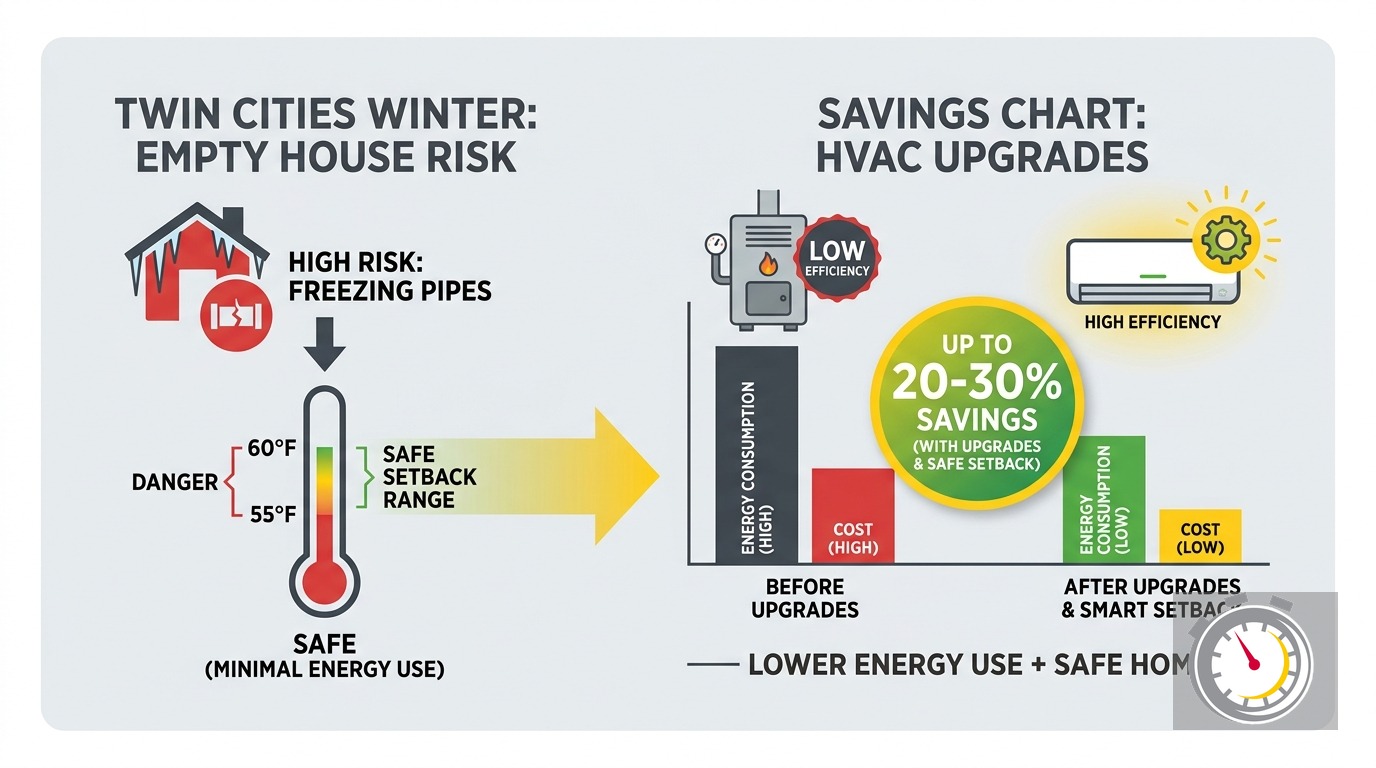
- Keep your thermostat at 60°F or higher when your home is empty for more than a day or two during a Minnesota winter.
- 55°F is your insurance policy’s minimum, not a safe pipe-protection target in a -16°F design climate.
- Pipes in exterior walls, under kitchen cabinets, and in crawlspaces can be 10-20°F colder than your thermostat reading.
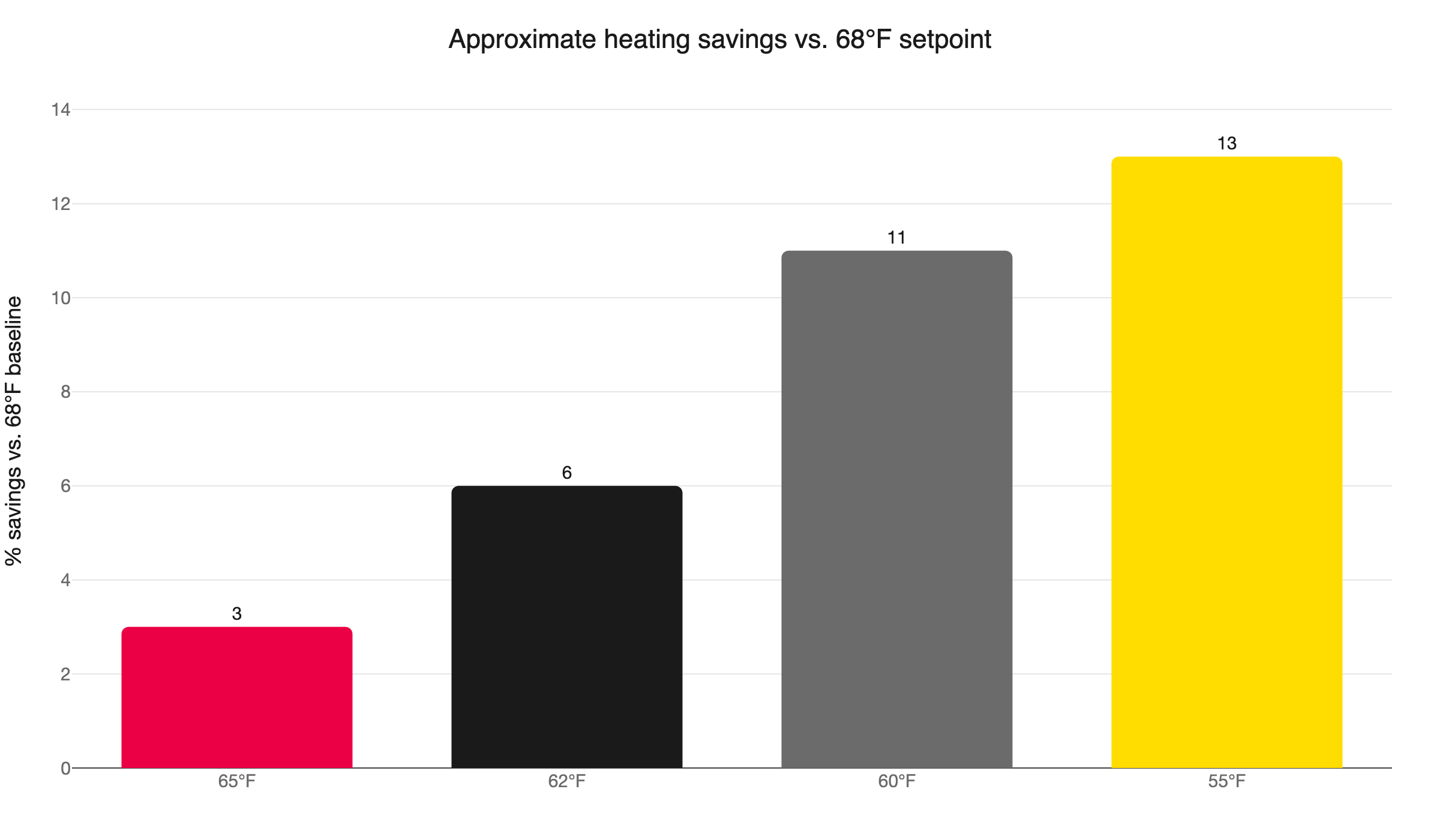
- Dropping from 68°F to 60°F saves approximately 11-12% on your monthly heating bill. The difference between 60°F and 55°F is about $4-6 per month, not the significant savings most homeowners assume.
- Heat pump owners should hold a steady setpoint. Large setbacks trigger expensive auxiliary or emergency heat and wipe out savings.
- Both Xcel Energy and CenterPoint Energy offer $50 rebates on ENERGY STAR smart thermostats for Minnesota residential customers.
- If you’re leaving for two or more weeks in January or February, consider shutting off the main water supply and draining the supply lines entirely.
The 55°F Rule Has a Minnesota Problem
The question of what temperature to leave your house in winter in Minnesota comes up every fall, and the internet has a fast, confident answer: 55-60°F. That range isn’t entirely wrong. But it comes from homeowners insurance policy language, not from the physics of what happens to a pipe in an exterior wall when it’s -10°F outside and the air in that wall cavity is heading south.
In the Twin Cities, 55°F is the floor your insurer requires. Drop below it and a frozen pipe claim can be denied outright. That makes 55°F important to know. It does not make 55°F the right target for a Minnesota home during an extended absence or a polar vortex.
This guide covers the actual safe setpoint range for vacant Twin Cities homes, what you realistically save by dialing back the heat, and what to do before you leave for a multi-week February trip. The short version: 60°F, not 55°F. The rest of this post explains why.
What temperature should you leave your house in winter in Minnesota?
Set it to at least 60°F. That’s the right answer for most Twin Cities homes during any absence longer than a day or two. The 60°F setpoint gives your pipes a real buffer. At 55°F, you’re right at the insurance floor with no margin for the temperature gap between your thermostat and your most exposed pipes.
Minneapolis has an ASHRAE 99% winter design temperature of -16°F, which places it among the most extreme heating climates in the continental United States. That figure means your heating system was engineered to hold indoor temperatures when outdoor conditions reach -16°F. At that outdoor temperature and a 55°F indoor setpoint, your furnace is fighting a 71-degree difference. A brief equipment failure - a tripped breaker, a clogged filter, a flame sensor fault - drops interior temperatures quickly. The Twin Cities averages 22 days per year below zero. Those are not rare outliers. They are a reliable feature of every Minnesota winter.
For homes built before 1980, with less wall insulation and more air infiltration around windows and rim joists, 62-65°F is a more conservative target during polar vortex conditions. Older homes lose heat faster and have more pathways for cold air to reach pipes in exterior wall cavities.
Why is 55°F the number everyone recommends?
Because it is the threshold homeowners insurance policies require. Below 55°F, most insurers can deny a frozen pipe claim on the grounds the home wasn’t adequately heated. Knowing that number protects your coverage. Treating it as the optimal setpoint is a different thing.
Most homeowners insurance policies set 55°F as the minimum required temperature for a vacant home during the heating season. If your home drops below that and a pipe bursts, your insurer can decline the claim. So 55°F is the lower boundary you must stay above to keep your coverage intact.
State Farm has processed a significant volume of frozen pipe claims in recent years, representing substantial losses. A meaningful share of those homes almost certainly maintained 55°F. Meeting the insurance floor keeps your claim technically valid. It does not guarantee the coldest pipe in your house stayed above 32°F during a February cold snap.
Setting your home to exactly 55°F puts you right at the boundary where your coverage disappears if anything goes wrong. In a Minnesota winter, that is not where you want to operate.
Does your thermostat reading actually protect every pipe in the house?
No. Your thermostat measures one point in one conditioned room. Pipes in exterior walls, beneath kitchen sink cabinets, in crawlspaces, and in runs near garage walls can be significantly colder than the air your thermostat reads.
Pipes can freeze when temperatures drop, but burst risk increases sharply when outdoor temperatures stay well below freezing for an extended stretch. The real hazard isn’t a brief plunge overnight. It’s a three-day polar vortex that gives cold air time to work into building cavities.
Here is a specific example. A kitchen sink on an exterior wall has supply pipes running through the cabinet space. That space is exposed to air infiltrating through the rim joist, sill plate, and gaps in the wall insulation. The cavity temperature there can be 10-20°F colder than the living room thermostat. During a multi-day cold snap, that pipe can approach 35-38°F even when the thermostat reads 55°F.
The same vulnerability applies to:
- Bathroom vanities on exterior walls
- Any pipe running through an unheated crawlspace
- Utility sinks in partially conditioned basements
- Supply lines near the shared wall of an attached garage
- Pipes in rooms with damaged or missing vapor barriers
That 15-20°F gap is exactly why 60°F is the target, not 55°F. The extra 5 degrees provides a cushion that accounts for the temperature lag between your thermostat and your most exposed pipes. If you notice uneven temperatures across your home even when you’re present, see our guide on cold spots and warm rooms in winter.
Is a daily setback the same as leaving the house empty for a week?
No. They are different situations. A daily overnight or workday setback lasts 8 hours, then the furnace recovers the house to the daytime setpoint. An extended absence means the house sits at the setback temperature continuously, with no one present to notice if the furnace stumbles.
For a daily 8-hour setback:
- Setting back 7-10°F overnight or during work hours saves roughly 10% annually on heating costs.
- Pipes never sit at a low setpoint long enough to get close to freeze territory.
- The furnace recovers the house to a comfortable temperature in 30-60 minutes each morning.
For an extended absence of several days or more:
- The house runs at the setback temperature around the clock.
- Any equipment failure goes undetected until someone checks.
- Cold air infiltration has days, not hours, to cool exterior wall cavities.
- The 60°F minimum applies here because continuous exposure changes the risk calculation entirely.
Standard setback savings advice is accurate. It is based on 8-hour cycles. An empty house for a week in January is a different physics problem, and 55°F doesn’t give you enough margin when the furnace must hold that temperature continuously through multiple nights at or below zero.
How much does turning down the heat actually save in a Minnesota winter?
Dropping from 68°F to 60°F saves roughly 11-12% on your heating bill. The jump from 60°F to 55°F adds only a few more percentage points. The marginal savings do not justify the added risk in a Minnesota January.
Here is what those savings look like on a $200 monthly heating bill:
- 65°F setpoint: saves roughly $6/month
- 62°F setpoint: saves roughly $12/month
- 60°F setpoint: saves roughly $22-24/month
- 55°F setpoint: saves roughly $26-28/month
The difference between holding 60°F and 55°F is $4-6 per month. A burst pipe and the resulting water damage - soaked drywall, ruined hardwood, warped cabinetry - can reach $10,000 to $20,000. That’s before you count your deductible or the time managing repairs from out of state. The math is not close.
One more detail specific to Minnesota: the Center for Energy and Environment notes that savings per degree diminish in severe cold. As the indoor-outdoor temperature gap grows, your furnace works harder to hold any setpoint. You get less incremental savings per degree at -15°F than you do in October. The DOE’s 1%/degree figure is accurate on average, but it works less in your favor during the coldest Minnesota weeks.
A smart thermostat makes the 60°F strategy practical. You set the departure temperature before you leave, watch the house from your phone, and raise the setpoint from anywhere if the forecast shifts. Both Xcel Energy and CenterPoint Energy offer rebates on qualifying ENERGY STAR smart thermostats for Minnesota residential customers. See our guide to smart thermostats in the Twin Cities for model comparisons and rebate details.
What if your home has a heat pump instead of a furnace?
Hold a steady setpoint. Do not use a large setback. When a heat pump drops the house temperature significantly during an extended absence, recovering from that setback on a cold Minnesota day forces the system into backup resistance heat. Resistance heat runs at two to three times the cost of normal heat pump operation. The savings disappear - and then some.
The Minnesota Air Source Heat Pump Collaborative is direct on this point: heat pump owners should maintain consistent indoor setpoints rather than using the large setbacks that work well for gas furnaces. At -10°F outdoor temperatures, a heat pump’s efficiency drops and it leans on the backup system. Asking it to recover from a setback under those conditions is expensive and counterproductive.
For a weekend trip, dropping 2-3 degrees is generally fine. For a week or more in January or February, stay at 65°F or close to your normal setpoint. The modest runtime reduction doesn’t offset the recovery cost.
Should you drain the plumbing if you’re leaving for more than two weeks?
Yes, it is worth considering for any absence of two weeks or more during peak freeze season, typically December through February. Shutting off the main water supply and draining the supply lines removes the freeze risk entirely. No water in the pipes means nothing to freeze and burst, regardless of what the furnace does or doesn’t do.
The process:
- Turn off the main water supply valve at the meter or where it enters the house.
- Open every faucet - hot and cold - throughout the house to drain the lines. Start at the top floor and work down.
- Flush all toilets to empty the tanks and bowls.
- Pour RV antifreeze (non-toxic type) into every toilet bowl and drain trap: sinks, showers, tubs, and floor drains. This prevents trap seals from drying out and cracking.
- Set the water heater to its lowest or “vacation” setting.
- Leave the heat at 55°F minimum to maintain your insurance coverage and protect anything that wasn’t fully drained.
This is the same approach used to winterize a lake cabin or second home. If you’re heading south for three weeks in February, the drain-and-shut-off approach is more reliable than trusting a furnace to run perfectly with no one watching for 21 days through the coldest stretch of the year.
Signs your heating system might struggle while you’re gone
Catching a problem before you leave is far easier than managing it remotely. Before any winter trip, check these items:
- Air filter. A clogged filter restricts airflow and can cause the furnace to overheat and lock out on a safety switch. Replace it before departure, even if it doesn’t look too dirty.
- Igniter and flame sensor. If the furnace has been slow to start or has missed a heating cycle recently, get it serviced before the trip. A failed igniter means no heat.
- Thermostat batteries. A thermostat that loses power may not hold the setpoint you programmed. Put in fresh batteries before you leave.
- Carbon monoxide detectors. Test them and confirm they are working. A furnace with a cracked heat exchanger running in an empty house is a serious hazard. If your detectors aren’t connected to a monitoring service, this matters even more during an extended absence.
- A trusted contact with a key. A neighbor or family member who checks the house every day or two catches problems no smart thermostat can flag on its own.
If your furnace hasn’t had a tune-up this season, schedule one before a long trip. Our furnace tune-up service includes a heat exchanger inspection, flame sensor cleaning, ignition test, flue inspection, and filter replacement. We confirm the system is ready to run unattended.
Schedule a checkup before you leave
We’re locally owned and operated in Ramsey, Minnesota. Our team serves homeowners throughout the Twin Cities: Minneapolis, St. Paul, Blaine, Maple Grove, Plymouth, Brooklyn Park, Woodbury, Bloomington, and the surrounding area.
Before your next winter trip, we can run a full furnace safety inspection, check the heat exchanger, clean the flame sensor, walk you through the right setpoint for your specific system - furnace, heat pump, or boiler - and give you an honest assessment of whether your equipment is ready for an extended absence.
We back every visit with our on-time promise: “Always On Time… Or You Don’t Pay a Dime!(R).”
Call us at (763) 260-6662 or book a heating maintenance visit before your trip.
Frequently Asked Questions
What is the minimum safe temperature for a vacant house in a Minnesota winter? +
How much money do I save by setting the heat to 60°F instead of 68°F? +
Should heat pump owners set back the thermostat when leaving for a winter trip? +
Need a technician now?