
Low Humidity Hardwood Floors Damage: Minnesota Winter Guide
Key Takeaways
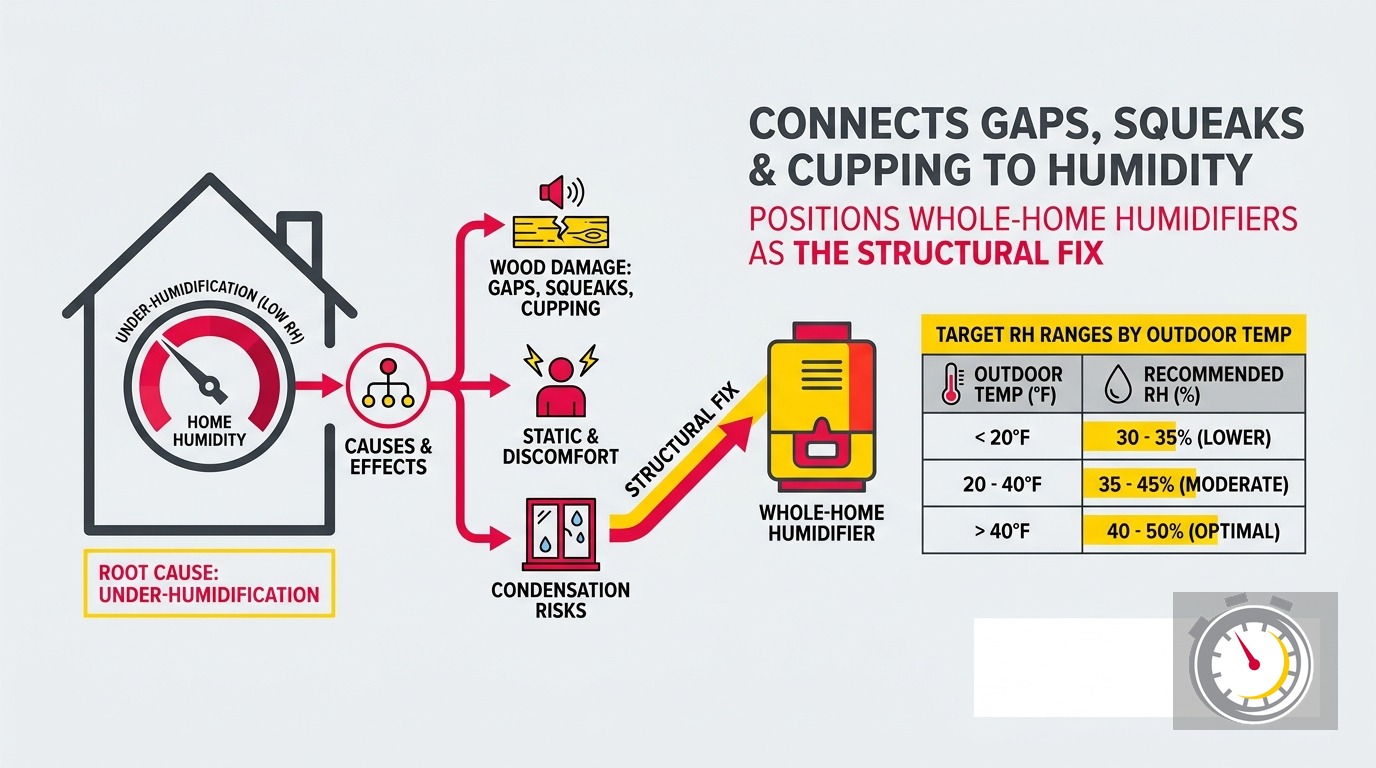
- Gaps, squeaks, and cupping in hardwood floors are almost always a humidity problem, not a flooring defect. The floor is responding to the air in your home.
- The National Wood Flooring Association specifies 30-50% relative humidity as the performance range for hardwood. Below 30%, planks shrink and gap. Most flooring warranties void outside this range.
- Without humidification, a Twin Cities home in January can fall to 10-15% RH, below the Sahara Desert’s typical 25%.
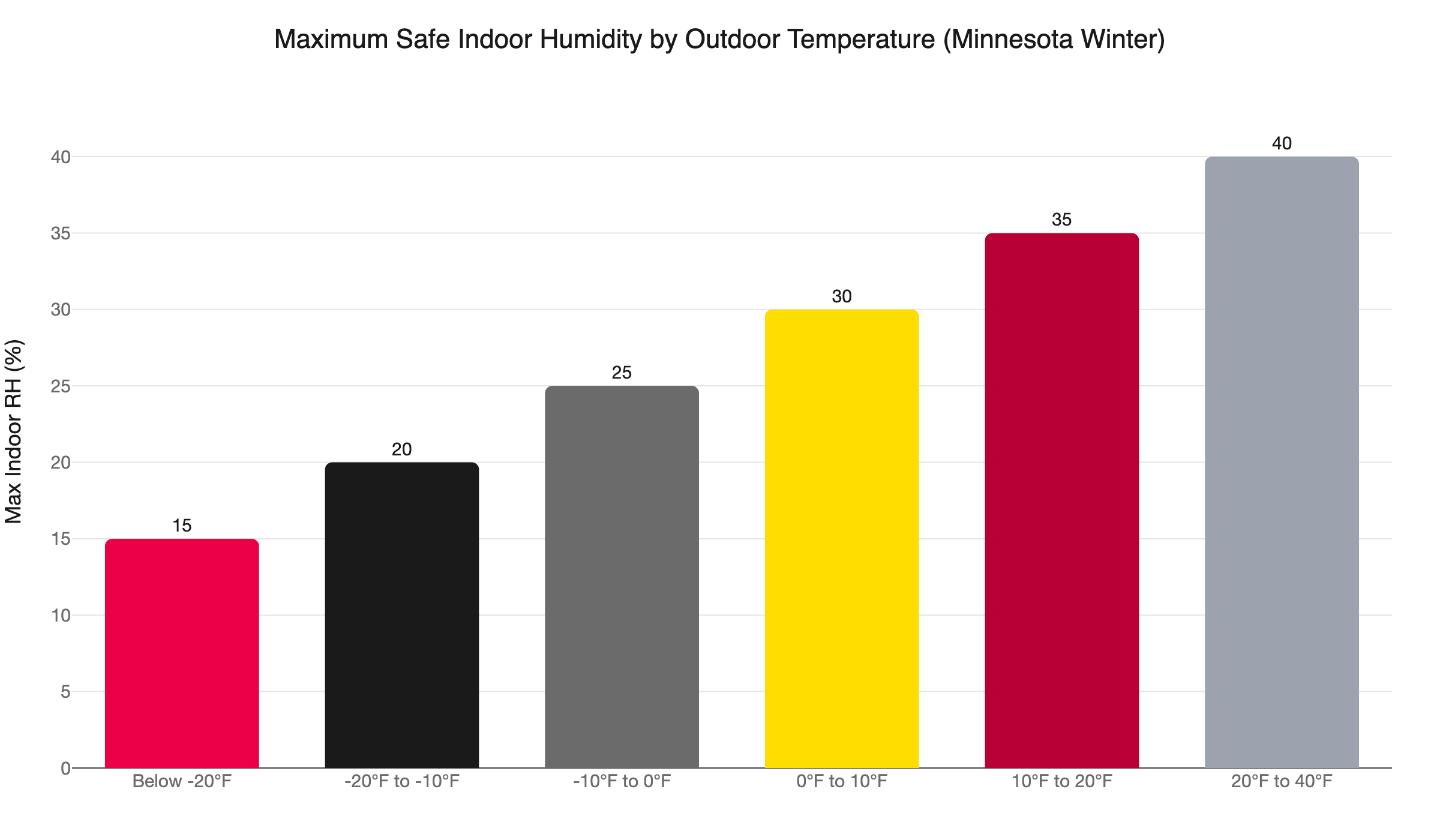
- The safe maximum indoor RH drops as outdoor temperatures fall. Setting 40% on a night that hits -20°F drives moisture into walls and windows.
- A portable humidifier cannot raise whole-home RH. Only an HVAC-integrated whole-home humidifier covers every room through every duct run.
- Addressing dry air this winter costs far less than refinishing or replacing a cupped or split hardwood floor.
What Does Low Humidity Do to Hardwood Floors?
Wood is hygroscopic. It releases moisture when the surrounding air is dry and absorbs it when the air is humid. When your furnace runs through a Minnesota winter without humidification, it creates a very warm, very dry environment. The wood in your floor responds by shrinking.
When humidity drops, wood shrinks across its width. Planks pull away from adjacent boards at the seams. Tongue-and-groove joints loosen. The finish floor and subfloor no longer move as a single unit, and that mismatch is where the squeaks originate. The movement is not random: it follows the grain direction of each board and affects every room in the house that shares the same dry air.
Cupping is the more serious symptom. It happens when the bottom face of a plank dries faster than the top, often because warm dry air circulates across the surface while the subfloor traps slightly more moisture underneath. The board bows across its width, edges rising above the center. In mild cases, the boards flatten when humidity returns in spring. In severe or prolonged cases, the deformation becomes permanent.
The National Wood Flooring Association establishes hardwood performance at 30-50% relative humidity. Below 30%, shrinkage begins in earnest. Most flooring manufacturers tie their warranty directly to this range. If your home has been under 30% RH for most of the winter, you may have voided coverage on a floor that still looks new from across the room.
At the correct humidity, the moisture content of hardwood runs 6-9%. Fall below that for long enough, and the wood becomes brittle. Gaps that form when the MC drops that far do not always close back up when humidity rises. The wood has been stressed past its recovery point.
How Bad Does Minnesota’s Winter Humidity Actually Get?
Without humidification, a Twin Cities home in deep winter can fall to 10-15% relative humidity. That is below the Sahara Desert’s typical 25%. Most homeowners have no idea their home reaches those levels because they have lived with it for years and adapted to how it feels.
The physics is simple. Cold outdoor air holds almost no moisture. At -10°F, the air outside your home is nearly devoid of water vapor. When your furnace pulls that air in, heats it to 70 degrees, and circulates it through every room, you have very warm air with almost no water vapor in it. Relative humidity drops sharply. A furnace running continuously through five or six months of Minnesota winter compounds that drying effect with no offset.
Minneapolis sits in ASHRAE Climate Zone 6, one step from the coldest residential classification in the country. Humidity control is not a comfort upgrade in this climate. It is a structural concern. The Minnesota Department of Administration’s indoor air quality guidance flags RH below 30% as a documented health and comfort risk for occupied buildings.
Your hardwood floors register that condition before most people notice anything else. The floor is measuring your air quality with every board gap.
What RH Level Do Hardwood Floors Need to Stay Stable?
The NWFA target is 30-50% relative humidity at an indoor temperature between 60 and 80 degrees Fahrenheit. For most of a Minnesota winter, the practical goal is to stay at or above 30%, because without active humidification the home drifts well below that within weeks of the heating season starting.
The 30-50% band is the year-round performance range for hardwood. In a Minnesota winter, the upper end of that band has a cap that changes with outdoor temperature. Holding 40% RH indoors is fine when it is 25 degrees outside. Hold 40% when it is -15 degrees outside, and you are pushing moisture through your wall assembly toward the cold exterior. It hits the dew point inside the wall or at the window glass and condenses. That is how you get frost on interior window panes and, eventually, mold or wood rot behind the drywall.
The right humidity target is a band: high enough to protect your hardwood, low enough to avoid driving moisture into the structure.
The Outdoor-Temperature RH Guide Minnesota Homeowners Need
Most humidifier guides say “aim for 35-45% in winter” and leave it there. That is not specific enough for a climate where outdoor temperatures swing from 40°F to -20°F in the same season. Aprilaire’s humidity research and building science guidance both document that the safe maximum indoor RH shifts significantly as outdoor temperatures change.
Here are the thresholds for a Minnesota home:
- 20°F to 40°F outdoors: max 40% indoor RH
- 10°F to 20°F outdoors: max 35%
- 0°F to 10°F outdoors: max 30%
- -10°F to 0°F outdoors: max 25%
- -20°F to -10°F outdoors: max 20%
- Below -20°F outdoors: max 15%
Going above these caps at the corresponding outdoor temperature pushes moisture into your building envelope. The first warning sign is condensation forming at the base of window glass. If it progresses, you get frost on interior panes. If moisture continues migrating into wall cavities, the long-term result is mold and structural wood rot.
The practical implication: you cannot set your humidistat to one number and walk away for the season. You need either a humidistat with an outdoor temperature sensor that adjusts automatically, or a personal habit of stepping the setting down during hard cold snaps. Our humidistat settings guide for Minnesota winters covers what to watch and when to make adjustments.
Why Won’t a Portable Humidifier Protect Your Whole House?
A portable humidifier raises humidity in the room where it runs. A two-story Minnesota home with multiple bedrooms, a main floor, and a basement cannot reach NWFA targets throughout the house from a single portable unit, even a large one running at full output.
Forced-air HVAC systems move conditioned air through every duct run in the house. An HVAC-integrated whole-home humidifier mounted on the furnace or air handler adds moisture to that airstream before it distributes to every room. Every register delivers humidified air. The humidity level across the house equalizes. A portable unit sitting in the bedroom, 40 feet from a guest room separated by walls and a closed door, cannot replicate that effect in the far room.
This matters for hardwood because the floor system spans the whole house. The planks in the living room and the planks in the back hallway are the same continuous system on the same subfloor. Uneven humidity across rooms means uneven movement across the floor. You may see gaps in the bedroom and none in the living room, which leads some homeowners to blame installation quality. The installation is not the variable. The humidity distribution is.
Two types of whole-home units are common in Minnesota homes. A bypass humidifier uses furnace heat to evaporate water from a media panel and adds moisture to the supply airstream. A steam humidifier generates its own output and works effectively even during extended cold snaps when outdoor temperatures stay well below zero. Our bypass vs. steam humidifier guide covers the trade-offs and which type fits different home configurations.
Will the Floor Recover Once Humidity Returns in Spring?
Mild gaps and minor squeaks often close on their own as spring moisture raises indoor RH and the planks re-absorb moisture. This creates a false impression that the problem has resolved and no action is needed.
The problem has not resolved. It is seasonal. The same floor will gap again in October when the furnace turns on. Each cycle of contraction and re-expansion stresses the finish, the tongue-and-groove joints, and the fasteners securing the boards to the subfloor. Over several heating seasons, that cumulative stress shows up as cracked finish along board edges, permanently widened seams that spring humidity no longer fully closes, and individual boards that rock slightly underfoot.
Cupping carries the greater risk of permanent damage. A cupped board has dried unevenly, with the bottom face losing moisture faster than the top face. When humidity returns, the board may flatten or may not, depending on how severe the cupping was and how long it lasted. If the wood memory has set, a professional can sometimes sand and refinish the floor to level. For widespread cupping that affected many boards through multiple winters, the answer may be partial or full board replacement.
Refinishing a single room runs $900-$2,000 or more. Board replacement on a cupped floor runs higher. A whole-home humidifier that prevents that outcome pays for itself in the first season it prevents a refinish call.
How Do You Set Your Humidistat Through a Minnesota Winter?
Set your humidistat based on outdoor temperature, not a fixed year-round number. Use the outdoor-temperature thresholds listed above. At 20 degrees Fahrenheit outside, 35-40% indoor RH is appropriate. At -10 degrees outside, drop to 25%. At -20 degrees or below, cap at 15%.
Modern humidistats often include an outdoor temperature sensor or connect to a smart thermostat that adjusts the target automatically based on outdoor conditions. If your control is manual, build a habit of checking the outdoor temperature during extended cold snaps and stepping the setting down accordingly. The Minnesota Center for Energy and Environment warns that whole-home humidifiers left at a fixed 40% setting during a -10-degree cold snap can over-humidify and push excess moisture into wall assemblies and onto window glass.
Signs your humidistat is set too high for current outdoor conditions: condensation or frost forming at the bottom corners of window glass. Dial the setting down until condensation clears.
Signs your humidistat is set too low: static shocks when touching light switches or door handles, dry nasal passages when you wake up, and the primary symptom that brought you to this article: gaps forming and widening in your hardwood floors.
A seasonal humidistat check is low-effort maintenance with a high return. Our home air quality monitoring guide covers the sensors and tools that make it easy to read your home’s actual RH at any moment.
What Else in Your Home Suffers When RH Falls Too Low
Hardwood floors are the most visible indicator of low winter humidity. They are not the only part of the house affected.
Interior wood trim, door casings, and baseboards shrink the same way hardwood planks do. The gaps that open between baseboard and drywall in February are the same humidity-driven shrinkage process as floor gaps, just less visible because they are painted over and low to the ground. Wood door frames shift enough to make doors stick against the jamb or stop latching, then loosen again in spring, then repeat the cycle next winter.
The structural lumber inside your walls moves through the same cycle. The U.S. Department of Energy’s building science resources classify uncontrolled moisture loss as a structural health issue, not a comfort inconvenience. Nail pops appearing in drywall, small paint cracks running along seams in the ceiling, and hairline separations at interior corners often trace back to wood framing cycling through humidity-driven movement across multiple heating seasons.
Dry air also costs money. Humid air at 68 degrees Fahrenheit feels as warm as dry air at 72 degrees. Homeowners who add whole-home humidification regularly lower their thermostat setting by 2-4 degrees without noticing any change in how comfortable the house feels. Reduced furnace runtime lowers the heating bill. The humidifier offsets part of its own cost through energy savings alone.
Static electricity in an under-humidified home is hard on electronics and a nuisance in everyday life. Dry air also dries out the mucous membranes that act as the body’s first line of defense against airborne pathogens. Minnesota heating seasons run long. The cumulative effect on respiratory health over five or six months adds up. Whole-home humidification addresses all of these conditions at once.
Is Installing a Whole-Home Humidifier Worth It in Minnesota?
For a Twin Cities homeowner with hardwood floors, the answer is almost always yes. The cost comparison is direct and the math is not close.
A bypass whole-home humidifier installed by a licensed HVAC technician typically runs $600-$1,200 all-in, depending on the unit, your home’s furnace configuration, and how easily a plumber or HVAC technician can tap the water supply. A fan-powered or steam unit costs more: steam units run $700-$1,800 installed in most Twin Cities homes. Annual maintenance is a water panel replacement once per year and a seasonal inspection during your fall heating tune-up.
A professional refinish on a single room of cupped or gapped hardwood starts at $900-$2,000. For severe cupping requiring board replacement, costs climb higher. One season without humidification can generate repair costs that exceed the price of the whole-home unit. Two or three seasons of cumulative damage can multiply that.
The savings extend past the floors. Reduced furnace runtime, extended life on wood finish, less trim movement, fewer nail pops, and the health benefits of appropriate indoor humidity all represent real value that a single repair bill does not capture.
If your home already has a bypass humidifier that seems to be underperforming, the problem is usually a clogged water panel, a failed float valve, or a stuck solenoid. All are inexpensive repairs. Our team can diagnose the unit during a service visit and restore its output without a full replacement.
For homes without any whole-home humidifier, this is the season to install one. We are a locally owned and operated HVAC team based in Ramsey, serving Minneapolis, St. Paul, Maple Grove, Blaine, Brooklyn Park, Plymouth, Woodbury, Bloomington, and the surrounding Twin Cities area.
Get Ahead of the Damage This Season
Low humidity hardwood floors damage does not happen overnight, but it compounds every winter you leave it unaddressed. Gaps widen, cupping deepens, and what might have been a seasonal reversal becomes a refinishing project.
The fix is not complicated. A whole-home humidifier properly sized and set to the right outdoor-temperature targets protects the floor, the trim, the structure, and the people inside. It is a one-time installation with minimal ongoing maintenance and a payback period measured in winters, not years.
Our indoor air quality team handles whole-home humidifier installation, repair, and seasonal service. We carry bypass, fan-powered, and steam models and will recommend the right type for your home’s layout and furnace setup.
Call (763) 260-6662 or book online to schedule a visit. We are “Always On Time… Or You Don’t Pay a Dime!(R)” — and we will get your humidifier running before the next cold snap takes your floors any further.
Frequently Asked Questions
What humidity level do hardwood floors need in winter? +
How low can indoor humidity get in a Minnesota home in winter? +
Why won't a portable humidifier protect my hardwood floors? +
What should I set my humidistat to in a Minnesota winter? +
Need a technician now?