
Dry Air Nosebleeds and Static Shock in Your Winter Home
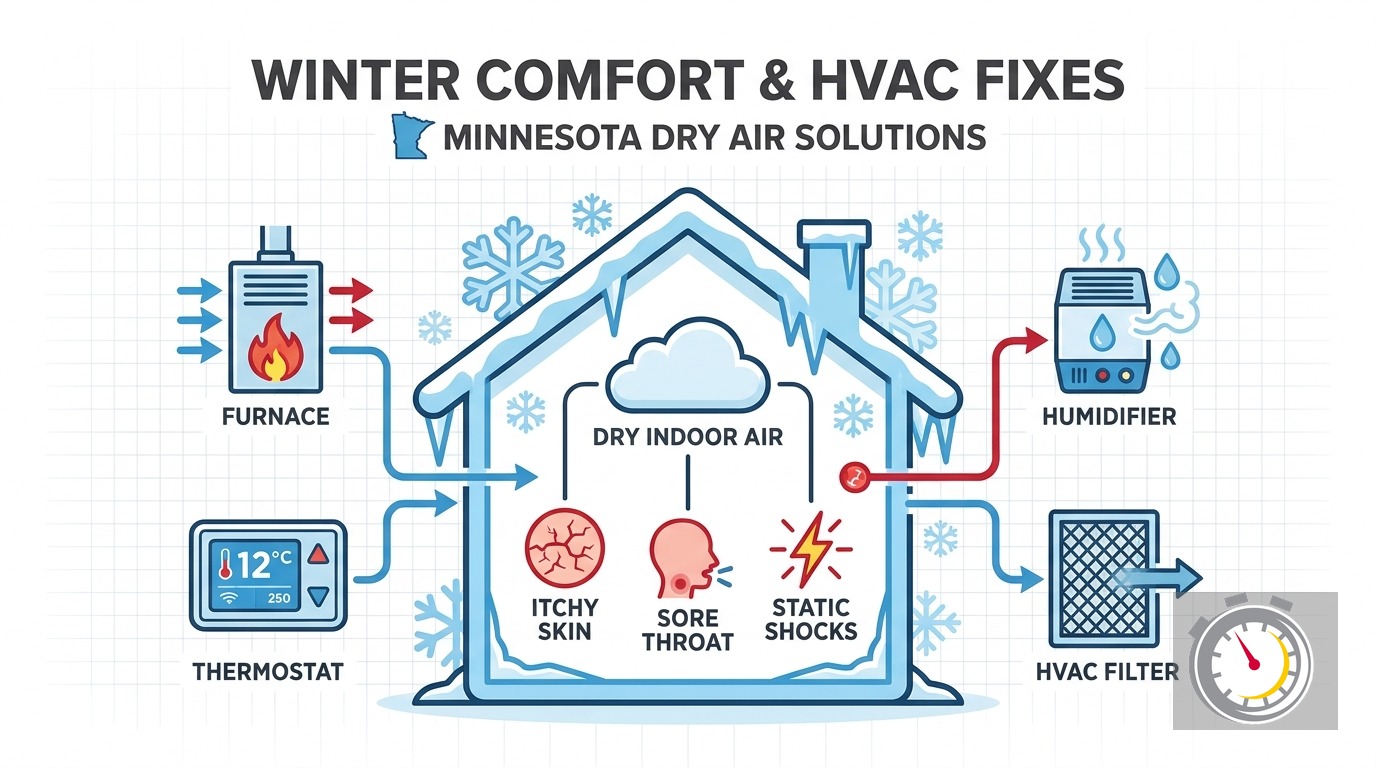
Key Takeaways
- Dry winter air can cause nosebleeds, static shocks, dry skin, chapped lips, and an irritated nose and throat.
- The EPA says to keep indoor humidity below 60 percent, ideally between 30 and 50 percent.
- In Minnesota, the right winter setting is a moving target. It should drop as the outdoor temperature drops.
- A hygrometer tells you what your home really measures. Guessing leads to dry air or foggy windows.
- A whole-home humidifier with a humidistat does the job better than a portable unit you refill by hand.
- Check windows, air leaks, and your furnace before you add moisture.
- Frequent or heavy nosebleeds need a clinician, not a humidifier.
Why does dry winter air cause nosebleeds?
Dry air pulls moisture out of the lining of your nose. The tissue cracks and bleeds easily. Heated indoor air in a Minnesota winter is often very dry, so nosebleeds are more common from December through March.
Start with what happens to the air. Cold outdoor air holds very little moisture. Your furnace warms it to 68 or 70 degrees. Warm air can hold much more water, so the relative humidity drops.
One consumer health guide lists nosebleeds from dry, cracked nostrils among the common effects of dry winter air. It also lists static shocks, dry skin, chapped lips, and dry nasal passages and throat.
A manufacturer’s guide says winter indoor air can fall to levels of 15 percent or less. That is a company claim, not a Minnesota measurement. Still, many Twin Cities homeowners see readings in the teens or twenties during a cold snap.
You may recognize the pattern in your own home. Kids get nosebleeds at night. Your lips crack by January. Your throat feels scratchy each morning. All of these point to air that is too dry.
What other symptoms does dry indoor air cause?
Dry indoor air can dry your skin, chap your lips, and irritate your nose and throat. It can also make you more vulnerable to colds, sinus infections, and flu. Static shocks are the most obvious sign. The same dryness can also affect your home.
The same consumer health source links dry winter air to greater vulnerability to colds, sinus infections, and flu. Dry air does not cause a cold by itself. It does leave your nose and throat less comfortable.
Watch for these signs in your home:
- Nosebleeds, especially at night or in the morning
- Static shocks on door handles, stair rails, and car doors
- Dry, itchy, or cracked skin
- Chapped lips that do not heal
- A dry, scratchy throat when you wake up
- Sinus congestion or headaches that ease when you leave the house
- Wood floors or trim with new gaps
- Houseplants that droop even when watered
Your house feels the dryness too. Wood shrinks as it loses moisture. If you see new gaps between hardwood boards, read our guide on low humidity and hardwood floors in Minnesota winters.
A symptom list does not prove the cause. Many things can cause a stuffy nose or a nosebleed. Dry air is a common one, and it is fixable. That is why it is worth measuring first.
Why do you get static shocks in winter?
Static shocks happen when charge builds up on your body and jumps to a metal object. Dry air makes this worse. In humid air, charge leaks away quietly. In dry winter air, it stays on you until you touch a door handle.
You walk across carpet in socks. Charge builds up. You reach for a light switch and feel a snap.
Humidity controls how fast that charge drains. Moist air lets it escape a little at a time. Dry air holds it, and you get a sharp shock.
Static is annoying, but it is also a useful clue. If your home snaps and crackles all winter, the air is probably too dry. If the shocks stop when you raise the humidity, you have your answer.
Some quick fixes help a little:
- Wear natural fibers instead of synthetics
- Touch a metal object with a key before you touch the handle
- Use a damp cloth on carpet
- Moisturize your hands
None of those fix the air. They only manage the symptom. For a deeper look at the cause, see our post on static electricity versus low humidity and whole-home humidifier setup in Minnesota winters.
What humidity level should your Twin Cities home have in winter?
The EPA says to keep indoor relative humidity below 60 percent, ideally between 30 and 50 percent. That is a good general range. In a Minnesota winter, aim for the lower part of it on cold days, because of condensation on windows and in walls.
Here is how the EPA puts it: indoor humidity should stay below 60 percent, ideally between 30 and 50 percent. That is an archived EPA page, but the range is widely used.
The consumer health guide gives a comfortable range of 30% to 50%. It warns against going above that because of mold and dust mites.
Some sources give a single number. The manufacturer guide we mentioned recommends keeping indoor humidity at a comfortable, moderate level. That may work in a mild climate. It can be too high for a Minnesota home on a 0°F night.
Why? Moisture moves toward cold surfaces. Windows are the first place you see it. Walls and ceilings are where it does damage you cannot see.
So there is no single fixed number. You have a range, and you pick your spot in it based on the weather.
Why does the right humidity setting change with the outdoor temperature?
Warm indoor air meets cold surfaces like window glass. When the glass is cold enough, moisture condenses on it. The colder it gets outside, the lower your indoor humidity must be to avoid that. A setting that works at 30°F can fog windows at 0°F.
The Cold Climate Housing Research Center is an Alaska nonprofit, not an HVAC company. It gives an example for a home with a 70 degree indoor temperature and a 0 degree outdoor temperature. At those temperatures, condensation forms at roughly 15 percent relative humidity on single-pane windows.
The same page gives numbers for better windows. On double-pane windows, condensation forms at around 25-40 percent. On triple-pane windows, it forms between 30-50 percent. The page calls these rough numbers.
Read that again. At 0°F outside, a single-pane window can start to fog at a very low humidity level. That is lower than what many people need to stop nosebleeds.
So a Minnesota winter pulls two ways. Your nose wants more moisture. Your windows and walls want less. The same 40 percent that feels good in November can cause trouble in January.
The CCHRC page advises targeting the lower end of the range in cold climates, citing condensation risk in walls and ceilings. It says to aim for less than 40 percent relative humidity.
Here is a practical way to use that idea:
- On mild winter days, you can run humidity toward the upper part of the 30 to 50 percent range.
- On very cold nights, lower the setting.
- Watch your windows. Fog or water on the glass means the setting is too high.
- If you have older single-pane windows, expect to run lower.
You can adjust by hand. You can also use a humidistat with outdoor-temperature compensation, which changes the target for you. We cover that below.
For more on foggy glass, read our guide to condensation on windows in Minnesota winters.
How do you measure humidity at home?
Use a hygrometer. It is a small, inexpensive device that shows relative humidity. Place one in the main living area and another in the bedroom. Check it daily during cold weather. Measuring beats guessing, because dry air and wet air can both feel uncomfortable.
Most homeowners guess. They feel dry skin and assume the air is dry. Or they see fog on a window and assume the air is wet. A hygrometer settles it.
Follow these steps:
- Buy two hygrometers.
- Put one in the living room, away from the kitchen and bathrooms.
- Put the other in the room where nosebleeds or dry throats happen most.
- Write down the readings each morning for a week.
- Note the outdoor temperature next to each reading.
After a week, you will see a pattern. You may find that the bedroom runs drier than the living room. You may find that humidity drops fast on the coldest days.
Check the glass at the same time. Look at the bottom corners of the windows, and at the frames for moisture or frost. Those are your early warning signs.
If you already have a humidifier, the hygrometer also tells you whether it works. If the reading stays low while the unit runs, something is wrong. Our post on why a humidifier runs but the house is still dry explains the common causes.
Are portable humidifiers enough?
Portable humidifiers help in one room, but they are hard to run well across a whole home. You must refill them often and clean them on a schedule. Without a humidistat, you can also overshoot. For a family with nosebleeds in several bedrooms, they quickly become a chore.
Portable units have a place. A small unit in a bedroom can help a child sleep. They cost little to try, and they let you test whether more humidity helps.
But there are limits:
- They cover one room or one floor at best.
- You must refill the tank by hand, often daily.
- Most have no link to the weather or your thermostat.
- Dirty tanks can spread what grows in them.
Cleaning matters. The consumer health guide says to clean a humidifier at least every 3 days. That is a lot of upkeep if you run three or four units.
Portable units also leave the whole-house problem unsolved. Your living room can stay dry while the bedroom is fine. Doors open and close, and moisture moves.
If you want to keep a portable unit in a bedroom, that is fine. Use a hygrometer and clean it on schedule. For whole-home comfort, most Twin Cities homeowners are better served by a system tied to the furnace.
What does a whole-home humidifier do better?
A whole-home humidifier connects to your furnace and ductwork. It adds moisture to the air that flows through your whole house. A humidistat controls it, so it runs only when needed. You do not refill tanks. Better models can also adjust to the outdoor temperature.
This is the main fix we recommend for dry winter air in the Twin Cities. Here is why it works.
It covers every room. Air moves through your ducts, and the humidifier adds moisture to that air. Bedrooms, living areas, and offices all benefit.
It runs on its own. It draws water from your plumbing. You do not carry jugs or refill tanks.
It follows a target. The humidistat reads the air and turns the unit on or off. You set the goal once.
It can adjust for the weather. Some humidistats use an outdoor sensor. As it gets colder outside, the system lowers the target. That protects your windows on the coldest nights. This is the “moving target” approach we described above.
There are a few main types. A bypass unit uses airflow from your furnace to carry moisture. A steam unit makes steam and can output more. Our guide to bypass versus steam humidifiers explains the choice.
Output varies by model. One manufacturer rates its bypass humidifier at up to 17 gallons a day. Bigger output is not always better. The right size depends on your home’s size, tightness, and windows.
A whole-home unit also needs care. Pads or water panels need regular replacement, and hard water leaves scale. Our guide to whole-home humidifier cleaning and maintenance covers the routine.
We install and service whole-home humidifiers as part of our indoor air quality work. You can learn more on our humidifiers page. For a deeper look at how winter dryness works with your furnace, see whole-home humidifiers for winter dry air.
What should you check before you add moisture?
Check your windows, air leaks, and furnace first. Leaky windows and drafty walls pull dry air in. Poor windows fog at lower humidity. If you add moisture to a leaky home, much of it escapes or lands on cold glass. A quick check helps you choose the right setting.
Here is the order we suggest.
1. Windows. Look at what you have. Single-pane windows fog first. Double-pane do better. Triple-pane handle the most moisture. Based on the CCHRC numbers above, window type sets your safe humidity ceiling.
2. Air leaks. Cold air leaks in around doors, attic hatches, and rim joists. That air is very dry. Sealing leaks means your humidifier works less. Our post on air sealing before an HVAC upgrade is a good place to start.
3. Furnace and filter. A clogged filter hurts airflow, which hurts a ducted humidifier too. The consumer health guide suggests changing filters at least every 3 months. In a Minnesota winter, many homes need it sooner. Check the filter monthly.
4. Exhaust fans. Fans pull indoor air outside. Running them too long can dry your home faster.
5. Your current humidifier. If you have one, check the water panel and the water line. A worn pad or a stuck valve can shut it down without warning.
Do this homework before you buy anything. It keeps you from paying for equipment that cannot do its job.
Can too much humidity be a problem?
Yes. Too much humidity fogs windows, wets walls and ceilings, and can support mold and dust mites. That is why you should not simply crank the setting up. The EPA says to keep indoor humidity below 60 percent. In a Minnesota winter, stay well under that.
More is not better. Overshooting trades one problem for another.
Watch for these warning signs:
- Water or frost on window glass that does not clear
- Wet window sills or stained trim
- A musty smell in closets or the basement
- Peeling paint near windows or exterior walls
- Mold spots in corners, especially on outside walls
The consumer health guide warns against going above its comfortable range because of mold and dust mites. The EPA page we cited says to keep humidity below 60 percent.
In a cold climate, the bigger risk is moisture inside the walls and ceilings. You may not see it until damage appears. That is the reason for the CCHRC advice to aim lower on cold days.
If you see fog on your windows, lower the setting right away. Then watch the hygrometer over the next few days. If problems keep coming back, call us. We can look at the system, your windows, and your ventilation together.
When are nosebleeds a medical problem, not an HVAC one?
Humidity helps with dry-air nosebleeds, but it does not treat a medical problem. If nosebleeds are frequent or heavy, or they will not stop with pressure, see a clinician. Seek emergency care if a nosebleed affects your breathing. A humidifier should never replace medical advice.
We are an HVAC company, not a medical provider. We can fix your air. We cannot diagnose why someone bleeds.
Here is a simple rule. If you fix the humidity and the nosebleeds stop, dry air was likely the cause. If they continue, call your doctor.
Talk to a clinician if:
- Nosebleeds happen often, even after you raise the humidity
- A nosebleed is heavy or lasts a long time
- Bleeding comes with dizziness or weakness
- A child or older adult has repeated nosebleeds
- You take blood thinners
For trusted medical guidance, look to your doctor, your local clinic, or reputable health sources like MedlinePlus. Do not rely on a heating company for medical advice.
If someone in your home has asthma or allergies, humidity matters there too. Our post on HVAC and asthma triggers in the Twin Cities covers how air quality and humidity interact.
What does a winter humidity plan look like for a Twin Cities home?
A good plan has four parts: a hygrometer, a target range, a humidifier tied to your furnace, and a quick weather check. You start near the middle of the range, then lower the target as the temperature drops. You also watch your windows for fog.
Here is a simple version you can follow.
Step 1: Measure. Place hygrometers in your living area and bedroom. Record daily readings for a week.
Step 2: Pick a range. Use the EPA’s 30 to 50 percent as your outer limits. In a cold snap, aim for the lower part.
Step 3: Match your windows. If you have single-pane glass, you may need to stay low. If you have newer windows, you may have more room.
Step 4: Automate. Install a whole-home humidifier with a humidistat. If your system supports it, choose outdoor-temperature compensation.
Step 5: Maintain. Replace the water panel on schedule. Clean scale from hard water. Change your furnace filter.
Step 6: Review. Check your windows each week in January and February. If you see fog, lower the setting.
Our humidistat settings guide for Minnesota winters walks through the dial in more detail.
A note on rebates. Utilities in Minnesota run programs for some HVAC equipment. For example, CenterPoint Energy’s rebate page covers upgrading or replacing your furnace or boiler to a high-efficiency model and qualifying thermostats. We found no rebate listed there for whole-home humidifiers. Programs change, so check current utility offers before you plan a project.
Does a better thermostat or furnace help with dry air?
A smart thermostat does not add moisture, but it can help you manage comfort. Some work with humidifiers. A high-efficiency furnace does not dry the air by itself either. The real fix is a humidifier and a humidity target that matches your weather and your windows.
People sometimes blame the furnace for dry air. Winter air is dry to begin with, and heating makes it feel drier. The furnace does not create the dryness. It exposes it.
If your furnace is old, though, it may be part of the story. Poor airflow, leaky ducts, and an undersized system can all make comfort worse. A tune-up is a good time to review your humidifier too.
Thermostats can help in two ways. They keep your temperature steady, and some link to humidity controls. If you are shopping, see our thermostats page for what we install.
If you plan a bigger project, like a new furnace, ask about adding a humidifier at the same time. It is easier to do both at once. We also offer financing for larger jobs, so ask us about options.
How can Northern One Hour help?
We are locally owned and operated, right here in the Twin Cities. We know what a Minnesota winter does to your air. We can measure your humidity, check your system, and set up a humidifier that fits your home. You get honest advice and a clear plan.
Our team can help in several ways:
- Check your current humidity and compare it to the weather
- Inspect your furnace, filter, and ductwork
- Diagnose a humidifier that runs but does not help
- Install a whole-home humidifier with a humidistat
- Recommend whether window or air leak work should come first
We also stand behind our timing. Our promise is “Always On Time… Or You Don’t Pay a Dime!(R)” We arrive within the time window you select. If the technician does not show up on time, you do not pay for the service.
You do not need to live with nosebleeds, static shocks, and cracked skin all winter. Start with a hygrometer and a look at your windows. Then let us handle the equipment.
Call us at (763) 260-6662 or book online to schedule fast. We will help you find the right humidity for your home, even on the coldest night.
Frequently Asked Questions
What humidity level should my Minnesota home have in winter? +
Why do I get static shocks in winter? +
Is a whole-home humidifier better than a portable one? +
Can a humidifier cause problems? +
When should I see a doctor about nosebleeds? +
Need a technician now?