
Humidifier Running but House Still Dry: Minnesota Fixes
Key Takeaways
- A dry house during a cold snap is often the system working as designed, or set wrong.
- The correct indoor humidity target drops as the outdoor temperature drops. MNCEE publishes the numbers.
- Raising the setting when it is brutally cold outside can cause window frost and condensation.
- A leaky house can lose moisture as fast as the humidifier adds it. Air sealing may help more than a bigger unit.
- A scaled or worn water panel can cut output. Follow your manufacturer’s manual for care.
- Whole-home settings are easy to forget. Check yours at every big temperature swing.
- We can inspect your system fast. Call (763) 260-6662 or book online.
Why is your humidifier running but the house still dry?
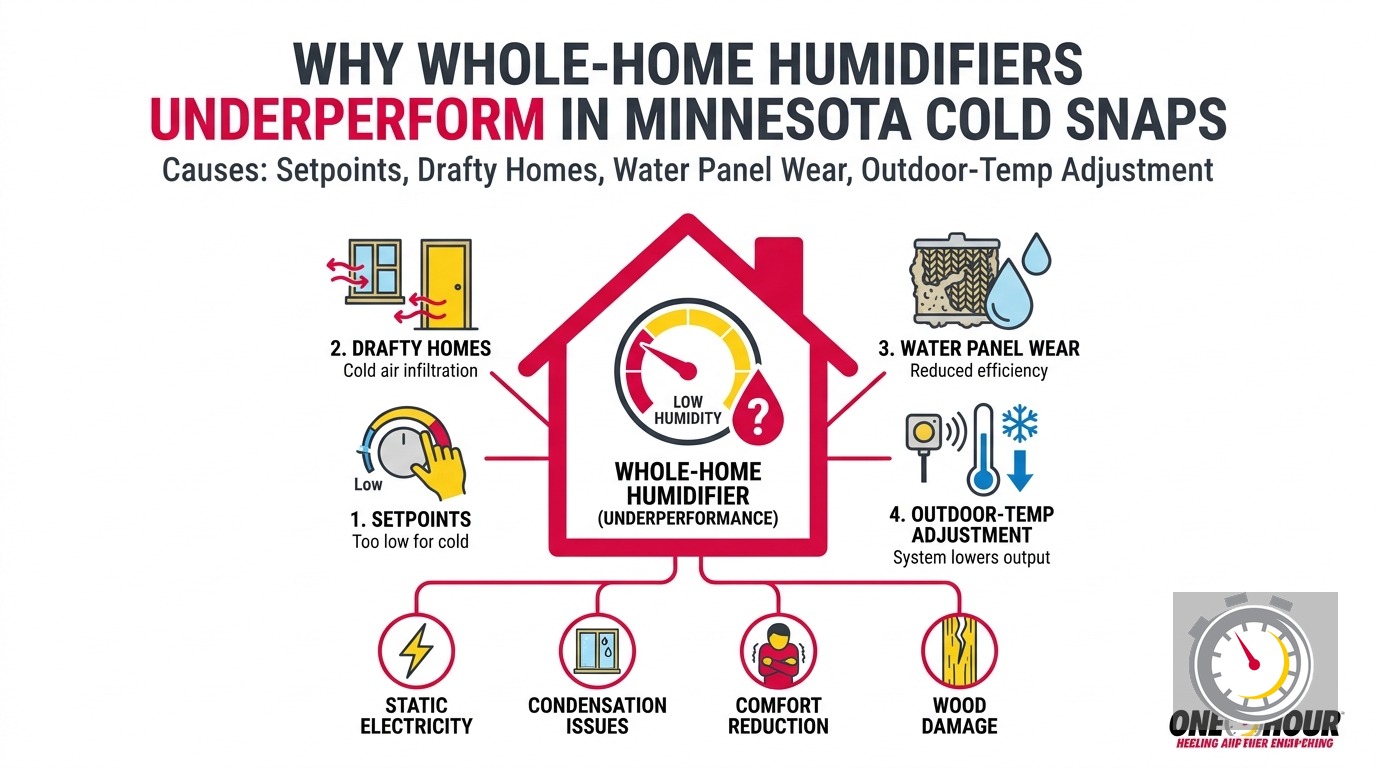
In a Twin Cities cold snap, a dry house usually traces to one of a few causes. The setpoint may be wrong, the house may leak moisture outdoors, or the water panel may be worn. Your humidifier may be working exactly as designed. Check those three things before you buy a bigger unit.
Most online advice treats this as a broken machine. It is written for portable units in mild climates, so it misses what happens in a Minnesota January.
When it gets very cold outside, the right indoor humidity target goes down. Keep the setting high and you get frost on the windows. See a low reading, raise the dial, and you can make things worse.
We are a locally owned and operated Twin Cities heating and cooling company. We get this call every winter.
How do you know if your whole-house humidifier is working?
A working whole-house humidifier shows water use, a damp water panel, and a rising humidity reading over several hours. If none of these happens while the furnace runs, the unit likely has a supply, control, or panel problem. Confirm each one before you change anything else.
Run through this short check. It takes about 15 minutes.
- Check the humidistat. Make sure it is switched on and set to a target. A control left in the off position does nothing.
- Confirm the furnace is running. Many whole-home units depend on furnace airflow to move moisture through your ducts.
- Look at the water supply. The supply valve should be open. A closed or clogged valve means no water reaches the panel.
- Open the humidifier cover. The water panel should be damp when the unit calls for humidity. A dry, crusty panel is a red flag.
- Check the drain line. It should not be kinked, clogged, or backed up.
- Read a hygrometer in several rooms. One reading in one room can mislead you.
A dry panel with the supply open points to a stuck valve or a failed control. A technician can sort that out quickly.
If the unit is wet and running, the machine is probably fine. Keep reading.
Why one number is not enough
A hygrometer tells you relative humidity at one spot. A bedroom and a basement can differ a lot. A reading next to a cold window may also differ from the room’s center.
Place a small hygrometer in the main living area, away from windows and vents. Check it at the same time each day. Track the outdoor temperature alongside it. You need that pairing for the next section.
What should your humidity setpoint be when it is below zero?
In winter, your indoor humidity target should fall as the outdoor temperature falls. MNCEE lists a cutoff for each range, from below 40 percent at 20 to 40 degrees down to below 15 percent at 20 below zero. Setting it higher than these numbers invites window condensation.
Most guides skip this. A humidifier does not need to hit one fixed number all winter. The target moves with the weather.
The table below comes from MNCEE’s humidity guidance.
| Outdoor temperature (°F) | Recommended indoor relative humidity |
|---|---|
| 20 to 40 | Below 40% |
| 10 to 20 | Below 35% |
| 0 to 10 | Below 30% |
| -10 to 0 | Below 25% |
| -20 to -10 | Below 20% |
| -20 or below | Below 15% |
Read it twice. At 5 degrees outside, the recommended maximum is below 30 percent. At 15 below, it is below 20 percent.
So a reading of 22 percent during a deep freeze may be fine. It may even be close to ideal. It does not mean your humidifier has failed.
The setpoint trap
A cold snap arrives. You glance at the hygrometer and see 20 percent. The house feels dry, so you turn the dial up.
Now the humidifier pushes moisture the house cannot hold. Warm indoor air meets cold window glass. The moisture condenses on the glass, then frosts.
MNCEE’s advice is clear. If moisture keeps building on windows or walls, turn off the humidifier. Then lower the set point before you restart it.
We say the same. Treat window moisture as the signal to back off. A low reading alone is no reason to push up.
What about the general range?
For a normal winter day, MNCEE says to run a humidifier “for short periods of time” with relative humidity set between 30 and 40 percent. That gives you a comfortable starting point.
The EPA gives a wider guide. It says to keep indoor humidity below 60 percent, ideally between 30 and 50 percent. You can read it in the EPA’s guide to mold and moisture.
The EPA range is general. The MNCEE table is built around cold weather. In a Minnesota deep freeze, use the MNCEE table.
The EPA page also says condensation can be a sign of high humidity. It does not mention winter. Still, the connection holds. Window moisture tells you the setting is too high for today’s temperature.
For more on dialing in the control, see our guide to humidistat settings for Minnesota winters.
A simple routine
You do not need to babysit the dial every day. Try this instead.
- Check the forecast on Sunday night.
- Match the lowest expected temperature to the table.
- Set the humidistat to that target.
- Look at your windows each morning.
- If you see moisture or frost, lower the setting a few points.
The routine takes two minutes a week. It prevents most winter humidity complaints.
Can a drafty house cancel out your humidifier?
Yes. A leaky home loses indoor air, and the moisture inside it, to the outdoors. When the leaks are big enough, the house sheds humidity as fast as the unit adds it. The fix in that case is air sealing, not a larger humidifier.
MNCEE says a dry home may point to air leakage. In a home that is not well air-sealed, leaks “create unintentional ventilation.” Cold, dry outdoor air comes in. Warm, humid indoor air goes out.
Minnesota winter air holds very little moisture. Every cubic foot that sneaks in must be warmed and humidified. A leaky house forces your humidifier to chase a moving target.
How common are leaks?
Quite common. ENERGY STAR says most U.S. homes “don’t have enough insulation and have significant air leaks.” It adds that, added up, a typical home’s leaks would amount to roughly a window left open all year. The numbers are on ENERGY STAR’s seal and insulate page.
Now picture running a humidifier in a room with a window open all winter. Your unit may be losing that same fight.
Where homes tend to leak
Leaks hide in places you rarely look. Common spots include:
- Attic hatches and recessed lights that open to the attic
- Rim joists in the basement
- Gaps around windows and exterior doors
- Plumbing and wiring penetrations
- Fireplace dampers that do not close tightly
- Duct seams in unconditioned spaces
A tight house keeps its moisture. It also keeps its heat. ENERGY STAR estimates homeowners can save an average of 15 percent on heating and cooling costs by air sealing and adding attic, crawl space, and basement insulation. The same estimate gives an average of 11 percent on total energy costs.
Those are national averages, and your results depend on your home. Still, sealing helps comfort and cost at once.
Fix the house, then the humidifier
In a leaky house, a bigger humidifier is a poor first move. It uses more water and more energy, and you still chase the number.
Seal first, then tune. We cover the order of operations in our post on air sealing before an HVAC upgrade.
MNCEE adds one more point on moisture. If condensation persists without a humidifier running, the cause may be “inefficient windows or under-insulated walls.” The recommended fix is to insulate and air seal them.
So window moisture can mean two different things:
- Humidifier running: the setting is too high for the weather.
- Humidifier off: the windows or walls may be the weak point.
Knowing which one you have keeps you from chasing the wrong fix.
How does a worn water panel hurt humidifier output?
A scaled or worn water panel absorbs and evaporates less water. That cuts the moisture your system adds, and the loss shows up in the coldest months, when the furnace runs most and the demand is highest. Care for the panel the way your manufacturer’s manual says.
Most whole-home units use a water panel, sometimes called a pad or evaporator. Water flows over it. Warm air passes through and picks up moisture.
Over time, minerals in the water build up on the panel. The surface hardens and clogs. Less water evaporates, and the house stays dry.
We could not find an authoritative source for how often panels should be replaced, so we will not give you a number. Your manufacturer’s manual is the best guide for your model. It will list a replacement schedule and approved cleaning steps.
Signs of a tired panel
Look for these clues when you open the cover:
- White or tan crust on the panel
- A hard, stiff feel instead of a damp, porous one
- Water that runs straight through without soaking in
- A musty smell
- Mineral flakes in the pan or drain
If you see any of these, the panel is probably limiting output. A fresh panel often restores what the unit was built to deliver.
Why it hits hardest in January
Many people forget the panel from spring through fall. The humidifier sits idle. Then the first deep freeze arrives, and the unit has to work hard.
A worn panel cannot keep up. The shortfall is largest exactly when you need the unit most. That is why we like to check the panel in early fall, before the heating season ramps up.
Hard water makes this worse. Our post on humidifier hard water scale buildup explains what to look for and what to avoid. It also covers why harsh cleaners can do more harm than good.
What not to do
Skip the shortcuts. Do not scrape the panel with metal tools. Do not soak it in a cleaner your manual does not approve. Do not run the unit with a panel you know is failing.
If you are unsure, ask us. A quick look can tell you whether to clean, replace, or investigate further.
Does a humidifier really put moisture in the air?
Yes. A humidifier adds water vapor to your indoor air. But it only adds. It does not hold the moisture in place. If air leaks, cold weather, or an extra-high setting pull the moisture out, the reading will still stay low or the windows will fog.
Think of a humidifier as a faucet filling a tub. The drain is your house. A tight house has a small drain. A leaky house has a big one.
When the tub never fills, you have two choices. Open the faucet wider, or plug the drain. In a Minnesota winter, plugging the drain is often the smarter move.
What the humidifier cannot do
A humidifier cannot fix:
- Air leaks in your attic or rim joists
- Cold, poorly insulated walls
- Windows that sweat in every cold snap
- A setpoint that ignores outdoor temperature
It can only do its own job. Help it with a tighter house and a smart setting.
Should you choose a whole-home unit or individual humidifiers?
Both can work. MNCEE says its energy auditors typically recommend individual humidifiers over whole-home units, because whole-home set points are easy to forget and can add too much moisture. A whole-home unit works well if you adjust it with the weather.
We sell and service whole-home humidifiers, so we will be straight with you. MNCEE’s point is fair. A whole-home unit invites set-it-and-forget-it habits. In Minnesota, that causes trouble.
Here is how the two compare in practice.
Whole-home unit
- Works through your ductwork, so it covers the entire house
- Needs no daily refilling
- Needs a seasonal panel check
- Needs a setpoint that follows the weather
Individual unit
- Covers one room or area
- Needs regular refilling and cleaning
- Is easy to switch off when windows fog
- Does not help the rest of the house
The best choice depends on your home, your habits, and your budget. If you like to adjust things, a whole-home unit is convenient. If you tend to forget, a smart control or a reminder helps.
Cost matters too. Our guide to whole-house humidifier cost in Minnesota lays out what to expect.
For a full look at how these systems work in our climate, read our whole-home humidifier winter guide.
What should you check during a cold snap?
When temperatures plunge, work through a short checklist in order. Start with the outdoor temperature and the setpoint. Then check your windows, the panel, and the house itself. Most cold snap complaints resolve at one of the first three steps.
This is the order we use.
Step 1: Look at the outdoor temperature. Find today’s low. Match it to the MNCEE table.
Step 2: Check your setpoint. If it is higher than the table suggests, lower it. Give the house a day to adjust.
Step 3: Look at your windows. Frost or beads of water mean the setting is too high. Turn the humidifier off if moisture keeps building, then restart at a lower number.
Step 4: Open the humidifier. Is the panel damp? Is it crusty? Is water reaching it?
Step 5: Check the reading in more than one room. Use the same hygrometer. Compare the rooms.
Step 6: Think about the house. Do you feel drafts near outlets, doors, or windows? Is the attic hatch loose? Does the basement feel cold and breezy?
Step 7: Decide who to call. A dry panel, a closed valve, or a dead control is a service call. A leaky house may need an energy audit or air sealing work.
People who skip the order end up with the wrong fix. Raising the setting is the most common wrong move.
A note on comfort
A dry house in January is uncomfortable. Dry skin, scratchy throats, and static shocks are real, and you should not have to live with them.
Aim for a number that is comfortable and also safe for your windows and walls. That number moves with the weather. Stay within the range in the table and you will land close.
When should you call a professional?
Call a professional when the unit does not add water, the panel looks damaged, or you cannot find the cause. Also call if you see mold, ongoing window damage, or damp walls. These problems can affect your home, not just your comfort.
Some jobs suit a homeowner. Checking the setpoint, reading a hygrometer, and looking at windows all fit. Opening the cover to look at the panel is usually fine too, with the power off.
Leave these jobs to a technician:
- Replacing a stuck water valve
- Diagnosing a control or wiring fault
- Fixing drain problems
- Checking how the unit ties into your furnace and ducts
- Sorting out whether leaks or equipment is the real culprit
A technician can also check your furnace, since many humidifiers rely on its airflow. A furnace that runs poorly can hurt humidification too.
What a visit looks like
When you call, we ask about your symptoms and your setting. We look at the humidistat, the water supply, the panel, and the drain. We read the humidity in more than one spot. Then we tell you what we find in plain language.
If the unit is fine, we say so. If the house is the issue, we say that too. We will not sell you a bigger humidifier when sealing is the answer.
You can learn more about what we do on our humidifier services page.
Our on-time promise
We are locally owned and operated, and we live through the same winters you do. A dry house on a 10-below night cannot wait.
That is why we stand behind our promise: “Always On Time… Or You Don’t Pay a Dime!(R)” We arrive within the time window you select. If your technician does not show up on time, you do not pay for the service.
You will also get honest, transparent pricing. Our 100 percent satisfaction guarantee backs the work.
What about humidity beyond the humidifier?
Humidity is a year-round balance. Winter is about holding moisture in. Summer is about keeping it out. A home that handles both stays more comfortable and avoids moisture damage.
A few habits help in winter:
- Run bathroom and kitchen fans only as long as you need them. Long runs vent warm, humid air.
- Close the fireplace damper when it is not in use.
- Replace worn weatherstripping around doors.
- Check that the attic hatch seals tightly.
- Keep an eye on windows during every temperature drop.
Small moves like these add up. Your humidifier works less and the house holds more.
Think in seasons
Spring and summer bring the opposite problem. Humid air can make a house feel sticky and fuel mold. That is a job for your air conditioner and, in some homes, a dehumidifier.
If your house swings from too dry to too damp, you may want a plan for the whole year. A seasonal check-up can catch panel wear, valve trouble, and control drift before they cause a problem.
Get your humidity under control
In Minnesota, a running humidifier in a dry house usually comes down to a setpoint that ignores the weather, a leaky house, or a worn panel. Match your setting to the outdoor temperature, watch your windows, check the panel, and seal the leaks.
If you want a second set of eyes, call (763) 260-6662 or book online to schedule fast. We will check your humidifier, your controls, and your airflow, and show up on time.
Frequently Asked Questions
How can the humidity be high but the air feel dry? +
How do you make a house less dry without a humidifier? +
Need a technician now?