
Whole Home Humidifier Hard Water Scale Buildup: Twin Cities
Key Takeaways
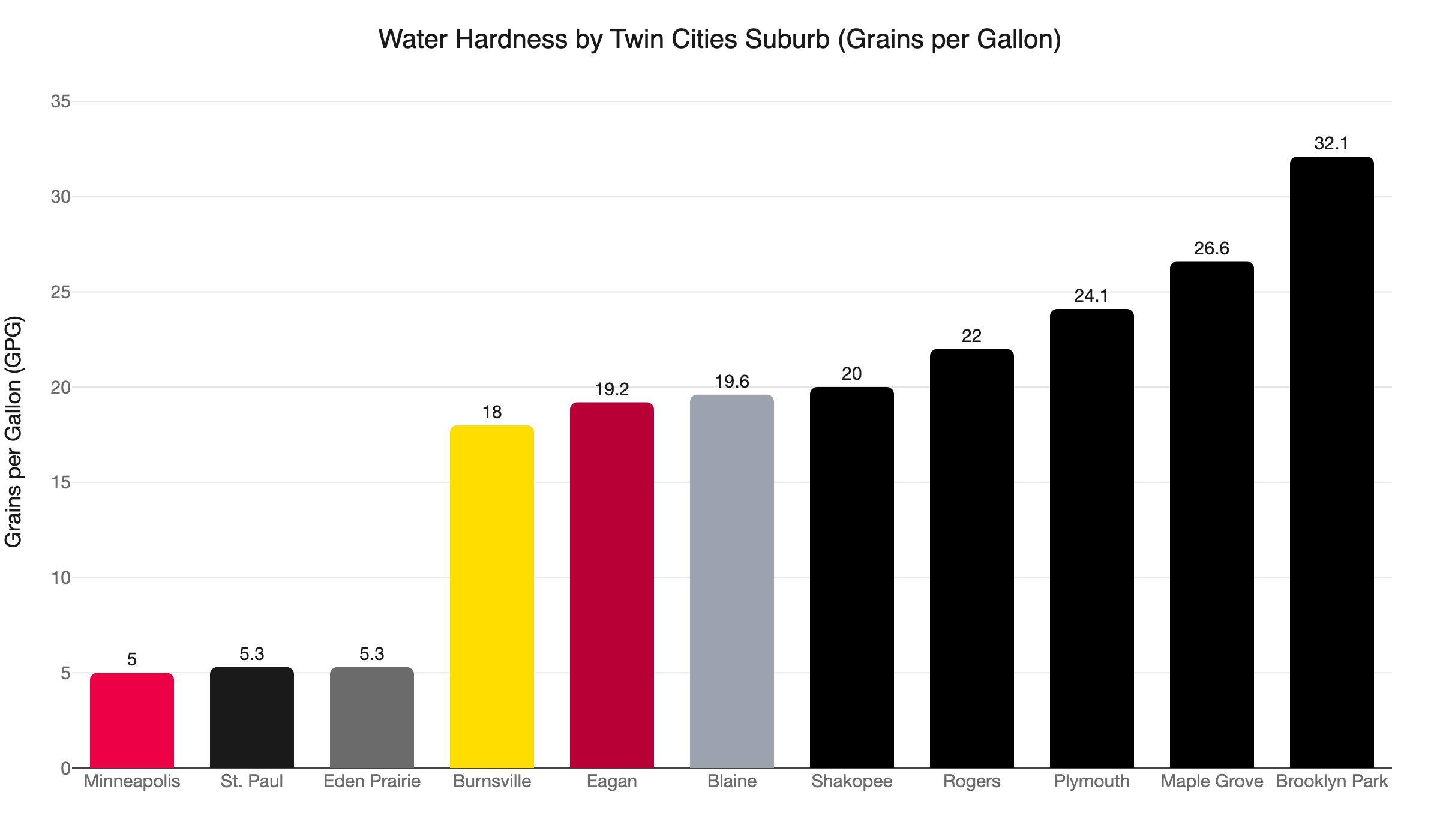
- Water hardness across the Twin Cities metro ranges from roughly 5 GPG in Minneapolis and St. Paul to 32.1 GPG in Brooklyn Park.
- At 32.1 GPG, Brooklyn Park water deposits scale more than six times faster per gallon than Minneapolis water at 5 GPG.
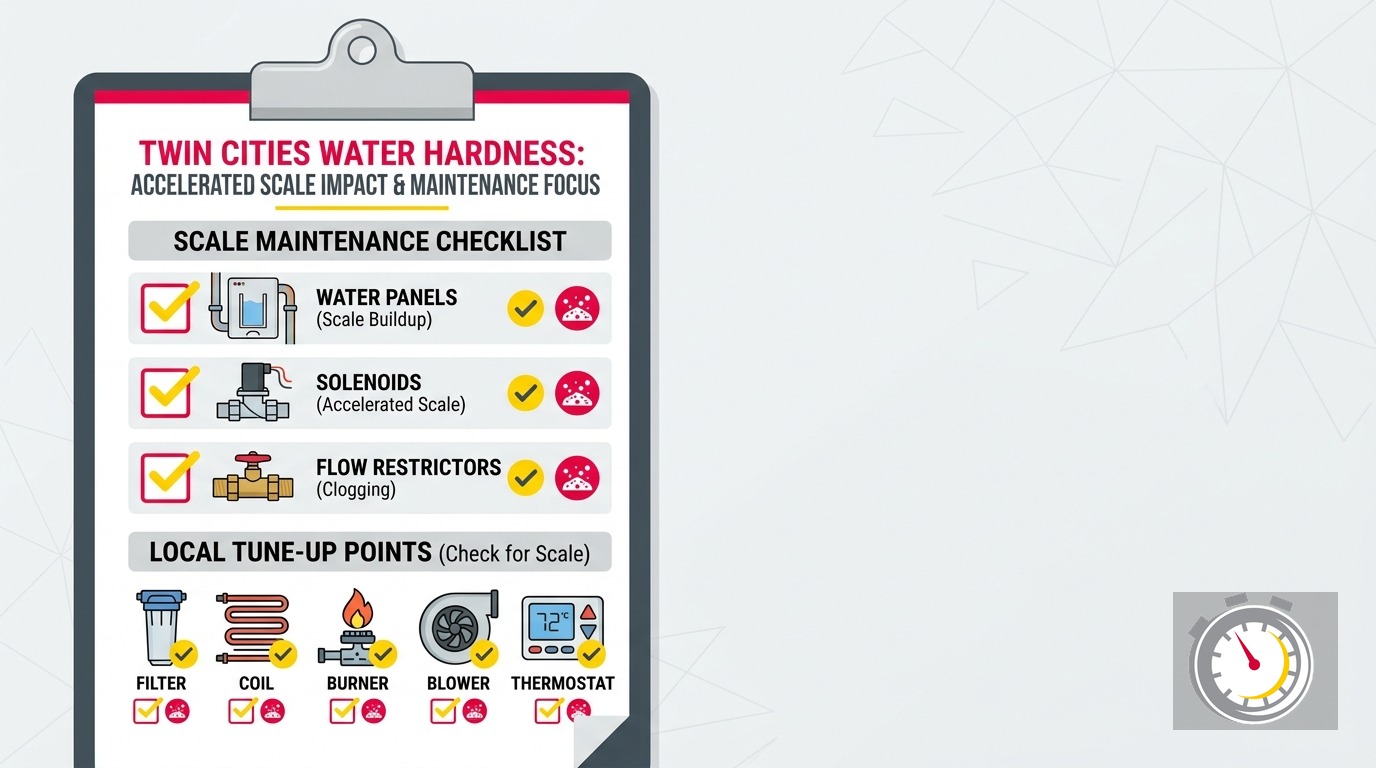
- Two components take the hit: the water panel (visible, replaceable, widely discussed) and the solenoid valve inlet strainer (hidden, and absent from most maintenance guides entirely).
- A failed solenoid valve either cuts water off completely or lets it run nonstop, overloading the drain pan under your furnace.
- Minnesota’s heating season runs October through April, roughly five to six months. Most maintenance articles were written for three- to four-month seasons.
- Annual water panel replacement is Aprilaire’s published baseline. In high-hardness suburbs above 20 GPG, mid-season replacement is often necessary.
Hard Water and Your Whole Home Humidifier: What Changes by Suburb
Whole home humidifier hard water scale buildup looks the same in every suburb. Dry skin. Static electricity. Hardwood floors that start gapping in January. But the rate at which scale builds depends entirely on your zip code.
Most homeowners assume scale only attacks the water panel. That is half right. In the Twin Cities suburbs, scale also accumulates in a second location almost no one checks: the solenoid valve inlet strainer. When that component fails, your system either runs completely dry all winter or floods the drain pan under your furnace.
Your suburb’s water hardness matters more than your humidifier brand.
Why does my whole home humidifier stop working mid-season?
Scale from hard water blocks either the water panel or the solenoid valve before the heating season ends. In high-hardness suburbs, the standard annual service schedule is not enough to prevent failure.
Whole home humidifiers work by running water over a porous panel. Your furnace blower moves air through that wet surface, picking up moisture on the way through. The process depends on two things: water actually reaching the panel, and the panel staying open enough for air to carry moisture.
Hard water leaves calcium and magnesium behind with every gallon that passes through the system. In a soft-water city, that accumulation is gradual. In a suburb drawing from limestone-heavy aquifers, it is not.
Minnesota’s heating season runs from roughly October through April. That is five to six months of continuous humidifier operation. Most published maintenance guides assume a three- or four-month season. The math on scale accumulation is meaningfully different here. A panel that survives a full season elsewhere may be glazed over by January in Brooklyn Park or Rogers.
How hard is the water in your Twin Cities suburb?
Water hardness varies dramatically across the metro. Suburbs drawing from the underlying limestone aquifers reach 17 to 32 GPG. Minneapolis and St. Paul treat their municipal water down to roughly 5 GPG. That difference controls how fast scale accumulates in your humidifier.
Minneapolis finished water is moderately hard, processed through lime softening at the Fridley plant. St. Paul’s finished water falls in the moderately hard range, per the September 2025 mineral report.
Most suburbs do not run that level of treatment. They draw from the Jordan, Mt. Simon, and Prairie du Chien-Jordan aquifers. These are limestone-heavy formations that produce naturally hard groundwater. Water hardness data from Aquatell shows the scale of the difference: Minneapolis sits at 5 GPG; Plymouth at 24.1 GPG; Maple Grove at 26.6 GPG; Brooklyn Park at 32.1 GPG. At 32.1 GPG, Brooklyn Park water deposits scale more than six times faster per gallon than Minneapolis water at 5 GPG.
Other familiar suburbs fall in between. Blaine comes in at 19.6 GPG. Eagan at 19.2 GPG. Burnsville at 18 GPG. Even at those levels, a humidifier running five to six months per year accumulates scale faster than most annual service schedules account for.
Eden Prairie is the notable suburban outlier. Its municipal system runs lime softening down to approximately 5.3 GPG, similar to Minneapolis and St. Paul.
This creates a real problem for homeowners who move. A Minneapolis homeowner who relocates to Plymouth or Maple Grove and keeps the same annual service schedule has a surprise coming. Nothing about the humidifier changed. The water chemistry in the new suburb deposits scale roughly five times faster per gallon.
Where does whole home humidifier hard water scale buildup actually concentrate?
Scale accumulates in two places: the water panel and the solenoid valve inlet strainer. The panel is visible and widely discussed. The solenoid inlet strainer is not mentioned in most maintenance guides and is absent entirely from Aprilaire’s humidifier maintenance page.
Aprilaire recommends annual water panel replacement for models 300, 500, 600, and 700, and twice per season for model 400. They also recommend annual inspection of the distribution tray for mineral deposits. That is the right floor for average conditions.
The floor is too low for most Twin Cities suburbs.
Scale is a poor conductor of heat. A 1/16-inch scale layer reduces heat transfer efficiency by approximately 10 to 12 percent. At 1/8 inch, the loss reaches roughly 23 to 27 percent. On a humidifier panel, scale also clogs the pores that allow air to carry moisture. The panel glazes over. Humidity output drops even as the system appears to run normally.
But the panel is visible and replaceable. The solenoid valve is what fails without warning.
What is a solenoid valve, and why does hard water scale damage it?
The solenoid valve is the electric gate that controls water flow into your humidifier. Scale lodges in the valve seat and in the inlet strainer just inside it. When the strainer clogs, the valve either stays shut or stays open. Both outcomes eliminate your humidity control for the season.
Your humidistat calls for humidity when indoor relative humidity drops below the set level. That signal opens the solenoid valve, letting water flow to the distribution tray and down through the water panel. When the target is reached, the humidistat closes the valve.
It is a simple on/off mechanism, but it is sensitive to debris. The Aprilaire 4040 solenoid valve is the replacement part for models 400, 500, 600, and 700. Its product documentation states: “Clean or replace the valve if debris or mineral buildup restricts movement.” Accessing the inlet strainer requires removing the compression nut. In hard-water suburbs, that strainer can pack with calcium within a single heating season.
The inlet strainer is a mesh screen inside the valve inlet. Its job is to catch debris before it reaches the valve seat. In a soft-water city, you might go years without it becoming an issue. In Brooklyn Park or Maple Grove, it can clog before the season ends. Once it does, the valve behaves as if stuck closed, even when it is electrically open.
Aprilaire’s humidifier maintenance page does not mention the solenoid valve at all. Neither do most competitor articles on humidifier cleaning. It is the component most likely to cause complete system failure, and the least likely to appear on a standard maintenance checklist.
What happens when the solenoid valve fails?
It fails in one of two directions. Stuck closed means no water reaches the water panel all season. Stuck open means water flows continuously into the drain, regardless of what the humidistat says.
Both failure modes have real consequences for your home.
Stuck closed: The furnace blower runs. The humidifier cabinet looks normal. No water is flowing. The home stays dry all winter despite the system appearing to operate. You may not notice until February, when hardwood floors gap at the seams. Or until you open the cabinet and find a dusty, bone-dry water panel with no mineral crust at all, because nothing has been flowing through it.
Stuck open: Water flows into the unit continuously. The drain line that handles normal humidifier runoff gets overwhelmed. Water backs up and overflows the drain pan under the furnace. Your furnace sits in a mechanical room near electrical components and the furnace itself. A stuck-open solenoid creates a slow leak that can go unnoticed until damage is already done.
The stuck-open failure is the more urgent of the two. If you notice the floor drain near your furnace running constantly, even when the heat is not calling, call for service that day.
How often should you replace the water panel in a hard water suburb?
In suburbs above roughly 20 GPG - Shakopee, Rogers, Plymouth, Maple Grove, Brooklyn Park - annual replacement is often not enough. Add a mid-season inspection in January. If more than half the panel is visibly crusted, replace it then, not in spring.
Aprilaire’s maintenance schedule was calibrated for typical conditions. Those conditions do not describe much of the Twin Cities metro.
A glazed panel is easy to spot. Open the humidifier cabinet during heating season. The panel should be damp and textured. If you see a hard white or tan crust covering more than half the surface, the panel is no longer efficient. If the pad feels rigid, replace it.
For the solenoid valve, the same logic applies. Inspect the inlet strainer each season in any suburb with moderately hard water. In the highest-hardness areas, inspect it mid-season as well. The Aprilaire 4040 replacement valve fits models 400, 500, 600, and 700. When buildup is heavy, replacing the valve rather than cleaning it gives you confidence the strainer is fully clear going forward.
A single humidifier tune-up visit typically runs $95 to $250 depending on what the system needs. If the solenoid valve requires replacement, the part and labor add to that. These are modest maintenance costs compared to the water damage a stuck-open solenoid can cause, or the months of dry air a stuck-closed one produces.
If you moved to a harder-water suburb in the last few years and kept your old service schedule, book an inspection this season. The humidifier that ran fine in Minneapolis on an annual panel change may need mid-season attention in its new location.
What does a whole home humidifier tune-up cover?
A thorough service visit inspects the water panel, distribution tray, solenoid valve and inlet strainer, drain line, and humidistat calibration. It also checks that the unit is wired to run only when the furnace blower is running.
When our technicians service a whole home humidifier, here is what they cover:
- Water panel condition: Is the panel glazed, saturated, or still serviceable? Replace as needed.
- Distribution tray: Mineral deposits on the tray restrict water flow to the panel. Cleaning or replacing the tray restores proper distribution across the pad.
- Solenoid valve and inlet strainer: Remove the compression nut, inspect for mineral buildup, clean the strainer or replace the valve, and test open/close function.
- Drain line: Scale and biofilm can partially block the drain. A restricted drain causes standing water in the unit and potential overflow.
- Humidistat calibration: A properly calibrated humidistat adjusts its set point as outdoor temperatures drop, preventing condensation on cold windows while maintaining comfort.
- Bypass damper (bypass models): The damper must be open in heating season and closed in cooling season. This setting gets skipped after a summer of AC use more often than you might expect.
- Wiring verification: The humidifier must only run when the furnace blower is on. Incorrect wiring lets it run against still air, reducing effectiveness and increasing scale buildup with no humidity gain.
A humidifier inspection pairs naturally with a furnace tune-up. One technician, one visit, before the coldest months arrive. Our heating maintenance service covers both in a single appointment.
How whole home humidifier hard water scale buildup affects your indoor air quality
Dry indoor air is more than a comfort issue in a Minnesota winter. Air below 30 percent relative humidity allows airborne viruses to survive longer, dries out the nasal passages that filter what you breathe, causes wood to shrink and gap, and generates the static electricity that builds on every fabric surface.
A humidifier with a clogged solenoid valve that produces no humidity is functionally the same as having no humidifier. Maintaining proper indoor humidity through winter requires a system that is actually moving water, not just running through the motions.
Watch both extremes. Bone-dry windows in January, when you would normally expect some light frost, may indicate humidity is too low. Heavy condensation on windows in winter may mean the opposite - humidity too high for the outdoor temperature, often from a stuck-open solenoid or a miscalibrated humidistat set too high. Both are fixable with a service visit.
Signs your humidifier has a scale problem right now
You do not need a water hardness kit to recognize when something is wrong. Watch for:
- Dry skin, chapped lips, or bloody noses that persist through the heating season despite adjusting the humidistat
- Static electricity on every fabric surface in the house
- Hardwood floor gaps appearing in January or February
- White or tan crust visible on the water panel when you open the humidifier cabinet
- Water running into the floor drain near the furnace continuously, even when the furnace is not calling for heat
- A musty odor near the furnace cabinet, which can indicate standing water or biofilm in the drain line
- Your humidistat reading below 25 percent despite the system appearing to run
The continuous drain flow is the most urgent sign on that list. It points directly to a stuck-open solenoid and can cause water damage if left unaddressed for even a few days.
Schedule a humidifier inspection before the season peaks
Northern One Hour is locally owned and operated in Ramsey, Minnesota. We service the full Twin Cities metro: Minneapolis, St. Paul, Blaine, Maple Grove, Plymouth, Brooklyn Park, Woodbury, Bloomington, and the surrounding suburbs. Our technicians service humidifiers across all hardness zones. We know which zip codes hit their panels and solenoids hardest and earliest in the heating season.
We back every service visit with our on-time promise. Schedule a window, and we arrive within it. If we do not, you do not pay. “Always On Time… Or You Don’t Pay a Dime!(R)”
Call (763) 260-6662 or book a humidifier inspection online. If your home is in a hard-water suburb and you have not had the solenoid valve checked this season, now is the right time.
Frequently Asked Questions
How do I know if my whole home humidifier has a hard water scale problem? +
How often should I replace the water panel in a high-hardness suburb? +
What is the hardest water in the Twin Cities metro? +
Can a clogged solenoid valve cause water damage? +
Need a technician now?