
Whole Home Humidifier Winter Guide for Twin Cities Homes
Key Takeaways
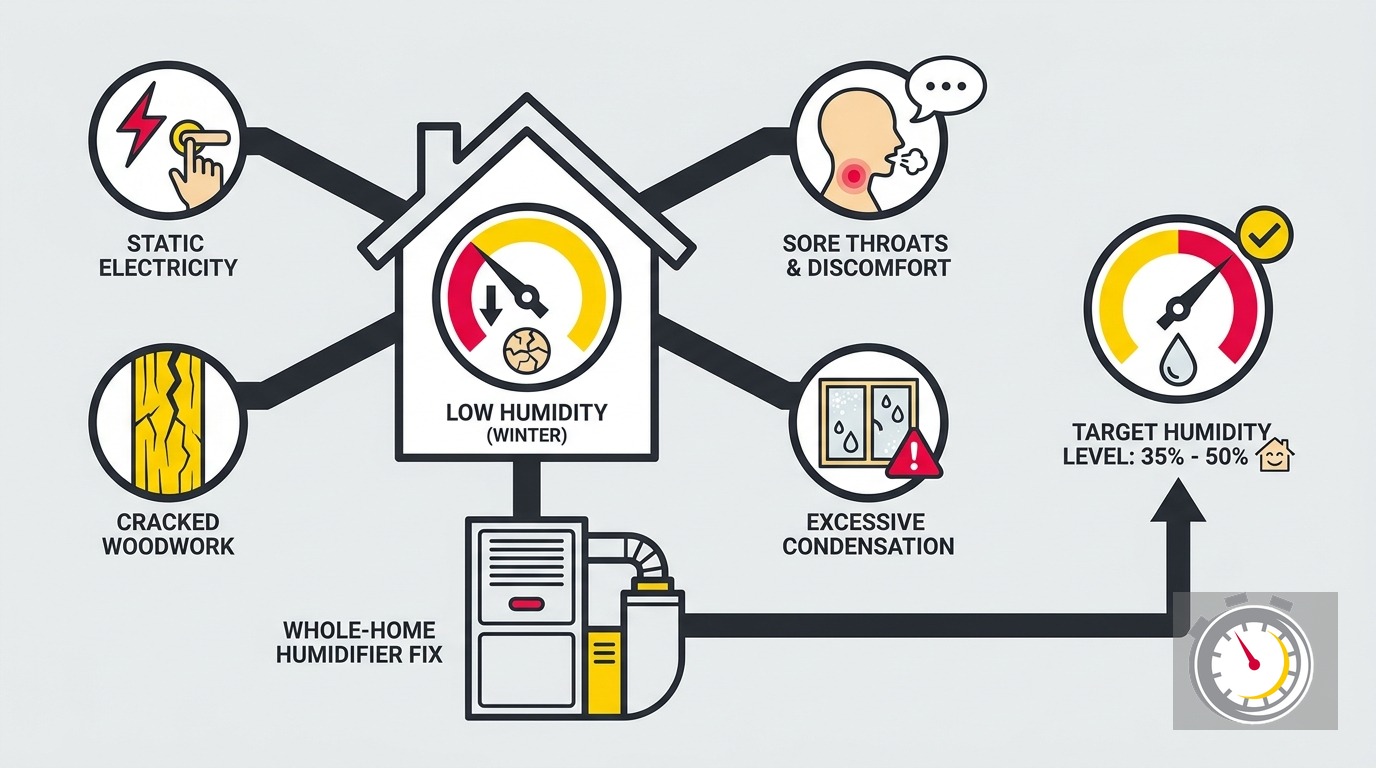
- Unhumidified Twin Cities homes can drop to 10-15% relative humidity in deep winter, drier than most deserts.
- Your humidity target must slide with the outdoor temperature, not stay fixed at 30-40%.
- Set too high on a cold day, and you invite frost on windows and moisture inside exterior walls.
- A whole home humidifier treats every room from one furnace-connected unit, unlike portable models.
- Humidified air feels warmer, so you can turn the thermostat down 2-4°F and still feel comfortable.
- Minnesota requires a mechanical permit for humidifier installation.
- Neither Xcel Energy nor CenterPoint Energy offers a rebate for whole home humidifiers today.
- A modern unit with an outdoor sensor solves the over-humidification risk that energy experts warn about.
The Real Problem With Dry Minnesota Winter Air
A dry Minnesota winter turns your home against you. Static shocks at every doorknob. Hardwood floors that creak and gap. Sore throats that will not go away. The fix is a whole home humidifier winter setup tied to your furnace, and it balances moisture in every room at once.
Cold air holds very little water. When that cold, dry outdoor air leaks in and your furnace heats it, the relative humidity plunges. The warmer your indoor air gets, the more moisture it can hold. The drier everything in your home feels.
In deep winter, an unhumidified Twin Cities home can fall to 10-15% relative humidity. That is drier than the Sahara Desert. Your body, your woodwork, and your comfort all feel the loss.
January in the Twin Cities averages a high of 20.3°F and a low of 7.5°F, with dew points often stuck in the single digits. That bone-dry air strips moisture out of everything it touches. A whole home humidifier puts that moisture back, evenly, across the entire house.
The symptoms are easy to spot once you know them:
- Static electricity that shocks you at every light switch
- Hardwood floors and trim that shrink, creak, and gap
- Dry skin, chapped lips, and scratchy throats that linger
- Indoor plants that dry out faster than you can water them
- Wood instruments or pianos that slip out of tune
Older Twin Cities homes often feel this worst, because leaky walls bring in more of that dry outdoor air. A whole home humidifier is one of the most direct fixes, and it is squarely an indoor air quality upgrade.
What Should Your Whole Home Humidifier Be Set to This Winter?
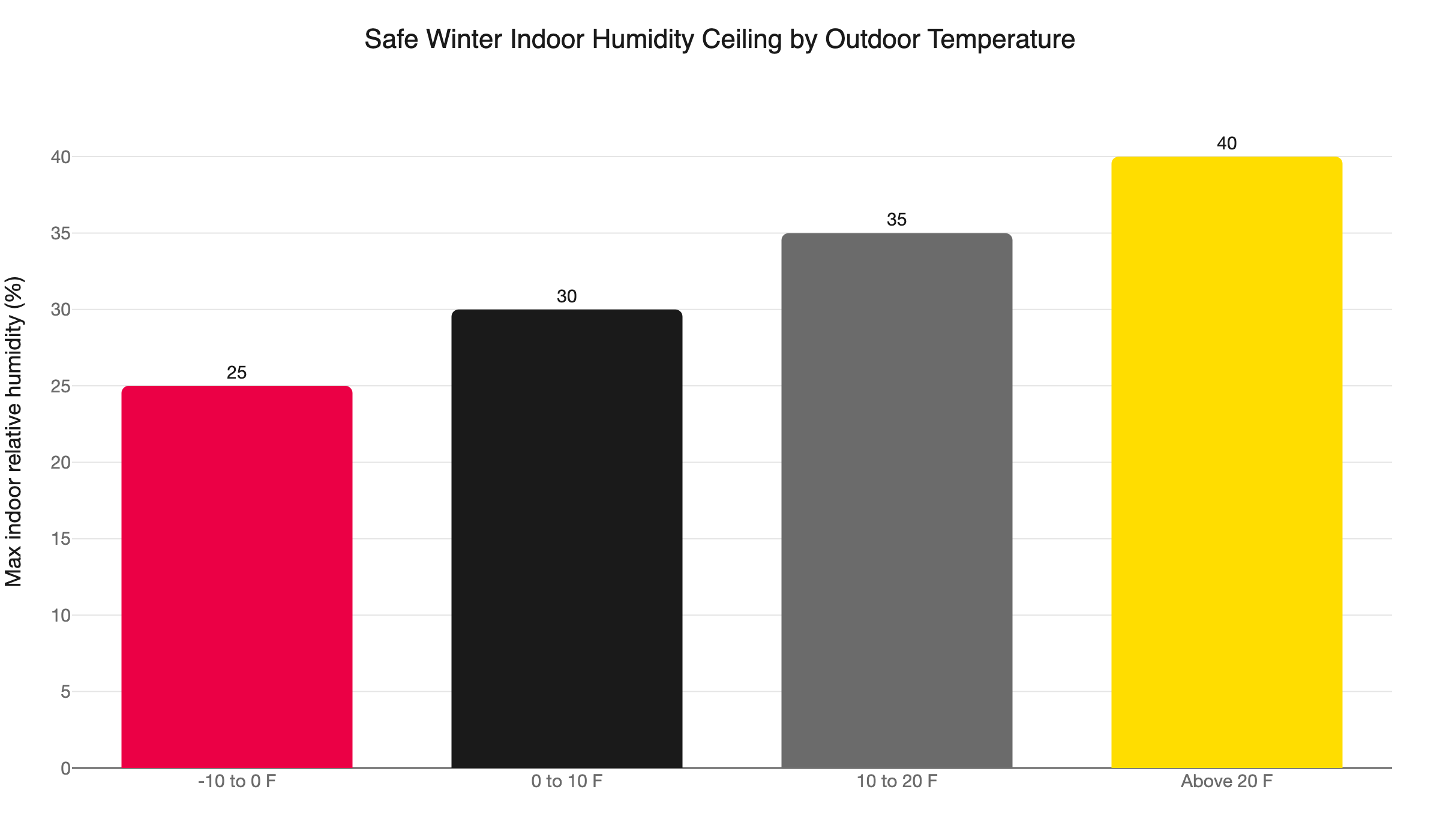
There is no single number. Your target should slide with the outdoor temperature. Below 0°F, hold indoor humidity to 20-25%. At 10-20°F, run 30-35%. Only above 20°F should you push toward 40%. Set it too high on a cold day and you invite frost and condensation.
Most guides tell you to set your humidifier to 30-40% and leave it alone. That advice works in a mild climate. In Minnesota, it causes real problems. When outdoor temperatures drop below 20°F, running 35-40% indoor humidity pushes moisture onto your cold windows and into your exterior walls. That moisture freezes as frost, then melts into the wood and drywall behind your paint.
The correct approach is to move the dial down as the temperature drops. Heating and indoor air quality experts lay out a clear sliding scale:
- Outdoor -10°F to 0°F: target 20-25% RH
- Outdoor 0°F to 10°F: target 25-30% RH
- Outdoor 10°F to 20°F: target 30-35% RH
- Outdoor 20°F and above: up to 40% RH
Hold that scale up against the Twin Cities winter. Most of January and February sits in the 0-20°F outdoor range. That means 25-30% is your practical ceiling for weeks at a time. The same guidance appears across trusted IAQ sources, and it exists for one reason. It protects your home.
Whole Home Humidifier Winter Targets by Outdoor Temperature
The chart above shows the maximum safe indoor relative humidity for each outdoor temperature band. As the thermometer climbs, your humidifier can safely add more moisture. As it falls, you dial back. This single concept is the most useful thing to understand about winter humidity in Minnesota, and almost no guide publishes it.
The reason is simple physics. Warm indoor air can hold more water than cold glass can. When humid indoor air meets a freezing window, the moisture condenses. The colder it gets outside, the lower your indoor humidity has to stay to keep that from happening.
The big health agencies back up the same narrow band. The EPA recommends keeping indoor relative humidity between 30-50% and explicitly warns against going above 50% to prevent mold and dust mite growth. ASHRAE Standard 55 sets a comfort range of 30-60% year-round, but practical winter guidance narrows to 30-40% to avoid condensation on cold surfaces. The sliding scale keeps you inside both bands while protecting your walls and windows.
What Are the Signs Your Home Needs a Humidifier?
Watch for static shocks, shrinking or creaking woodwork, dry skin and sore throats, and plants that dry out fast. If your windows frost up on cold mornings, the air may already be too damp rather than too dry. A hygrometer confirms the real number.
A hygrometer is a cheap, accurate way to know where you stand. You can pick one up for under $20. Set it in your main living area and check it on a cold morning. If it reads under 30% for days at a time, you are deep in the dry zone for comfort and for your home.
The physical signs are just as telling. Static shocks at the doorknob mean the air is very dry. Hairline cracks opening in wood trim or doors mean the wood is losing moisture and shrinking. If you wake up with a dry throat or winter nosebleeds, low humidity is a likely cause.
This is an indoor air quality problem first. A whole home humidifier is one of the most effective fixes, and it works alongside the other IAQ upgrades your home may need. See our full indoor air quality options for the bigger picture.
Does a Whole Home Humidifier Save on Heating Bills?
Yes, indirectly. Properly humidified air feels warmer at the same thermostat setting, so you can often lower the thermostat 2-4°F and stay comfortable. Lowering the thermostat 1°F saves about 2-4% on heating, so the savings add up across a long Minnesota winter.
Moist air holds heat against your skin better than dry air. That is why 68°F at 35% humidity can feel as warm as 70°F at 15% humidity. When your home is properly humidified, you feel comfortable at a lower thermostat setting.
Every degree you turn the thermostat down saves roughly 2-4% on heating costs, according to ENERGY STAR data on residential humidifiers. Lower the dial 3°F because the air feels warmer, and you could trim 6-12% off the heating portion of your bill over a season.
This is why humidifier payback is real, even without a utility rebate. The comfort gain and the thermostat savings repeat every single winter. It pairs directly with keeping your furnace efficient through the cold months.
Will Not a Whole Home Humidifier Cause Mold or Wall Damage?
Only if it is set too high for the outdoor temperature. Minnesota’s own energy experts warn that whole home systems can over-humidify when set points are forgotten. The fix is an outdoor-sensor humidistat that adjusts automatically, so you never push moisture past the safe point.
This is the honest objection, and it deserves a direct answer. The Center for Energy and Environment is Minnesota’s authoritative energy efficiency nonprofit. They recommend 30-40% for winter but caution that whole home humidifiers can over-humidify when set points are not adjusted as temperatures drop. Left at 40% through a -10°F cold snap, a humidifier will drive moisture into your walls and onto your windows. That is how frost, mold, and wood rot begin.
They are right to warn homeowners. But the warning is really about the old approach of setting the dial once and forgetting it. A modern whole home humidifier with an outdoor temperature sensor solves exactly this problem. The sensor reads the outdoor temperature and automatically scales the indoor target down as it gets colder. You set it once at install, and it manages the sliding scale for you.
That is the real reason professional installation matters. The sensor has to be placed and wired correctly, and the humidistat has to be set up to use it. Done right, you get the comfort benefits of a humidifier without the over-humidification risk that worries the energy experts.
How a Whole Home Humidifier Works With Your Furnace
A whole home humidifier mounts on your furnace’s supply plenum or return duct. When the furnace runs, a portion of the warm air passes through the humidifier, picks up moisture from a water pad or steam element, and carries it through your ductwork to every room.
The most common types are:
- Bypass humidifiers, which use the furnace’s own airflow over a wet pad
- Fan-powered humidifiers, which add their own fan to push air through the pad
- Steam humidifiers, which generate steam directly for the most precise control
Because it ties into your existing ductwork, one unit covers the whole house. There are no tanks to refill and no portable units to move from room to room. The water supply is plumbed in, and a drain handles the runoff.
That is why we install humidifiers as part of heating maintenance and furnace tune-ups. The unit lives with your furnace, and it runs best when your furnace is running cleanly.
Do You Need a Permit to Install a Humidifier in Minnesota?
Yes. The Minnesota Mechanical Code treats humidifier installation as mechanical work that requires a permit. Cities including Plymouth, Brooklyn Park, and Apple Valley list humidifiers on their mechanical permit pages. A licensed contractor like Northern One Hour pulls the permit and handles the inspection.
This catches a lot of homeowners by surprise. Adding a humidifier is not a quick DIY swap like changing a thermostat. Because it connects to your HVAC system and your home’s water supply, Minnesota classifies it as mechanical work under the state mechanical permit rules.
Twin Cities cities spell this out directly. Plymouth, Brooklyn Park, and Apple Valley all list humidifiers explicitly on their mechanical permit requirement pages. Skipping the permit can cause problems when you sell the home, and it can void equipment warranties. When we install a humidifier, we pull the proper permit and schedule the inspection. You do not have to navigate the city paperwork yourself.
Are There Rebates for Whole Home Humidifiers in Minnesota?
No, not for the humidifier alone. Neither Xcel Energy nor CenterPoint Energy currently offers a rebate specifically for whole home humidifiers in their Minnesota residential programs. Larger bundled projects may qualify for other incentives, but a standalone humidifier does not.
Some contractors will hint at rebates to close a sale. We will not do that. We checked the current Minnesota residential rebate summaries from both utilities. Neither Xcel Energy’s rebate sheet nor CenterPoint Energy’s Minnesota efficiency programs list a whole home humidifier rebate.
That does not mean a humidifier is a poor investment. The comfort and thermostat savings carry the value on their own. If you are also replacing a furnace or adding other indoor air quality equipment, those larger projects may qualify for utility or manufacturer incentives. We will tell you exactly what applies to your job before you commit.
When to Call Northern One Hour
You do not have to stand in front of your humidistat in January guessing at the right number. Northern One Hour Heating & Air Conditioning is a locally owned and operated Twin Cities HVAC company. We install and service whole home humidifiers across Minneapolis, St. Paul, Ramsey, Blaine, Maple Grove, Plymouth, Brooklyn Park, Woodbury, and Bloomington.
Our team sizes the unit to your home, places the outdoor sensor correctly, and sets the humidistat to follow the safe sliding scale. We pull the mechanical permit. We make sure the install protects your walls and windows instead of risking them. You can see our full whole home humidifier service for what is included.
We back every visit with our on-time promise: Always On Time… Or You Don’t Pay a Dime!(R). Call (763) 260-6662 or book online to schedule fast. We will get there when we say we will, every time.
Frequently Asked Questions
What should I set my whole home humidifier to in a Minnesota winter? +
Does Minnesota require a permit to install a whole home humidifier? +
Are there rebates for whole home humidifiers from Xcel or CenterPoint? +
Will a whole home humidifier cause mold? +
Need a technician now?