
What Size Whole House Humidifier Do I Need? MN Guide
Key Takeaways
- Start with your home’s square footage, then adjust for how tight or leaky the house is.
- Gallons per day (GPD) is the water a unit can vaporize in 24 hours. Bigger is not always better.
- Minnesota’s outdoor temperature caps safe indoor humidity. At -20°F or below, the target drops under 15%.
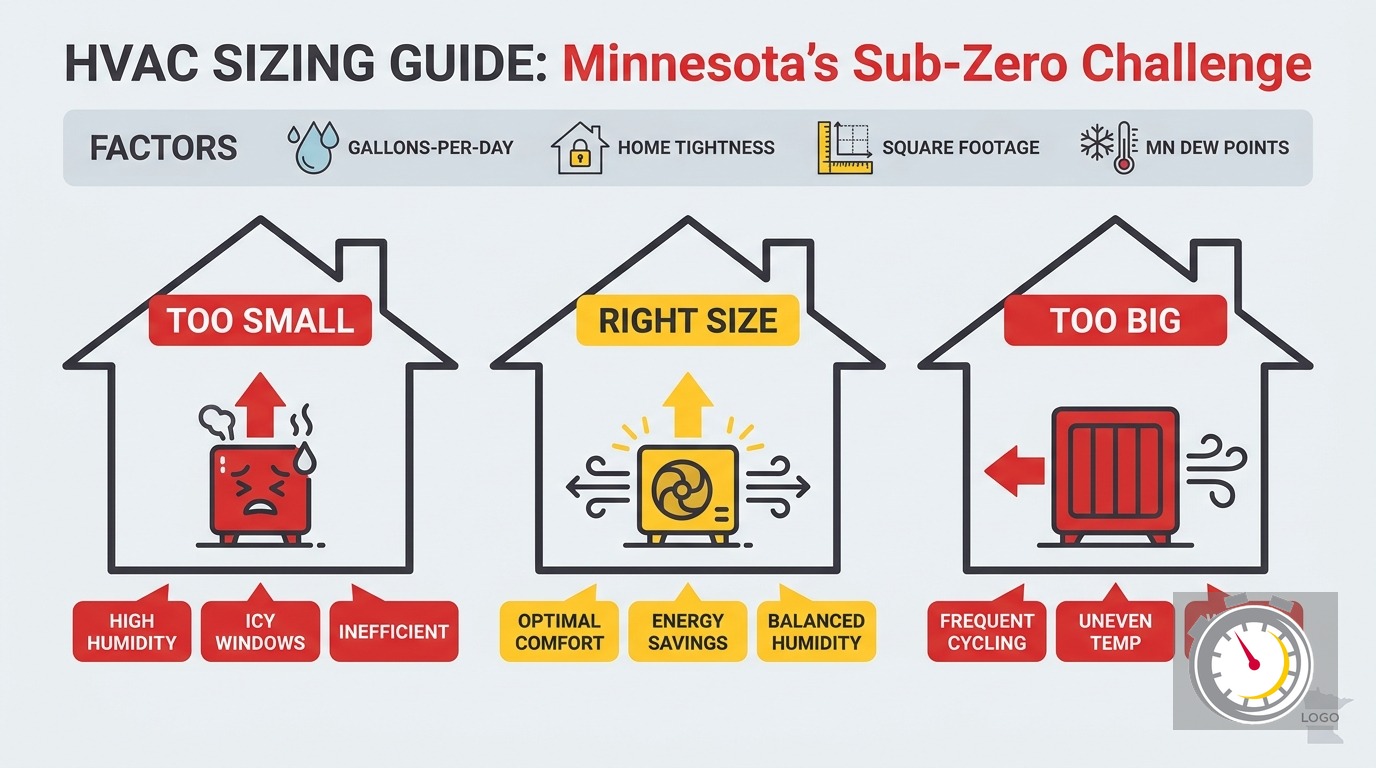
- An oversized unit can cause window condensation. An undersized unit will not keep up.
- A unit with an outdoor sensor that adjusts the setpoint automatically often beats raw GPD.
- Persistent condensation can point to leaky or under-insulated windows and walls, not the humidifier.
- A $10 to $50 humidity meter tells you what your home is really doing.
How big a humidifier do I need?
Most Twin Cities homes need a humidifier rated for their square footage, then adjusted for how tight the house is. A leaky older home needs more output. A tight newer home needs less. In Minnesota, the outdoor temperature then caps how much humidity your windows can handle, no matter the rating.
Square footage sets your starting point. Tightness moves that number up or down. Outdoor temperature sets the ceiling.
Most online sizing guides stop after the first step. In Minnesota, the last one matters most. A unit that looks perfect on paper can still fog your windows on a January night.
We are Northern One Hour Heating & Air Conditioning, a locally owned and operated Twin Cities HVAC company. We size humidifiers for homes in Ramsey, Blaine, Maple Grove, and across the metro. The method below is the one we use.
What does gallons per day mean, and what range is normal?
Gallons per day, or GPD, is how much water a humidifier can turn into vapor in 24 hours. Carrier uses this measure, and its humidifier line spans 500 to 4,000 square feet at 11.5 to 34 GPD.
Think of GPD as a size rating, like tonnage on an air conditioner. It tells you the most the unit can do. It says nothing about how much the unit should do in your house on a given day.
Carrier lists several types with different outputs:
- Small bypass: 12 GPD
- Large bypass: 17 GPD
- Water-saver bypass: 17 GPD
- Large fan-powered: 18 GPD
- Steam: 34 GPD, which varies with voltage and amperage
Bob Vila gives an average home size of about 2,300 square feet. It also lists models at 12 and 18 gallons per day. A typical house often lands in the middle of the range, not at the top.
Square footage alone cannot pick the model. Two 2,300-square-foot homes can need very different output, depending on how much air leaks in and out.
How does home tightness change the size?
A leakier home needs a higher-output humidifier because dry outdoor air keeps replacing your indoor air. A tighter home holds moisture longer and needs less. Carrier says sizing depends on insulation quality, air leakage, and local climate.
In winter, cold outdoor air holds very little moisture. Every draft pulls that dry air into your house, and your humidifier has to add water to the new air all day.
A tight, newer home swaps far less air. Moisture stays inside, so a smaller unit can reach the target. A bigger unit in that house may overshoot.
Bob Vila says homes that are not fully insulated or have drafts may need a model 40 to 50 percent more powerful. Treat that as a rule of thumb, not a guarantee.
Signs your home runs on the leaky side:
- Cold drafts near outlets, baseboards, or window frames
- Older single-pane or poorly sealed windows
- A thinly insulated attic or rim joist
- Rooms that feel dry within hours of a humidifier cycling off
- Static shocks that return fast after you raise the setting
Signs your home runs tight:
- Newer construction with modern air sealing
- Little to no draft around windows and doors
- Humidity that climbs quickly when you cook, shower, or run a unit
- Windows that fog early in a cold snap
If you are not sure which group fits, a technician can often judge it on a walkthrough. A blower door test gives a firmer answer. Sealing leaks first can also shrink the humidifier you need. Our post on whole-house humidifier cost in Minnesota explains how sizing ties into the final price.
Why does Minnesota’s cold cap the usable output?
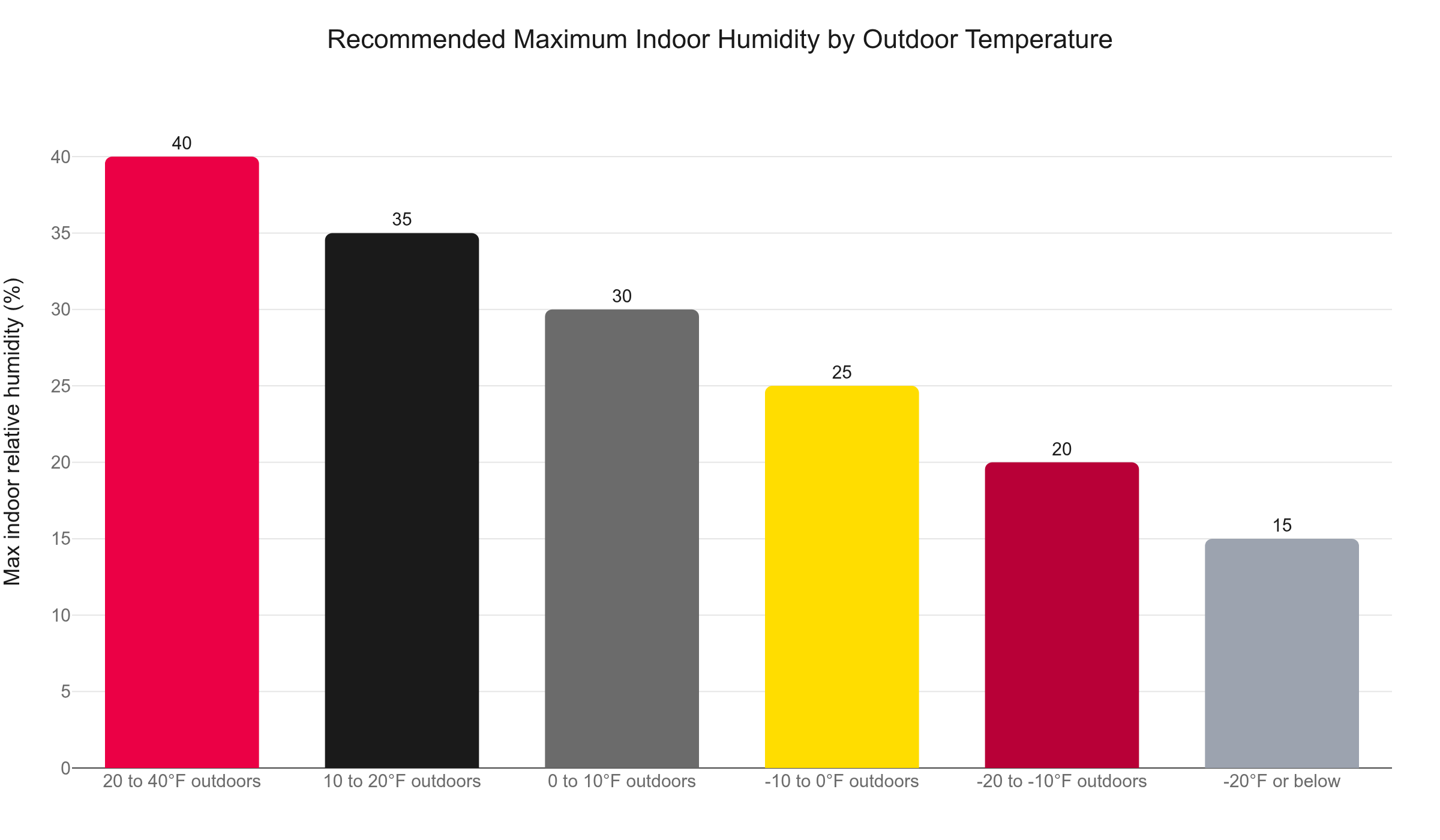
Cold outdoor air chills your window glass, and humid indoor air condenses on cold glass. So the colder it gets outside, the lower your indoor humidity must go. MNCEE’s guidance drops from under 40% at 20 to 40°F to under 15% at -20°F or below.
Most sizing guides miss this. They treat your humidifier as if it works in a vacuum. Your windows are the weakest link, and they set the real limit.
MNCEE publishes recommended winter indoor humidity by outdoor temperature. The full steps run as shown in the chart above. At 20 to 40°F outdoors, aim for under 40%. At 0 to 10°F, aim for under 30%. At -10 to 0°F, aim for under 25%.
MNCEE also notes that even at 40% relative humidity, extremely cold weather can still cause condensation. If you see it, lower the setting.
You may hear this called a dew-point problem. The dew point is the temperature where air can no longer hold its moisture and water forms. Cold glass drops below your indoor dew point first, so windows fog before anything else. The outdoor-temperature steps above cover the same ground in plain terms.
Picture a house with a big, powerful unit. On a mild November day, it runs happily at 40%. Then a -10°F night arrives, and the target should fall under 25%. If nothing lowers the setpoint, the unit keeps pushing humidity toward 35%. Your windows pay for it.
A bigger unit does not give you more comfortable humidity on the coldest days. It adds risk. The right unit meets your needs on a typical winter day and has a control that backs off in a deep freeze.
How do I size a humidifier step by step?
Use a four-step method: measure your square footage, rate your home’s tightness, match a unit to both, then check it against the outdoor-temperature ceiling. The last step is the one that keeps Minnesota windows clear.
Step 1: Find your conditioned square footage. Count the space your furnace or boiler system heats and the ducts serve. Include a finished basement if it is on the same system. Skip an unheated garage.
Step 2: Rate your home’s tightness. Choose leaky, average, or tight, using the signs listed earlier. When in doubt, ask a pro to look. A wrong guess here can swing your answer by a full size.
Step 3: Match the output. Look at the manufacturer’s rating for your square footage, then adjust for tightness. Bob Vila’s 40 to 50 percent bump for drafty homes gives you a reasonable upper bound.
Here is a quick example. Suppose a tight-home rating for your size calls for 12 GPD. For a drafty version of that house, adding 40 to 50 percent lands near 17 to 18 GPD. That is the same jump from a small bypass unit to a large one.
Step 4: Check the outdoor ceiling. Ask what humidity your windows can take at -10°F. MNCEE says under 25%. Then ask whether your control can drop to that level on its own. If it cannot, a perfectly sized unit can still cause problems.
When you land between two sizes, let your home’s tightness break the tie. In a tight house, pick the smaller one. In a leaky house, pick the larger one and plan to seal the leaks over time.
Our team can run this check during a visit. We look at the house, not just the nameplate.
What happens if the humidifier is too big or too small?
An undersized humidifier cannot keep up with demand, so your air stays dry. An oversized one can push humidity too high and cause condensation. Carrier warns about both. The fix is the right size plus a control that adjusts to the weather.
Signs the unit is too small:
- Static shocks, dry skin, and nosebleeds all winter
- Gaps opening in hardwood floors or trim
- A humidity meter that never reaches your target
- A unit that runs nonstop on mild days
Signs the unit is too big, or set too high:
- Fogged or wet windows in cold snaps
- Water pooling on sills
- Damp window frames or stained trim
- Humidity that overshoots your setpoint
Check the basics before you blame size. A clogged water panel or a stuck valve makes a unit act undersized. A forgotten setpoint makes it act oversized. Our guide to humidistat settings for Minnesota winters walks through how to set it.
If you see condensation and have no humidifier running, look at the building. MNCEE says persistent condensation without a humidifier may mean the windows or walls are under-insulated or leaky. Its advice is to insulate and air seal.
Keep that in mind when you shop. A bigger humidifier cannot fix a leaky wall. It only makes the symptoms show up faster.
Which humidifier type fits which size?
Bypass units fit most average homes, fan-powered units move more water through larger systems, and steam units cover the biggest homes. Match the type to your size and tightness, not to the highest GPD on the shelf.
Here is how the main types line up, using Carrier’s published outputs:
- Small bypass (12 GPD): A good fit for tight or smaller homes with modest needs.
- Large bypass or water-saver bypass (17 GPD): A common choice for average homes with some leaks.
- Large fan-powered (18 GPD): Adds a bit more output and does not rely on the furnace blower the same way.
- Steam (34 GPD): The top of the range for the largest or leakiest homes. Output varies with voltage and amperage.
Steam units are powerful. In a typical Minnesota home, that power may be more than the windows can handle in deep cold. Choose steam only when your house really needs the output and your controls can back it down.
We cover the trade-offs in our post on bypass versus steam humidifiers. Read it before you commit to a type.
Do not shop only by GPD. Ask these questions too:
- Does it have an outdoor temperature sensor?
- Can it adjust the humidity target automatically?
- How much maintenance does the water panel or cylinder need?
- Will my furnace or air handler support it?
The outdoor sensor deserves extra weight. It lowers the target as the temperature falls, which protects your windows without you touching a dial. For many Minnesota homes, that does more for comfort than extra gallons.
Are whole house humidifiers a good idea?
Yes, when you size them right and automate them. A whole-house unit treats every room at once and does not need daily refills. The risk is a forgotten setpoint. MNCEE’s auditors often prefer individual humidifiers for that reason.
MNCEE says its auditors typically prefer individual humidifiers over whole-home systems. Their reason is simple: set points are easy to forget and can add too much moisture. They also suggest running humidifiers only for short periods, with relative humidity set between 30% and 40%.
That concern is real. A whole-house unit works all winter without asking. If you set it to 40% in October and forget it, January will punish you.
Where whole-house systems shine:
- They humidify the whole home, not one room.
- You do not carry water or refill tanks.
- They tie into your existing heating system.
- With an outdoor sensor, they adjust on their own.
Where they fall short:
- A manual-only control invites mistakes.
- They need regular water panel service.
- A bad size choice affects the whole house.
- They cannot cure a leaky building.
Our view: a whole-house humidifier is a good idea for most Minnesota homes that run dry in winter. It gets better when you pick the right size and add automatic control.
If your home is very tight and only one or two rooms feel dry, a portable unit may do the job. We will tell you that on a visit. We aim for the right fit, whatever its size.
Is 70% humidity too high for a bedroom?
Yes. The EPA advises keeping indoor humidity below 60 percent, ideally between 30 and 50 percent. At 70%, a bedroom is in mold-friendly territory. That figure is a general all-year guide, so winter targets in Minnesota run much lower.
The EPA says condensation on windows, walls, or pipes can be a sign of high humidity. If you see moisture on your bedroom windows, take it seriously.
In a Minnesota winter, 70% in any room would be a red flag. On a -10°F night, MNCEE’s target is under 25%. A reading of 70% means something is wrong, and the humidifier is not the only suspect. Showers, cooking, drying clothes indoors, and a leaky basement can all add moisture.
If your bedroom reads high:
- Check with a meter in the room, not just the hallway.
- Lower or turn off the humidifier and watch the reading for a day.
- Run bathroom fans during and after showers.
- Look for water leaks and damp spots.
- Call us if it stays high.
Summer is a different story. In July, Twin Cities humidity can climb on its own. That is a dehumidifier question, and our post on portable versus whole-home dehumidifiers covers it.
How do I check my numbers at home?
Buy a humidity meter and watch it for a week. The EPA describes it as a small, inexpensive instrument, $10 to $50, sold at many hardware stores. Compare the readings to the outdoor-temperature targets and look at your windows each morning.
A meter turns guesswork into data. Here is a simple routine:
- Place one meter in your main living area and one in a bedroom.
- Check the reading each morning and evening.
- Note the outdoor temperature.
- Compare the reading to the MNCEE target for that temperature.
- Look at the bottom corners of your windows for fog or water.
If you are above the target and your windows are wet, lower the setpoint. If you are well below it and the air feels dry, your unit may be small or under-maintained. If the readings bounce around, your control may be the issue.
Keep notes for a week or two. They help a technician see the pattern fast, and you will learn how your home reacts to each cold snap.
A cheap meter can drift. To compare two, place them side by side for a day. A big gap means one of them is off.
What does a Northern One Hour sizing visit look like?
We measure your home, judge its tightness, check your current equipment, and match a humidifier to your real conditions. We then set the control to follow the outdoor temperature. You get a clear recommendation, not a guess from a chart.
A typical visit covers:
- Your square footage and layout: We confirm what the system serves.
- Tightness clues: We look at windows, insulation, and signs of drafts.
- Your furnace or air handler: We confirm the unit can support the humidifier you want.
- Your control options: We favor automatic outdoor-sensing controls.
- Your goals: Static shocks, wood floors, health concerns, or all three.
We also tell you when the better fix is air sealing or insulation. If your windows fog because the building leaks, a larger unit will not help, and we would rather say so up front.
We are locally owned and operated, and we live through the same winters you do. Our promise: “Always On Time… Or You Don’t Pay a Dime!(R)” We arrive within the time window you select. If the technician does not show up on time, you do not pay for the service.
Learn more about our whole-home humidifier services, or keep reading to see how to book.
Ready to size your humidifier the right way?
Call Northern One Hour at (763) 260-6662 or book online. We will measure your home, check its tightness, and recommend a humidifier that works on a mild day and a -20°F night.
You get a local team, a clear plan, and a technician who shows up when we say we will. Schedule your visit and keep your windows clear this winter.
Frequently Asked Questions
What does GPD mean on a humidifier? +
Do I need a humidity meter to size a humidifier? +
Can I fix window condensation by buying a smaller humidifier? +
Need a technician now?