
Portable Dehumidifier vs Whole Home Dehumidifier: MN Guide
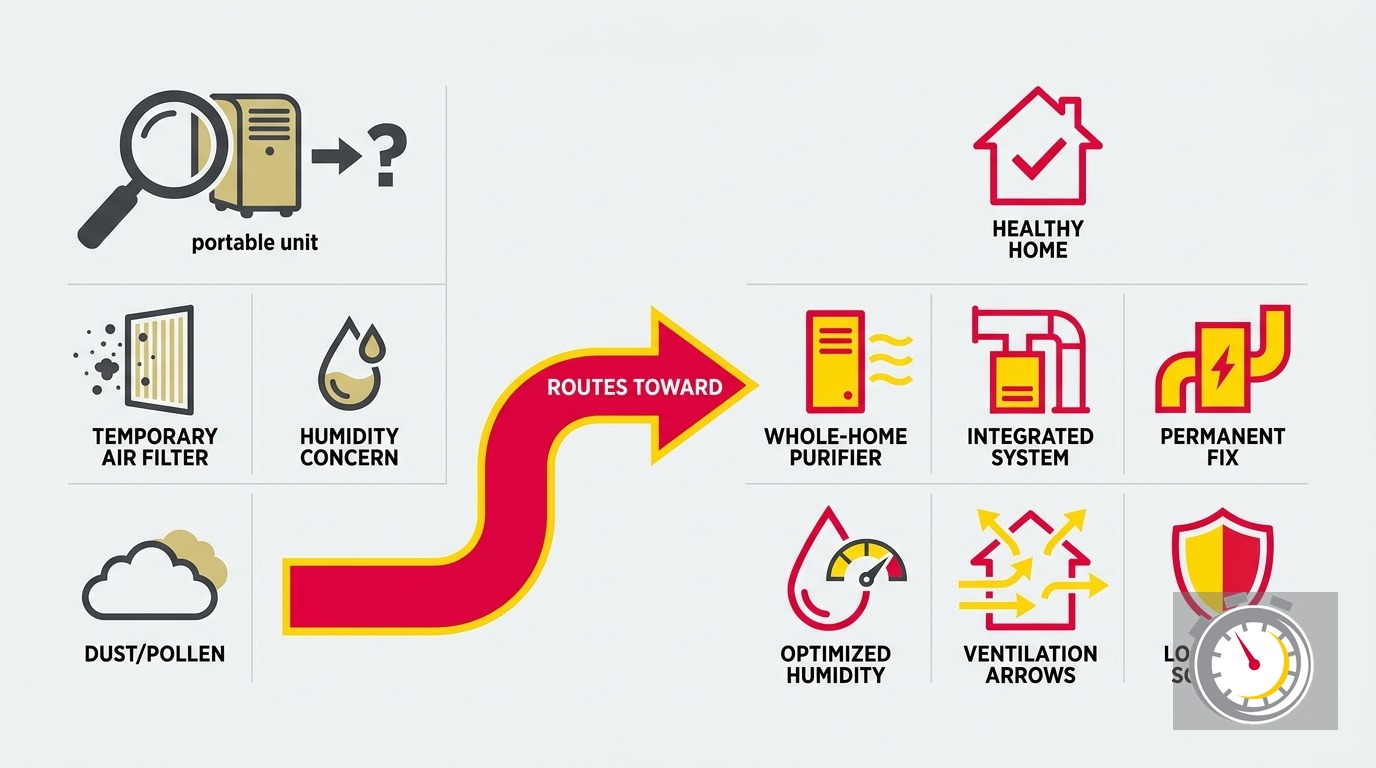
Key Takeaways
- The EPA recommends keeping indoor relative humidity between 30-50% year-round. Above 60%, mold becomes a real risk.
- Portable dehumidifiers stop working effectively when room temperatures drop below 65 degrees F. Minnesota basements frequently hit that threshold in May, September, and October.
- Twin Cities outdoor humidity averages 60-74% through summer. Every time a door opens, humid air pushes in.
- A whole-home dehumidifier reduces the moisture load on your central AC, freeing it to focus on temperature during our most humid months.
- Running two portable units to cover more of your home costs more per month than running a whole-home dehumidifier, and still leaves gaps.
- ENERGY STAR-certified dehumidifiers use 20% less energy than non-certified models. Xcel Energy’s rebate program may offset part of the installed cost.
- Installed cost for a whole-home unit runs $3,200-$5,800. Portables cost $300-500 at retail.
You are standing in your basement. It smells damp. You notice condensation on the pipes, maybe a white haze creeping along the baseboards. The hardware store has a portable dehumidifier for $350. Your HVAC company is talking about a whole-home system for several thousand dollars. Deciding between a portable dehumidifier vs whole home dehumidifier feels straightforward until you look at the details that box-store marketing skips entirely. This post covers what those details are and why they matter more in Minnesota than almost anywhere else.
Why Does Humidity Feel Worse in Twin Cities Summers?
The short answer: The Twin Cities faces some of the most persistently humid summer conditions in the Upper Midwest. Outdoor air at 60-70% relative humidity pushes into your home constantly through doors, windows, and gaps in the building envelope.
Average outdoor relative humidity in Minneapolis runs 60-74% through summer, with an annual average sitting around 67%. July dew points regularly reach the upper 50s and low 60s Fahrenheit. One recent June-July period posted an average dew point of 60.21 degrees F at MSP, ranking it fifth-highest since records began at that station in 1938.
High indoor humidity makes your home feel warmer than the thermostat says. It promotes mold and mildew growth, encourages dust mites, and forces your air conditioner to work harder removing moisture before it can address temperature. That extra work shows up on your utility bill every July and August.
Humidity control is a year-round job in Minnesota. Winters dry the indoor air to the point where you need to add moisture back. Summers flood the house with it. A home swinging between 22% relative humidity in February and 68% in July ages faster and never feels quite right. Getting both ends under control is not optional maintenance. It is basic home stewardship in this climate.
Portable Dehumidifier vs Whole-Home Dehumidifier: What Is the Difference?
The short answer: A portable plugs into an outlet and treats one room. A whole-home unit connects to your ductwork and treats the air throughout the entire house. The ducting integration is the key distinction and the reason the two products serve different jobs.
By ENERGY STAR’s definition, a whole-home dehumidifier operates with ducting: return air feeds into the unit’s inlet and dehumidified air distributes back through the duct system to one or more rooms. That integration is what makes it a permanent, house-wide solution rather than a spot treatment.
What a portable does well
- Handles a single, contained space: a finished basement room, a bedroom, a crawl space.
- No installation needed. Plug it in, position it, and empty the tank when it fills.
- Lower upfront cost: $300-500 at retail.
- A practical choice if you rent and cannot modify ductwork, or if your home uses a boiler or radiant system without central air ducts.
What a portable cannot do
- It treats one room. Humid air migrates freely through doorways and ductwork into adjacent spaces. A single portable unit cannot dehumidify a whole home.
- The tank fills and the unit shuts off. Emptying it on a schedule is real, ongoing maintenance.
- Performance degrades sharply when the room temperature drops below 65 degrees F. That point matters enormously in Minnesota, and it is where most portable comparisons stop short.
A whole-home dehumidifier integrates with your furnace fan. It runs automatically based on a humidistat set point. You set the target humidity once and it maintains it throughout the house without further intervention.
Does a Portable Dehumidifier Work in a Cold Minnesota Basement?
The short answer: Not reliably. The Department of Energy tests portable dehumidifiers at 65 degrees F specifically because that is where real basement conditions begin to challenge the technology. Below that threshold, compressor coils frost over and the unit stops removing meaningful moisture.
This is the detail competitors in warmer states never mention. It is a serious problem here.
Think about the shoulder seasons in Minnesota: May, September, October. These are exactly the months when spring snowmelt and fall rains saturate the soil around your foundation, pushing moisture through the slab and foundation walls. They are also the months when your basement is most likely to run below 65 degrees F. Your portable dehumidifier is performing worst precisely when the moisture load on your home is highest.
When a portable’s coils frost in a cold room, the unit enters a defrost cycle. It warms the coils, pauses extraction, then tries again. In a basement running at 58-62 degrees F in early May, this cycle repeats constantly. The unit pulls almost no moisture and runs up your electricity bill doing it.
A whole-home dehumidifier draws from the return duct. It is not sitting in a cold room trying to extract moisture from cool stagnant air. It works within the conditioned airstream, which sidesteps the cold-coil limitation. If your portable has consistently disappointed you in spring and fall, the temperature floor is almost certainly why.
How Does a Whole-Home Dehumidifier Help Your Air Conditioner?
The short answer: Your AC removes moisture as a byproduct of cooling. A whole-home dehumidifier takes that moisture job off the AC’s plate, reducing its workload and improving efficiency on the hot, sticky days when your system is already under the most stress.
Here is the mechanism. Warm, humid outdoor air pushes into your home all summer. Your AC runs and the refrigerant coil gets cold. Warm air passes over the coil, moisture condenses out, and the cooled, drier air returns to the living space. The AC is doing two jobs simultaneously: removing heat and removing moisture.
Efficiency engineers call the moisture-removal portion the latent cooling load. In a Twin Cities summer with outdoor humidity regularly at 65-70%, a meaningful portion of your AC’s energy goes toward that latent load before it ever addresses temperature. The AC is spending electricity changing the moisture content of the air, not making you cooler.
A whole-home dehumidifier handles latent load independently. It often runs with just the furnace fan, not the full compressor, moving air across its coil and exhausting condensate. The AC gets to focus on sensible cooling: actual temperature reduction. The result is a more comfortable home at the same thermostat setting and less wear on your compressor during the months that stress it most.
If your AC runs constantly but the house still feels clammy, that is a sign your system is losing the latent load battle on its own. Our post on why your home feels humid in spring and how AC systems help control it covers this dynamic in detail. A whole-home dehumidifier is often the right next step when the AC alone is not enough.
Portable Dehumidifier vs Whole-Home Dehumidifier: How Do the Costs Compare?
The short answer: Portables win on upfront cost. A whole-home unit wins on monthly operating cost once you need more than one room covered. Two portables running to cover more of your home cost more per month than a single whole-home system.
Upfront cost
- Portable dehumidifier: $300-500 at retail.
- Whole-home dehumidifier (installed): $3,200-$5,800 as a general range. Call us for a local Twin Cities quote. Your duct configuration and existing equipment affect labor time.
The gap is real. If you only need one basement room treated and that room stays above 65 degrees F year-round, the portable’s economics are reasonable.
Monthly operating cost
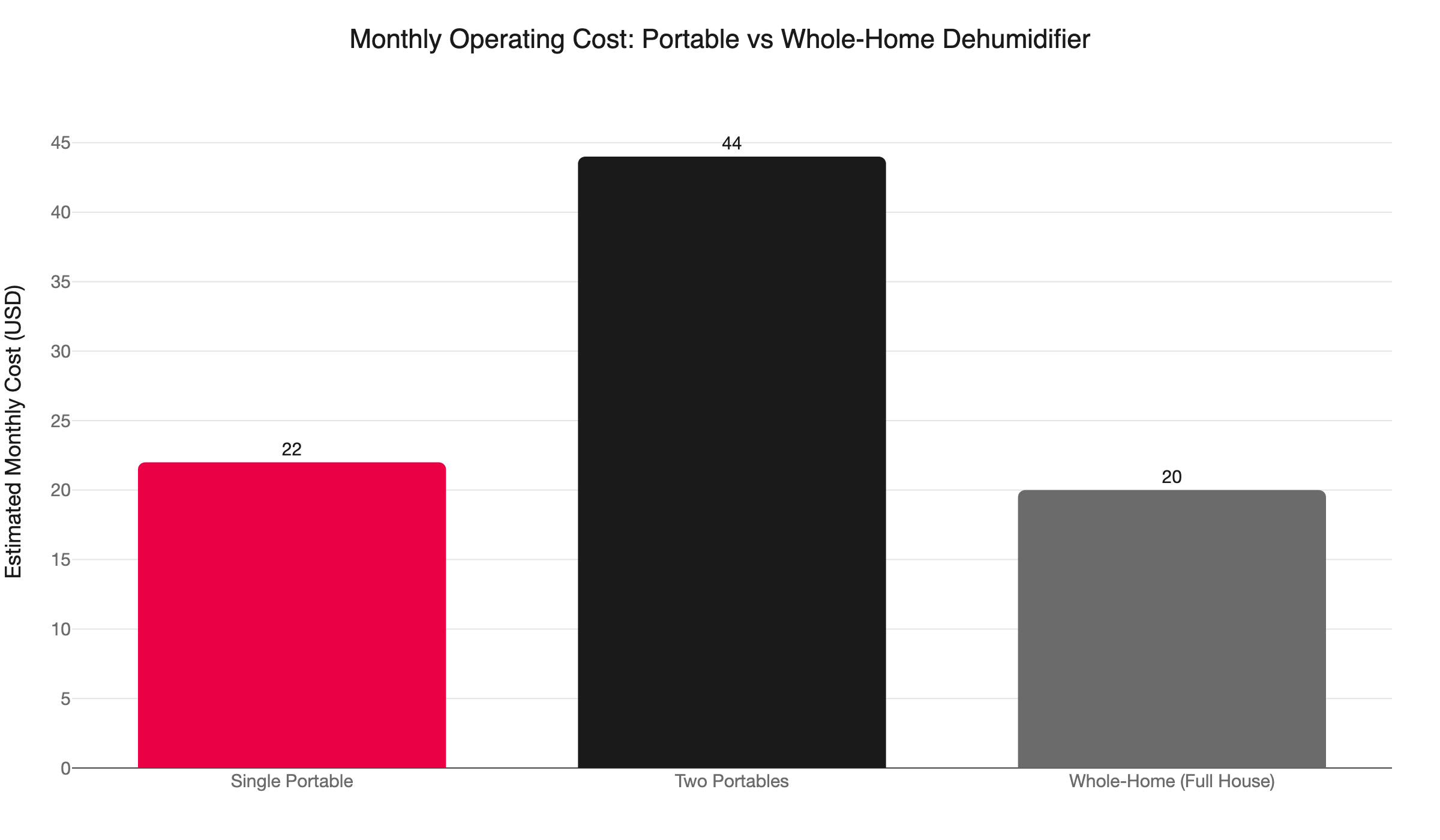
A single portable running 8-12 hours a day costs roughly $12-32 per month. A whole-home system covering the entire house costs approximately $15-25 per month.
Those figures look similar at first glance, but the whole-home number covers every room your ducts reach. The portable number covers one room.
Now consider what happens when one portable is not enough. If you need to cover your basement and your main floor, which is a common scenario in Twin Cities split-levels and two-story homes, you need at least two units. Two portables cost $24-64 per month combined. That exceeds the whole-home monthly figure. And you still have gaps in coverage, plus two tanks to empty.
The math on running multiple portables rarely favors that approach past the first or second cooling season. The convenience and cost advantages shift decisively toward the whole-home unit once you move beyond a single isolated space.
Utility rebates
ENERGY STAR-certified dehumidifiers use 20% less energy than non-certified models. Xcel Energy’s Minnesota Conservation Improvement Program for 2024-2026 covers ENERGY STAR-qualified appliances, which may include dehumidifiers. The exact rebate amount for dehumidifiers was not confirmed at publication. Call Xcel at 1-800-895-4999 or visit mn.my.xcelenergy.com to get the current figure before you purchase. Our guide to Xcel and CenterPoint HVAC rebates in Minnesota has broader context on what the rebate landscape looks like for HVAC equipment.
What About Energy Efficiency and the ENERGY STAR Label?
ENERGY STAR-certified dehumidifiers are tested and verified to use 20% less energy than standard models. The efficiency metric is Integrated Energy Factor (IEF): liters of water removed per kilowatt-hour consumed, including standby power draw. This replaced the older Energy Factor metric as of June 2019. The current ENERGY STAR dehumidifier specification took effect October 1, 2025.
When you are comparing portables at a hardware store, look for the ENERGY STAR label. An uncertified unit will cost more to operate over the life of the appliance. A few dollars saved at purchase translates to more spent every month for years.
When comparing whole-home units, sizing matters as much as certification. An undersized unit runs constantly and never catches up with the moisture load. An oversized unit short-cycles and wears out faster. Your HVAC technician sizes the unit based on your square footage, duct configuration, and the moisture characteristics of your specific home. Correct sizing is one of the primary reasons professional installation of a whole-home dehumidifier outperforms a self-installed portable in actual practice.
Which Option Is Right for My Home?
The short answer: A portable works if you need one contained room treated and that room stays warm year-round. A whole-home system is right if you need consistent dehumidification throughout the house, have a cold basement in shoulder seasons, or want to reduce the latent load on your AC.
Choose a portable if:
- You rent and cannot modify ductwork.
- Your home uses a boiler, radiant floor heat, or another system without central air ducts.
- You have one isolated space with a moisture problem and that space consistently stays above 65 degrees F from spring through fall.
- You need a short-term solution while planning a longer-term fix.
Choose a whole-home dehumidifier if:
- You want consistent humidity control in every room, not just one.
- Your home has central ductwork (most Twin Cities construction built after 1980 does).
- Your AC runs long cycles but the house still feels sticky and uncomfortable.
- Your basement temperature drops below 65 degrees F in May, September, or October.
- You are planning a furnace or AC replacement and want to bundle the installation.
That last point is worth emphasizing on its own. Adding a whole-home dehumidifier at the same time as an HVAC replacement is the most cost-effective window for the work. Labor overlaps significantly. Our team can assess your home and walk you through the options when we do your system installation. You can also learn more on our indoor air quality and dehumidifier page or read our dedicated post on whole-home dehumidification in the Twin Cities before you call.
For the heating season flip side of this equation, our post on whole-home humidifiers for winter dry air covers how to keep humidity in the right range when Minnesota cold pulls it too low.
How Northern One Hour Can Help
We are a locally owned and operated HVAC company serving the Twin Cities out of Ramsey, MN. Our team works in homes across Minneapolis, St. Paul, Blaine, Maple Grove, Plymouth, Brooklyn Park, Woodbury, and Bloomington every week.
When a homeowner calls us about a sticky, humid house, we start with an assessment. We measure current indoor humidity and identify where it is highest. We check whether the AC is sized correctly and maintaining its latent load. We look at the ductwork to confirm whether a whole-home dehumidifier integrates cleanly with the existing system. We review current rebate eligibility with Xcel.
If a portable dehumidifier genuinely solves your specific problem, we will tell you that directly. What we will not do is let you invest in two or three portable units that cost more to operate than a whole-home system and still leave parts of the house humid and uncomfortable.
Call us at (763) 260-6662 or book online to schedule an assessment. We show up when we say we will. That commitment is the foundation of everything we do, and it is the promise behind “Always On Time… Or You Don’t Pay a Dime!(R).”
Frequently Asked Questions
What humidity level should I target in my Twin Cities home?
The EPA recommends 30-50% relative humidity as the healthy indoor range. Keep it below 60% to prevent mold. In Minnesota summers, 45-50% is a comfortable, realistic target. In winter, aim for 30-40% to prevent condensation on windows and window frames.
Why does my portable dehumidifier stop working in spring and fall?
Portable dehumidifiers are tested at 65 degrees F. When room temperature drops below that threshold, the compressor coils frost over and the unit stops removing moisture effectively. Minnesota basements in May and September regularly run below 65 degrees F, which is also when ground moisture intrusion from snowmelt and rain is highest.
Can I just buy two portables instead of one whole-home unit?
You can, but the math usually does not favor it. Two portables running 8-12 hours a day typically cost more per month combined than a whole-home dehumidifier covering the entire house. You also still have coverage gaps between rooms and two tanks to manage. Beyond the second cooling season, the operating cost gap grows.
Does Northern One Hour install whole-home dehumidifiers?
Yes. We install and service whole-home dehumidifiers integrated with your existing forced-air system. Visit our dehumidifier service page for more detail, or call (763) 260-6662 to schedule an in-home assessment.
Is there currently a rebate for a whole-home dehumidifier in Minnesota?
Xcel Energy’s Conservation Improvement Program covers ENERGY STAR-certified appliances. Whether dehumidifiers qualify in the current program year and at what amount: confirm directly with Xcel at 1-800-895-4999 or at mn.my.xcelenergy.com before purchasing. Rebate amounts change between program years and we do not want you to budget around a figure that may have shifted.
Frequently Asked Questions
What is the ideal indoor humidity level for a Minnesota home? +
Does a portable dehumidifier work in a cold Minnesota basement? +
Can a portable dehumidifier handle a whole house? +
Does a whole-home dehumidifier help my air conditioner? +
Is there a utility rebate for a whole-home dehumidifier in Minnesota? +
Need a technician now?