
Ductwork Sweating and Condensation in Minnesota Basements
Key Takeaways
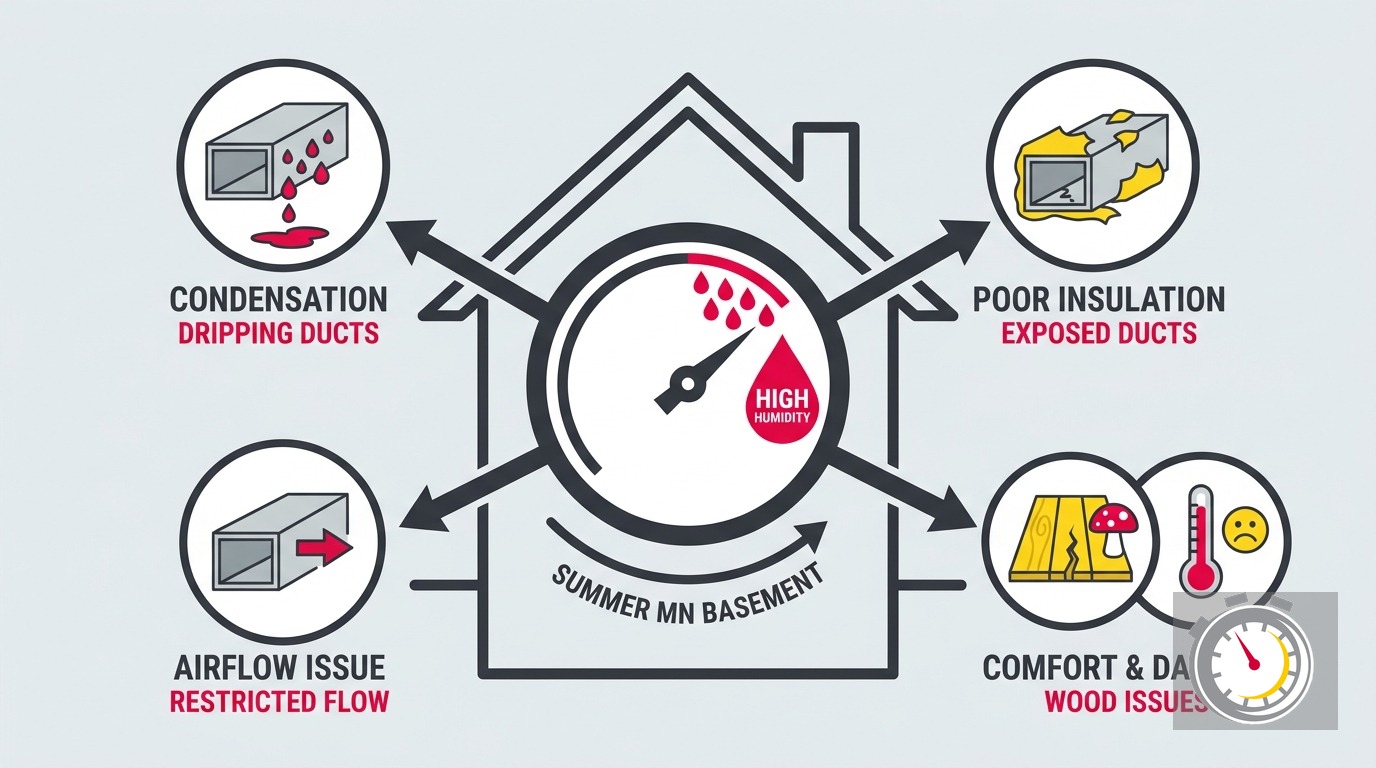
- Ductwork sweating and condensation in Minnesota basements happens when humid basement air contacts cold supply ducts. Supply air runs around 55°F. Twin Cities dew points spike to 65-72°F in summer.
- Minnesota energy code requires R-6 duct insulation on ducts outside the thermal envelope. That is a floor, not a performance guarantee on peak-humidity days.
- Three root causes: high basement humidity, failing or missing insulation, and HVAC system problems (airflow restriction, oversized equipment, low refrigerant, duct leaks).
- Return-side duct leaks pull humid basement air into the system and spread moisture to every room. Supply-side leaks chill nearby surfaces and create condensation outside the duct itself.
- Materials that stay wet longer than 24 to 48 hours can grow mold, according to EPA guidance. Recurring drips need to be addressed this season.
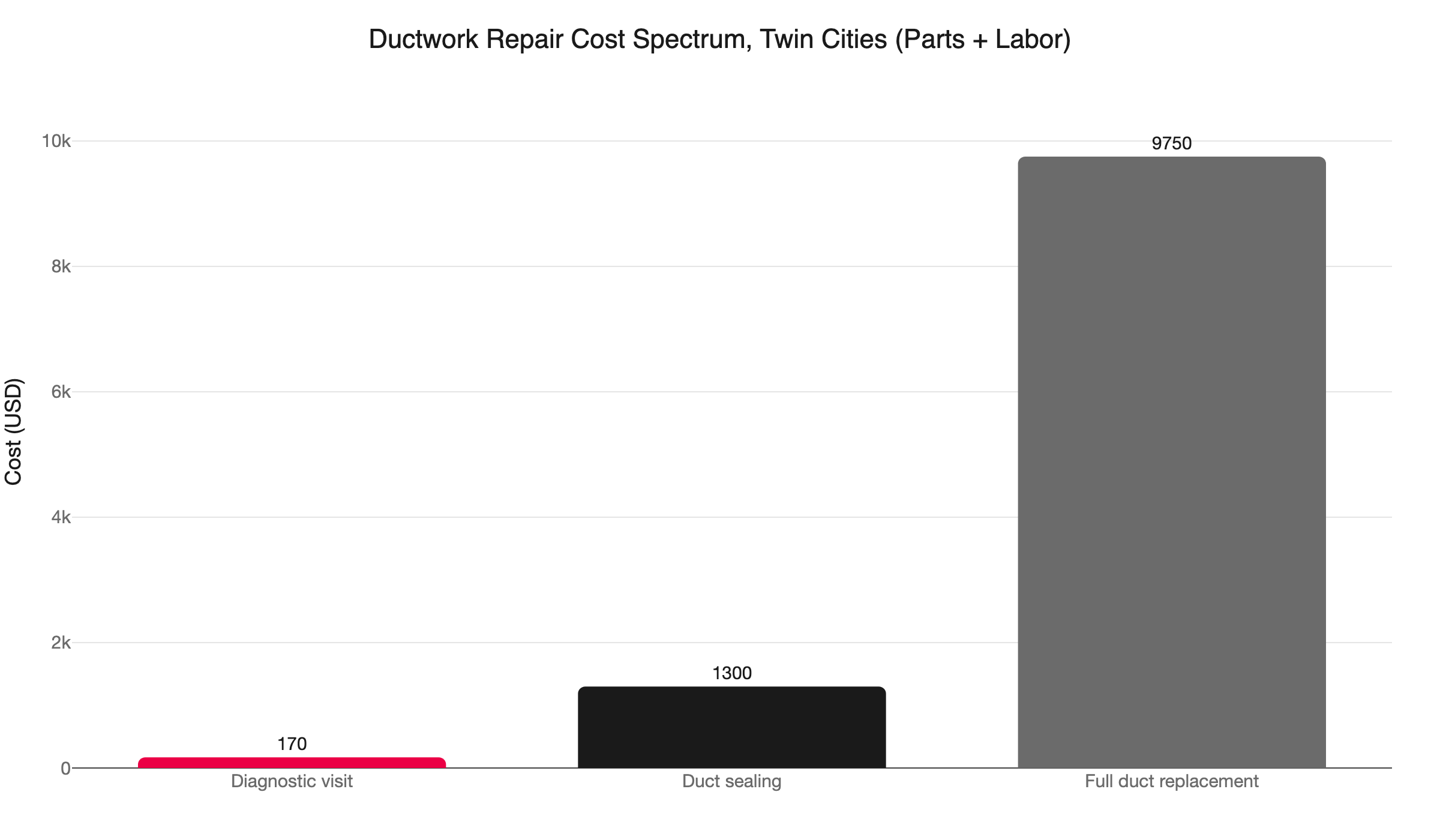
- A diagnostic visit runs $95 to $250. Duct sealing runs about $1,300. Full ductwork replacement is $6,500 to $13,000 installed.
Ductwork sweating and condensation in Minnesota basements is one of the most common summer HVAC complaints we hear from Twin Cities homeowners. The ducts drip. The insulation looks damp. The floor gets wet.
Sometimes the fix is simple. Sometimes the dripping is a symptom of a system problem: airflow restriction, duct leakage, or low refrigerant. Those problems waste energy and affect comfort throughout the whole house. This guide covers how to tell the difference.
Why Does Ductwork Sweat in a Minnesota Basement?
Short answer: Your supply ducts carry air at roughly 55°F. When surrounding basement air has a dew point higher than that surface temperature, moisture condenses on the metal jacket. On humid Minnesota days, basement dew points routinely exceed 65°F. That gap drives dripping.
The physics is the same as a cold glass at a summer cookout. A glass filled with ice water drops below the dew point of the surrounding air. Moisture appears on the outside of the glass. Your supply ducts do the same thing.
Condensation forms on duct surfaces when those surfaces drop below the dew point of the surrounding air. Your AC system delivers supply air at roughly 55°F. A well-insulated duct jacket stays above that temperature because insulation slows heat transfer from warm basement air to the cold duct surface. A bare, poorly wrapped, or damaged jacket drops toward 55°F.
When the basement dew point is 68°F and the duct jacket is 56°F, you get condensation. When the dew point is 62°F and the jacket is 60°F, you might not. The margin is narrow. Small insulation gaps and modest humidity spikes tip the balance.
What Minnesota Summers Do to Your Basement Air
Duct condensation is a humid-climate, cooling-season problem. In dry western states, summer dew points stay below 50°F and bare ducts rarely sweat. Minnesota is not a dry climate.
The Twin Cities sit in a continental humid zone. Dew points climb into the mid-60s regularly and hit the low 70s during the worst stretches of July and August. That puts basement air well above the surface temperature of a running supply duct.
Minnesota basements add their own moisture sources on top of summer humidity:
- Frost heave and spring snowmelt push water through foundation cracks and porous concrete.
- Freeze-thaw cycles open seams in foundations that look solid from the inside.
- Unfinished concrete stays cold and damp well into summer, wicking ground moisture upward.
- Basement windows left open during mild spells bring in humid outdoor air.
An unfinished basement with no dehumidifier is the hardest environment for duct insulation to manage. Our post on basement humidity control in summer covers the mechanical and structural steps for lowering basement moisture year-round.
Is Your Duct Insulation Meeting Minnesota Code?
Short answer: Minnesota energy code requires R-6 insulation on supply and return ducts outside the building thermal envelope, including most unfinished basements. R-6 is a code minimum, not a performance target. On peak-humidity days with dew points near 70°F, correctly installed R-6 wrap may still leave the duct jacket close to the condensation threshold.
Minnesota is in Climate Zone 6. The state energy code (Chapter 1322, adopting the IECC with Minnesota amendments) requires a minimum of R-6 insulation on supply and return ducts that run outside the conditioned building envelope. Most unfinished basements qualify as outside the thermal envelope when the basement walls are uninsulated and unconditioned.
R-6 slows heat transfer from warm basement air to the cold duct surface. On a typical summer day, that is enough. On a day when the basement dew point hits 70°F and supply air is 55°F, the math gets tighter.
Air-permeable insulation like fiberglass duct wrap allows ambient air to reach the duct surface if the wrap is not airtight. Adding more thickness does not solve a gaps problem. If humid air can reach the duct jacket through an opening in the wrap, the jacket temperature tracks the dew point of that air regardless of what is around it.
Common insulation failure points in Minnesota basements:
- Gaps at duct joints and elbows where the wrap does not fully cover the metal.
- Compressed or crushed sections that have lost R-value.
- Loose seams where the wrap has pulled away from the duct surface.
- Missing or damaged vapor barriers, which allow moisture to migrate into the insulation itself.
- Bare sections left after a renovation and never re-wrapped.
A single uncovered joint on a long supply run is enough to produce visible drips on a humid day.
What Causes Ductwork Sweating and Condensation in Minnesota Basements?
Short answer: Three layers drive the problem. High basement humidity sets the conditions. Insulation gaps give moisture a surface to condense on. And system problems, including dirty coils, oversized equipment, and duct leaks, push supply air colder than design and make condensation worse. Most homeowners and most articles only address the first two layers.
Layer 1: High basement humidity
If the air around your ducts holds excess moisture all summer, condensation is nearly unavoidable on hot days. The starting point is reducing moisture at the source: grade drainage away from the foundation, seal visible cracks in the concrete, and manage basement ventilation. A whole-home dehumidifier can keep basement relative humidity below the EPA-recommended ceiling of 60% even during humid Minnesota summers.
Layer 2: Insulation gaps and failures
Even moderate basement humidity causes sweating when duct insulation is missing, damaged, or incorrectly installed. Old fiberglass duct wrap compresses over time, pulls away at seams, and loses its vapor barrier integrity. Duct insulation requires an exterior vapor barrier. Without one, moisture migrates into the insulation itself, creating a hidden damp zone and eventually mold inside the wrap.
Layer 3: System problems that drive supply air colder
Your AC is designed to deliver supply air at a specific temperature under normal operating conditions. When something goes wrong, supply air runs colder than intended. A colder duct surface means condensation happens at lower dew points: days that should be manageable start producing drips.
Three system problems do this:
Airflow restriction. A dirty filter, blocked return vent, or closed supply registers restricts airflow and changes how the cooling system operates. The evaporator coil runs colder than it should. A dirty evaporator coil compounds the problem by restricting airflow further and causing the coil to run abnormally cold.
Oversized equipment. An AC that is too large for the house short-cycles. It blasts very cold air for short bursts and shuts off before fully removing humidity. Each burst delivers supply air colder than design, while leaving the basement air damp overall. Our post on oversized AC problems explains what that looks like from a comfort and humidity standpoint.
Low refrigerant. A refrigerant leak causes the evaporator coil to run colder than designed. Supply air temperature drops. Dehumidification capacity falls. Both effects worsen duct condensation at the same time. Fixing the insulation alone will not stop the dripping if the system is undercharged.
When ductwork that has been dry for years suddenly starts sweating, a system problem is the most likely explanation. Weather and insulation conditions did not change. Something in the system did.
How Do Return and Supply Duct Leaks Make Condensation Worse?
Short answer: Supply-side leaks let cold air escape into the basement, chilling nearby surfaces that then condense moisture. Return-side leaks pull humid basement air into the system and spread that moisture throughout the house. Both types require professional testing to find reliably.
Supply-side leaks allow cold conditioned air to escape into the basement. That escaped air chills surrounding metal, joists, and strapping. You may see condensation on surfaces near the duct that have no insulation: floor joists, metal hangers, nearby pipes. The actual leak point may be several feet away.
Return-side leaks pull humid basement air directly into the HVAC system. The system then distributes that humid air through supply registers to every room in the house. You get higher indoor humidity on every floor, reduced dehumidification performance, and worsening duct condensation. Return leaks are harder to detect visually because you are looking for air being pulled in, not blown out. A pressure test during a professional inspection is the reliable detection method.
Duct leakage also costs money in lost conditioned air across the cooling season. Our post on duct sealing and leaky ductwork covers what that loss adds up to over a summer. Professional duct sealing typically runs about $1,300. If the ductwork is deteriorated, undersized, or poorly configured, full replacement ranges from $6,500 to $13,000 installed in the Twin Cities.
When Can You Fix It Yourself, and When Should You Call?
Short answer: A single humid day that resolves on its own is weather, not a system problem. Call a professional when dripping is recurring, when it started suddenly after years without a problem, when you see mold or persistent wet spots, or when the AC is running differently than before.
Handle it yourself if:
- Dripping appeared during an extreme humidity stretch and has not returned.
- You can see a clear insulation gap on a short section of duct. Re-wrapping a small area with R-6 duct wrap and sealing the seams with mastic is a manageable DIY task.
- Basement humidity is high and you have not yet run a dehumidifier. Starting one and sealing basement windows is a reasonable first step.
Call a professional if:
- Dripping returns every summer, even on days that are not unusually humid.
- Condensation appeared in a new location that was dry in previous years.
- The insulation looks intact but the duct is still sweating.
- You see mold, staining, or deterioration on the duct jacket, nearby joists, or drywall. The EPA notes that wet or damp materials not dried within 24 to 48 hours will grow mold in most cases. Recurring drips almost always exceed that window.
- The AC is running differently: longer or shorter cycles, reduced airflow, or rooms that are harder to cool than in previous years.
The system-problem layer is the reason professional diagnosis matters. Visible insulation failures are easy to spot. Finding return-side leakage, low refrigerant, or restricted airflow requires equipment and a trained eye.
What Does a Professional Inspection Cover?
When our team responds to a ductwork sweating call, we check more than the insulation. A diagnostic visit typically runs $95 to $250 and covers:
- Insulation coverage and condition. We check seams, joints, elbows, takeoffs, and vapor barrier integrity. Any section that has been re-routed or left bare gets noted.
- Supply air temperature. If it is running significantly below 55°F, the system is working differently than designed. That points toward refrigerant charge, coil condition, or airflow issues.
- Airflow volume. We check filter condition, evaporator coil condition, and whether supply and return registers are properly positioned and open.
- Duct leakage testing. A pressure test identifies supply- and return-side leaks that a visual walkthrough misses.
- Refrigerant charge. Low refrigerant drives the evaporator coil colder and cuts dehumidification capacity. It is a common hidden driver of summer duct condensation.
We will give you a clear explanation of what we find and a straight quote on fixing it. No surprises, no pressure. That is what locally owned and operated means in practice.
The Risk of Ignoring Summer Drips
Water dripping from ductwork feels like a nuisance. Over time, it becomes a mold, structural, and indoor air quality problem.
Wet duct insulation loses R-value and does not fully recover when it dries. Fiberglass wrap that has been saturated will perform below its rated value in future seasons even if the outer surface looks dry.
Dripping that falls on wood joists or drywall creates the moisture conditions mold needs. The 24 to 48 hour window in the EPA guidance applies to materials that get wet once. Ducts that drip every hot day through July and August keep those materials consistently wet across the entire cooling season.
Mold that grows near a return duct can be pulled into the living space through the system. That is a real concern for any household member with asthma or allergies.
The right time to address ductwork sweating and condensation in a Minnesota basement is the summer it starts. Not next spring.
Call Northern One Hour at (763) 260-6662 or book online to schedule a ductwork inspection. We are locally owned and operated in Ramsey, MN, and we serve Minneapolis, St. Paul, Blaine, Maple Grove, Plymouth, Brooklyn Park, Woodbury, and the surrounding Twin Cities area. Every appointment is backed by our on-time commitment: “Always On Time… Or You Don’t Pay a Dime!(R)” We will diagnose the full problem, whether it is an insulation gap, a duct leak, or a system issue, and give you a straight quote on fixing it.
Frequently Asked Questions
Why is my basement ductwork sweating in summer? +
Is sweating ductwork dangerous? +
How much does duct sealing cost in Minnesota? +
Need a technician now?