
Fiberglass Duct Board vs Metal Ductwork: A Minnesota Guide
Key Takeaways
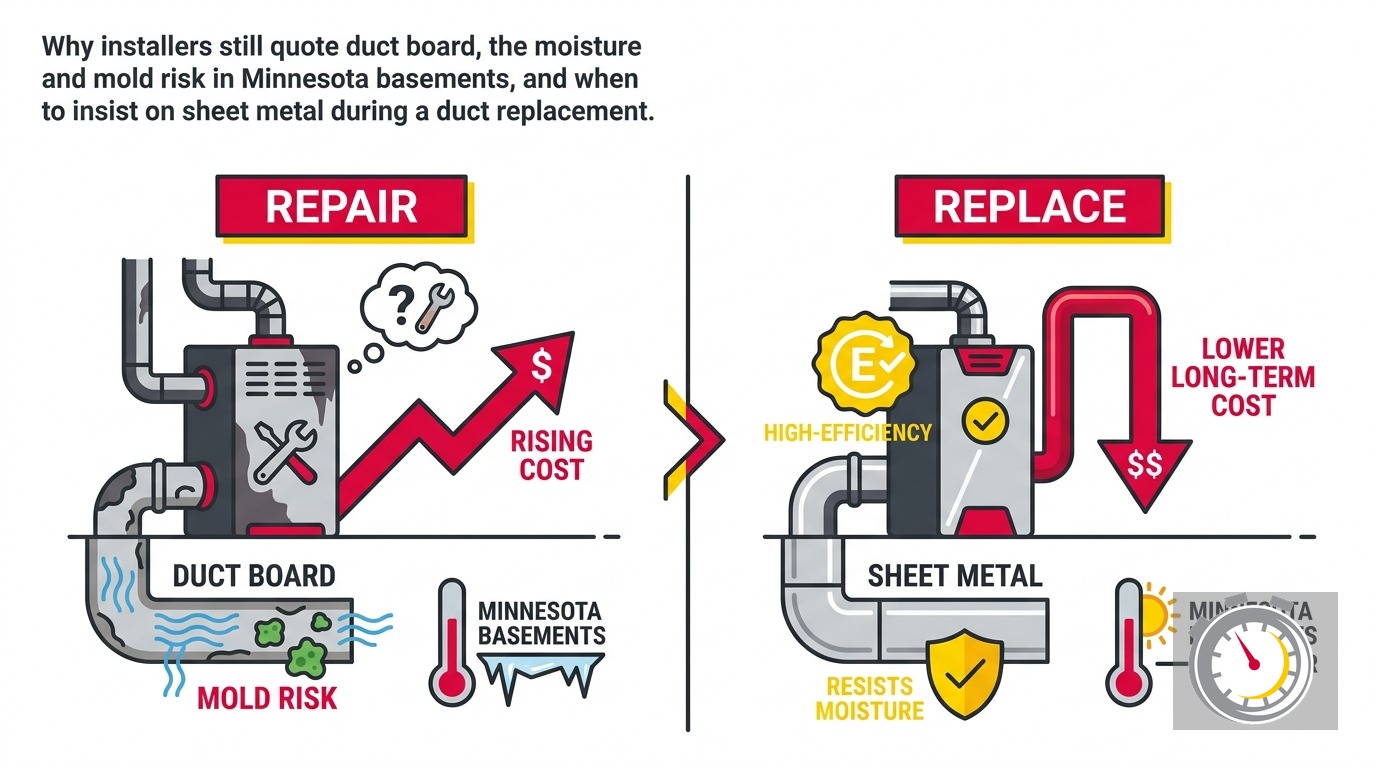
- Fiberglass duct board and sheet metal are both code-legal in Minnesota. The choice matters most in humid, below-grade spaces like Twin Cities basements.
- Duct board installs faster and costs less upfront. That economic reality - not performance in your specific home - is the primary reason it appears on so many estimates.
- The EPA requires full removal and replacement of any wet or visibly moldy fiberglass duct insulation. There is no repair, cleaning, or sealing option.
- Twin Cities basements routinely exceed the EPA’s 60% relative humidity mold-risk threshold from May through September. That is an average Minnesota summer, not a worst case.
- In a humid below-grade space, duct board’s expected service life drops significantly. Sheet metal lasts 30 or more years and survives moisture events duct board cannot.
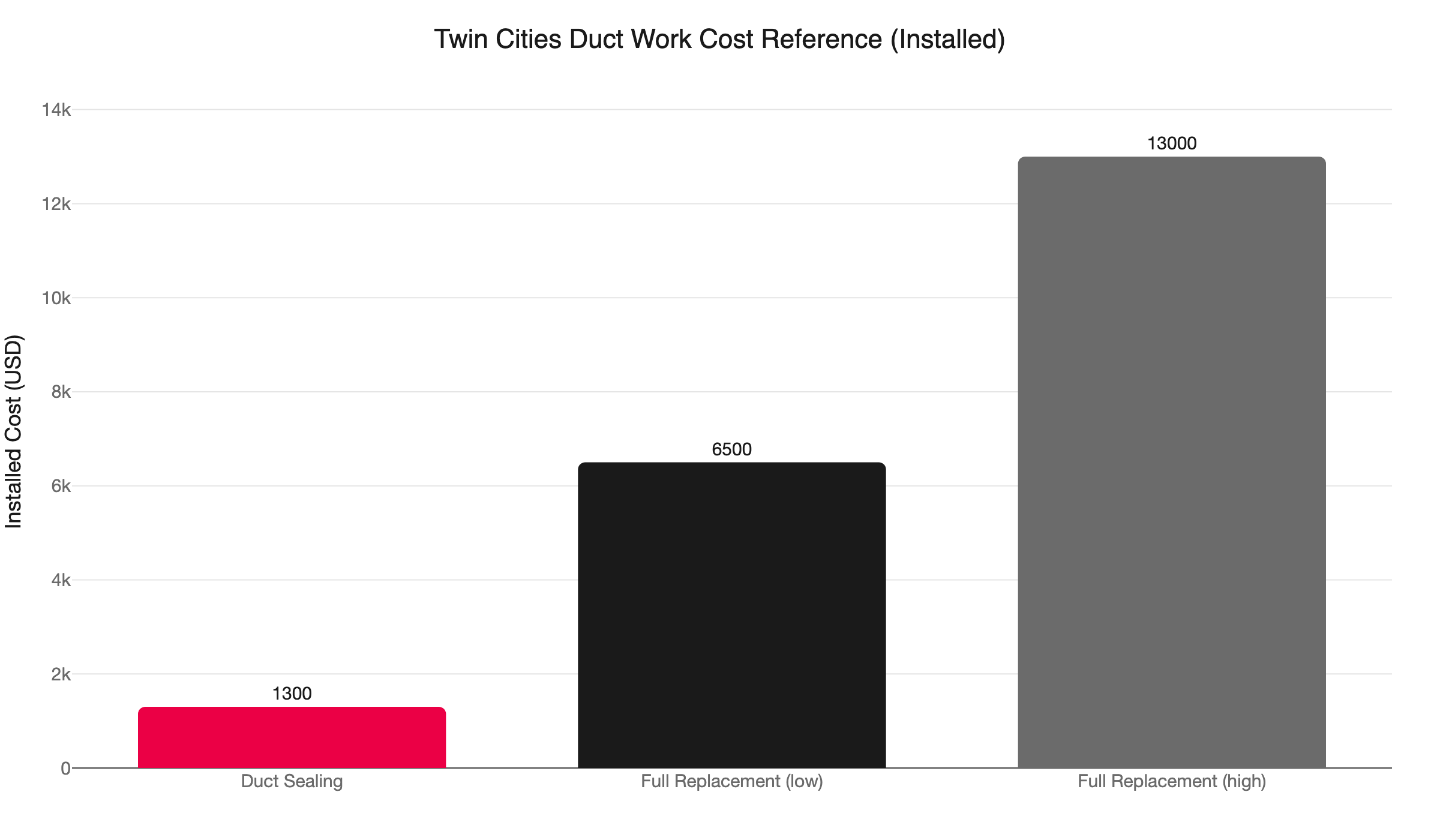
- Full duct replacement in the Twin Cities runs $6,500-$13,000 installed. Sheet metal costs more upfront. It usually costs less over the life of the system. Get the material choice documented before the job starts.
The phrase “fiberglass duct board vs metal ductwork” comes up fast in a duct replacement conversation. The estimator mentions it, keeps moving, and you end up agreeing to a material you do not fully understand.
In a dry climate, that might not matter much. In a Twin Cities basement, it matters a great deal - and most articles on this topic never explain why.
Why Do Contractors Still Quote Fiberglass Duct Board?
The honest reason: duct board installs roughly 40% faster than sheet metal and requires no sheet metal fabrication shop. Lower labor hours and no specialized tooling mean more margin per job for the installer. That economic reality, not the material’s long-term performance in your specific basement, often drives the recommendation.
Duct board is a legitimate product. It carries UL 181 certification and is permitted under Minnesota’s adopted version of the 2020 International Mechanical Code. It is lighter than sheet metal, easier to cut and fit in tight or irregular spaces, and it carries built-in insulation value - typically R-6 to R-8 - without requiring separate insulation wrap. Sheet metal runs through unconditioned space need that wrap added on top.
None of that is dishonest. But there is a difference between a material that works and a material that is right for your home’s specific conditions. A basement in Ramsey or Brooklyn Park has different stakes than a dry, well-ventilated attic. The location is everything, and that half of the conversation is often skipped.
When a contractor recommends duct board, a fair question is: “Why is this the right material for my basement specifically?” The answer tells you a lot.
What Is Fiberglass Duct Board, and What Makes It Different?
Fiberglass duct board is a rigid panel of compressed fiberglass insulation faced with a foil or reinforced foil vapor barrier. Installers score, fold, and join it into rectangular duct sections on-site. No fabrication shop, no brake. The foil facing becomes the interior duct surface that conditioned air contacts.
Sheet metal ductwork is fabricated from galvanized steel in custom sections connected on-site with fittings, mastic sealant, and metal tape. It requires more tooling and setup time. What it produces is a hard, non-porous interior surface that does not absorb or hold moisture.
Both systems can deliver conditioned air efficiently when properly installed and sealed. The material difference becomes decisive the moment moisture enters the picture. One surface sheds it. The other absorbs it.
Why Are Minnesota Basements the Worst Environment for Fiberglass Duct Board?
Short answer: three risk factors converge in one space. Below-grade concrete walls that stay cool year-round, summer dew points that regularly hit 60-65°F, and limited air circulation combine to push Twin Cities basement humidity well above the threshold where moisture damages duct board.
Minneapolis-St. Paul sits in ASHRAE Climate Zone 6A, classified as “cold and humid.” According to NWS Twin Cities climate records, the Twin Cities averages approximately 7,900 heating degree days per year - among the highest in the contiguous U.S. That means your ductwork spends a large portion of the year carrying air that is significantly warmer or cooler than the surrounding basement space.
In summer, cool supply air running through duct board inside a warm, humid basement creates a temperature differential at the duct surface. If the vapor barrier is breached - even at a seam, a fitting joint, or a spot where the foil was nicked during installation - that differential causes condensation. Moisture works into the fiberglass insulation layer below the facing. There it stays, because fiberglass cannot dry out the way metal can.
The EPA states clearly: “experts do agree that moisture should not be present in ducts and if moisture and dirt are present, the potential exists for biological contaminants to grow and be distributed throughout the home.” Fiberglass is porous. Once moisture penetrates the facing, you have the conditions mold needs to grow inside the insulation itself.
The EPA’s guidance on indoor humidity recommends keeping indoor humidity below 60 percent - ideally between 30 and 50 percent. Minnesota basements without active dehumidification routinely exceed that threshold from May through September. Our post on ductwork sweating and condensation in Minnesota basements covers the mechanics of how this plays out in a typical Twin Cities home.
What Does the EPA Actually Say About Wet Fiberglass Duct Insulation?
One directive: remove and replace it. There is no cleaning option, no treatment option, no sealing option for fiberglass insulation that has become wet or shows visible mold.
This is the fact that nearly every article comparing fiberglass duct board vs metal ductwork leaves out. It changes the entire cost calculation.
The EPA’s duct cleaning guidance is explicit: “Fiber glass, or any other insulation material that is wet or visibly moldy (or if an unacceptable odor is present) should be removed and replaced by a qualified heating and cooling system contractor.”
The reason comes from how porous materials hold contamination. As the EPA’s mold guidance explains: “Absorbent or porous materials, such as ceiling tiles and carpet, may have to be thrown away if they become moldy. Mold can grow on or fill in the empty spaces and crevices of porous materials, so the mold may be difficult or impossible to remove completely.”
Mold does not just grow on the surface of fiberglass. It grows through the insulation. You cannot brush it off, treat it with a biocide spray, or seal it in. The EPA specifically addresses that last point: sealants must never be used on wet duct liner or to cover actively growing mold.
For a homeowner, the practical consequence is stark. A single moisture event - a condensation problem, a basement seepage event, a humidifier that drips into a supply run - can turn an entire duct board run into a total loss that requires full replacement. The cheaper upfront material becomes the more expensive long-term outcome.
Sheet metal does not work this way. Metal gets wet and dries. A moisture event requires cleaning, not replacement.
What Are the Health Risks If Mold Develops in a Duct System?
Direct answer: every room in the house receives air that has passed through the contaminated material, carrying mold spores with it.
The EPA’s guidance on mold health effects identifies “allergic reactions, asthma, and other respiratory complaints” as the primary health effects of mold exposure. For households with children, elderly occupants, or anyone managing asthma or respiratory conditions, contaminated supply ductwork is not a minor comfort problem. It is an ongoing health exposure delivered through every vent in the home every time the system runs.
If you are concerned about what may already be present in your current system, our post on mold in HVAC ducts: signs and remediation in the Twin Cities walks through the warning signs and what a professional inspection involves.
Fiberglass Duct Board vs Metal Ductwork: The True Cost Comparison
Service life drives the real numbers. In a dry climate, duct board can reach 15-20 years. In a humid Minnesota basement, that figure drops toward 8-12 years when moisture management is imperfect. Sheet metal, properly installed and sealed, routinely lasts 30 or more years.
The upfront gap is real. Duct board costs less to install. The material is cheaper and the faster installation means fewer labor hours on the invoice. In a climate where humidity is not a variable, that savings represents genuine value.
Run the numbers differently in a Twin Cities basement. A duct board system replaced in year 10 or 12 instead of year 25 means you have spent the full replacement cost twice in the span of a single sheet metal system’s service life. The upfront savings disappears, and you have added years of potential indoor air quality risk in the meantime.
Full duct replacement in the Twin Cities runs $6,500-$13,000 installed, depending on home size, duct layout, and material. Sheet metal typically lands toward the upper end of that range. That is a real number. In a humid basement environment, it is a number you pay once. For a detailed look at what drives cost in this market, see our post on ductwork replacement cost in the Twin Cities.
How Do You Know Which Material Is Currently in Your Home?
A quick visual check is usually enough. Go to your basement and look at the duct runs.
Sheet metal ductwork has smooth, hard exterior surfaces - typically bare galvanized steel, sometimes covered in gray or silver foil-faced insulation wrap. Seams have visible screws or crimped joints. The surface is rigid and cold to the touch.
Fiberglass duct board looks different. The exterior surface has a rigid, slightly textured foil facing. Corners are folded and stapled or taped. The material feels slightly resilient if you press it gently. Seams between sections are typically taped with foil tape.
If you see sagging sections, water staining on the foil facing, dark spots at seams, or a musty odor near the vents, those are signals worth a professional assessment. Our team can identify material condition and tell you whether sealing, insulation repair, or full replacement is the right call.
When Should You Insist on Sheet Metal?
If any of the following apply, ask for sheet metal specifically before the job is quoted, and get the answer documented.
- Your ductwork runs through an unfinished or semi-finished basement. This is the highest-risk location for duct board in Minnesota. It concentrates every factor that shortens its service life.
- Your basement has had moisture problems. Prior flooding, seepage, or visible efflorescence on the concrete walls means moisture events happen in your home. Duct board cannot survive repeated ones.
- You are replacing duct board that failed before its expected service life. Understand what caused the early failure before installing the same material in the same location.
- Anyone in the household has asthma or a respiratory condition. The health stakes raise the value of durable material choices. The cost premium for sheet metal is straightforward insurance.
- The quote just says “ductwork” without specifying a material. Ask. Get it in writing before you sign.
Can You Seal Existing Duct Board Instead of Replacing It?
Yes, if the material is intact and dry. No, if there is any sign of moisture damage or mold.
Leaky duct board joints lose conditioned air before it reaches the living space. Sealing intact, dry duct board with mastic sealant or metal tape is a legitimate maintenance step that reduces energy waste. Professional duct sealing on an existing system typically runs around $1,300 and is worth considering before committing to full replacement if the material is in good condition.
The EPA, NADCA, NAIMA, and SMACNA are unified on the limit of sealing: it is not a remediation tool. It cannot be applied to wet duct liner or active mold growth. Sealing over a contaminated surface does not eliminate the problem. It conceals it while the damage continues.
Our post on duct sealing and leaky ductwork energy loss covers what sealing can and cannot accomplish and when it makes sense as a standalone step.
What Should You Ask Before Signing a Duct Replacement Quote?
Before you agree to anything, get answers to these questions - and get them in writing.
- What material is being installed: sheet metal, fiberglass duct board, or a hybrid?
- Is the material choice documented on the written quote?
- What is the sealing method: mastic sealant or metal tape?
- Does the quote include insulation wrap on sheet metal runs through unconditioned spaces?
- Does the work require a mechanical permit? In most Twin Cities municipalities, full duct replacement does. A permitted job triggers an inspection - an independent quality check.
A contractor who answers these questions directly and puts the answers in writing is showing you how they operate. Vague answers or a quote that cannot be made specific before signing are their own kind of signal.
Our post on HVAC contractor red flags in the Twin Cities covers the broader list of what to watch for when comparing quotes on a larger job.
We are locally owned and operated in Ramsey, and our team gives you straight answers on material choices before a job starts. When we recommend sheet metal for a Twin Cities basement, we explain why - and we document it on the quote.
Call us at (763) 260-6662 or schedule online. We show up when we say we will. “Always On Time… Or You Don’t Pay a Dime!(R)”
Frequently Asked Questions
Is fiberglass duct board safe for Minnesota basements? +
What happens if fiberglass duct board gets wet or develops mold? +
Why do HVAC contractors quote fiberglass duct board instead of sheet metal? +
How much does duct replacement cost in the Twin Cities? +
Need a technician now?